Question
Read the passage given below and answer the following questions:
Although chlorobenzene is inert to nucleophilic substitution, however it gives quantitative yield of phenol when heated with aq. $Na OH$ at high temperature and under high pressure. As far as electrophilic substitution in phenol is concemed the — OH group is an activating group, hence, its presence enhances the electrophilic substitution at o - and p - positions.
The following questions are multiple choice questions. Choose the most appropriate answer:
  1. Conversion of chlorobenzene into phenol involves:
  1. Modified $S_N1$ mechanism.
  2. Modified $S_N2$ mechanism.
  3. Both (a) and (b).
  4. Elimination-addition mechanism.
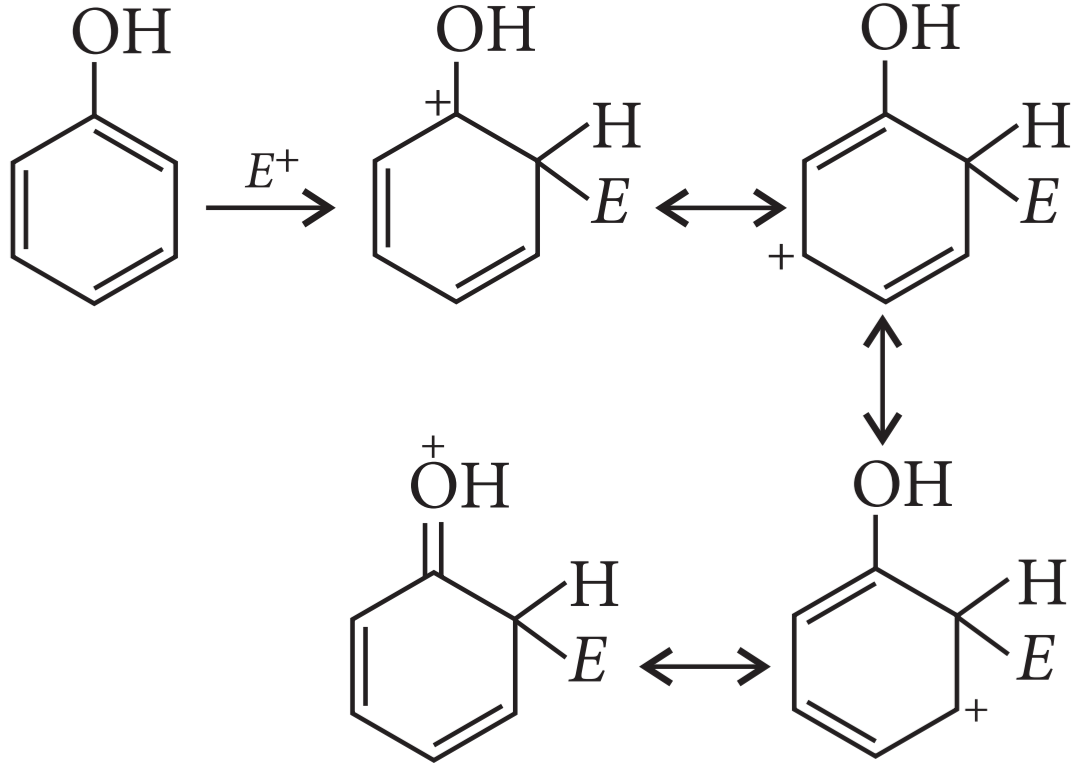
  1. Phenol undergoes electrophilic substitution more readily than benzene because:
  1. The intermediate carbocation is a resonance hybrid of more resonating structures than that from benzene.
  2. The intermediate is more stable as it has positive charge on oxygen, which can be better accommodated than on carbon.
  3. In one of the canonical structures, every atom (except hydrogen) has complete octet.
  4. The — OH group is o, p-directing which like all other o, p - directing group, is activating.
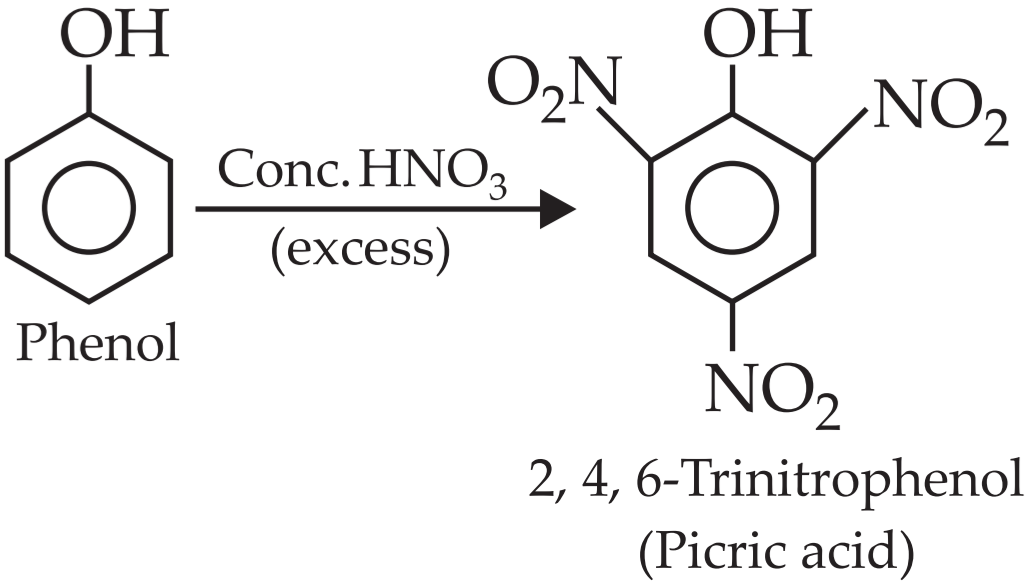
  1. Phenol on treatment with excess of cone. $HNO_3$ gives:
  1. O - nitrophenol.
  2. P - nitrophenol.
  3. O - and p - nitrophenol.
  4. 2, 4, 6 - trinitrophenol.
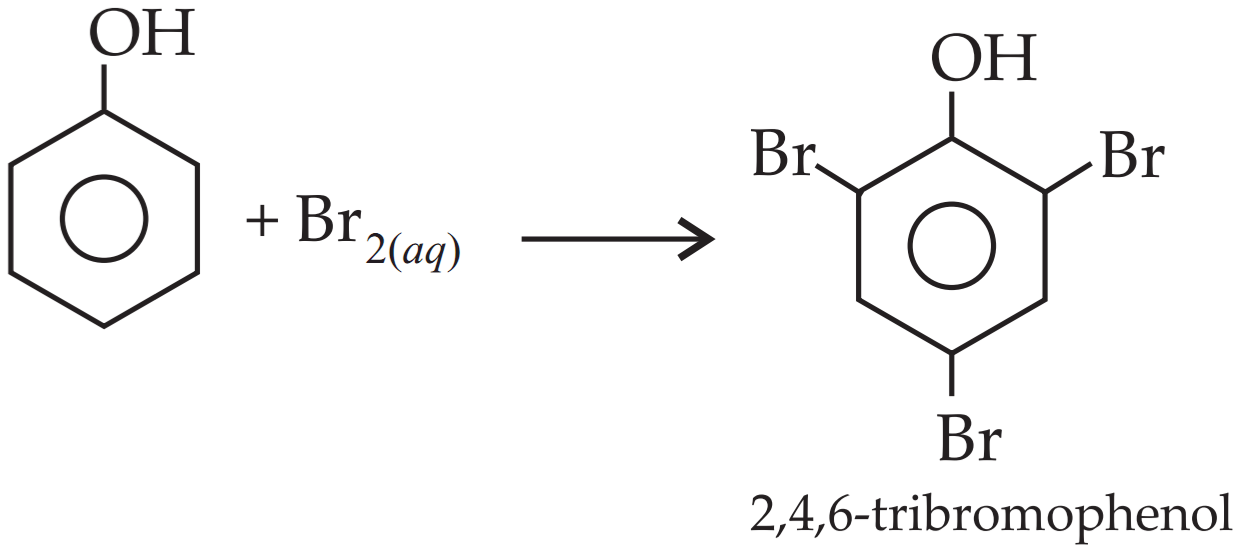
  1. Phenol is heated with a solution of mixture of $KBr$ and $KBrO_3$. The major product obtained in the above reaction is:
  1. 2 - bromophenol.
  2. 3 - bromophenol.
  3. 4 - bromophenol.
  4. 2, 4, 6 - tribromophenol.
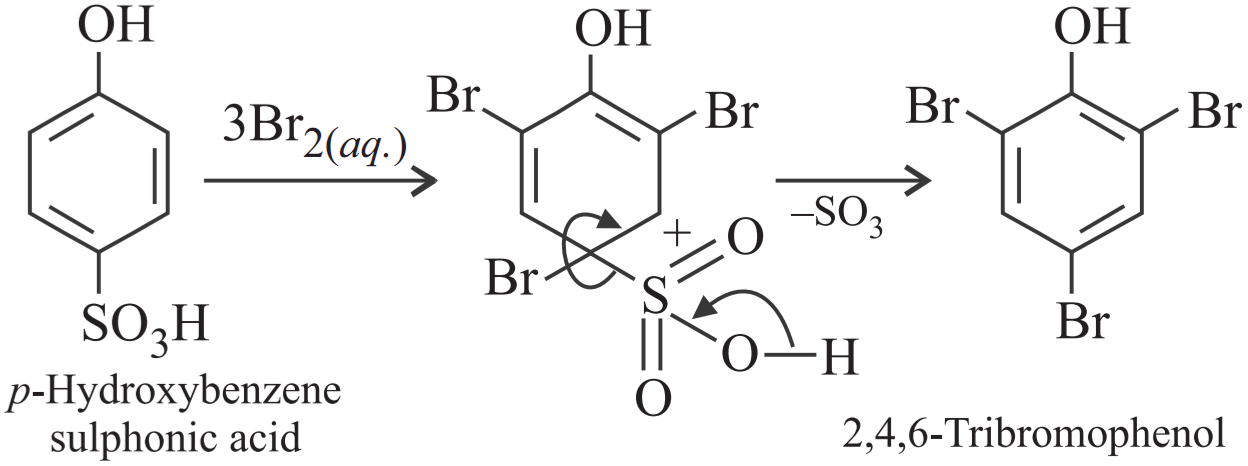
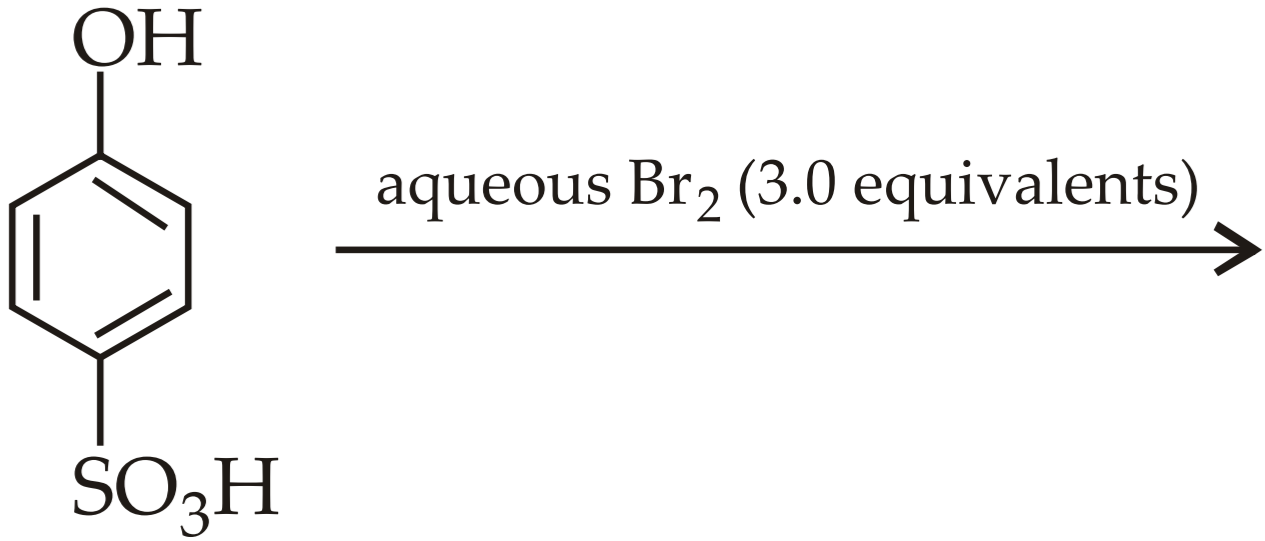
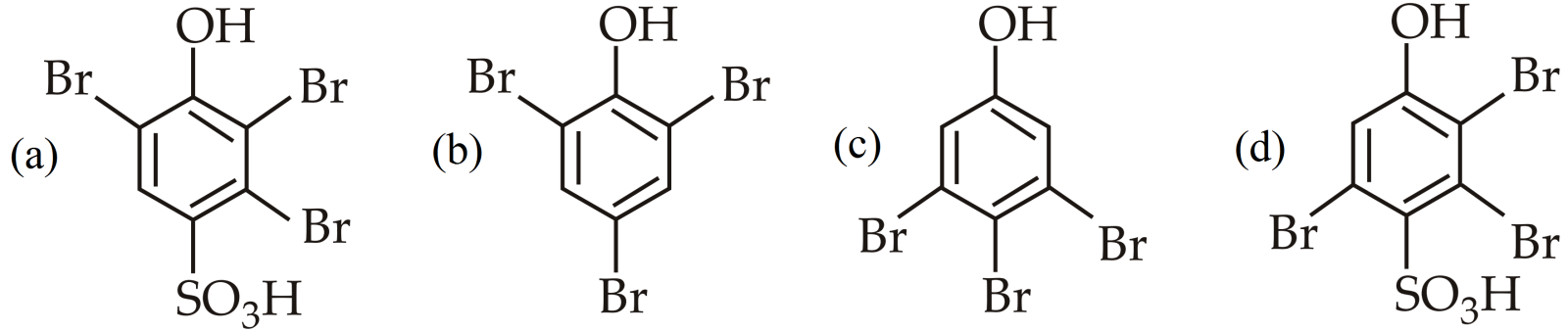
  1. The major product of the following reaction is:
Answer

    1. (d) Elimination-addition mechanism.
    2. (c) In one of the canonical structures, every atom (except hydrogen) has complete octet.
    Explanation:
    1. (d) 2, 4, 6 - trinitrophenol.
    Explanation:
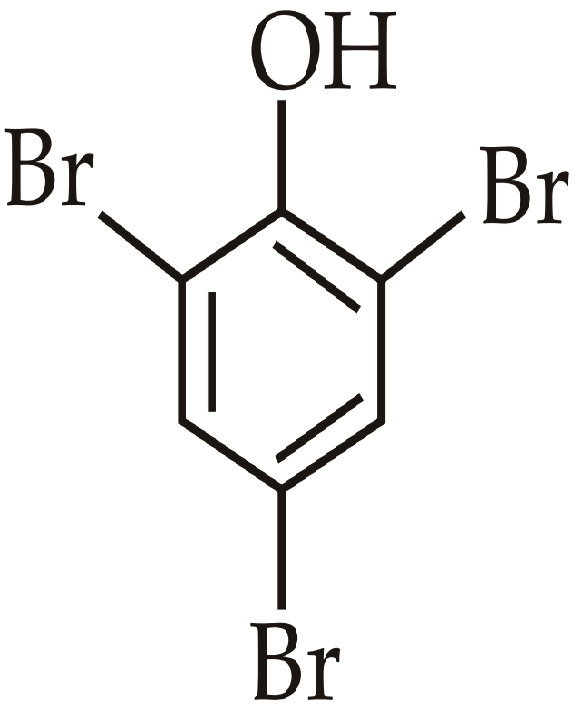
    1. (d) 2, 4, 6 - tribromophenol.
    Explanation:
    $\text{KBr}_{\text{(aq)}}+\text{KBrO}_{3\text{(aq)}}\rightarrow\text{Br}_{2\text{(aq)}}$
    This bromine reacts with phenol and 2, 4, 6 - tribromophenol.
    1. ​​​​​​​(b)
    ​​​​​​​
    ​​​​​​​​​​​​​​​​​​​​​Explanation:

Need a full question paper?

Generate a complete, print-ready paper with questions like this in minutes — across 16+ boards, with answer keys.

Start Generating Free

Similar questions

Read the passage given below and answer the following questions:
In haloalkanes, when a nucleophile stronger than the halide ion approaches the positively charged carbon atom of an alkyl halide, the halogen atom along with its bonding electron pair gets displaced and a new bond with the carbon and the nucleophile is formed. These reactions are called nucleophilic substitution reactions.

In these reactions the atom or group of atoms which loses its bond from carbon and takes on an additional pair of electrons is called leaving group. Halide ions are good leaving groups. Some important nucleophilic substitution reactions ofhaloalkanes with common nucleophiles are given in the table below.
 
Reagent
Nucleophile (Nu^-)
Substitution product R-Nu
Class of main product
1.
$NaOH$ or $KOH$ or moist $Ag_2O$
$^-OH$
$ROH$
Alcohol
2.
$H_2O$
$H^2O$
$ROH$
Alcohol
3.
$Nal$
$I^-$
$R – I$
Alkyl iodide
4.
$R'NH_2$
$\text{R'}\ddot{\text{N}}\text{H}_2$
$RNHR'$
Sec. amine
5.
$KCN$
$\overline{\text{C}}\equiv\text{N}:$
$RCN$
Nitrile (cyanide)
6.
$KNO_2$
$O = N – O^-$
$R – O – N = O$
Alkvl nitrite
In these questions (Q. No. i-iv), a statement of assertion followed by a statement ofreason is given. Choose the correct answer out of the following choices.
  1. Assertion and reason both are correct statements and reason is correct explanation for assertion.
  2. Assertion and reason both are correct statements but reason is not correct explanation for assertion.
  3. Assertion is correct statement but reason is wrong statement.
  4. Assertion is wrong statement but reason is correct statement.
  1. Assertion: Alkyl halides are hydrolysed to alcohols by moist silver oxide.
Reason: $RCI$ is hydrolysed to $ROH$ easily but reactions slow down on addition of KI.
  1. Assertion: Alkyl halides fonn alkenes when heated above $300^\circ C.$
Reason: $CH3CH21$ reacts slowly with strong base as compared to $CD_3CH_2I.$
  1. Assertion: RBr reacts with $AgNO_2$ to give nitroalkane.
Reason: Silver nitrite $(AgNO_2)$ is an ionic compound, therefore the negative charge on nitrogen is the attacking site.
  1. Assertion: The nucleophilic substitution of vinyl chloride is difficult than ethyl chloride.
Reason: Vinyl group is electron donating group.
  1. Assertion: $2-$Bromobutane on reaction with sodium ethoxide in ethanol gives 1-butene as the major product.
Reason: $1-$Butene is less stable than $2-$butene.
Read the passage given below and answer the following questions:
At $298\ K$, the vapour pressure of pure benzene, $C_6, H_6$ is $0.256$ bar and the vapour pressure of pure toluene $C_6 H_5 CH_3$ is $0.0925$ bar. Two mixtures were prepared as follows:
  1. $7.8g of C_6 H_6 + 9.2g$ of toluene
  2. $3.9g of C_6 H_6 + 13.8g$ of toluene
The following questions are multiple choice questions. Choose the most appropriate answer:
  1. The total vapour pressure (bar) of solution I is.
  1. $0.128$
  2. $0.174$
  3. $0.198$
  4. $0.258$
  1. Which of the given solutions have higher vapour pressure?
  1. $I$
  2. $II$
  3. Both have equal vapour pressure
  4. Cannot be predicted
  1. Mole fraction of benzene in vapour phase in solution I is.
  1. $0.128$
  2. $0.174$
  3. $0.734$
  4. $0.266$
  1. Which of the following statements is/are correct?
  1. Mole fraction of toluene in vapour phase is more in solution I.
  2. Mole fraction of toluene in vapour phase is less in solution I.
  3. Mole fraction of benzene in vapour phase is less in solution I.
  1. Only II
  2. Only I
  3. I and III
  4. II and III
  1. Solution I is an example of a/an.
  1. Ideal solution.
  2. Non-ideal solution with positive deviation.
  3. Non-ideal solution with negative deviation.
  4. Can't be predicted.
Read the passage given below and answer the following questions:
Glucose is known as dextrose because it occurs in nature as the optically active dextrorotatory isomer. lt is essential constituent of human blood. The blood normally contains $65$ to $110mg$ of glucose per 100mL (hence named Blood sugar). The level may be much higher in diabetic persons. The urine of diabetic persons also contain considerable amount of glucose. ln combined form, it occurs in cane sugar and polysaccharides such as starch and cellulose.
Glucose has an aldehyde group $(-CHO)$, one primary alcoholic group $(-CH_2OH)$ and four secondary alcoholic groups $(-CHOH)$ in their structure. Due to the presence five hydroxyl groups $(-OH)$. glucose undergoes acetylation. Glucose also undergoes oxidation with mild oxidising agents like bromine water as well as with strong oxidising agents like nitric acid. Since glucose is readily oxidised, it acts as a strong reducing agent and reduces Tollen's reagent and Fehling solution. Glucose exists in two crystalline forms: $\alpha$-D-glucose and $\beta$-D-glucose. If either of the two forms is dissolved in water and allowed to stand, the specific rotation of the solution changes gradually, until a constant value is obtained. This change is called mutarotation.
A statement of assertion followed by a statement of reason is given. Choose the correct answer out of the following choices.
  1. Assertion and reason both are correct statements and reason is correct explanation for assertion.
  2. Assertion and reason both are correct statements but reason is not correct explanation for assertion.
  3. Assertion is correct statement but reason is wrong statement.
  4. Assertion is wrong statement but reason is correct statement.
  1. Assertion: A diabetic person carries a packet of glucose with him always.
Reason: Glucose increases the blood sugar level almost instantaneously.
  1. Assertion: On oxidation with nitric acid, glucose as well as gluconic acid both yield saccharic acid.
Reason: The pentaacetate of glucose does not react with hydroxylamine indicating the absence of free $-CHO$ group.
  1. Assertion: Glucose reacts with acetyl chloride to form pentaacetyl glucose.
Reason: The formation of pentaacetyl derivative confirms the presence of five $-OH$ groups in glucose.
  1. Assertion: A certain compound gives negative test with ninhydrin and positive test with Benedict's solution, the compound is an amino acid.
Reason: Glucose is a monosaccharide.
  1. Assertion: The rapid interconversion of $\alpha$-D-glucose and $\beta$-D-glucose in solution is known as racemisation.
Reason: Hydrolysis reaction will take place when a mineral acid is treated with sugar.
For a reaction, A + B → Products, the rate law is – Rate = $k[A][B]^{3/2}$ Can the reaction be an elementary reaction? Explain.
Read the passage given below and answer the following questions:
In hexagonal system of crystals, a frequently encountered arrangement of atoms, is described as a hexagonal prism. Here, the top and bottom of the cell are regular hexagons and three atoms are sandwiched in between them. A space-filling model of this structure, called hexagonal close packed (hep), is constituted of a sphere on a flat surface surrounded in the same plane by six identical spheres as closely as possible. Three spheres are then placed over the first layer so that they touch each other and represent the second layer. Each one of these three spheres touches three spheres of the bottom layer. Finally, the second layer is covered with a third layer that is identical to the bottom layer in relative position.
The following questions are multiple choice questions. Choose the most appropriate answer:
  1. The number of atoms in this hep unit cell is.
  1. 4
  2. 6
  3. 12
  4. 17
  1. The number of atoms in this hep unit cell is.
  1. $24\sqrt{2\pi^3}$
  2. $16\sqrt{2\text{r}^3}$
  3. $12\sqrt{2\text{r}^3}$
  4. $\frac{64}{3\sqrt{3}}\text{r}^3$
  1. The empty space in this hcp unit cell is.
  1. 74%
  2. 47.6%
  3. 32%
  4. 26%
  1. Which of the following statements is correct about hexagonal close packing?
  1. In this arrangement, third layer is identical to the first layer.
  2. The coordination number in this arrangement is 6.
  3. It is as closely packed as body centered cubic packing.
  4. It has 32% empty space.
  1. In hexagonal close packing of spheres in three-dimensions.
  1. In one unit cell there are 12 octahedral voids and all are completely inside the unit cell.
  2. In one unit cell there are six octahedral voids and all are completely inside the unit cell.
  3. In one unit cell there are six octahedral voids out of which three are completely inside the unit cell and other three are from contributions of octahedral voids which are partially inside the unit cell.
  4. In one unit cell there are 12 tetrahedral voids, all are completely inside the unit cell.
Read the passage given below and answer the following questions: Williamson's synthesis is used for the preparation of symmetrical as well as unsymmerical ether. It is $S_N2$ reaction mechanism. In Williamson's synthesis, $1º$ alkyl halide are used for preparation of ethers because $2º$ and $3º$ alkyl halide give alkene. Ethers are cleaved by hydrogen halides to alcohol and alkyl halide where alkyl halide is corresponding to that alkyl which has less number of carbon atom (it is because of less steric hindrance). In polar media unsymmetrical ether like tertiary butyl ethyl ether gives ethyl alcohol and tertiary butyl halide as reaction proceeds via carbocation. In these questions (Q. No. i-iv), a statement of assertion followed by a statement of reason is given. Choose the correct answer out of the following choices.
  1. Assertion and reason both are correct statements and reason is correct explanation for assertion.
  2. Assertion and reason both are correct statements but reason is not correct explanation for assertion.
  3. Assertion is correct statement but reason is wrong statement.
  4. Assertion is wrong statement but reason is correct statement.
  1. Assertion: Rate of reaction of alkyl halide in Williamson's synthesis reaction is 1ºRX > 2ºRX > 3ºRX.
Reason: It is a type of bimolecular substitution reaction $(S_N2)$.
  1. Assertion: T-Butyl methyl ether is not prepared by the reaction of t-butyl bromide with sodium methoxide.
Reason: Sodium methoxide is a weak nucleophile.
  1. Assertion: Williamson's synthesis method cannot be used for preparing diphenyl ether.
Reason: Aryl halides do not undergo nucleophilic substitution easily.
  1. Assertion: When isopropyl bromide is treated with sodium isopropoxide, di-isopropyl ether is obtained as a major product.
Reason: With secondary alkyl halides, both substitution and elimination occur.
  1. Assertion: Both symmetrical and unsymmetrical ethers can be prepared by Williamson's synthesis.
Reason: Williamson's synthesis is an example of nucleophilic substitution reaction.
Read the passage given below and answer the following questions:
Under the normal conditions, noble gases are monoatomic and have closed shell electronic configuration. Lighter noble gases have low boiling points due to weak dispersion forces between the atoms and the absence of other interatomic interactions. Xenon, one of the important noble gas, forms a series of compounds with fluorine with oxidation number $+2, +4$ and $+6.$ All xenon fluorides are strong oxidising agents. $XeF_4$ reacts violently with water to give $XeO_3.$ The geometry of xenon compounds can be deduced by considering the total number of electron pairs in their valence shell.
The following questions are multiple choice questions. Choose the most appropriate answer:
  1. Among noble gases (from He to Xe) only xenon reacts with fluorine to form stable xenon fluorides because xenon.
  1. Has the largest size.
  2. Has the lowest ionisation enthalpy.
  3. Has the highest heat ofvapourisation.
  4. Is the most readily available noble gas.
  1. The structure of $XeO_3$ is:
  1. Square planar.
  2. Pyramidal.
  3. Linear.
  4. T-shaped.
  1. $XeF_6$ is expected to be.
  1. Oxidising agent.
  2. Reducing agent.
  3. Unreactive.
  4. Strongly basic.
  1. In the preparation of compound of xenon, Bartlett had taken $\text{O}_2^+\text{PtF}_6^-$ as a base compound. This is because,
  1. Both $O_2$ and $Xe$ have same size.
  2. Both $Xe$ and $O_2$ have same electron gain enthalpy.
  3. Both have almost same ionisation enthalpy.
  4. Both $Xe$ and $O_2$ are gases.
  1. The oxidation state of xenon in $XeO_3$ is:
  1. $+4$
  2. $+2$
  3. $+8$
  4. $+6$
The electrochemical cell shown below is concentration cell.
$M \mid M ^{2+}$ (saturated solution of a sparingly soluble salt, $\left.MX _2\right)\left|\left| M ^{2+}\left(0.001 mol dm ^{-3}\right)\right| M\right.$ The emfof the cell depends on the difference in concentrations of $M ^{2+}$ ions at the two electrodes. The emf of the cell at 298 K is 0.059 V . The following questions are multiple choice questions. Choose the most appropriate answer:
  1. The solubility product ($K_{sp'} mol^3 dm^{-9})$ of $MX_2$ at 298 K based on the information available for the given concentration cell is $(\text{take }2.303 \times \text{R}\times \frac{298}{\text{F}} = 0.059)$
  1. $2 \times 10^{-15}$
  2. $4 \times 10^{-15}​​​​​​​$
  3. $3 \times 10^{-12}​​​​​​​$
  4. $1 \times 10^{-12}​​​​​​​$
  1. The value of $\triangle\text{G}$ (in kJ $mol^{-1}​​​​​​​$) for the given cell is (take $1 F = 96500 C mol^{-1})$
  1. 3.7
  2. -3.7
  3. 10.5
  4. -11.4
  1. The equilibrium constant for the foUowing reaction is:
$\text{Fe}^{2+}+\text{Ce}^{4+}\rightleftharpoons\text{Ce}^{3+}+\text{Fe}^{3+}$

(Given, $\text{E}^\circ_\frac{\text{Ce}^{4+}}{\text{Ce}^{3+}}=1.44\text{V}$ and $\text{E}^\circ_\frac{\text{Fe}^{3+}}{\text{Fe}^{2+}}=0.68\text{V}$)
  1. $7.6 \times 10^{12}$​​​​​​​
  2. $6.5 \times 10^{10}$
  3. $5.2 \times 10^9$
  4. $3.4 \times 10^{12}​​​​​​​$
  1. The solubility product of a saturated solution of $Ag_2CrO_4 $in water at 298 K if the emf of the cell
$Ag|Ag^+ (satd. Ag_2CrO_4 soln) || Ag^+ (0.1 M) | Ag$

is 0.164V at 298 K, is:
  1. $3.359 \times 10^{-12} mol^3 L^{-3}$​​​​​​​
  2. $2.287 \times 10^{-12} mol^3 L^{-3}$
  3. $1.158 \times 10^{-12} mol^3 L^{-3}$
  4. $4.135 \times 10^{-12} mol^3 L^{-3}$
  1. To calculate the emf of the cell, which of the foUowing options is correct?
  1. emf $= E_{cathode}- E_{anode}$​​​​​​​
  2. emf $= E_{anode}- E_{cathode}$
  3. emf $= E_{anode} + E_{cathode}$
  4. None of these.
Read the passage given below and answer the following questions:
Noble gases are inert gases with general electronic configuration of $ns^2np^6$. These are monoatomic, colourless, odourless and tasteless gases. The first compound of noble gases was obtained by the reaction of Xe with $PtF_6.$ A large number of compounds of Xe and fluorine have been prepared till now. The structure of these compounds can be explained on the basis of VSEPR theory as well as concept of hybridisation. The compounds of krypton are fewer. Only the diftuoride of krypton $(KrF_2)$ has been studied in detail. Compounds of radon have not isolated but only identified by radio tracer technique. However, no true compounds of helium, neon or argon are yet known.
The following questions are multiple choice questions. Choose the most appropriate answer:
  1. The formula of the compound when $Xe$ and $PtF_6$ are mixed, is:
  1. $XeF_6$
  2. $XeF_4$
  3. $Xe_2PtF_6$
  4. $Xe^+[PtF_6]^-$
  1. The shape and hybridisation of some xenon oxy-fluoride and fluoride compounds are given below. Find the incorrect one.
  1. $XeOF_2 - T-$shape $- sy^3d$
  2. $XeOF_4 -$ square pyramidal $- sp^3d^2$
  3. $XeF_2 -$ linear $- sp^3d$
  4. $XeF_6 -$ square planar $- dsp^2$
  1. Which of the following is not formed by $Xe?$
  1. $XeF_5$
  2. $XeF$
  3. $XeF_3$
  4. All of these.
  1. The number oflone pairs and bond pairs of electrons around $Xe$ in $XeOF_4$ respectively are,
  1. $0$ and $5$
  2. $1$ and $5$
  3. $1$ and $4$
  4. $2$ and $3$
  1. Which of the following compounds has more than one lone pair of electrons around central atom?
  1. $XeO_3$
  2. $XeF_2$
  3. $XeOF_4$
  4. $XeO_2F_2$
In these questions, a statement of assertion followed by a statement of reason is given. Choose the correct answer out of the following choices.
Assertion: In chemisorption, adsorption keeps on increasing with temperature.
Reason: Chemisorption increases with increase of pressure.