Question
Read the passage given below and answer the following questions:
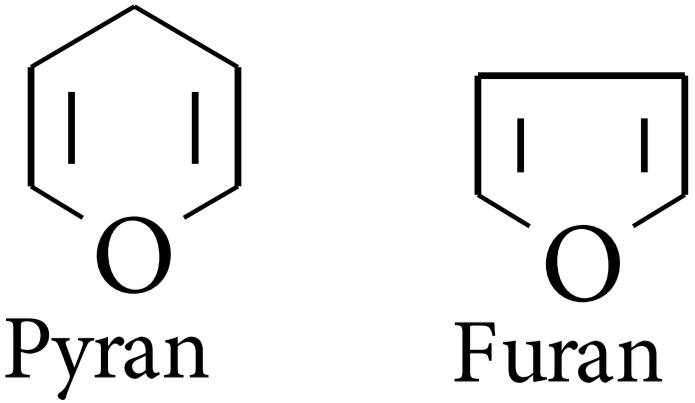
Pentose and hexose undergo intramolecular hemiacetal or hemiketal formation due to combination of the –OH group with the carbonyl group. The actual structure is either of five or six membered ring containing an oxygen atom. In the free state all pentoses and hexoses exist in pyranose form (resembling pyran). However,inthe combined state some of them exist as five membered cyclic structures, called furanose (resembling furan).
The cyclic structure of glucose is represented by Haworth structure:
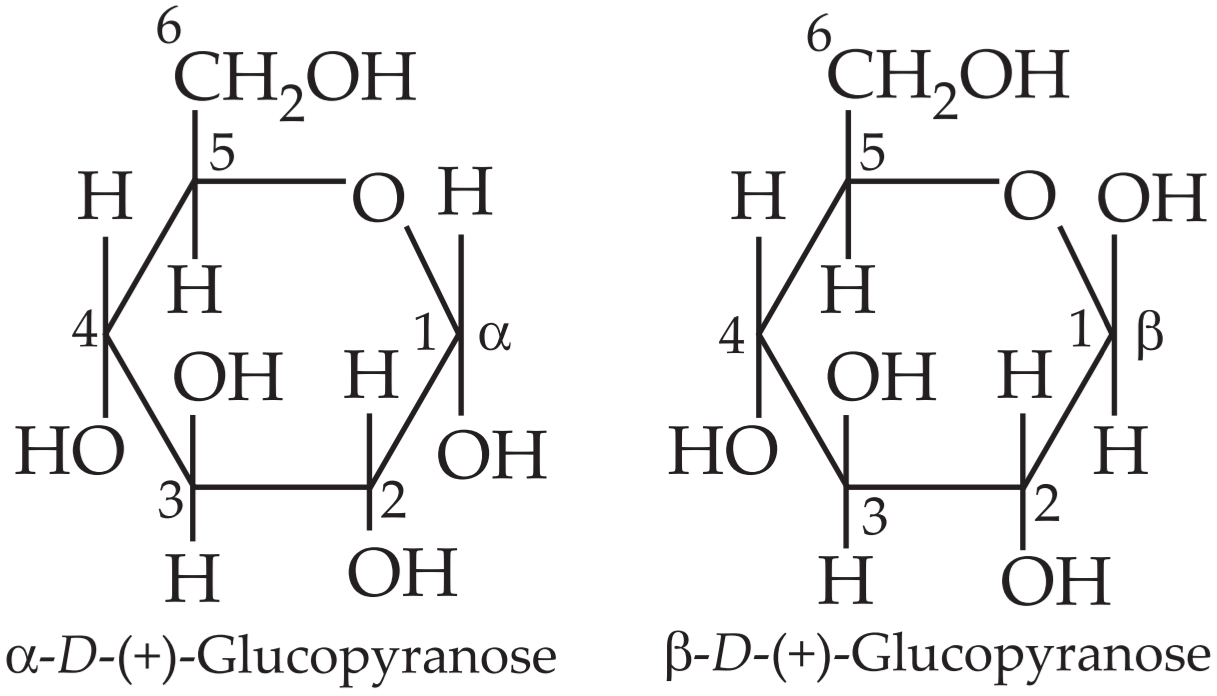
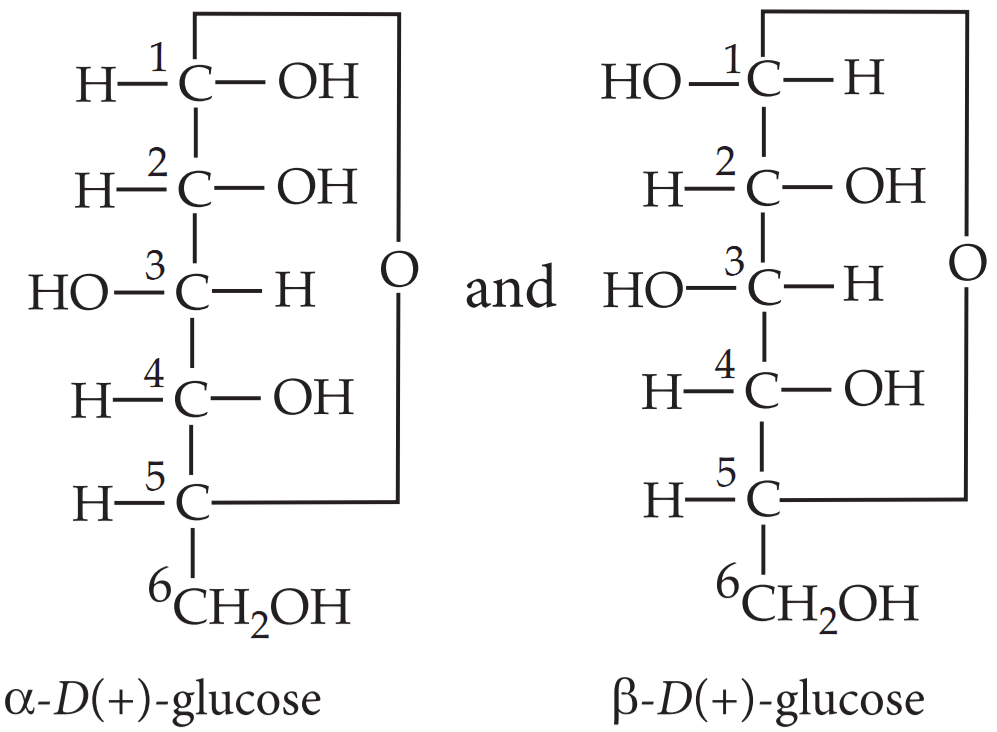
$\alpha$ and $\beta$ D-glucose have different configuration at anomeric (C-1) carbon atom, hence are called anomers and the C-1 carbon atom is called anomeric carbon (glycosidic carbon).
The six membered cyclic structure of glucose is called pyranose structure.
The following questionsare multiple choice questions. Choose the most appropriate answer:
- $\alpha$ D(+)-glucose and $\beta$ D(+)glucose are:
- Enantiomers.
- Conformers.
- Epimers.
- Anomers.
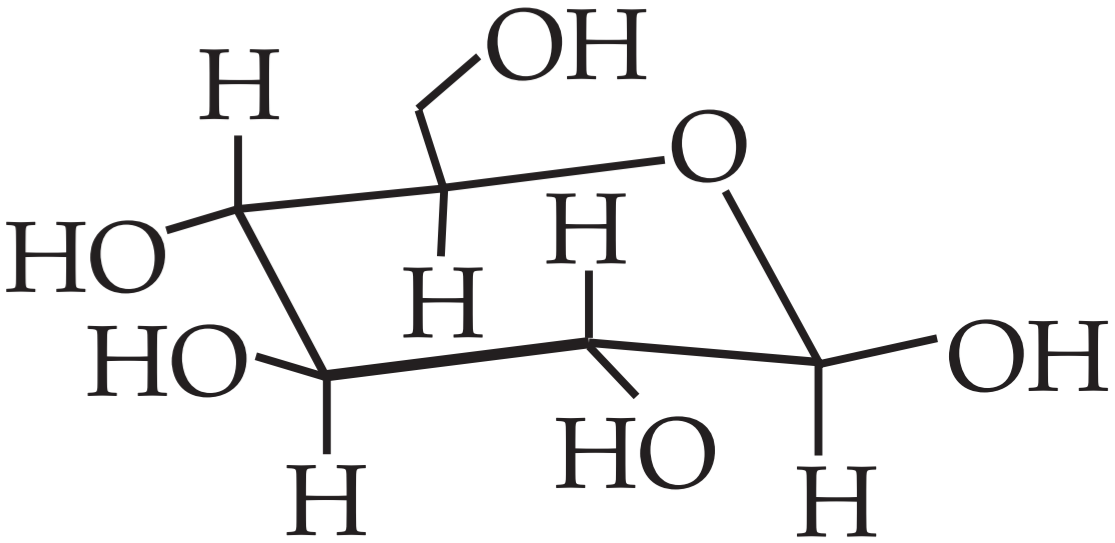
- The following carbohydrate is:
- A ketohexose.
- An aldohexose.
- An n-furanose.
- An $\alpha$-pyranose.
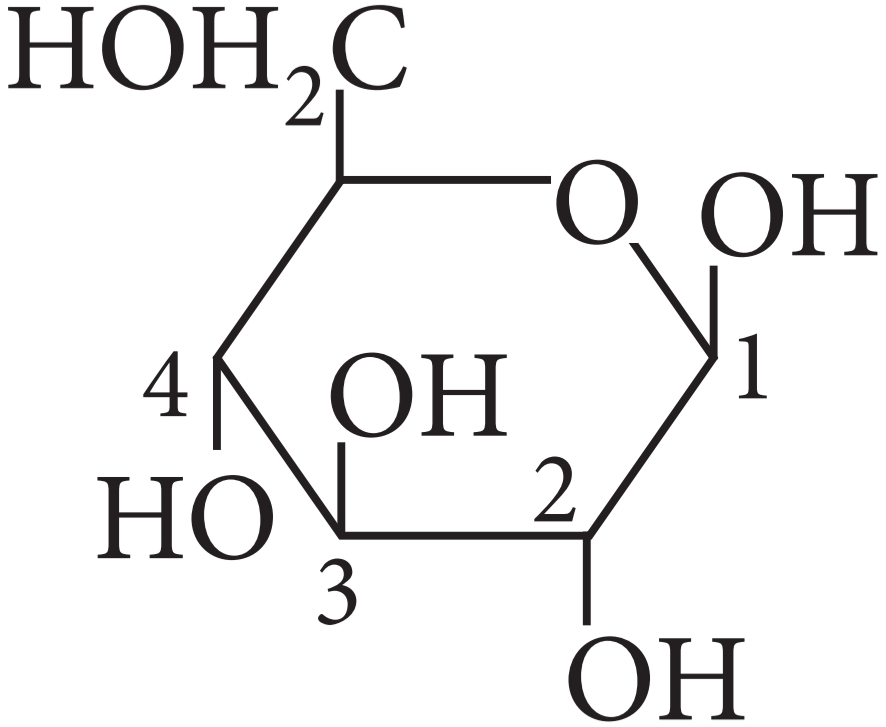
- In the following structure, anomeric carbon is:
- C-1
- C-2
- C-3
- C-4
- The term anomers of glucose refers to:
- Isomers of glucose that differ in configurations at carbons one and four (C-1 and C-4).
- A mixture of (D)-glucose and (L)-glucose.
- Enantiomers of glucose.
- Isomers of glucose that differ in configuration at carbon one (C-1).
- What percentage of $\beta$-D-(+) glucopyranose is found at equilibrium in the aqueous solution?
- 50%
- $\approx100%$
- 36%
- 64%