Question
Read the passage given below and answer the following questions:
Due to intermolecular hydrogen bonding, the boiling points of alcohols and phenols are much higher than those of corresponding haloalkanes, haloarenes, aliphatic and aromatic hydrocarbons. Among isomeric alcohols, the boiling points follow the order: primary > secondary > tertiary. Boiling points of ethers are much lower than those of isomeric alcohols. The solubility of alcohols in water decreases as the molecular mass of alcohols increases. Amongst isomeric alcohols solubility increases with branching. The solubility of phenols in water is much lower than that of alcohols. Lower ethers such as dimethyl ether and ethyl methyl ether are soluble in water, but the solubility decreases as the molecular mass increases.
In these questions (Q. No. i-iv), a statement of assertion followed by a statement of reason is given. Choose the correct answer out of the following choices.
  1. Assertion and reason both are correct statements and reason is correct explanation for assertion.
  2. Assertion and reason both are correct statements but reason is not correct explanation for assertion.
  3. Assertion is correct statement but reason is wrong statement.
  4. Assertion is wrong statement but reason is correct statement.
  1. Assertion: Alcohols have higher boiling points than ethers of comparable molecular masses.
Reason: Alcohols and ethers are isomeric in nature.
  1. Assertion: The solubility of phenols in water is much lower than that of alcohols.
Reason: Phenols do not form H-bonds with water.
  1. Assertion: Among n-butane, ethoxyethane, 1-propanol and 2-propanol, the increasing order of boiling points is, 1-butanol < 1-propanol < ethoxyethane < n-butane.
Reason: Boiling point increases with increase in molecular mass.
  1. Assertion: Dimethyl ether and diethylether are soluble in water.
Reason: As the molecular mass increases, solubility of ethers in water decreases.
  1. Assertion: Butan-2-ol has higher boiling point than 2-methylpropan-2-ol.
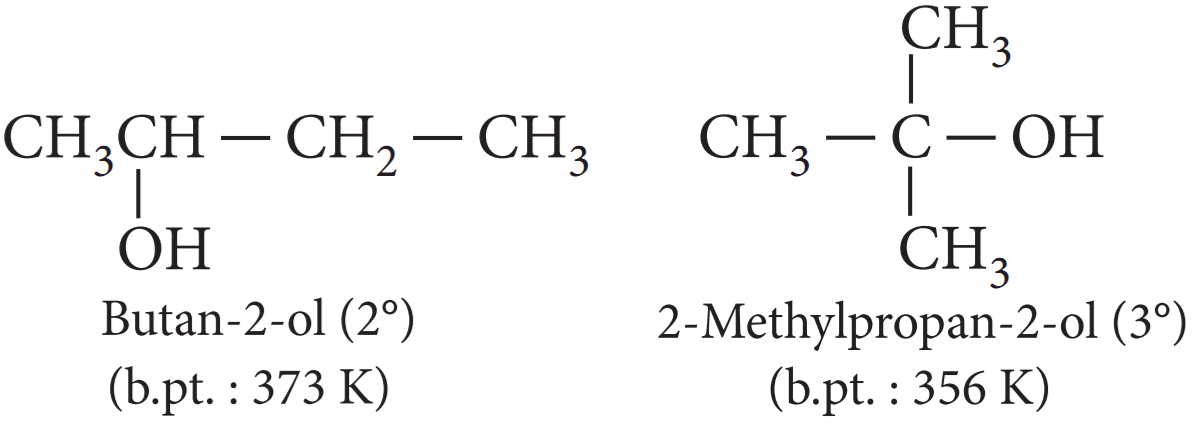
Reason: Amongst isomeric alcohols, the boiling points decreases with branching.

Answer

  1. (b) Assertion and reason both are correct statements but reason is not correct explanation for assertion.
Explanation:

Due to the presence of intermolecular H-bondi ng in alcohols, they have higher boiling points than isomeric ethers.
  1. (c) Assertion is correct statement but reason is wrong statement.
​​​​​​​Explanation:

Like alcohols, phenols also form H-bond with water. But the solubility of phenols in water is much lower than that of alcohols because of the larger non-polar hydrocarbon part (benzene ring) present in their molecules.
  1. (d) Assertion is wrong statement but reason is correct statement.
​​​​​​​​​​​​​​​​​​​​​Explanation:

Boiling point increases with increase in molecular mass so, 1-butanol has higher boiling point than 1-propanol. Ethers do not form hydrogen bonds thus, they have lower boiling points than the corresponding alcohols.

Due to weak dipole-dipole interactions, the boiling points of lower ethers are only slightly higher than those of the n-alkanes having comparable molecular masses,

Thus, the increasing order of boiling points is n-butane < ethoxyethane < 1-propanol < l-butanol.
  1. (b) Assertion and reason both are correct statements but reason is not correct explanation for assertion.
​​​​​​​​​​​​​​​​​​​​​​​​​​​​Explanation:

The solubility of lower ethers in water is due to the formation of H-bonds between water and ether molecules. As the molecular mass increases, the solubility of ethers in water decreases due to corresponding increase in the hydrocarbon portion of the molecule.
  1. (a) Assertion and reason both are correct statements and reason is correct explanation for assertion.
​​​​​​​​​​​​​​​​​​​​​​​​​​​​​​​​​​​Explanation:


Amongst isomeric alcohols,the boiling points decrease with branching due to a corresponding decrease in surface area.

Need a full question paper?

Generate a complete, print-ready paper with questions like this in minutes — across 16+ boards, with answer keys.

Start Generating Free

Similar questions

Molar conductivity of ions are given as product of charge on ions to their ionic mobilities and Faradays constant.
$\lambda_\text{A}\text{n}+=\text{n}\mu_\text{A}\text{n}+\text{F}$ (here $\mu$ is the ionic mobility of $A^{n+})$
For electrolytes say $A_xB_y,$ molar conductivity is given by
$\lambda_{\text{m}(\text{A}_\text{x}\text{B}_\text{y})}=\text{x}_\text{n}\mu_{\text{A}^\text{n}}+\text{F}+\text{y}_\text{m}\lambda_{\text{A}^\text{m}}-\text{F}$
Ions
Ionic mobility
$K^+$
$7.616 \times 10^{-4}$
$Ca^{2+}$
$12.33 \times 10^{-4}$
$Br^-$
$8.09 \times 10^{-4}$
$\text{SO}_{4}^{2-}$
$16.58 \times 10^{-4}$
The following questions are multiple choice questions. Choose the most appropriate answer:
  1. At infinite dilution, the equivalent conductance of $CaSO_4$ is:
  1. $256 \times 10^{-4}$
  2. $279$
  3. $23.7$
  4. $2.0 \times 10^{-8}$
  1. If the degree of dissociation of $CaSO_4$ solution is $10\%$ then equivalent conductance of $CaSO_4$ is:
  1. $3.59$
  2. $36.9$
  3. $27.9$
  4. $30.6$
  1. The correct order of equivalent conductance at infinite dilution of LiCl, NaCl, KCl is:
  1. $LiCl = NaCl = KCl$
  2. $LiCl > NaCl > KCl$
  3. $KCl > LiCl > NaCl$
  4. $KCl > NaCl > LiCl$
  1. What is the unit of equivalent conductivity?
  1. $ohm^{-1}\ cm^2\ eq^{-1}$
  2. $ohm\ cm^2\ eq-1$
  3. $ohm^{-1}\ cm\ eq^{-1}$
  4. $ohm\ cm^{-2}\ eq^{-2}$
  1. If the molar conductance value of $Ca^{2+}$ and $Cl^-$ at infinite dilution are $118.88 \times 10^{-4}m^2$ mho $mol^{-1}$ and $77.33 \times 10^{-4}m^2$ mho $mol^{-1}$ respectively then the molar conductance of $CaCl_2 ($in $m^2$ mho $mol^{-1})$ will be:
  1. $120.18 \times 10^{-4}$
  2. $135 \times 10^{-4}$
  3. $273.54 \times 10^{-4}$
  4. $192.1 \times 10^{-4}$
Read the passage given below and answer the following questions:
Both alcohols and phenols are acidic in nature, but phenols are more acidic than alcohols. Acidic strength of alcohols mainly depends upon the inductive effect. Acidic strength of phenols depends upon a combination of both inductive effect and resonance effects of the substituent and its position on the benzene ring. Electron withdrawing groups increases the acidic strength of phenols whereas electron donating groups decreases the acidic strength of phenols. Phenol is a weaker acid than carboxylic acid.
The following questions are multiple choice questions. Choose the most appropriate answer:
  1. Phenols are highly acidic as compare to alcohols due to:
  1. The higher molecular mass of phenols.
  2. The stronger hydrogen bonds in phenols.
  3. Alkoxide ion is a strong conjugate base.
  4. Phenoxide ion is resonance stabilised.
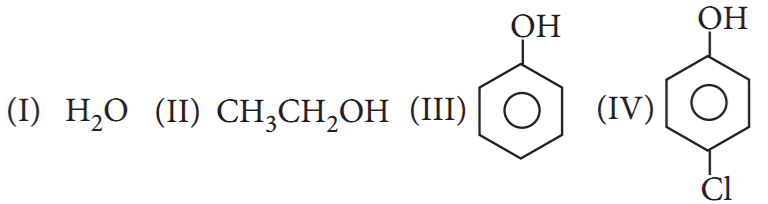
  1. The correct order of acidic strength among the following is:
  1. (III) > (IV) > (II) > (I)
  2. (IV) > (III) > (I) > (II)
  3. (IV) > (III) > (II) > (I)
  4. (I) > (II) > (IV) > (III)
  1. The correct decreasing order of $pK_a$ value is:
  1. II > IV > I > III
  2. IV > II > III > I
  3. II I> II > IV > I
  4. IV > I > II > III
  1. The compound that does not liberate $CO_2$, on treatment with aqueous sodium bicarbonate solution is:
  1. Benzoic acid.
  2. Benzenesulphonic acid.
  3. Salicylic acid.
  4. Carbolic acid.
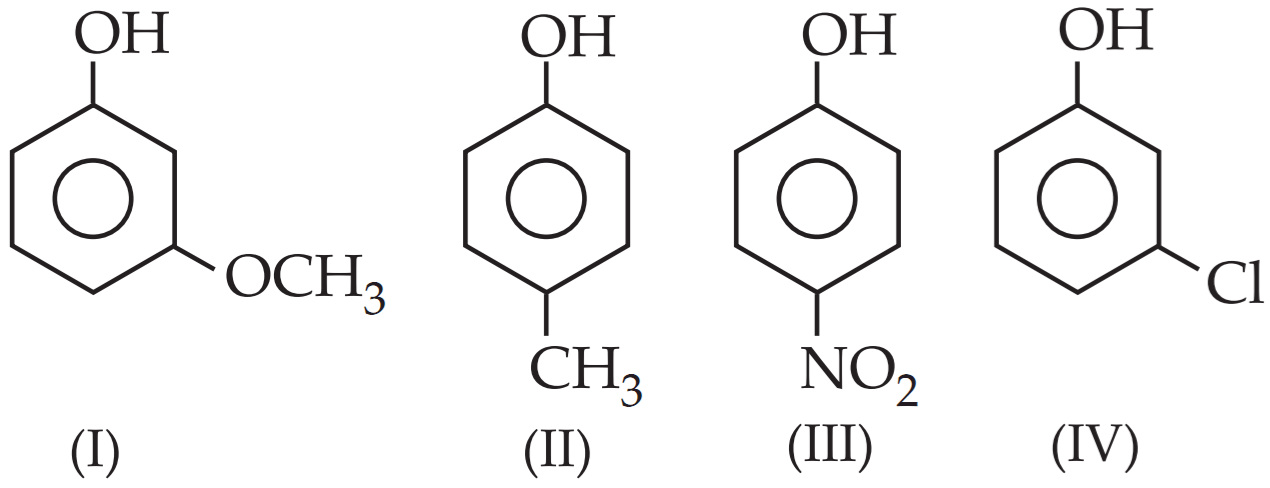
  1. Most acidic amongst the following is:
What is the most suitable pKa value of the substituted propylamine formed with substituent "X" with electronegativity 3.0
(i)10.67 (ii)10.08 (iii) 10.15 (iv)11.10
Read the passage given below and answer the following questions:
At the freezing point of a solvent, the solid and the liquid are in equilibrium. Therefore, a solution will freeze when its vapour pressure becomes equal to the vapour pressure of the pure solid solvent. It has been observed that when a non-volatile solute is added to a solvent, the freezing point of the solution is always lower than that of the pure solvent. Depression in freezing point can be given as, $\Delta\text{T}_\text{f}=\text{K}_\text{f}\text{m}$ Where, $K_f =$ Molal freezing point depression constant or we can write, $\Delta\text{T}_\text{f}=\frac{\text{K}_\text{f}\times\text{W}_\text{B}\times1000}{\text{W}_A\times\text{M}_\text{B}}$
a statement of assertion followed by a statement of reason is given. Choose the correct answer out of the following choices.
  1. Assertion and reason both are correct statements and reason is correct explanation for assertion.
  2. Assertion and reason both are correct statements but reason is not correct explanation for assertion.
  3. Assertion is correct statement but reason is wrong statement.
  4. Assertion is wrong statement but reason is correct statement.
  1. Assertion: $0.1M$ solution of glucose has same depression in the freezing point as $0.1M$ solution of urea.
Reason: $K_f $ for both has same value.
  1. Assertion: Increasing pressure on pure water decreases its freezing point.
Reason: Density of water is maximum at $273K.$
  1. Assertion: Larger the value of cryoscopic constant of the solvent, lesser will be the freezing point of the solution.
Reason: Extent of depression in the freezing point depends on the nature of the solvent.
  1. Assertion: The water pouch of instant cold pack for treating athletic injuries breaks when squeezed and NH4N03 dissolves thus lowering the temperature.
Reason: Addition of non-volatile solute into solvent results into depression of freezing point of solvent.
  1. Assertion: If a non-volatile solute is mixed in a solution then elevation in boiling point and depression in freezing point both wiII be same.
Reason: Elevation in boiling point and depression in freezing point both depend on number of particles of solute.
In these questions, a statement of assertion followed by a statement of reason is given. Choose the correct answer out of the following choices.
Assertion: There is no interface between gases.
Reason: The shape and volume of gases are not definite.
Read the passage given below and answer the following questions:
To explain bonding in coordination compounds various theories were proposed. One of the important theory was valence bond theory. According to that, the central metal ion in the complex makes available a number of empty orbitals for the formation of coordination bonds with suitable ligands. The appropriate atomic orbitals of the metal hybridise to give a set of equivalent orbitals of definite geometry.
The d-orbitals involved in the hybridisation may be either inner d-orbitals i.e., $(n - 1)d$ or outer d-orbitals i.e., nd. For example, $Co^{3+}$ forms both inner orbital and outer orbital complexes, with ammonia it forms $[Co(NH_3)_6]^{3+}$ and with fluorine it forms $[CoF_6]^{3-}$ complex ion.
The following questions are multiple choice questions. Choose the most appropriate answer:
  1. Which of the following is not true for $[CoF_6]^{3-}?$
  1. It is paramagnetic.
  2. It has coordination number of $6.$
  3. It is outer orbital complex.
  4. It involves $d^2sp^3$ hybridisation.
  1. $[Cr(H_2O)_6]Cl_3 ($at. no. of $Cr = 24)$ has a magnetic moment of $3.83B.M.$ The correct distribution of $3d-$electrons in the central metal of the complex is:
  1. $3\text{d}^1_\text{xy},3\text{d}^1_{\text{x}^2-\text{y}^2},3\text{d}^1_\text{yz}$
  2. $3\text{d}^1_\text{xy},3\text{d}^1_{\text{yz}},3\text{d}^1_\text{zx}$
  3. $3\text{d}^1_\text{xy},3\text{d}^1_{\text{zy}},3\text{d}^1_{\text{z}^2}$
  4. $3\text{d}^1_{\text{x}^2-\text{y}^2},3\text{d}^1_{\text{z}^2},3\text{d}^1_\text{xz}$
  1. Which of the following is true for $[Co(NH_3)_6]^{3+}?$
  1. It is an octahedral, di magnetic and outer orbital complex.
  2. It is an octahedral, paramagnetic and outer orbital complex.
  3. It is an octahedral, paramagnetic and inner orbital complex.
  4. It is an octahedral, di magnetic and inner orbital complex.
  1. The paramagnetism of $[CoF_6]^{3-}$ is due to.
  1. $3$ electrons.
  2. $4$ electrons.
  3. $2$ electrons.
  4. $1$ electron.
  1. Which of the following is an inner orbital or low spin complex?
  1. $[Ni(H_2O)_6]^{3+}$
  2. $[FeF_6]^{3-}$
  3. $[Co(CN)_6]^{3-}$
  4. $[NiCl_4]^{2-}$
Read the passage given below and answer the following questions:
(A), (B) and (C) are three non-cyclic functional isomers of a carbonyl compound with molecular formula $C_4H_8O$. Isomers (A) and (C) give positive Tollen's test whereas isomer (B) does not give Tollen's test but gives positive iodoform test. Isomers (A) and (B) on reduction with $\frac{\text{Zn(Hg)}}{\text{conc.}}.$ HCl give the same product (D).
The following questions are multiple choice questions. Choose the most appropriate answer:
  1. Compound A is:
  1. $\text{CH}_3-\text{CH}-\text{CHO}\\\ \ \ \ \ \ \ \ \ \ \ \ \ |\\ \ \ \ \ \ \ \ \ \ \ \ \ \text{CH}_3$
  2. $\text{CH}_3\text{CH}_2\text{CH}_2\text{CHO}$
  3. $\ \ \ \ \ \ \ \ \ \ \ \ \text{O}\\\ \ \ \ \ \ \ \ \ \ \ \ \ ||\\\text{CH}_3-\text{C}-\text{CH}_2-\text{CH}_3$
  4. None of these.
  1. Compound (C) is:
  1. Iso-butyraldehyde
  2. Butyraldehyde
  3. Crotonaldehyde
  4. Acrolein
  1. Compound (B) can be obtained by:
  1. $\text{CH}_3-\text{C}\equiv\text{C}-\text{CH}_2-\text{CH}_3\xrightarrow[333\text{K}]{\text{dil.H}_2\text{SO}_4+\text{HgSO}_4}$
  2. $(\text{CH}_3\text{CH}_2\text{COO})_2\text{Ca}\xrightarrow{\text{Dry distill}}$
  3. $\text{CH}_3-\text{C}\equiv\text{C}-\text{CH}_3\xrightarrow[\frac{\text{H}_2\text{O}_2}{\text{NaOH}}]{\frac{\text{B}_2\text{H}_6}{\text{THF}}}$
  4. $\text{CH}_3-\text{CH}=\text{CH}-\text{CH}_3\xrightarrow[\frac{\text{ZN}}{\text{H}_2\text{O}}]{\text{O}_3}$
  1. Out of (A), (B) and ( C) isomers, which one is least reactive towards addition of HCN?
  1. A
  2. B
  3. C
  4. All are equally reactive.
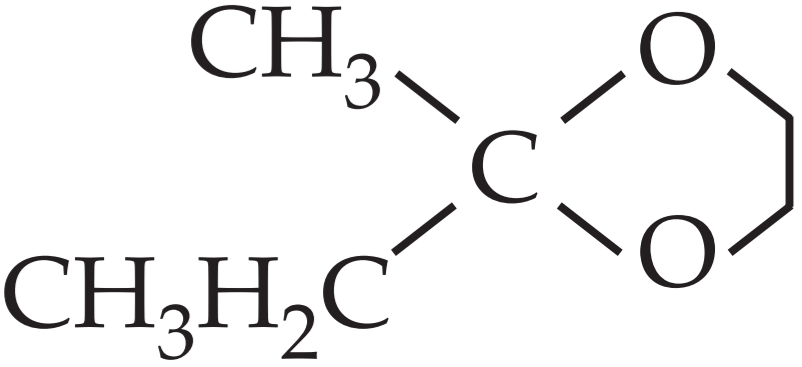
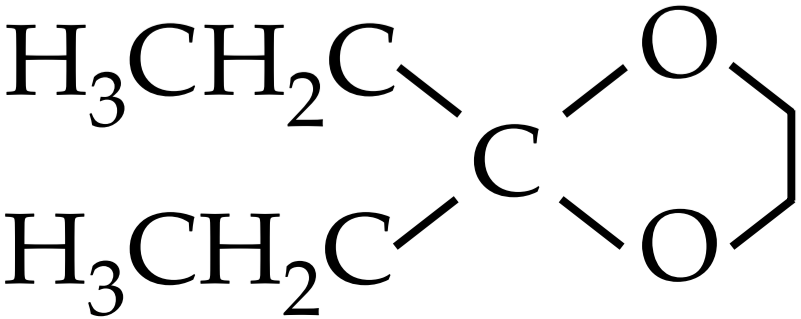
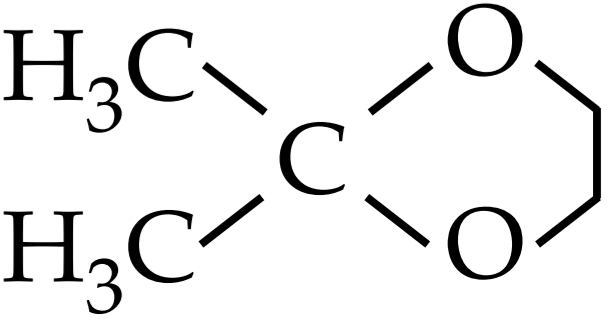
  1. What will be the product when (B) reacts with ethylene glycol in presence of HCl gas?
  1.  
  1.  
  1.  
  1. None of these.
Read the passage given below and answer the following questions:
Most important crystal lattices are the simple cubic, body centred cubic and face centred cubic. In simple cubic lattice, all the atoms are present at all the corners of the cube. In body-centred cubic lattice, atoms are present at all the corners and at the body-centre. In face-centred cubic lattice, atoms are present at the corners and at the centers of all six faces. In the formation of crystals, the constituent particles get closely packed together. The closely packed arrangement is that in which maximum available space is occupied, leaving minimum vacant space. The most efficient close packing, can be achieved in two ways, one which is called hexagonal close packing.(hcp) and the other, cubic close packing (ccp or fcc)
In these questions (Q. No. i-iv) a statement of assertion followed by a statement of reason is given. Choose the correct answer out of the following choices.
  1. Assertion and reason both are correct statements, and reason is correct explanation for assertion.
  2. Assertion and reason both are correct statements, but reason is not correct explanation for assertion.
  3. Assertion is correct statement, but reason is wrong statement.
  4. Assertion is wrong statement, but reason is correct statement.
  1. Assertion: Face centred cubic cell has $4$ atoms per unit cell.
Reason: ln fee unit cell, there are $8$ atoms at the corners and $ 6$ atoms at face centres
  1. Assertion: CsCl has body-centred cubic arrangement.
Reason: CsCl has one $Cs^+$ ion and $8$ $CI^-$ ions in its unit cell.
  1. Assertion: fcc and hcp have same packing efficiency.
Reason: bcc and fcc both have same number of atoms per unit cell and same arrangement.
  1. Assertion: The total number of atoms present in a simple cubic unit cell is one.
Reason: Simple cubic unit cell has atoms at its corners, each of which is shared between eight adjacent unit cells.
  1. Assertion: The packing efficiency is maximum for the fee structure.
Reason: The coordination number is $12$ in fcc structures.
Read the passage given below and answer the following questions:
Metal carbonyl is an example of coordination compounds in which carbon monoxide (CO) acts as ligand. These are also called homoleptic carbonyls. These compounds contain both $\sigma$ and $\pi$ character. Some carbonyls have metal-metal bonds. The reactivity of metal carbonyls is due to (i) the metal centre and (ii) the CO ligands. CO is capable of accepting an appreciable amount of electron density from the metal atom into their empty $\pi$ or $\pi-\text{orbital}.$ These types of ligands are called $\pi-\text{accepter}$ or $\pi-\text{acid}$ ligands. These interactions increases the $\Delta_0$ value.
The following questions are multiple choice questions. Choose the most appropriate answer:
  1. What is the oxidation state of metal in $[Mn_2(CO)_{10}]?$
  1. $+1$
  2. $-1$
  3. $+2$
  4. $0$
  1. Among the following metal carbonyls, the $C-O$ bond order is lowest in:
  1. $[Mn(CO)_6]^+$
  2. $[Fe(CO)_5]$
  3. $[Cr(CO)_6]$
  4. $[V(CO)_6]^-$
  1. Which of the following can be reduced easily?
  1. $V(CO)_6$
  2. $Mo(CO)_6$
  3. $[Co(CO)_4]^-$
  4. $Fe(CO)_5$
  1. The oxidation state of cobalt in $K[Co(CO)_4]$ is:
  1. $+1$
  2. $+3$
  3. $-1$
  4. $0$
  1. Structure of decacarbonyl manganese is:
  1. Trigonal bipyramidial
  2. Octahedral
  3. Tetrahedral
  4. Square pyramidal
In these questions, a statement of assertion followed by a statement of reason is given. Choose the correct answer out of the following choices.
Assertion: Colloidal particles show Brownian movement.
Reason: Brownian movement arises because of the impact of the molecules of the dispersion medium with the colloidal particles.