Question
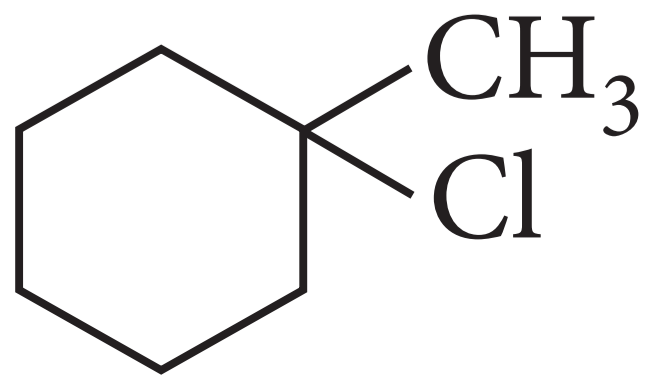 is more reactive than
 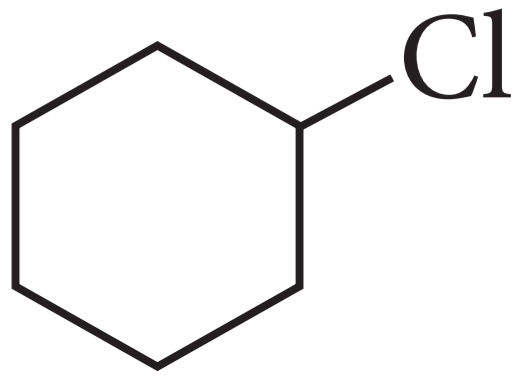 towards nucleophilic substitution reactions.
✓
Answer
- (b) Assertion and reason both are correct statements but reason is not correct explanation for assertion.
Explanation:
Primary benzylic halides show higher reactivity in SN1 reactions than primary alkyl halides. This is due to the greater stabilisation of the benzylic carbocation intermediates by resonance.
- (a) Assertion and reason both are correct statements and reason is correct explanation for assertion.
- (a) Assertion and reason both are correct statements and reason is correct explanation for assertion.
Explanation:
On comparing the relative stabilities of carbanion of chlorobenzene and p-chloroanisole,
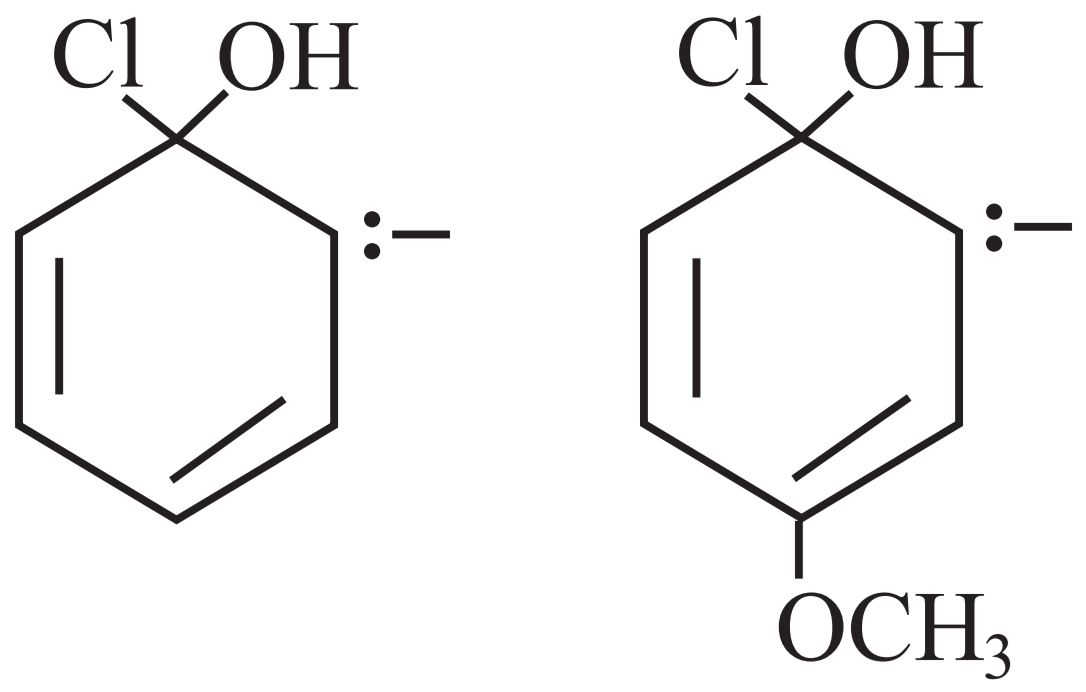
The electron donating group (OCH3) in anisole tends to intensify the negative charge relative to carbanion in chlorobenzene. Thus, p-chloroanisole is less reactive than chlorobenzene.
- (b) Assertion and reason both are correct statements but reason is not correct explanation for assertion.
Explanation:
As compared to chlorobenzene, the intermediate carbanion resulting from 4-nitrochlorobenzene is stabilized by-R-effect of the N02 group.
- (c) Assertion is correct statement but reason is wrong statement.
Explanation:
Chlorobenzene is less reactive than benzene towards the electrophilic substitution reactions due to -I effect.
Need a full question paper?
Generate a complete, print-ready paper with questions like this in minutes — across 16+ boards, with answer keys.
Explore more
Similar questions
Two types of conductors are generally used, metallic and electrolytic. Free electrons are the current carrier in metallic and in electrolytic conductors, free ions. Specific conductance or conductivity of an electrolytic solution is given by $\text{K}=\text{C}\times\frac{\text{l}}{\text{A}}$ where, $\text{C}\times\frac{1}{\text{R}}$ and $\frac{\text{l}}{\text{A}}=\text{G}^\star$ (cell constant) Molar conductance $(\wedge_\text{m})$ and equivalent conductance $(\wedge_\text{e})$ of an electrolyte solution are calculated as $\wedge_\text{m}=\frac{\text{K}\times1000}{\text{M}}$ or $\wedge_\text{e}=\frac{\text{K}\times1000}{\text{N}}$ where, M = molarity of solution and N is normality of solution. Molar conductance of strong electrolyte depends on the concentration. $\wedge_\text{m}=\wedge^\circ_{\text{m}^-}\text{b}\sqrt{\text{C}}$ $\wedge^\circ_\text{m}=$ molar conductance at infinite dilution, b = constant, C = cone.of solution In these questions (Q. No. i-iv), a statement of assertion followed by a statement of reason is given. Choose the correct answer out of the following choices.
→- Assertion and reason both are correct statements and reason is correct explanation for assertion.
- Assertion and reason both are correct statements but reason is not correct explanation for assertion.
- Assertion is correct statement but reason is wrong statement.
- Assertion is wrong statement but reason is correct statement.
- Assertion: The molar conductivity of strong electrolyte decreases with increase in concentration.
Reason: At high concentration, migration ofions is slow.
- Assertion: The molar conductance of weak electrolyte at infinite dilution is equal to the sum of molar conductance of cations and anions.
Reason: Kohlrausch's law is applicable for strong electrolytes.
- Assertion: Equivalent conductance of all electrolytes increases with increasing concentration.
Reason: More number ofions are available per gram equivalent at higher concentration.
- Assertion: Specific conductance decreases with dilution whereas equivalent conductance increases.
Reason: On dilution, number of ions per millilitre decreases but total number ofions increases considerably.
- Assertion: The ratio of specific conductivity to the observed conductance does not depend upon the concentration of the solution taken in the conductivity cell.
Reason: Specific conductivity decreases with dilution whereas observed conductance increases with dilution.
Dependence of the rate of reaction on the concentration of reactants, temperature, and other factors is the most general method for weeding out unsuitable reaction mechanisms. The term mechanism means all the individual collisional or elementary processes involving molecules (atoms, radicals, and ions included) that take place simultaneously or consecutively to produce the observed overall reaction. For example, when hydrogen gas reacts with bromine, the rate of the reaction was found to be proportional to the concentration of H₂ and to the square root of the concentration of Br2. Furthermore, the rate was inhibited by increasing the concentration of HBr as the reaction proceeded. These observations are not consistent with a mechanism involving bimolecular collisions of a single molecule of each kind. The currently accepted mechanism is considerably more complicated, involving the dissociation of bromine molecules into atoms followed by reactions between atoms and molecules:
It is clear from this example that the mechanism cannot be predicted from the overall stoichiometry.
(source: Moore, J. W., & Pearson, R. G. (1981). Kinetics and mechanism. John Wiley & Sons.)
(a). Predict the expression for the rate of reaction and order for the following:
H2 + Br2 → 2 HBr
What are the units of rate constant for the above reaction?
(b). How will the rate of reaction be affected if the concentration of Br2 is tripled?
It is clear from this example that the mechanism cannot be predicted from the overall stoichiometry.
(source: Moore, J. W., & Pearson, R. G. (1981). Kinetics and mechanism. John Wiley & Sons.)
(a). Predict the expression for the rate of reaction and order for the following:
H2 + Br2 → 2 HBr
What are the units of rate constant for the above reaction?
(b). How will the rate of reaction be affected if the concentration of Br2 is tripled?
ln a reaction, the rates of disappearance of different reactants or rates of formation of different products may not be equal but rate of reaction at any instant of time has the same value expressed in terms of any reactant or product. Further, the rate of reaction may not depend upon the stoichiometric coefficients of the balanced chemical equation. The exact powers of molar concentrations of reactants on which rate depends are found experimentally and expressed in terms of 'order of reaction'. Each reaction has a characteristic rate constant depends upon temperature. The units of the rate constant depend upon the order of reaction.
The following questions are multiple choice questions. Choose the most appropriate answer:
→The following questions are multiple choice questions. Choose the most appropriate answer:
- The rate constant of a reaction is found to be 3 × 10⁻³ mol-2 L2 sec-1. The order of the reaction is:
- 0.5
- 2
- 3
- 1
- ln the reaction, A + 3B → 2C, the rate of formation of C is:
- The same as rate of consumption of A.
- The same as the rate of consumption of B.
- Twice the rate of consumption of A.
- $\frac{3}{2}$ times the rate of consumption of B.
- Rate of a reaction can be expressed by following rate expression, Rate = k[A]2 [B], if concentration of A is increased by 3 times and concentration of B is increased by 2 times, how many times rate of reaction increases?
- 9 times
- 27 times
- 18 times
- 8 times
- The rate of a certain reaction is given by, rate = k[H+]n.The rate increases 100 times when the pH changes from 3 to 1. The order (n) of the reaction is:
- 2
- 0
- 1
- 1.5
- ln a chemical reaction A + 2B → products, when concentration of A is doubled, rate of the reaction increases 4 times and when concentration of B alone is doubled rate continues to be the same. The order of the reaction is:
- 1
- 2
- 3
- 4
Read the passage given below and answer the following questions:
Coordination compounds are formulated and named according to the IUPAC system.
Few rules for naming coordination compounds are:
Coordination compounds are formulated and named according to the IUPAC system.
Few rules for naming coordination compounds are:
- In ionic complex, the cation is named first and then the anion.
- In the coordination entity, the ligands are named first and then the central metal ion.
- When more than one type of ligands are present, they are named in alphabetical order of preference without any consideration of charge.
- The IUPAC name of the complex [Pt(NH3)3Br(NO2)Cl]Cl is:
- Triamminechlorobromonitroplatinum (IV) chloride.
- Triamminebromonitrochloroplatinum (IV) chloride.
- Triamminebromidochloridonitroplatinum (IV) chloride.
- Triamminenitrochlorobromoplatinum (IV) chloride.
- The IUPAC name of [Ni(CO)4] is:
- Tetracarbonylnickel (II).
- Tetracarbonylnickel (0).
- Tetracarbonylnickelate (II).
- Tetracarbonylnickelate (0).
- As per IUPAC nomenclature, the name of the complex [Co(H2O)4(NH3)2]Cl3 is:
- Tetraaquadiamminecobalt (II) chloride.
- Tetraaquadiamminecobalt (III) chloride.
- Diamminetetraaquacobalt (II) chloride.
- Diamminetetraaquacobalt (III) chloride.
- Which of the following represents correct formula of dichloridobis(ethane -1, 2-diamine)cobalt (III) ion?
- [CoCl2(en)]2+
- [CoCl2(en)2]2+
- [CoCl2(en)]+
- [CoCl2(en)2]+
- Correct formula of pentaamminenitro-O-cobalt (III) sulphate is:
- [Co(NO2)(NH3)5]SO4
- [Co(ONO)(NH3)5]SO4
- [Co(NO2)(NH3)4](SO4)2
- [Co(ONO)(NH3)4](SO4)2
Molar conductivity of ions are given as product of charge on ions to their ionic mobilities and Faradays constant.
$\lambda_\text{A}\text{n}+=\text{n}\mu_\text{A}\text{n}+\text{F}$ (here $\mu$ is the ionic mobility of An+)
For electrolytes say AxBy, molar conductivity is given by
$\lambda_{\text{m}(\text{A}_\text{x}\text{B}_\text{y})}=\text{x}_\text{n}\mu_{\text{A}^\text{n}}+\text{F}+\text{y}_\text{m}\lambda_{\text{A}^\text{m}}-\text{F}$
The following questions are multiple choice questions. Choose the most appropriate answer:
→$\lambda_\text{A}\text{n}+=\text{n}\mu_\text{A}\text{n}+\text{F}$ (here $\mu$ is the ionic mobility of An+)
For electrolytes say AxBy, molar conductivity is given by
$\lambda_{\text{m}(\text{A}_\text{x}\text{B}_\text{y})}=\text{x}_\text{n}\mu_{\text{A}^\text{n}}+\text{F}+\text{y}_\text{m}\lambda_{\text{A}^\text{m}}-\text{F}$
| Ions | Ionic mobility |
| K+ | 7.616 × 10⁻⁴ |
| Ca2+ | 12.33 × 10⁻⁴ |
| Br- | 8.09 × 10⁻⁴ |
| $\text{SO}_{4}^{2-}$ | 16.58 × 10⁻⁴ |
- At infinite dilution, the equivalent conductance of CaSO4 is:
- 256 × 10-4
- 279
- 23.7
- 2.0 × 10⁻⁸
- If the degree of dissociation of CaSO4 solution is 10% then equivalent conductance of CaSO4 is:
- 3.59
- 36.9
- 27.9
- 30.6
- The correct order of equivalent conductance at infinite dilution of LiCl, NaCl, KCl is:
- LiCl = NaCl = KCl
- LiCl > NaCl > KCl
- KCl > LiCl > NaCl
- KCl > NaCl > LiCl
- What is the unit of equivalent conductivity?
- ohm-1 cm2 eq-1
- ohm cm2 eq-1
- ohm-1 cm eq-1
- ohm cm-2eq-2
- If the molar conductance value of Ca2+ and Cl- at infinite dilution are 118.88 × 10⁻⁴m2 mho mol-1 and 77.33 × 10⁻⁴m2 mho mol-1 respectively then the molar conductance of CaCl2 (in m2 mho mol-1) will be:
- 120.18 × 10⁻⁴
- 135 × 10-4
- 273.54 × 10⁻⁴
- 192.1 × 10⁻⁴
The potential of each electrode is known as electrode potential. Standard electrode potential is the potential when concentration of each species taking part in electrode reaction is unity and the reaction is taking place at 298K. By convention, the standard electrode potential of hydrogen (SHE) is 0.0V. The electrode potential value for each electrode process is a measure of relative tendency of the active species in the process to remain in the oxidised/ reduced form. The negative electrode potential means that the redox couple is stronger reducing agent than $\frac{\text{H}^+}{\text{H}_2}$ couple. A positive electrode potential means that the redox couple is a weaker reducing agent than the $\frac{\text{H}^+}{\text{H}_2}$ couple. Metals which have higher positive value of standard reduction potential form the oxides of greater thermal stability. In these questions (Q. No. i-iv), a statement of assertion followed by a statement ofreason is given. Choose the correct answer out of the following choices.
→→- Assertion and reason both are correct statements and reason is correct explanation for assertion.
- Assertion and reason both are correct statements but reason is not correct explanation for assertion.
- Assertion is correct statement but reason is wrong statement.
- Assertion is wrong statement but reason is correct statement.
- Assertion: An electrochemical cell can be set-up only if the redox reaction is spontaneous.
Reason: A reaction is spontaneous if the free energy change is negative.
- Assertion: The standard electrode potential of hydrogen is 0.0V.
Reason: It is by convention.
- Assertion: The more negative is the standard reduction potential, greater is its ability to displace H2 from acid.
Reason: Strength of reducing agent increases with the increase in negative value of the standard reduction potential.
- Assertion: The negative value of standard reduction potential means that reduction takes place on this electrode with reference to hydrogen electrode.
Reason: The standard electrode potential of a half cell has a fixed value.
- Assertion: The absolute value of electrode potential cannot be determined experimentally.
Reason: The electrode potential values are generally determined with respect to SHE.


Read the passage given below and answer the following questions: Transition metal oxides are compounds fanned by the reaction of metals with oxygen at high temperature. The highest oxidation number in the oxides coincides with the group number. In vanadium, there is a gradual change from the basic V2O3 to less basic V2O4 and to amphoteric V2O5· V2O4 dissolves in acids to give VO2+ salts. Transition metal oxides are commonly utilized for their catalytic activity and semi conductive properties. Transition metal oxides are also frequently used as pigments in paints and plastic. Most notably titatnium dioxide. One of the earliest application of transition metal oxides to chemical industry involved the use of vanadium oxide for catalytic oxidation of sulfur dioxide to sulphuric acid. Since then, many other applications have emerged, which include benzene oxidation to maleic anhydride on vandium oxides; cyclohexane oxidation to adipic acid on cobalt oxides. An important property of the catalyst material used in these processes is the ability of transition metals to change their oxidation state under a given chemical potential of reductants and oxidants. The following questions are multiple choice questions. Choose the most appropriate answer:
→- Which oxide of vanadium is most likely to be basic and ionic?
- VO
- V2O3
- VO2
- V2O5
- Vanadyl ion is:
- $\text{VO}^{2+}$
- $\text{VO}^{+}_2$
- $\text{V}_{2}\text{O}^+$
- $\text{VO}^{3-}_4$
- Which of the following statements is false?
- With fluorine vanadium can form VF5.
- With chlorine vanadium can form VCl5.
- Vanadium exhibits highest oxidation state in oxohalides VOCl3, VOBr3 and fluoride VF5.
- With iodine vanadium cannot form Vl5 due to oxidising power of V5+ and reducing nature of I-.
- The oxidation state of vanadium in V2O5 is:
- $\frac{+5}{2}$
- +7
- +5
- +6
- Identify the oxidising agent in the following reaction.
V2O5 + 5Ca → 2V + 5CaO
- V2O5
- Ca
- V
- None of these.
Explain the structure of nucleic acid compounds.