Question
The potential of each electrode is known as electrode potential. Standard electrode potential is the potential when concentration of each species taking part in electrode reaction is unity and the reaction is taking place at 298K. By convention, the standard electrode potential of hydrogen (SHE) is 0.0V. The electrode potential value for each electrode process is a measure of relative tendency of the active species in the process to remain in the oxidised/ reduced form. The negative electrode potential means that the redox couple is stronger reducing agent than $\frac{\text{H}^+}{\text{H}_2}$ couple. A positive electrode potential means that the redox couple is a weaker reducing agent than the $\frac{\text{H}^+}{\text{H}_2}$ couple. Metals which have higher positive value of standard reduction potential form the oxides of greater thermal stability.

In these questions (Q. No. i-iv), a statement of assertion followed by a statement ofreason is given. Choose the correct answer out of the following choices.

  1. Assertion and reason both are correct statements and reason is correct explanation for assertion.
  2. Assertion and reason both are correct statements but reason is not correct explanation for assertion.
  3. Assertion is correct statement but reason is wrong statement.
  4. Assertion is wrong statement but reason is correct statement.
  1. Assertion: An electrochemical cell can be set-up only if the redox reaction is spontaneous.

Reason: A reaction is spontaneous if the free energy change is negative.

  1. Assertion: The standard electrode potential of hydrogen is 0.0V.

Reason: It is by convention.

  1. Assertion: The more negative is the standard reduction potential, greater is its ability to displace H2 from acid.

Reason: Strength of reducing agent increases with the increase in negative value of the standard reduction potential.

  1. Assertion: The negative value of standard reduction potential means that reduction takes place on this electrode with reference to hydrogen electrode.

Reason: The standard electrode potential of a half cell has a fixed value.

  1. Assertion: The absolute value of electrode potential cannot be determined experimentally.

Reason: The electrode potential values are generally determined with respect to SHE.
Answer

  1. (b) Assertion and reason both are correct statements but reason is not correct explanation for assertion.
  1. (a) Assertion and reason both are correct statements and reason is correct explanation for assertion.
  1. (a) Assertion and reason both are correct statements and reason is correct explanation for assertion.

Explanation:

More negative is the standard reduction potential, greater is its ability to displace hydrogen from acid.

  1. (d) Assertion is wrong statement but reason is correct statement.

Explanation:

A negative value of standard reduction potential means that oxidation takes place on the electrode with reference to SHE.

  1. (a) Assertion and reason both are correct statements and reason is correct explanation for assertion.

Need a full question paper?

Generate a complete, print-ready paper with questions like this in minutes — across 16+ boards, with answer keys.

Start Generating Free

Similar questions

Read the passage given below and answer the following questions: Boiling point or freezing point of liquid solution would be affected by the dissolved solids in the liquid phase. A soluble solid in solution has the effect of raising its boiling point and depressing its freezing point. The addition of non-volatile substances to a solvent decreases the vapor pressure and the added solute particles affect the formation of pure solvent crystals. According to many researches the decrease in freezing point directly correlated to the concentration of solutes dissolved in the solvent. This phenomenon is expressed as freezing point depression and it is useful for several applications such as freeze concentration of liquid food and to find the molar mass of an unknown solute in the solution. Freeze concentration is a high quality liquid food concentration method where water is removed by forming ice crystals. This is done by cooling the liquid food below the freezing point of the solution. The freezing point depression is referred as a colligative property and it is proportional to the molar concentration of the solution (m), along with vapor pressure lowering, boiling point elevation, and osmotic pressure. These are physical characteristics of solutions that depend only on the identity of the solvent and the concentration of the solute. The characters are not depending on the solute’s identity.
  1. When a non volatile solid is added to pure water it will:
  1. boil above 100°C and freeze above 0°C
  2. boil below 100°C and freeze above 0°C
  3. boil above 100°C and freeze below 0°C
  4. boil below 100°C and freeze below 0°C
  1. Colligative properties are:
  1. dependent only on the concentration of the solute and independent of the solvent’s and solute’s identity.
  2. dependent only on the identity of the solute and the concentration of the solute and independent of the solvent's identity.
  3. dependent on the identity of the solvent and solute and thus on the concentration of the solute.
  4. dependent only on the identity of the solvent and the concentration of the solute and independent of the solute’s identity.
  1. Assume three samples of juices A, B and C have glucose as the only sugar present in them. The concentration of sample A, B and C are 0.1M, 5M and 0.2 M respectively. Freezing point will be highest for the fruit juice:
  1. A
  2. B
  3. C
  4. All have same freezing point
  1. Identify which of the following is a colligative property:
  1. freezing point
  2. boiling point
  3. osmotic pressure
  4. all of the above
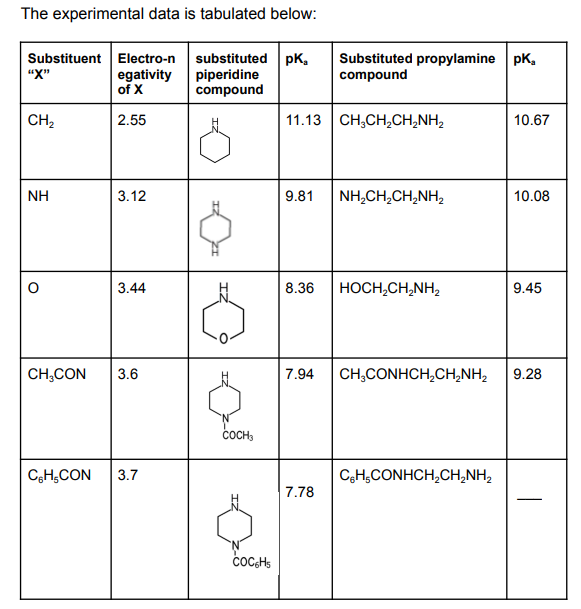
What is the most suitable pKa value of the substituted propylamine formed with substituent "X" with electronegativity 3.0
(i)10.67 (ii)10.08 (iii) 10.15 (iv)11.10
Read the passage given below and answer the following questions:
A chlorocompound (A) on reduction with Zn-Cu and ethanol gives the hydrocarbon (B) with five carbon atoms. When (A) is dissolved in dry ether and treated with sodium metal it gave 2, 2, 5, 5 - tetramethylhexane. The treatment of (A) with alcoholic KCN gives compound ( C).
The following questions are multiple choice questions. Choose the most appropriate answer:
  1. The compound (A) is:
  1. 1-chloro-2, 2-dimethylpropane.
  2. 1-chloro-2, 2-dimethyl butane.
  3. 1-chloro-2-methyl butane.
  4. 2-chloro-2-methyl butane.
  1. The reaction of (C) with Na, C2H5OH gives:
  1. (CH3)3C CH2CONH2
  2. (CH3)3C NH2
  3. (CH3)3C CH2CH2NH2
  4. (CH3)2CHCH2NH2
  1. The reaction of (C) with Na, C2H5OH is called:
  1. Gilman reaction.
  2. Mendius reaction.
  3. Grooves process.
  4. Swart's reaction.
  1. The reaction of (A) with aq. KOH will preferably favour:
  1. SN1 mechanism.
  2. SN2 mechanism.
  3. E1 mechanism.
  4. E2 mechanism.
  1. Compound (B) is:
  1. N-pentane.
  2. 2, 2-dimethylpropane.
  3. 2-methylbutane.
  4. None of these.

Read the passage given below and answer the following questions:

A primary alkyl halide (A) C4H9Br reacted with akoholic KOH to give compound (B). Compound (B) is reacted with HBr to give compound (C) which is an isomer of (A). When (A) reacted with sodium metal, it gave a compound (D) C8H18 that is different than the compound obtained when n-butyl bromide reacted with sodium metal.

The following questions are multiple choice questions. Choose the most appropriate answer:

  1. Compound (A) is:
  1. CH3CH2CH2CH2Br

  2. $\text{CH}_3\text{CH}-\text{CH}_2\text{Br}\\\ \ \ \ \ \ \ \ \ |\\\ \ \ \ \ \ \ \ \text{CH}_3$

  3. $\ \ \ \ \ \ \ \ \ \ \ \ \ \ \text{CH}_3\\\ \ \ \ \ \ \ \ \ \ \ \ \ \ \ |\\\text{CH}_3-\text{C}-\text{Br} \\\ \ \ \ \ \ \ \ \ \ \ \ \ \ \ \ |\\\ \ \ \ \ \ \ \ \ \ \ \ \ \ \ \text{CH}_3$

  4. CH3CH2CH2Br

  1. Which type of isomerism is present in compound (A) and (C)?
  1. Positional
  2. Functional
  3. Chain
  4. Both (a) and (c)
  1. Identify compound (B).
  1. $\text{CH}_3-\text{C}=\text{CH}_2 \ \ \\ \ \ \ \ \ \ \ \ \ \ \ \ \ \mid \\ \ \ \ \ \ \ \ \ \ \ \ \text{CH}_3$
  2. CH3 – CH = CH – CH3
  3. CH3 – CH2 – CH = CH2
  4. None of these.
  1. IUPAC name of compound (D) is:
  1. N - octane
  2. 2, 5 - dimethylhexane
  3. 2 - methylheptane
  4. 3, 4 - dimethyl hexane.
  1. When compoound (C) is treated with ale. KOH and then treated with presence of peroxide, the compound obtained is:
  1. $\ \ \ \ \ \ \ \ \ \ \ \ \ \ \text{CH}_3\\\ \ \ \ \ \ \ \ \ \ \ \ \ \ \ |\\\text{CH}_3-\text{C}-\text{Br} \\\ \ \ \ \ \ \ \ \ \ \ \ \ \ \ \ |\\\ \ \ \ \ \ \ \ \ \ \ \ \ \ \ \text{CH}_3$

  2. $\ \ \ \ \ \ \ \ \ \ \ \ \ \ \text{CH}_3\\\ \ \ \ \ \ \ \ \ \ \ \ \ \ \ |\\\text{CH}_3-\text{CH}-\text{CH}_2-\text{Br}$

  3. $\text{CH}_3\text{CH}_2\text{CH}_2\text{CH}_2\text{Br}$

  4. $$$\text{CH}_3\text{CH}_2\text{CH}_2\text{CH}-\text{Br}\\\ \ \ \ \ \ \ \ \ \ \ \ \ \ \ \ \ \ \ \ \ \ \ \ \ |\\\ \ \ \ \ \ \ \ \ \ \ \ \ \ \ \ \ \ \ \ \ \ \ \ \text{CH}_3$

Read the passage given below and answer the following questions:

When a solution of an et-amino acid is placed in an electric field depending on the pH of the medium, following three cases may happen.

  1. In alkaline solution, CL-amino acids exist as anion II, and there is a net migration of amino acid towards the anode.
  2. In acidic solution, a-amino acids exist as cation III, and there is a net migration of amino acid towards the cathode.
  3. If II and III are exactly balanced there is no net migration; under such conditions any one molecule exists as a positive ion and as a negative ion for exactly the same amount of time, and any small movement in the direction of one electrode is subsequently cancelled by an equal movement back toward the other electrode. The pH of the solution in which a particular amino acid does not migrate under the influence of an electric field is called the is oelectric point of that amino acid.

The following questions are multiple choice questions. Choose the most appropriate answer:

  1.  

Arrange in order of increasing acid strengths. 

  1. X > Z > Y
  2. Z < X < Y
  3. X > Y > Z
  4. Z > X > Y
  1. In aqueous solutions, amino acids mostly exist as:
  1. NH2 - CHR - COOH
  2. NH2 - CHR - COO-
  3. $\stackrel{+}{\hbox{ N}}\text{H}_3\text{CHRCOOH}$

  4. $\text{H}_3\stackrel{{+}}{\hbox{N}}\text{CHRCOO}^-$

  1. Amino acids are least soluble:
  1. at pH 1
  2. at pH 7
  3. At their isoelectric points.
  4. None of these.
  1. The $\text{pK}_{\text{a}_1}$ and $\text{pK}_{\text{a}_2}$ of an amino acid are 2.3 and 9.7 respectively. The is oelectric point of the amino acid is:
  1. 12.0
  2. 7.4
  3. 6.0
  4. 3.7
  1. A tripeptide (X) on partial hydrolysis gave two dipeptides Cys-Gly and Glu-Cys. Identify the tripeptide.
  1. Glu-Cys-Gly
  2. Gly-Glu-Cys
  3. Cys-Gly-Glu
  4. Cys-Glu-Gly

Read the passage given below and answer the following questions:

(A), (B) and (C) are three non-cyclic functional isomers of a carbonyl compound with molecular formula C4H8O. Isomers (A) and (C) give positive Tollen's test whereas isomer (B) does not give Tollen's test but gives positive iodoform test. Isomers (A) and (B) on reduction with $\frac{\text{Zn(Hg)}}{\text{conc.}}.$ HCl give the same product (D).

The following questions are multiple choice questions. Choose the most appropriate answer:

  1. Compound A is:
  1. $\text{CH}_3-\text{CH}-\text{CHO}\\\ \ \ \ \ \ \ \ \ \ \ \ \ |\\ \ \ \ \ \ \ \ \ \ \ \ \ \text{CH}_3$

  2. $\text{CH}_3\text{CH}_2\text{CH}_2\text{CHO}$

  3. $\ \ \ \ \ \ \ \ \ \ \ \ \text{O}\\\ \ \ \ \ \ \ \ \ \ \ \ \ ||\\\text{CH}_3-\text{C}-\text{CH}_2-\text{CH}_3$

  4. None of these.
  1. Compound (C) is:
  1. Iso-butyraldehyde
  2. Butyraldehyde
  3. Crotonaldehyde
  4. Acrolein
  1. Compound (B) can be obtained by:
  1. $\text{CH}_3-\text{C}\equiv\text{C}-\text{CH}_2-\text{CH}_3\xrightarrow[333\text{K}]{\text{dil.H}_2\text{SO}_4+\text{HgSO}_4}$

  2. $(\text{CH}_3\text{CH}_2\text{COO})_2\text{Ca}\xrightarrow{\text{Dry distill}}$

  3. $\text{CH}_3-\text{C}\equiv\text{C}-\text{CH}_3\xrightarrow[\frac{\text{H}_2\text{O}_2}{\text{NaOH}}]{\frac{\text{B}_2\text{H}_6}{\text{THF}}}$

  4. $\text{CH}_3-\text{CH}=\text{CH}-\text{CH}_3\xrightarrow[\frac{\text{ZN}}{\text{H}_2\text{O}}]{\text{O}_3}$

  1. Out of (A), (B) and ( C) isomers, which one is least reactive towards addition of HCN?
  1. A
  2. B
  3. C
  4. All are equally reactive.
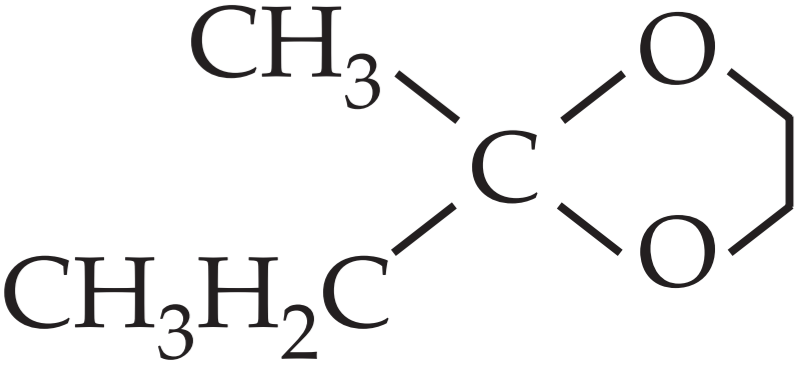
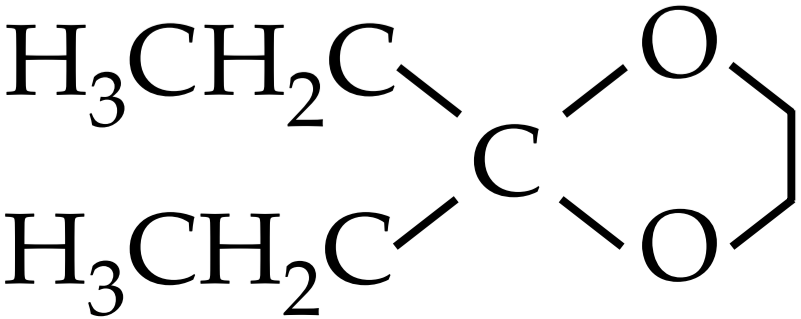
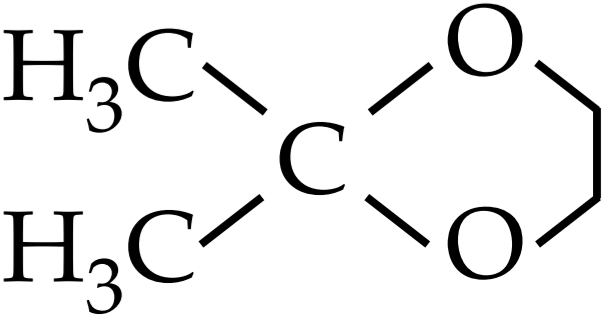
  1. What will be the product when (B) reacts with ethylene glycol in presence of HCl gas?
  1.  

  1.  

  1.  

  1. None of these.
Standard electrode potentials are used for various processes:

  • It is used to measure relative strengths of various oxidants and reductants.
  • It is used to calculate standard cell potential.
  • It is used to predict possible reactions.
A set of half-reactions (in acidic medium) along with their standard reduction potential, Eº (in volt) values are given below:

I2 + 2e- → 2I- ; Eº = 0.54 V

Cl2 + 2e- → 2Cl- ; Eº = 1.36 V

Mn3+ +e- → Mn2+ ; Eº = 1.50 V

Fe3+ + e- → Fe2+ ; Eº = 0.77 V

O2 + 4H+ + 4e- → 2H2O ; Eº = 1.23 V

The following questions are multiple choice questions. Choose the most appropriate answer:

  1. Which of the following statements is correct?
  1. Cl- is oxidised by O2.
  2. Fe2+ is oxidised by iodine.
  3. I- is oxidised by chlorine.
  4. Mn2+ is oxidised by chlorine.
  1. Mn3+ is not stable in acidic medium, while Fe3+ is stable because:
  1. O2 oxidises Mn2+ to Mn3+
  2. O2 oxidises both Mn2+ to Mn3+ and Fe2+ to Fe3+
  3. Fe3+ oxidises H2O to O2
  4. Mn3+ oxidises H2O to O2
  1. The strongest reducing agent in the aqueous solution is:
  1. I-
  2. Cl-
  3. Mn2+
  4. Fe2+
  1. The emf for the following reaction is:

$\text{I}_2+\text{KCl}\rightleftharpoons2\text{KI}+\text{Cl}_2$

  1. -0.82 V
  2. +0.82 V
  3. -0.73 V
  4. +0.73 V
  1. Which of the following statements is correct for the following reaction?

Fe3+ + Mn2+ → Fe2+ + Mn3+

  1. The emf of the cell is positive.
  2. Fe3+ oxidises Mn2+.
  3. The reaction does not occur.
  4. All are correct.
Read the passage given below and answer the following questions:
An organic compound (A) having molecular formula C6H6O gives a characteristic colour with aqueous FeCl3 solution. (A) on treatment with CO2 and NaOH at 400K under pressure gives (B), which on acidification gives a compound (C). The compound (C) reacts with acetyl chloride to give (D) which is a popular pain killer.
The following questions are multiple choice questions. Choose the most appropriate answer:
  1. Compound (A) is:
  1. 2-Hexanol.
  2. Dimethyl ether.
  3. Phenol.
  4. 2-Methyl pentanol.
  1. Compound (C) is:
  1. Salicylic acid.
  2. Salicyladehyde.
  3. Benzoic acid.
  4. Benzaldehyde.
  1. Number of carbon atoms in compound (D) is:
  1. 7
  2. 6
  3. 8
  4. 9
  1. The conversion of compound (A) to (C) is known as:
  1. Reimer-Tiemann reaction.
  2. Kolbe's reaction.
  3. Schimdt reaction.
  4. Swarts reaction.
  1. Compound (A) on heating with compound (C) in presence of POCl3 gives a compound (D) which is used:
  1. In perfumery as a ftavouring agent
  2. As an antipyretic
  3. As an analgesic
  4. As an intestinal antiseptic.
What is fructose? Explain the structure of fructose.