Question
✓
Answer
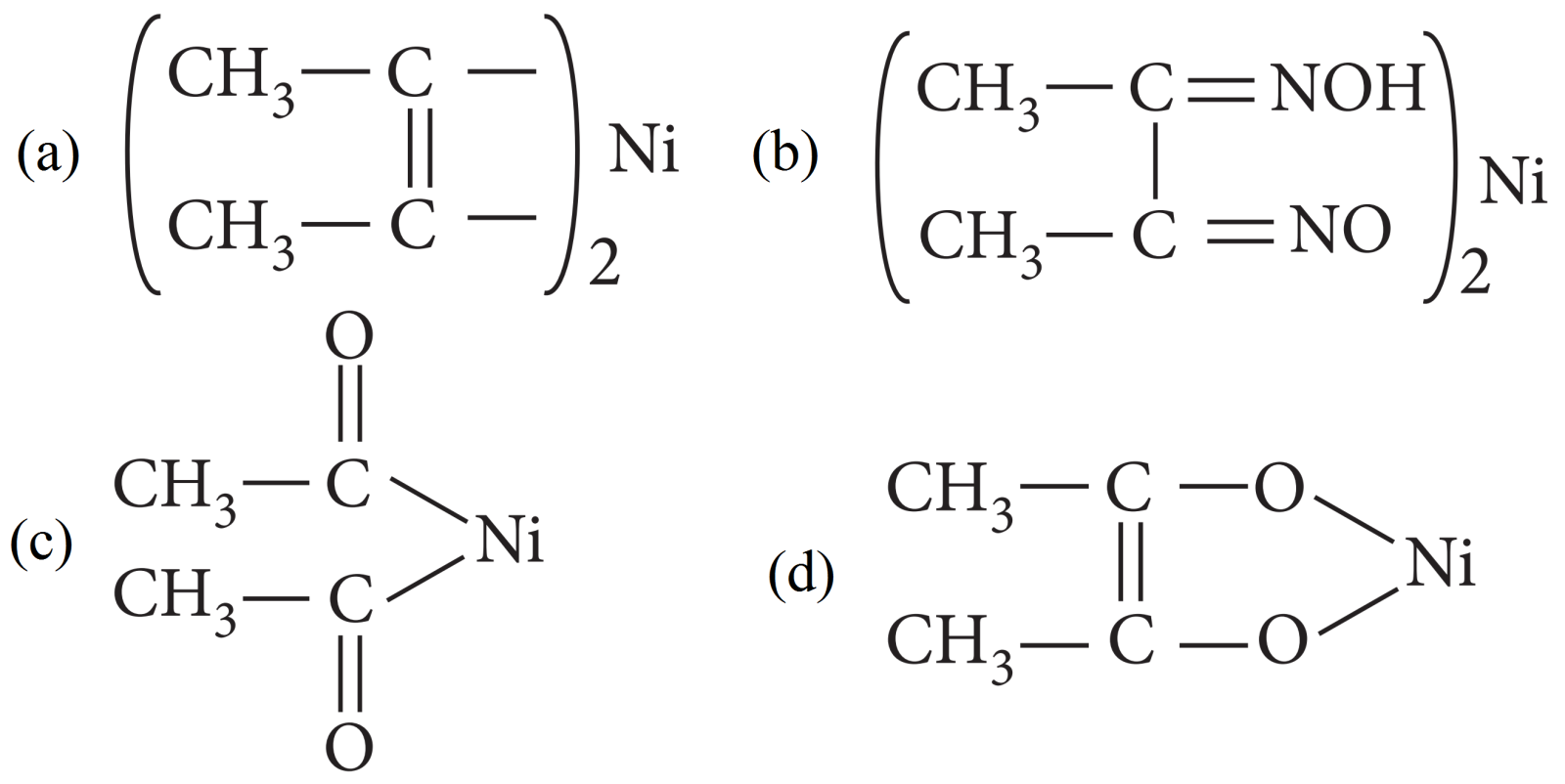
- (b)
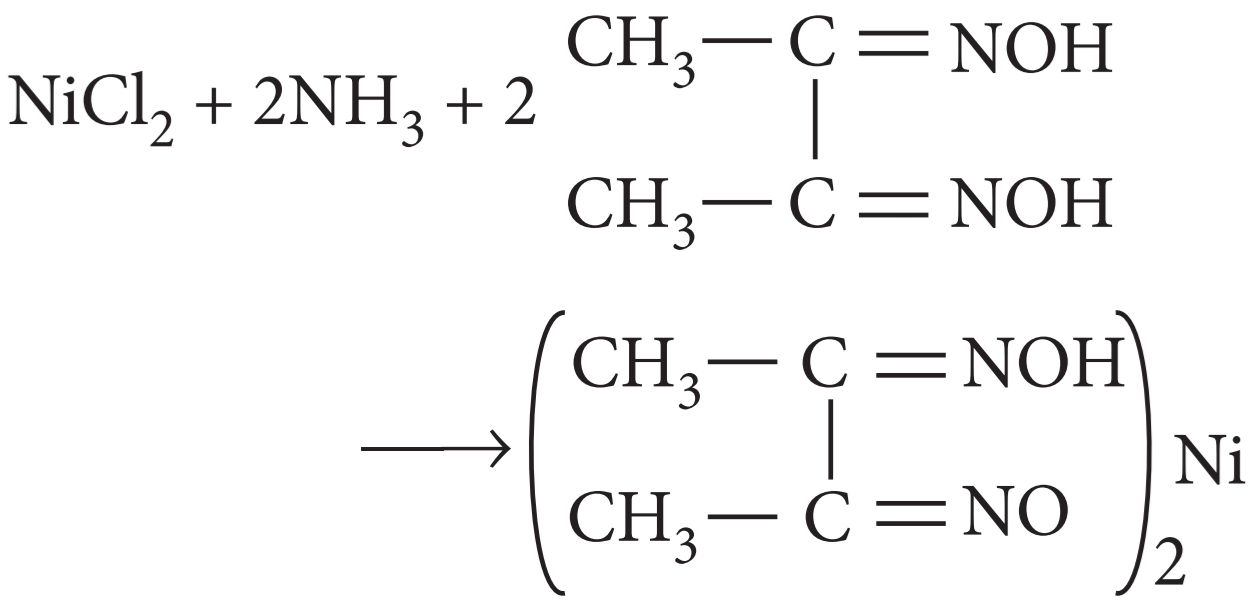
- (c) +2
- (b) dsp2, square planar.
- (d) It is diamagnetic with no unpaired electron.
- (d) Fe2(S04)3
Explanation:
(a) and (b) are coordination compounds hence cannot give free Fe2+ or Fe3+ ions in solution. (c) and (d) represent simple compounds hence are free to give ions in solution, but only Fe2(SO4)3 contains Fe3+ ions. (NH4)2SO4. FeSO4· 6H2O contains Fe2+ ions not Fe3+ ions.
Need a full question paper?
Generate a complete, print-ready paper with questions like this in minutes — across 16+ boards, with answer keys.
Explore more
Similar questions
Read the passage given below and answer the following questions: Transition metal oxides are compounds fanned by the reaction of metals with oxygen at high temperature. The highest oxidation number in the oxides coincides with the group number. In vanadium, there is a gradual change from the basic V2O3 to less basic V2O4 and to amphoteric V2O5· V2O4 dissolves in acids to give VO2+ salts. Transition metal oxides are commonly utilized for their catalytic activity and semi conductive properties. Transition metal oxides are also frequently used as pigments in paints and plastic. Most notably titatnium dioxide. One of the earliest application of transition metal oxides to chemical industry involved the use of vanadium oxide for catalytic oxidation of sulfur dioxide to sulphuric acid. Since then, many other applications have emerged, which include benzene oxidation to maleic anhydride on vandium oxides; cyclohexane oxidation to adipic acid on cobalt oxides. An important property of the catalyst material used in these processes is the ability of transition metals to change their oxidation state under a given chemical potential of reductants and oxidants. The following questions are multiple choice questions. Choose the most appropriate answer:
→- Which oxide of vanadium is most likely to be basic and ionic?
- VO
- V2O3
- VO2
- V2O5
- Vanadyl ion is:
- $\text{VO}^{2+}$
- $\text{VO}^{+}_2$
- $\text{V}_{2}\text{O}^+$
- $\text{VO}^{3-}_4$
- Which of the following statements is false?
- With fluorine vanadium can form VF5.
- With chlorine vanadium can form VCl5.
- Vanadium exhibits highest oxidation state in oxohalides VOCl3, VOBr3 and fluoride VF5.
- With iodine vanadium cannot form Vl5 due to oxidising power of V5+ and reducing nature of I-.
- The oxidation state of vanadium in V2O5 is:
- $\frac{+5}{2}$
- +7
- +5
- +6
- Identify the oxidising agent in the following reaction.
V2O5 + 5Ca → 2V + 5CaO
- V2O5
- Ca
- V
- None of these.
Read the passage given below and answer the following questions:
To explain bonding in coordination compounds various theories were proposed. One of the important theory was valence bond theory. According to that, the central metal ion in the complex makes available a number of empty orbitals for the formation of coordination bonds with suitable ligands. The appropriate atomic orbitals of the metal hybridise to give a set of equivalent orbitals of definite geometry.
The d-orbitals involved in the hybridisation may be either inner d-orbitals i.e., (n - 1)d or outer d-orbitals i.e., nd. For example, Co3+ forms both inner orbital and outer orbital complexes, with ammonia it forms [Co(NH3)6]3+ and with fluorine it forms [CoF6]3- complex ion.
The following questions are multiple choice questions. Choose the most appropriate answer:
→To explain bonding in coordination compounds various theories were proposed. One of the important theory was valence bond theory. According to that, the central metal ion in the complex makes available a number of empty orbitals for the formation of coordination bonds with suitable ligands. The appropriate atomic orbitals of the metal hybridise to give a set of equivalent orbitals of definite geometry.
The d-orbitals involved in the hybridisation may be either inner d-orbitals i.e., (n - 1)d or outer d-orbitals i.e., nd. For example, Co3+ forms both inner orbital and outer orbital complexes, with ammonia it forms [Co(NH3)6]3+ and with fluorine it forms [CoF6]3- complex ion.
The following questions are multiple choice questions. Choose the most appropriate answer:
- Which of the following is not true for [CoF6]3-?
- It is paramagnetic.
- It has coordination number of 6.
- It is outer orbital complex.
- It involves d2sp3 hybridisation.
- [Cr(H2O)6]Cl3 (at. no. of Cr = 24) has a magnetic moment of 3.83B.M. The correct distribution of 3d-electrons in the central metal of the complex is:
- $3\text{d}^1_\text{xy},3\text{d}^1_{\text{x}^2-\text{y}^2},3\text{d}^1_\text{yz}$
- $3\text{d}^1_\text{xy},3\text{d}^1_{\text{yz}},3\text{d}^1_\text{zx}$
- $3\text{d}^1_\text{xy},3\text{d}^1_{\text{zy}},3\text{d}^1_{\text{z}^2}$
- $3\text{d}^1_{\text{x}^2-\text{y}^2},3\text{d}^1_{\text{z}^2},3\text{d}^1_\text{xz}$
- Which of the following is true for [Co(NH3)6]3+?
- It is an octahedral, di magnetic and outer orbital complex.
- It is an octahedral, paramagnetic and outer orbital complex.
- It is an octahedral, paramagnetic and inner orbital complex.
- It is an octahedral, di magnetic and inner orbital complex.
- The paramagnetism of [CoF6]3- is due to.
- 3 electrons.
- 4 electrons.
- 2 electrons.
- 1 electron.
- Which of the following is an inner orbital or low spin complex?
- [Ni(H2O)6]3+
- [FeF6]3-
- [Co(CN)6]3-
- [NiCl4]2-
Standard electrode potentials are used for various processes:
→- It is used to measure relative strengths of various oxidants and reductants.
- It is used to calculate standard cell potential.
- It is used to predict possible reactions.
I2 + 2e- → 2I- ; Eº = 0.54 V
Cl2 + 2e- → 2Cl- ; Eº = 1.36 V
Mn3+ +e- → Mn2+ ; Eº = 1.50 V
Fe3+ + e- → Fe2+ ; Eº = 0.77 V
O2 + 4H+ + 4e- → 2H2O ; Eº = 1.23 V
The following questions are multiple choice questions. Choose the most appropriate answer:- Which of the following statements is correct?
- Cl- is oxidised by O2.
- Fe2+ is oxidised by iodine.
- I- is oxidised by chlorine.
- Mn2+ is oxidised by chlorine.
- Mn3+ is not stable in acidic medium, while Fe3+ is stable because:
- O2 oxidises Mn2+ to Mn3+
- O2 oxidises both Mn2+ to Mn3+ and Fe2+ to Fe3+
- Fe3+ oxidises H2O to O2
- Mn3+ oxidises H2O to O2
- The strongest reducing agent in the aqueous solution is:
- I-
- Cl-
- Mn2+
- Fe2+
- The emf for the following reaction is:
$\text{I}_2+\text{KCl}\rightleftharpoons2\text{KI}+\text{Cl}_2$
- -0.82 V
- +0.82 V
- -0.73 V
- +0.73 V
- Which of the following statements is correct for the following reaction?
Fe3+ + Mn2+ → Fe2+ + Mn3+
- The emf of the cell is positive.
- Fe3+ oxidises Mn2+.
- The reaction does not occur.
- All are correct.
The progress of the reaction, $\text{A}\rightleftharpoons\text{nB}$ with time is represented in the following figure:
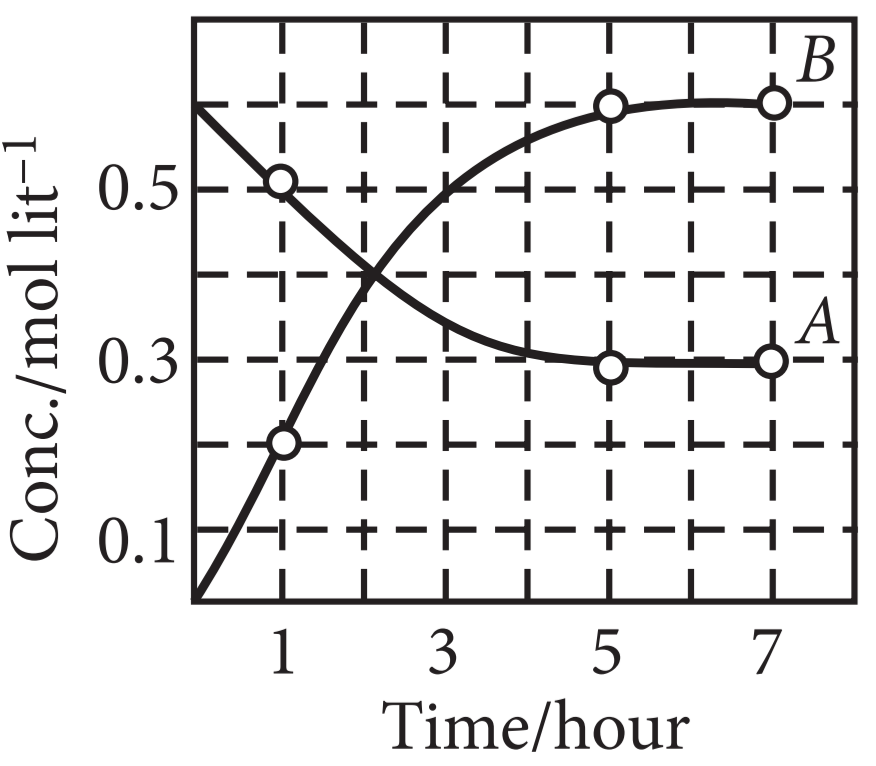
The following questions are multiple choice questions. Choose the most appropriate answer:
→The following questions are multiple choice questions. Choose the most appropriate answer:
- What is the value of n?
- 1
- 2
- 3
- 4
- Find the value of the equilibrium constant.
- 0.6M
- 1.2M
- 0.3M
- 2.4M
- The initial rate of conversion of A will be:
- 0.1 mol L-1hr-1
- 0.2 mol L-1hr-1
- 0.4 mol L-1hr-1
- 0.8 mol L-1hr-1
- For the reaction, if $\frac{\text{d}[\text{B}]}{\text{dt}}=2\times10^{-4},$ value of $-\frac{\text{d}[\text{A}]}{\text{dt}}$ will be:
- 2 × 10⁻⁴
- 10-4
- 4 × 10⁻⁴
- 0.5 × 10⁻⁴
- Which factor has no effect on rate of reaction?
- Temperature.
- Nature of reactant.
- Concentration of reactant.
- Molecularity.
Read the passage given below and answer the following questions: Boiling point or freezing point of liquid solution would be affected by the dissolved solids in the liquid phase. A soluble solid in solution has the effect of raising its boiling point and depressing its freezing point. The addition of non-volatile substances to a solvent decreases the vapor pressure and the added solute particles affect the formation of pure solvent crystals. According to many researches the decrease in freezing point directly correlated to the concentration of solutes dissolved in the solvent. This phenomenon is expressed as freezing point depression and it is useful for several applications such as freeze concentration of liquid food and to find the molar mass of an unknown solute in the solution. Freeze concentration is a high quality liquid food concentration method where water is removed by forming ice crystals. This is done by cooling the liquid food below the freezing point of the solution. The freezing point depression is referred as a colligative property and it is proportional to the molar concentration of the solution (m), along with vapor pressure lowering, boiling point elevation, and osmotic pressure. These are physical characteristics of solutions that depend only on the identity of the solvent and the concentration of the solute. The characters are not depending on the solute’s identity.
- When a non volatile solid is added to pure water it will:
- boil above 100°C and freeze above 0°C
- boil below 100°C and freeze above 0°C
- boil above 100°C and freeze below 0°C
- boil below 100°C and freeze below 0°C
- Colligative properties are:
- dependent only on the concentration of the solute and independent of the solvent’s and solute’s identity.
- dependent only on the identity of the solute and the concentration of the solute and independent of the solvent's identity.
- dependent on the identity of the solvent and solute and thus on the concentration of the solute.
- dependent only on the identity of the solvent and the concentration of the solute and independent of the solute’s identity.
- Assume three samples of juices A, B and C have glucose as the only sugar present in them. The concentration of sample A, B and C are 0.1M, 5M and 0.2 M respectively. Freezing point will be highest for the fruit juice:
- A
- B
- C
- All have same freezing point
- Identify which of the following is a colligative property:
- freezing point
- boiling point
- osmotic pressure
- all of the above
The potential of each electrode is known as electrode potential. Standard electrode potential is the potential when concentration of each species taking part in electrode reaction is unity and the reaction is taking place at 298K. By convention, the standard electrode potential of hydrogen (SHE) is 0.0V. The electrode potential value for each electrode process is a measure of relative tendency of the active species in the process to remain in the oxidised/ reduced form. The negative electrode potential means that the redox couple is stronger reducing agent than $\frac{\text{H}^+}{\text{H}_2}$ couple. A positive electrode potential means that the redox couple is a weaker reducing agent than the $\frac{\text{H}^+}{\text{H}_2}$ couple. Metals which have higher positive value of standard reduction potential form the oxides of greater thermal stability. In these questions (Q. No. i-iv), a statement of assertion followed by a statement ofreason is given. Choose the correct answer out of the following choices.
→- Assertion and reason both are correct statements and reason is correct explanation for assertion.
- Assertion and reason both are correct statements but reason is not correct explanation for assertion.
- Assertion is correct statement but reason is wrong statement.
- Assertion is wrong statement but reason is correct statement.
- Assertion: An electrochemical cell can be set-up only if the redox reaction is spontaneous.
Reason: A reaction is spontaneous if the free energy change is negative.
- Assertion: The standard electrode potential of hydrogen is 0.0V.
Reason: It is by convention.
- Assertion: The more negative is the standard reduction potential, greater is its ability to displace H2 from acid.
Reason: Strength of reducing agent increases with the increase in negative value of the standard reduction potential.
- Assertion: The negative value of standard reduction potential means that reduction takes place on this electrode with reference to hydrogen electrode.
Reason: The standard electrode potential of a half cell has a fixed value.
- Assertion: The absolute value of electrode potential cannot be determined experimentally.
Reason: The electrode potential values are generally determined with respect to SHE.
Read the passage given below and answer the following questions :
When an aldehyde with no a-hydrogen reacts with concentrated aqueous NaOH, half the aldehyde is converted to carboxylic acid salt and other half is converted to an alcohol. In other words, half of the reactant is oxidized
and other half is reduced. This reaction is known as Cannizzaro reaction
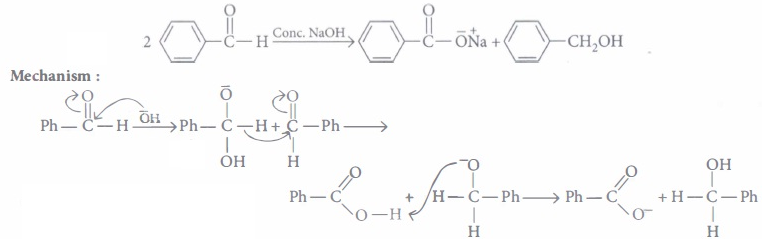
The following questions are multiple choice questions. Choose the most appropriate answer:
When an aldehyde with no a-hydrogen reacts with concentrated aqueous NaOH, half the aldehyde is converted to carboxylic acid salt and other half is converted to an alcohol. In other words, half of the reactant is oxidized
and other half is reduced. This reaction is known as Cannizzaro reaction
The following questions are multiple choice questions. Choose the most appropriate answer:
- A mixture of benzaldehyde and formaldehyde on heating with aqueous NaOH solution gives:
- Benzyl alcohol and sodium formate.
- Sodium benzoate and methyl alcohol.
- Sodium benzoate and sodium formate.
- Benzyl alcohol and methyl alcohol.
- Which of the following compounds will undergo Cannizzaro reaction?
- CH3CHO
- CH3COCH3
- C6H5CHO
- C6H5CH2CHO
- Trichloroacetaldehyde is subjected to Cannizzaro's reaction by using NaOH. The mixture of the products contains sodium trichloroacetate ion and another compound. The other compounds is:
- 2, 2, 2-trichloroethanol
- Trichloromethanol
- 2, 2, 2-trichloropropanol
- Chloroform
- Which of the following reaction will not result in the formation of carbon-carbon bonds?
- Cannizzaro reaction
- Wurtz reaction
- Reimer- Tiemann reaction
- Friedel - Crafts acylation
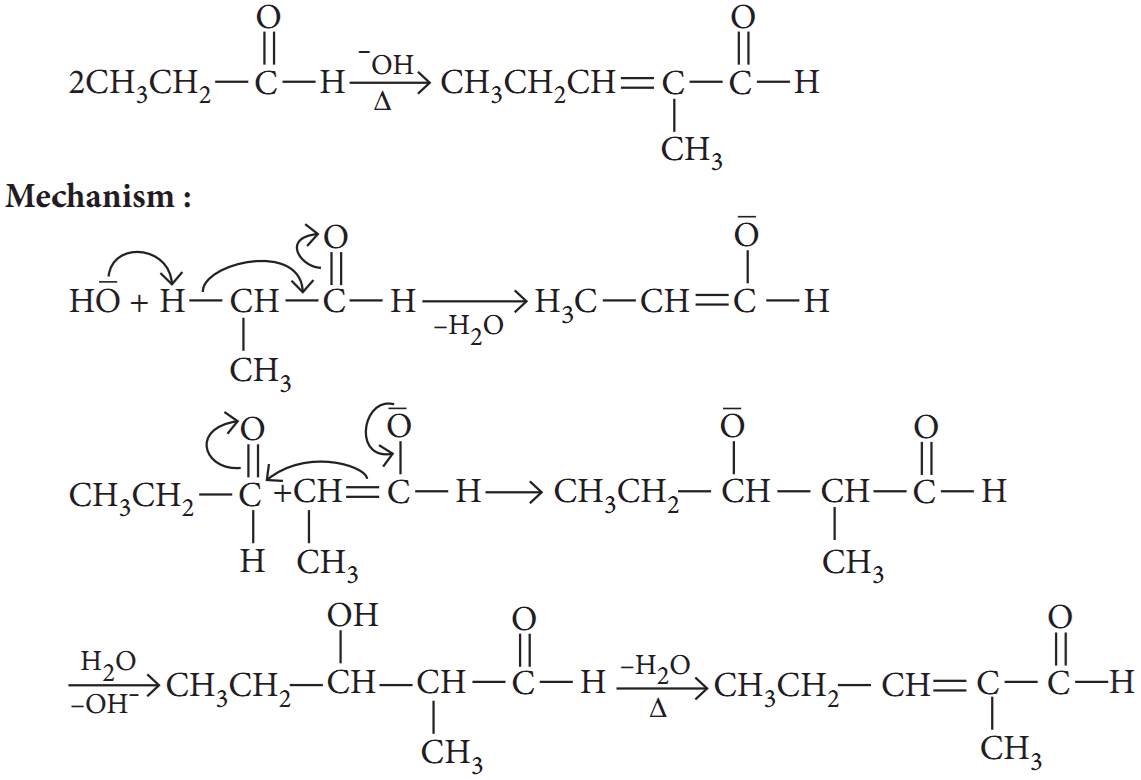
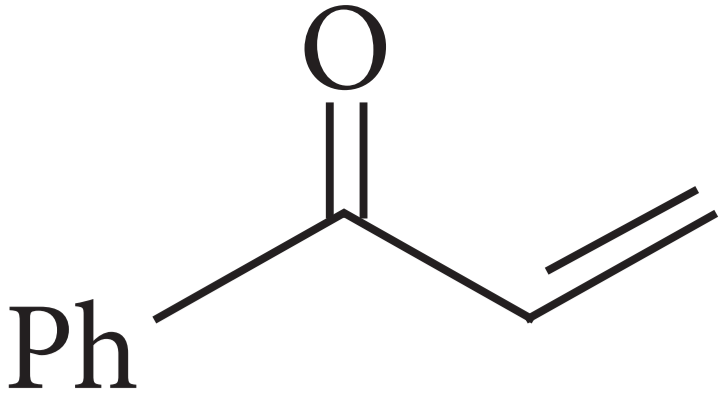
Read the passage given below and answer the following questions:
The concentration of a solute is very important in studying chemical reactions because it determines how often molecules collide in solution and thus indirectly determine the rate of reactions and the conditions at equilibrium. There are several ways to express the amount of solute present in a solution. The concentration of a solution is a measure of the amount of solute that has been dissolved in a given amount of solvent or solution. Concentration can be expressed in terms of molarity, molality, parts per million, mass percentage, volume percentage, etc.
The following questions are multiple choice questions. Choose the most appropriate answer:
→The concentration of a solute is very important in studying chemical reactions because it determines how often molecules collide in solution and thus indirectly determine the rate of reactions and the conditions at equilibrium. There are several ways to express the amount of solute present in a solution. The concentration of a solution is a measure of the amount of solute that has been dissolved in a given amount of solvent or solution. Concentration can be expressed in terms of molarity, molality, parts per million, mass percentage, volume percentage, etc.
The following questions are multiple choice questions. Choose the most appropriate answer:
- A solution is prepared using aqueous Kl which is turned out to be 20% w/w Density of Kl is 1.202 g/mL the molality of the given solution and mole fraction of solute are respectively.
- 1.95m, 0.120
- 1.5m, 0.0263
- 2.5m, 0.0569
- 3.0m, 0.0352
- The molarity (in mol L-1) of the given solution will be.
- 1.56
- 1.89
- 0.263
- 1.44
- Which of the following is correct relationship between mole fraction and molality?
- $\text{x}_2=\frac{\text{mM}_1}{1+\text{mM}_1}$
- $\text{x}_2=\frac{\text{mM}_1}{1-\text{mM}_1}$
- $\text{x}_2=\frac{1+\text{mM}_1}{\text{mM}_1}$
- $\text{x}_2=\frac{1-\text{mM}_1}{\text{mM}_1}$
- Which of the following is temperature dependent?
- Molarity
- Molality
- Mole fraction
- Mass percentage
- Which of the following is true for an aqueous solution of the solute in terms of concentration?
- 1M = 1m
- 1M > 1m
- 1M < 1m
- Cannot be predicted
Read the passage given below and answer the following questions: Lucas test is a test to differentiate between primary, secondary and tertiary alcohols. This test consists of treating an alcohol with Lucas' reagent, and turbidity, due to the formation of insoluble alkyl chloride, is observed. Lucas test is based on the difference in reacting of three classes of alcohols with hydrogen chloride via SN1 reaction. The different reactivity reflects the differing ease of formation of the corresponding carbocations. In these questions (Q. No. i-iv), a statement of assertion followed by a statement ofreason is given. Choose the correct answer out of the following choices.
- Assertion and reason both are correct statements and reason is correct explanation for assertion.
- Assertion and reason both are correct statements but reason is not correct explanation for assertion.
- Assertion is correct statement but reason is wrong statement.
- Assertion is wrong statement but reason is correct statement.
- Assertion: Equimolar mixture of cone. HCI and anhydrous ZnCl2 is called Lucas' reagent.
Reason: Lucas' reagent can be used to distinguish between methanol and ethanol.
- Assertion: 2-Methyl-2-butanol gives no turbidity with Lucas' reagent at room temperature.
Reason: It is a 3º alcohol.
- Assertion: Tertiary alcohols react fastest with Lucas' reagent by SN1 mechanism.
Reason: 3º carbocation is most stable.
- Assertion: Amongst the compounds, H2C = CHCH2OH (I), C6H5OH (II), CH3CH2CH2OH (III) and (CH3)3COH (IV), only (IV) reacts with Lucas' reagent at room temperature.
Reason: Tertiary alcohol gives turbidity immediately with Lucas' reagent.
- Assertion: Lucas test can be used to distinguish between 1-propanol and 2-propanol.
Reason: Lucas test is based upon the difference in reactivity of primary, secondary and tertiary alcohols with cone. HCI and anhyd. ZnCl2.