Question
Read the passage given below and answer the following questions: Boiling point or freezing point of liquid solution would be affected by the dissolved solids in the liquid phase. A soluble solid in solution has the effect of raising its boiling point and depressing its freezing point. The addition of non-volatile substances to a solvent decreases the vapor pressure and the added solute particles affect the formation of pure solvent crystals. According to many researches the decrease in freezing point directly correlated to the concentration of solutes dissolved in the solvent. This phenomenon is expressed as freezing point depression and it is useful for several applications such as freeze concentration of liquid food and to find the molar mass of an unknown solute in the solution. Freeze concentration is a high quality liquid food concentration method where water is removed by forming ice crystals. This is done by cooling the liquid food below the freezing point of the solution. The freezing point depression is referred as a colligative property and it is proportional to the molar concentration of the solution (m), along with vapor pressure lowering, boiling point elevation, and osmotic pressure. These are physical characteristics of solutions that depend only on the identity of the solvent and the concentration of the solute. The characters are not depending on the solute’s identity.
  1. When a non volatile solid is added to pure water it will:
  1. boil above 100°C and freeze above 0°C
  2. boil below 100°C and freeze above 0°C
  3. boil above 100°C and freeze below 0°C
  4. boil below 100°C and freeze below 0°C
  1. Colligative properties are:
  1. dependent only on the concentration of the solute and independent of the solvent’s and solute’s identity.
  2. dependent only on the identity of the solute and the concentration of the solute and independent of the solvent's identity.
  3. dependent on the identity of the solvent and solute and thus on the concentration of the solute.
  4. dependent only on the identity of the solvent and the concentration of the solute and independent of the solute’s identity.
  1. Assume three samples of juices A, B and C have glucose as the only sugar present in them. The concentration of sample A, B and C are 0.1M, 5M and 0.2 M respectively. Freezing point will be highest for the fruit juice:
  1. A
  2. B
  3. C
  4. All have same freezing point
  1. Identify which of the following is a colligative property:
  1. freezing point
  2. boiling point
  3. osmotic pressure
  4. all of the above

Answer

  1. (b) boil below 100°C and freeze above 0°C
  2. (d) dependent only on the identity of the solvent and the concentration of the solute and independent of the solute’s identity.
  3. (a) A
  4. (c) osmotic pressure

Need a full question paper?

Generate a complete, print-ready paper with questions like this in minutes — across 16+ boards, with answer keys.

Start Generating Free

Similar questions

Read the passage given below and answer the following questions:

Amines are basic in nature. The basic strength of amines can be expressed by their dissociation constant, Kb or pKb.

$\text{RNH}_2+\text{H}_2\text{O}\rightleftharpoons\text{RNH}^+_3+\text{OH}^-$

$\text{k}_\text{b}=\frac{[\text{RNH}^+_3][\text{OH}^-]}{[\text{RNH}_2]}\text{and}\text{ pk}_\text{b}=-\log\text{k}_\text{b}$

Greater the Kb value or smaller the pKb value, more is the basic strength of a mine. Aryl amines such as aniline are less basic than aliphatic amines due to the involvement of lone pair of electrons on N-atom with the resonance in benzene. In derivatives of aniline, the electron releasing groups increase the basic strength while electron withdrawing groups decrease the basic strength. The base weakening effect of electron withdrawing group and base strengthening effect of electron releasing group is more marked at p-position than at m-position. a-Substituted aniline is less basic than aniline due to ortho effect and is probable due to combination of electronic and steric effect.

The following questions are multiple choice questions. Choose the most appropriate answer:

  1. Which of the following has lowest pKb value?

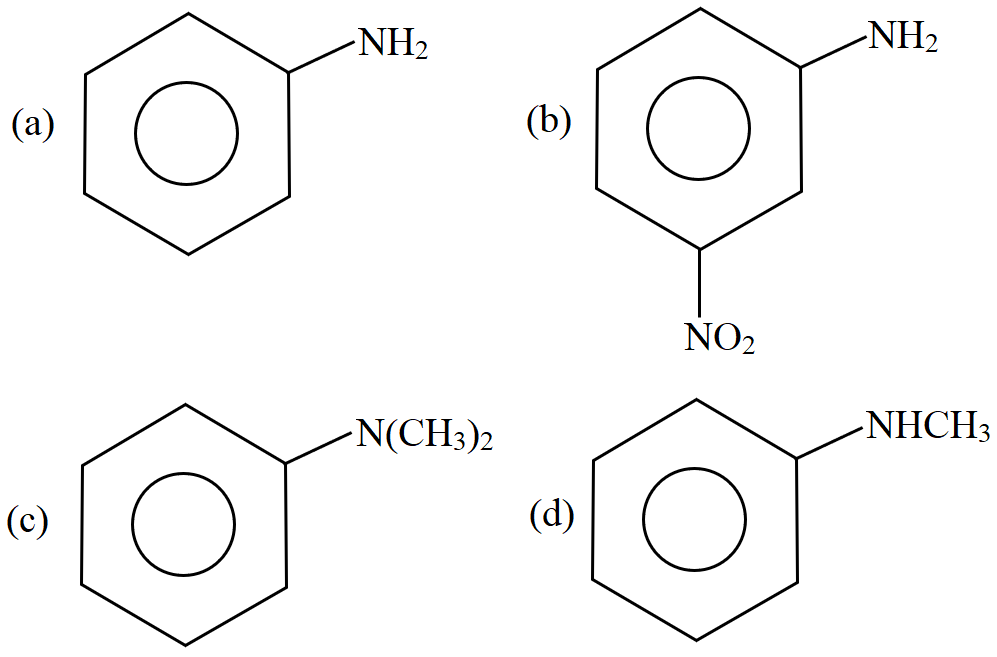
  1. The strongest base among the following is:
  1. C6H5NH2

  2. p-NO2 - C6H4NH2

  3. m-NO2 - C6H4NH2

  4. C6H5CH2NH2

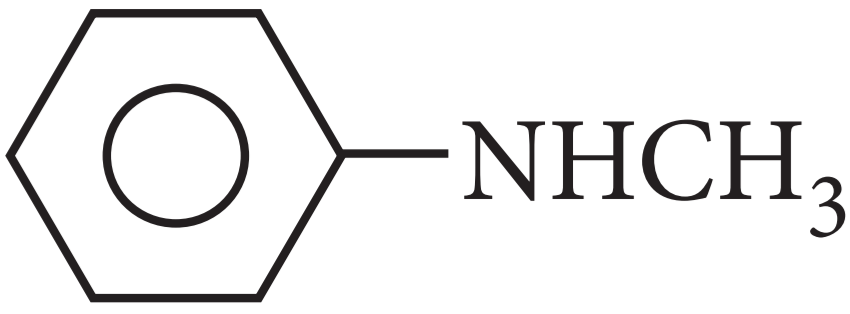
  1. Maximum pKb value of:
  1.  

  1.  

  1. (CH3CH2)2NH

  2. (CH3)2NH

  1.  The order of basic strength among the following amines in benzene solution is:
  1. Methylamine is more basic than NH3.
  2. Amines form hydrogen bonds.
  3. Ethylamine has higher boiling point than propane.
  4. Dimethylamine is less basic than methylamine.
  1. CH3CH2NH2 contains a basic -NH2 group, but CH3CONH2 does not because:
  1. Acetamide is amphoteric in character.
  2. In ethylamine the electron pair on N-atom is delocalised by resonance.
  3. In ethylamine there is no resonance while in acetamide the lone pair of electrons on N-atom is delocalised and is less available for protonation.
  4. None of these.
Read the passage given below and answer the following questions:

Glucose is known as dextrose because it occurs in nature as the optically active dextrorotatory isomer. lt is essential constituent of human blood. The blood normally contains 65 to 110mg of glucose per 100mL (hence named Blood sugar). The level may be much higher in diabetic persons. The urine of diabetic persons also contain considerable amount of glucose. ln combined form, it occurs in cane sugar and polysaccharides such as starch and cellulose.

Glucose has an aldehyde group (-CHO), one primary alcoholic group (-CH2OH) and four secondary alcoholic groups (-CHOH) in their structure. Due to the presence five hydroxyl groups (-OH). glucose undergoes acetylation. Glucose also undergoes oxidation with mild oxidising agents like bromine water as well as with strong oxidising agents like nitric acid. Since glucose is readily oxidised, it acts as a strong reducing agent and reduces Tollen's reagent and Fehling solution. Glucose exists in two crystalline forms: $\alpha$-D-glucose and $\beta$-D-glucose. If either of the two forms is dissolved in water and allowed to stand, the specific rotation of the solution changes gradually, until a constant value is obtained. This change is called mutarotation.

A statement of assertion followed by a statement of reason is given. Choose the correct answer out of the following choices.

  1. Assertion and reason both are correct statements and reason is correct explanation for assertion.
  2. Assertion and reason both are correct statements but reason is not correct explanation for assertion.
  3. Assertion is correct statement but reason is wrong statement.
  4. Assertion is wrong statement but reason is correct statement.
  1. Assertion: A diabetic person carries a packet of glucose with him always.

Reason: Glucose increases the blood sugar level almost instantaneously.

  1. Assertion: On oxidation with nitric acid, glucose as well as gluconic acid both yield saccharic acid.

Reason: The pentaacetate of glucose does not react with hydroxylamine indicating the absence of free -CHO group.

  1. Assertion: Glucose reacts with acetyl chloride to form pentaacetyl glucose.

Reason: The formation of pentaacetyl derivative confirms the presence of five -OH groups in glucose.

  1. Assertion: A certain compound gives negative test with ninhydrin and positive test with Benedict's solution, the compound is an amino acid.

Reason: Glucose is a monosaccharide.

  1. Assertion: The rapid interconversion of $\alpha$-D-glucose and $\beta$-D-glucose in solution is known as racemisation.

Reason: Hydrolysis reaction will take place when a mineral acid is treated with sugar.

Read the passage given below and answer the following questions:

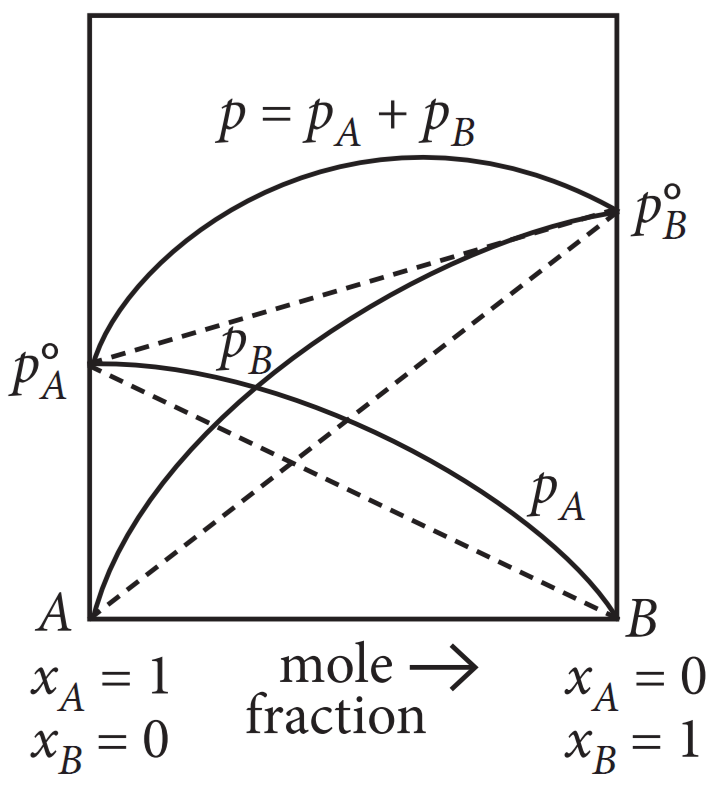
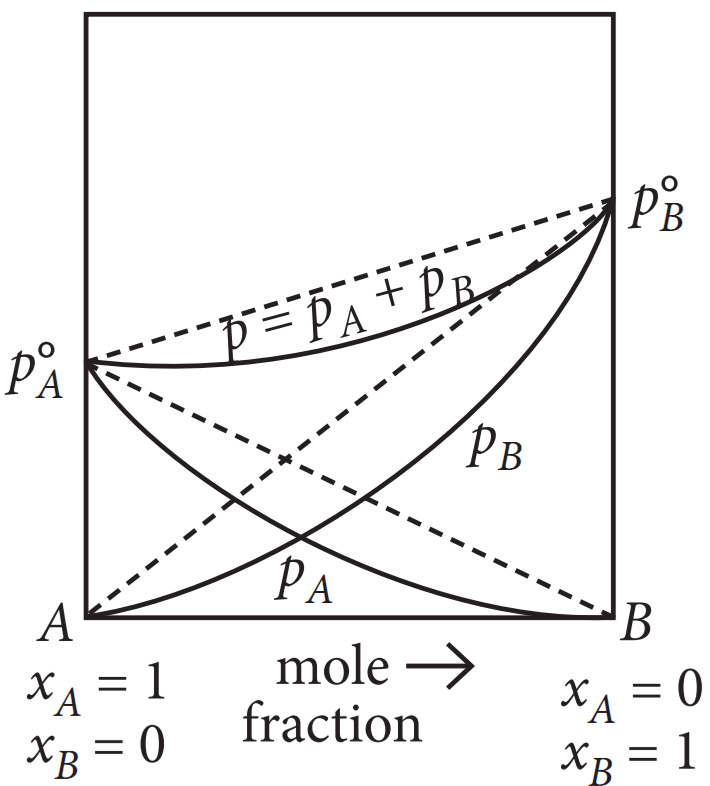
An ideal solution may be defined as the solution which obeys Raoult's law exactly over the entire range of concentration. The solutions for which vapour pressure is either higher or lower than that predicted by Raoult's law are called non-ideal solutions.Non-ideal solutions can show either positive or negative deviations from Raoult's law depending on whether the A-B interactions in solution are stronger or weaker than A - A and B - B interactions.

The following questions are multiple choice questions. Choose the most appropriate answer:

  1. Which of the following solutions is/are ideal solution(s)?
  1. Bromoethane and iodoethane.
  2. Acetone and chloroform
  3. Benzene and acetone
  4. n-heptane and n-hexane
  1. Only I
  2. I and II
  3. II and III
  4. I and Iv
  1. For which of the following solutions $\Delta\text{H}_{\text{mix}}$ and $\Delta\text{V}_{\text{mix}}$ is negative?
  1. Acetone and aniline
  2. Ethyl alcohol and cyclohexane
  3. Acetone and CS2
  4. Benzene and toluene
  1. Which of the following is not true for positive deviations?
  1. The A-B interactions in solution are weaker than the A - A and B - B interactions.
  2. $\text{P}_\text{A}<\text{P}\mathring{\text{A}}\ \text{x}_\text{A}$ and $\text{P}_\text{B}<\text{P}\mathring{\text{B}}\ \text{x}_\text{B}$
  3. Carbon tetrachloride and chloroform mixture is an example of positive deviations.
  4. All of these.
  1. For water and nitric acid mixture, which of the given graph is correct?


  1.  


  1.  

  1. Both of these
  2. None of these
  1. Water-HCI mixture.
  1. Shows positive deviations.
  2. Forms minimum boiling azeotrope.
  3. Shows negative deviations.
  4. Forms maximum boiling azeotrope.
  1. I and II
  2. I and III
  3. I and IV
  4. III and IV

Read the passage given below and answer the following questions:

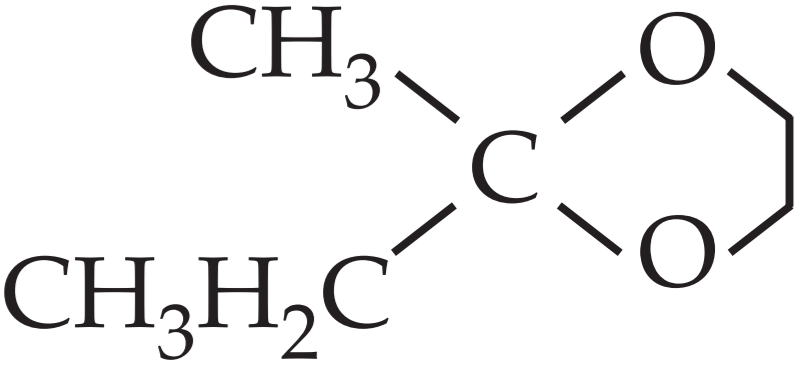
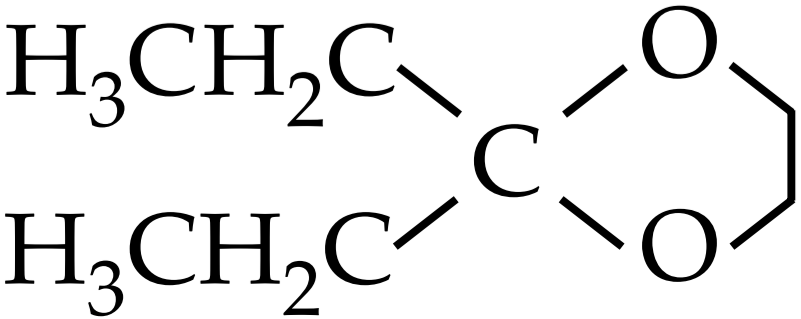
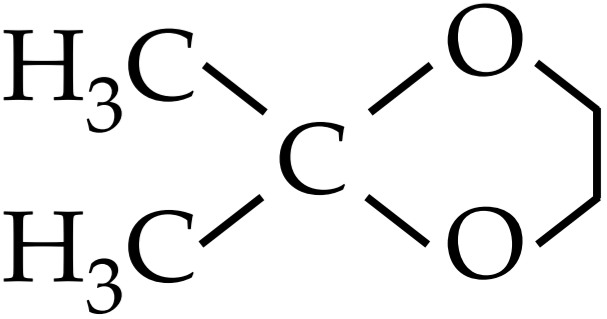
(A), (B) and (C) are three non-cyclic functional isomers of a carbonyl compound with molecular formula C4H8O. Isomers (A) and (C) give positive Tollen's test whereas isomer (B) does not give Tollen's test but gives positive iodoform test. Isomers (A) and (B) on reduction with $\frac{\text{Zn(Hg)}}{\text{conc.}}.$ HCl give the same product (D).

The following questions are multiple choice questions. Choose the most appropriate answer:

  1. Compound A is:
  1. $\text{CH}_3-\text{CH}-\text{CHO}\\\ \ \ \ \ \ \ \ \ \ \ \ \ |\\ \ \ \ \ \ \ \ \ \ \ \ \ \text{CH}_3$

  2. $\text{CH}_3\text{CH}_2\text{CH}_2\text{CHO}$

  3. $\ \ \ \ \ \ \ \ \ \ \ \ \text{O}\\\ \ \ \ \ \ \ \ \ \ \ \ \ ||\\\text{CH}_3-\text{C}-\text{CH}_2-\text{CH}_3$

  4. None of these.
  1. Compound (C) is:
  1. Iso-butyraldehyde
  2. Butyraldehyde
  3. Crotonaldehyde
  4. Acrolein
  1. Compound (B) can be obtained by:
  1. $\text{CH}_3-\text{C}\equiv\text{C}-\text{CH}_2-\text{CH}_3\xrightarrow[333\text{K}]{\text{dil.H}_2\text{SO}_4+\text{HgSO}_4}$

  2. $(\text{CH}_3\text{CH}_2\text{COO})_2\text{Ca}\xrightarrow{\text{Dry distill}}$

  3. $\text{CH}_3-\text{C}\equiv\text{C}-\text{CH}_3\xrightarrow[\frac{\text{H}_2\text{O}_2}{\text{NaOH}}]{\frac{\text{B}_2\text{H}_6}{\text{THF}}}$

  4. $\text{CH}_3-\text{CH}=\text{CH}-\text{CH}_3\xrightarrow[\frac{\text{ZN}}{\text{H}_2\text{O}}]{\text{O}_3}$

  1. Out of (A), (B) and ( C) isomers, which one is least reactive towards addition of HCN?
  1. A
  2. B
  3. C
  4. All are equally reactive.
  1. What will be the product when (B) reacts with ethylene glycol in presence of HCl gas?
  1.  

  1.  

  1.  

  1. None of these.
Nemst equation relates the reduction potential of an electrochemical reaction to the standard potential and activities of the chemical species undergoing oxidation and reduction.

Let us consider the reaction, $\text{M}^{\text{n+}}_{(\text{aq})}\xrightarrow{\ \ \ \ \ \ \ \ }\text{nM}_\text{(s)}$

For this reaction, the electrode potential measured with respect to standard hydrogen electrode can be given as

$\text{E}_{\Big(\frac{\text{M}^{\text{n+}}}{\text{M}}\Big)}=\text{E}^\circ_{\Big(\frac{\text{M}^\text{n+}}{\text{M}}\Big)}-\frac{\text{RT}}{\text{nF}}\text{ln}\frac{[\text{M}]}{[\text{M}^{\text{n}+}]}$

In these questions (Q. No. i-iv), a statement of assertion followed by a statement ofreason is given. Choose the correct answer out of the following choices.

  1. Assertion and reason both are correct statements and reason is correct explanation for assertion.
  2. Assertion and reason both are correct statements but reason is not correct explanation for assertion.
  3. Assertion is correct statement but reason is wrong statement.
  4. Assertion is wrong statement but reason is correct statement.
  1. Assertion: For concentration cell, $\text{Zn}_{(\text{s})}|\text{ Zn}^{2+}_{\text{(aq)}}||\text{ Zn}^{2+}_{(\text{aq})}|\text{ Zn}\\\ \ \ \ \ \ \ \ \ \ \ \ \text{C}_1\ \ \ \ \ \ \ \ \text{C}_2$

For spontaneous cell reaction, C1 < C2

Reason: For concentration cell, $\text{E}_\text{cell}=\frac{\text{RT}}{\text{nF}}\log\frac{\text{C}_2}{\text{C}_1}$

For spontaneous reaction, $\text{E}_\text{cell}=+\text{ve}\Rightarrow\text{C}_2>\text{C}_1$

  1. Assertion: For the cell reaction, $\text{Zn}_{(\text{s})}+\text{Cu}^{2+}_{(\text{aq})}\xrightarrow{\ \ \ \ \ }\text{Zn}^{2+}_{(\text{aq})}+\text{Cu}_{(\text{s})}$ voltmeter gives zero reading at equilibrium.

Reason: At the equilibrium, there is no change in concentration of Cu2+ and Zn2+ ions.

  1. Assertion: The Nernst equation gives the concentration dependence of emf of the cell.

Reason: In a cell, current flows from cathode to anode.

  1. Assertion: Increase in the concentration of copper half cell in a cell, increases the emfofthe cell.

Reason: $\text{E}_\text{cell}=\text{E}^\circ_\text{cell}+\frac{0.059}{2}\log\frac{[\text{Cu}^{2+}]}{[\text{Zn}^{2+}]}$

  1. Assertion: Electrode potential for the electrode $\frac{\text{Mn}^+}{\text{Mn}}$ with concentration is given by the expression under STP conditions.

$\text{E}=\text{E}^\circ+\frac{0.059}{\text{n}}\log[\text{Mn}^{+}]$

Reason: STP conditions require the temperature to be 273K.

Read the passage given below and answer the following questions:
When haloalkanes with $\beta-$hydrogen atom are boiled with alcoholic solution of KOH, they undergo elimination of hydrogen halide resulting in the formation of alkenes. These reactions are called $\beta-$elimination reactions or dehydrohalogenation reactions. These reactions follow Saytzeff's rule. Substitution and elimination reactions often compete with each other. Mostly bases behave as nucleophiles and therefore can engage in substitution or elimination reactions depending upon the alkyl halide and the reaction conditions.
The following questions are multiple choice questions. Choose the most appropriate answer:
  1. Among the following the most reactive towards alcoholic KOH is:
  1. CH2 = CHBr
  2. CH3COCH2CH2Br
  3. CH3CH2Br
  4. CH3CH2CH2Br
  1. The general reaction, $\text{R}-\text{X}\xrightarrow{\text{aq.OH}^-}\text{ROH}+\text{X}^-,$ is expected to follow decreasing order of reactivity as in:
  1. t-BuI> t-BuBr > t-BuCI > t-BuF
  2. t-BuF > t-BuCI > t-BuBr > t-BuI
  3. t-BuBr > t-BuCI >t-BuI> t-BuF
  4. t-BuF > t-BuCI > t-BuI > t-BuBr
  1. Reaction of t-butyl bromide with sodium methoxide produces:
  1. Sodium t-butoxide.
  2. t-butyl methyl ether.
  3. Iso-butane.
  4. Iso-butylene.
  1. In the elimination reactions, the reactivity of alkyl halides follows the sequence:
  1. R - F > R - CI > R - Br > R - I
  2. R - I > R - Br > R - Cl > R - F
  3. R - I > R - F > R - Br > R - CI
  4. R - F > R - I > R - Br > R - CI
  1. The ease of dehydrohalogenation of alkyl halide with alcoholic KOH is:
  1. 3º < 2º < 1º
  2. 3º > 2º > 1º
  3. 3º < 2º > 1º
  4. 3º > 2º < 1º
Read the passage given below and answer the following questions:

Transition elements are elements that have partially filled d-orbitals. The configuration of these elements corresponds to (n - 1)d1-10ns1-2. It is important to note that the elements mercury, cadmium and zinc are not considered transition elements because of their electronic configurations, which corresponds to (n - 1)d10ns2. Some general properties of transition elements are:

These elements can fonn coloured compounds and ions due to d-d transition;

These elements exhibit many oxidation states;

A large variety of ligands can bind themselves to these elements, due to this, a wide variety of stable complexes formed by these ions. The boiling and melting point of these elements are high. These elements have a large ratio of charge to the radius.

In these questions (Q. No. i-iv), a statement of assertion followed by a statement ofreason is given. Choose the correct answer out of the following choices.

  1. Assertion and reason both are correct statements and reason is correct explanation for assertion.
  2. Assertion and reason both are correct statements but reason is not correct explanation for assertion.
  3. Assertion is correct statement but reason is wrong statement.
  4. Assertion is wrong statement but reason is correct statement.
  1. Assertion: Tungsten has very high melting point.

Reason: Tungsten is a covalent compound.

  1. Assertion: Zn, Cd and Hg are normally not considered transition metals.

Reason: d-Orbitals in Zn, Cd and Hg elements are completely filled, hence these metals do not show the general characteristics properties of the transition elements.

  1. Assertion: Copper metal gets readily corroded in acidic aqueous solution such as HCl and dil. H2SO4.

Reason: Free energy change for this process is positive.

  1. Assertion: Tailing of mercury occurs on passing ozone through it.

Reason: Due to oxidation of mercury.

  1. Assertion: Transition metals are poor reducing agents.

Reason: Transition metals fonn numerous alloys with other metals.

Read the passage given below and answer the following questions:

For understanding the structure and bonding in transition metal complexes, the magnetic properties are very helpful. Low spin complexes are generally diamagnetic because of pairing of electrons, whereas high spin complexes are usually paramagnetic because of presence of unpaired electrons. Larger the number of unpaired electrons, stronger will be the paramagnetism. However magnetic behaviour of a complex can be confirmed from magnetic moment measurement. Magnetic moment $\mu=\sqrt{\text{n(n+2)}}\text{B.M.}$ where n = number of unpaired electrons. Greater the number of unpaired electrons, more will be the magnetic moment.

In these questions (Q. No. i-iv), a statement of assertion followed by a statement ofreason is given. Choose the correct answer out of the following choices.

  1. Assertion and reason both are correct statements and reason is correct explanation for assertion.
  2. Assertion and reason both are correct statements but reason is not correct explanation for assertion.
  3. Assertion is correct statement but reason is wrong statement.
  4. Assertion is wrong statement but reason is correct statement.
The following questions are multiple choice questions. Choose the most appropriate answer:

  1. Assertion: Both [Cr(H2O)6]2+ and [Fe(H2O)6]2+ have same magnetic moment.

Reason: Number of unpaired electrons in Cr2+ and Fe2+ are same.

  1. Assertion: [Fe(H2O)5NO]SO4 is paramagnetic.

Reason: The Fe in [Fe(H2O)5NO]SO4 has three unpaired electrons.

  1. Assertion: [Co(en)3]3+ is paramagnetic.

Reason: It is an inner orbital complex.

  1. Assertion: [Ni(CO)4] is diamagnetic and tetrahedral in shape.

Reason: [Ni(CO)4] contains no unpaired electrons and involves dsp2 hybridisation.

  1. Assertion: [Ni(CN)4]2- is diamagnetic complex.

Reason: It involves dsp2 hybridisation and there is no unpaired electron.

Read the passage given below and answer the following questions:

Proteins are high molecular mass complex biomolecules of amino acids. The important proteins required for our body are enzymes, hormones, antibodies, transport proteins, structural proteins, contractile proteins etc. Except for glycine, all $\alpha$-amino acids have chiral carbon atom and most of them have L-configuration. The amino acids exists as dipolar ion called zwitter ion, in which a proton goes from the carboxyl group to the amino group. A large number of $\alpha$-amino acids are joined by peptide bonds forming polypeptides. The peptides having very large molecular mass (more than 10,000) are called proteins. The structure of proteins is described as primary structure giving sequence of linking of amino acids; secondary structure giving manner in which polypeptide chains are arranged and folded; tertiary structure giving folding, coiling or bonding polypeptide chains producing three dimensional structures and quaternary structure giving arrangement of sub-units in an aggregate protein molecule.

A statement of assertion followed by a statement of reason is given. Choose the correct answer out of the following choices.

  1. Assertion and reason both are correct statements and reason is correct explanation for assertion.
  2. Assertion and reason both are correct statements but reason is not correct explanation for assertion.
  3. Assertion is correct statement but reason is wrong statement.
  4. Assertion is wrong statement but reason is correct statement.
  1. Assertion: Except glycine, all naturally occurring CL-amino acids are optically active.

Reason: All naturally occurring CL-amino acids, except glycine, has at least one asymmetric carbon.

  1. Assertion: All amino acids are optically active.

Reason: Amino acids contain asymmetric carbon atoms.

  1. Assertion: In $\alpha$-helix structure, intramolecular H-bonding takes place whereas in $\beta$-pleated structure, intermolecular H-bonding takes place.

Reason: An egg contains a soluble globular protein called albumin which is present in the white part.

  1. Assertion: Secondary structure of protein refers to regular folding patterns of continuos portions of the polypeptide chain.

Reason: Out of 20 amino acids, only 12 amino acids can be synthesised by human body.

  1. Assertion: The helical structure of protein is stabilised by intramolecular hydrogen bond between -NH and carbonyl oxygen.

Reason: Sanger's reagent is used for the identification of N-tenninal amino acid of peptide chain.

Read the passage given below and answer the following questions:
Nucleophilic substitution reactions are of two types; substitution nucleophilic bimolecular (SN2) and substitution nucleophilic unimolecular (SN1) depending on molecules taking part in determining the rate of reaction. Reactivity of alkyl halide towards SN1 and SN2 reactions depends on various factors such as steric hindrance, stability of intermediate or transition state, and polarity of solvent. SN2 reaction mechanism is favoured mostly by primary alkyl halide then secondary and then tertiary. This order is reversed in case of SN1 reactions.
The following questions are multiple choice questions. Choose the most appropriate answer:
  1. Which of the following is most reactive towards nucleophilic substitution reaction?
  1. C6H5Cl
  2. CH2 = CHCl
  3. ClCH2CH = CH2
  4. CH3CH = CHCl
  1. Isopropyl chloride undergoes hydrolysis by:
  1. SN1 mechanism.
  2. SN2 mechanism.
  3. SN1 and SN2 mechanism.
  4. Neither SN1 nor SN2 mechanism.
  1. The most reactive nucleophile among the following is:
  1. CH3O-
  2. C6H5O-
  3. (CH3)2CHO-
  4. (CH3)3CO-
  1. Tertiary alkyl halides are practically inert to substitution by SN2 mechanism because of:
  1. Insolubility.
  2. Instability.
  3. Inductive effect.
  4. Stearic hindrance.
  1. Which of the following is the correct order of decreasing SN2 reactivity?
  1. RCH2X > R2CHX > R3CX
  2. R3CX > R2CHX > RCH2X
  3. R2CHX > R3CX > RCH2X
  4. RCH2X > R3CX > R2CHX