Question
The potential of each electrode is known as electrode potential. Standard electrode potential is the potential when concentration of each species taking part in electrode reaction is unity and the reaction is taking place at 298K. By convention, the standard electrode potential of hydrogen (SHE) is 0.0V. The electrode potential value for each electrode process is a measure of relative tendency of the active species in the process to remain in the oxidised/ reduced form. The negative electrode potential means that the redox couple is stronger reducing agent than $\frac{\text{H}^+}{\text{H}_2}$ couple. A positive electrode potential means that the redox couple is a weaker reducing agent than the $\frac{\text{H}^+}{\text{H}_2}$ couple. Metals which have higher positive value of standard reduction potential form the oxides of greater thermal stability.

In these questions (Q. No. i-iv), a statement of assertion followed by a statement ofreason is given. Choose the correct answer out of the following choices.

  1. Assertion and reason both are correct statements and reason is correct explanation for assertion.
  2. Assertion and reason both are correct statements but reason is not correct explanation for assertion.
  3. Assertion is correct statement but reason is wrong statement.
  4. Assertion is wrong statement but reason is correct statement.
  1. Assertion: An electrochemical cell can be set-up only if the redox reaction is spontaneous.

Reason: A reaction is spontaneous if the free energy change is negative.

  1. Assertion: The standard electrode potential of hydrogen is 0.0V.

Reason: It is by convention.

  1. Assertion: The more negative is the standard reduction potential, greater is its ability to displace H2 from acid.

Reason: Strength of reducing agent increases with the increase in negative value of the standard reduction potential.

  1. Assertion: The negative value of standard reduction potential means that reduction takes place on this electrode with reference to hydrogen electrode.

Reason: The standard electrode potential of a half cell has a fixed value.

  1. Assertion: The absolute value of electrode potential cannot be determined experimentally.

Reason: The electrode potential values are generally determined with respect to SHE.
Answer

  1. (b) Assertion and reason both are correct statements but reason is not correct explanation for assertion.
  1. (a) Assertion and reason both are correct statements and reason is correct explanation for assertion.
  1. (a) Assertion and reason both are correct statements and reason is correct explanation for assertion.

Explanation:

More negative is the standard reduction potential, greater is its ability to displace hydrogen from acid.

  1. (d) Assertion is wrong statement but reason is correct statement.

Explanation:

A negative value of standard reduction potential means that oxidation takes place on the electrode with reference to SHE.

  1. (a) Assertion and reason both are correct statements and reason is correct explanation for assertion.

Need a full question paper?

Generate a complete, print-ready paper with questions like this in minutes — across 16+ boards, with answer keys.

Start Generating Free

Similar questions

Write detailed note on: Starch

Read the passage given below and answer the following questions:

Amines are basic in nature. The basic strength of amines can be expressed by their dissociation constant, Kb or pKb.

$\text{RNH}_2+\text{H}_2\text{O}\rightleftharpoons\text{RNH}^+_3+\text{OH}^-$

$\text{k}_\text{b}=\frac{[\text{RNH}^+_3][\text{OH}^-]}{[\text{RNH}_2]}\text{and}\text{ pk}_\text{b}=-\log\text{k}_\text{b}$

Greater the Kb value or smaller the pKb value, more is the basic strength of a mine. Aryl amines such as aniline are less basic than aliphatic amines due to the involvement of lone pair of electrons on N-atom with the resonance in benzene. In derivatives of aniline, the electron releasing groups increase the basic strength while electron withdrawing groups decrease the basic strength. The base weakening effect of electron withdrawing group and base strengthening effect of electron releasing group is more marked at p-position than at m-position. a-Substituted aniline is less basic than aniline due to ortho effect and is probable due to combination of electronic and steric effect.

The following questions are multiple choice questions. Choose the most appropriate answer:

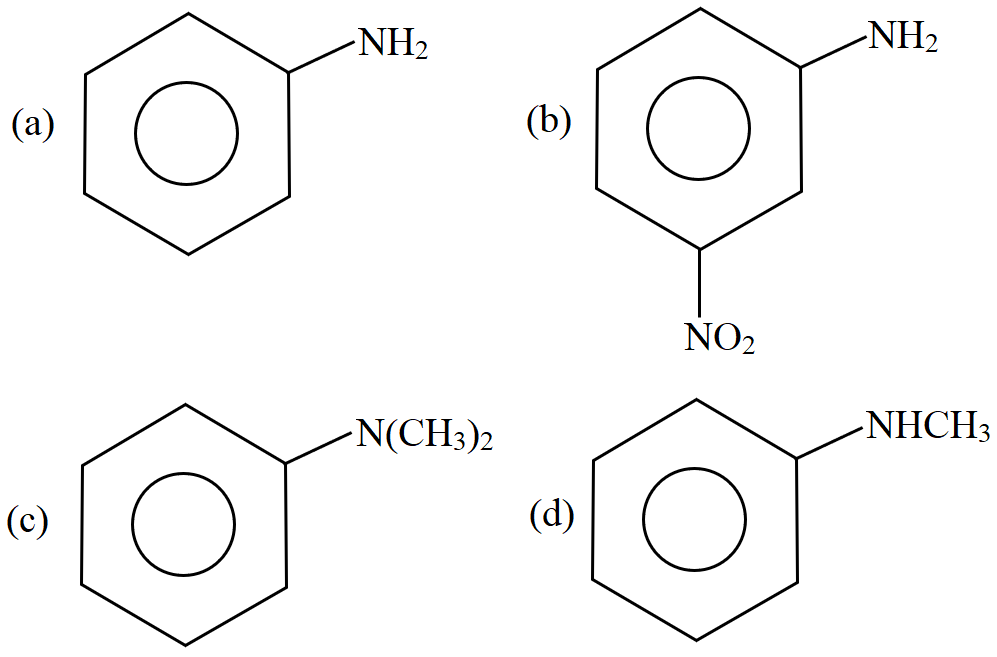
  1. Which of the following has lowest pKb value?

  1. The strongest base among the following is:
  1. C6H5NH2

  2. p-NO2 - C6H4NH2

  3. m-NO2 - C6H4NH2

  4. C6H5CH2NH2

  1. Maximum pKb value of:
  1.  

  1.  

  1. (CH3CH2)2NH

  2. (CH3)2NH

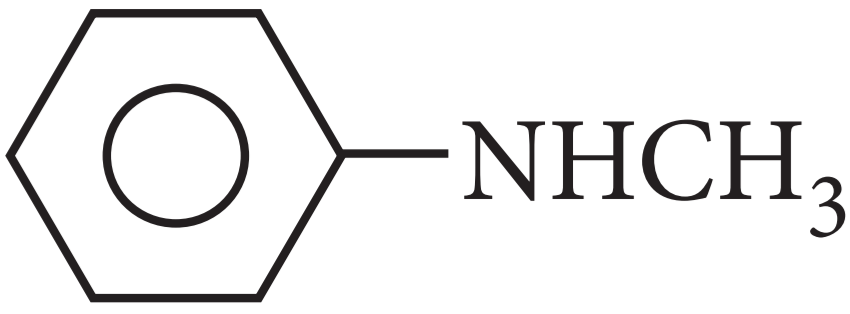
  1.  The order of basic strength among the following amines in benzene solution is:
  1. Methylamine is more basic than NH3.
  2. Amines form hydrogen bonds.
  3. Ethylamine has higher boiling point than propane.
  4. Dimethylamine is less basic than methylamine.
  1. CH3CH2NH2 contains a basic -NH2 group, but CH3CONH2 does not because:
  1. Acetamide is amphoteric in character.
  2. In ethylamine the electron pair on N-atom is delocalised by resonance.
  3. In ethylamine there is no resonance while in acetamide the lone pair of electrons on N-atom is delocalised and is less available for protonation.
  4. None of these.
Nemst equation relates the reduction potential of an electrochemical reaction to the standard potential and activities of the chemical species undergoing oxidation and reduction.

Let us consider the reaction, $\text{M}^{\text{n+}}_{(\text{aq})}\xrightarrow{\ \ \ \ \ \ \ \ }\text{nM}_\text{(s)}$

For this reaction, the electrode potential measured with respect to standard hydrogen electrode can be given as

$\text{E}_{\Big(\frac{\text{M}^{\text{n+}}}{\text{M}}\Big)}=\text{E}^\circ_{\Big(\frac{\text{M}^\text{n+}}{\text{M}}\Big)}-\frac{\text{RT}}{\text{nF}}\text{ln}\frac{[\text{M}]}{[\text{M}^{\text{n}+}]}$

In these questions (Q. No. i-iv), a statement of assertion followed by a statement ofreason is given. Choose the correct answer out of the following choices.

  1. Assertion and reason both are correct statements and reason is correct explanation for assertion.
  2. Assertion and reason both are correct statements but reason is not correct explanation for assertion.
  3. Assertion is correct statement but reason is wrong statement.
  4. Assertion is wrong statement but reason is correct statement.
  1. Assertion: For concentration cell, $\text{Zn}_{(\text{s})}|\text{ Zn}^{2+}_{\text{(aq)}}||\text{ Zn}^{2+}_{(\text{aq})}|\text{ Zn}\\\ \ \ \ \ \ \ \ \ \ \ \ \text{C}_1\ \ \ \ \ \ \ \ \text{C}_2$

For spontaneous cell reaction, C1 < C2

Reason: For concentration cell, $\text{E}_\text{cell}=\frac{\text{RT}}{\text{nF}}\log\frac{\text{C}_2}{\text{C}_1}$

For spontaneous reaction, $\text{E}_\text{cell}=+\text{ve}\Rightarrow\text{C}_2>\text{C}_1$

  1. Assertion: For the cell reaction, $\text{Zn}_{(\text{s})}+\text{Cu}^{2+}_{(\text{aq})}\xrightarrow{\ \ \ \ \ }\text{Zn}^{2+}_{(\text{aq})}+\text{Cu}_{(\text{s})}$ voltmeter gives zero reading at equilibrium.

Reason: At the equilibrium, there is no change in concentration of Cu2+ and Zn2+ ions.

  1. Assertion: The Nernst equation gives the concentration dependence of emf of the cell.

Reason: In a cell, current flows from cathode to anode.

  1. Assertion: Increase in the concentration of copper half cell in a cell, increases the emfofthe cell.

Reason: $\text{E}_\text{cell}=\text{E}^\circ_\text{cell}+\frac{0.059}{2}\log\frac{[\text{Cu}^{2+}]}{[\text{Zn}^{2+}]}$

  1. Assertion: Electrode potential for the electrode $\frac{\text{Mn}^+}{\text{Mn}}$ with concentration is given by the expression under STP conditions.

$\text{E}=\text{E}^\circ+\frac{0.059}{\text{n}}\log[\text{Mn}^{+}]$

Reason: STP conditions require the temperature to be 273K.

Read the passage given below and answer the following questions:

Although chlorobenzene is inert to nucleophilic substitution, however it gives quantitative yield of phenol when heated with aq. Na OH at high temperature and under high pressure. As far as electrophilic substitution in phenol is concemed the — OH group is an activating group, hence, its presence enhances the electrophilic substitution at o - and p - positions.

The following questions are multiple choice questions. Choose the most appropriate answer:

  1. Conversion of chlorobenzene into phenol involves:
  1. Modified SN1 mechanism.
  2. Modified SN2 mechanism.
  3. Both (a) and (b).
  4. Elimination-addition mechanism.
  1. Phenol undergoes electrophilic substitution more readily than benzene because:
  1. The intermediate carbocation is a resonance hybrid of more resonating structures than that from benzene.
  2. The intermediate is more stable as it has positive charge on oxygen, which can be better accommodated than on carbon.
  3. In one of the canonical structures, every atom (except hydrogen) has complete octet.
  4. The — OH group is o, p-directing which like all other o, p - directing group, is activating.
  1. Phenol on treatment with excess of cone. HNO3 gives:
  1. O - nitrophenol.
  2. P - nitrophenol.
  3. O - and p - nitrophenol.
  4. 2, 4, 6 - trinitrophenol.
  1. Phenol is heated with a solution of mixture of KBr and KBrO3. The major product obtained in the above reaction is:
  1. 2 - bromophenol.
  2. 3 - bromophenol.
  3. 4 - bromophenol.
  4. 2, 4, 6 - tribromophenol.
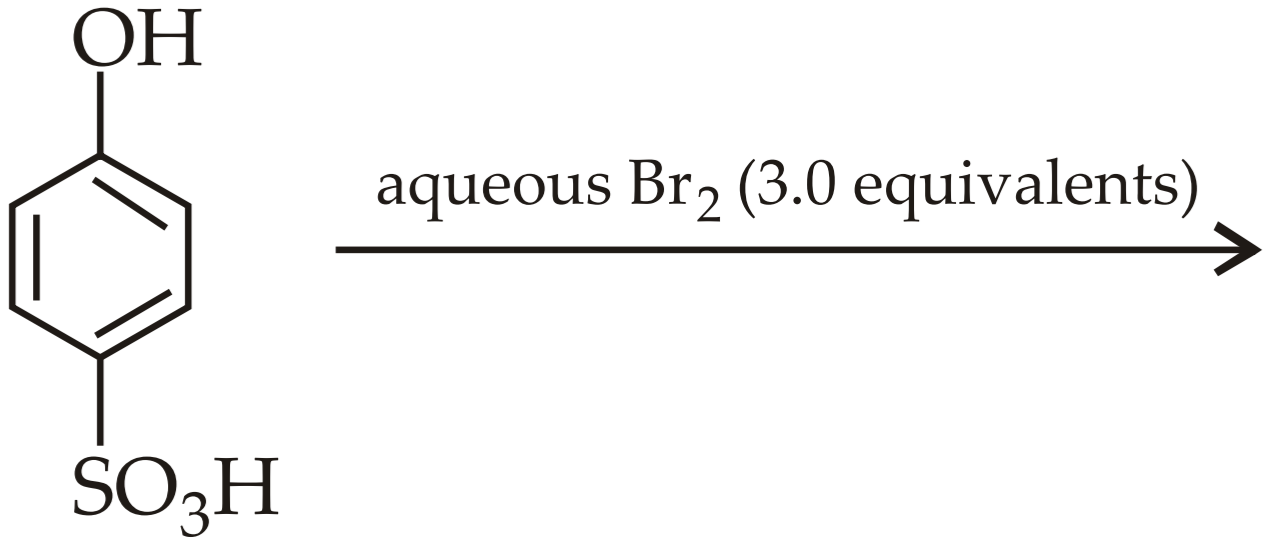
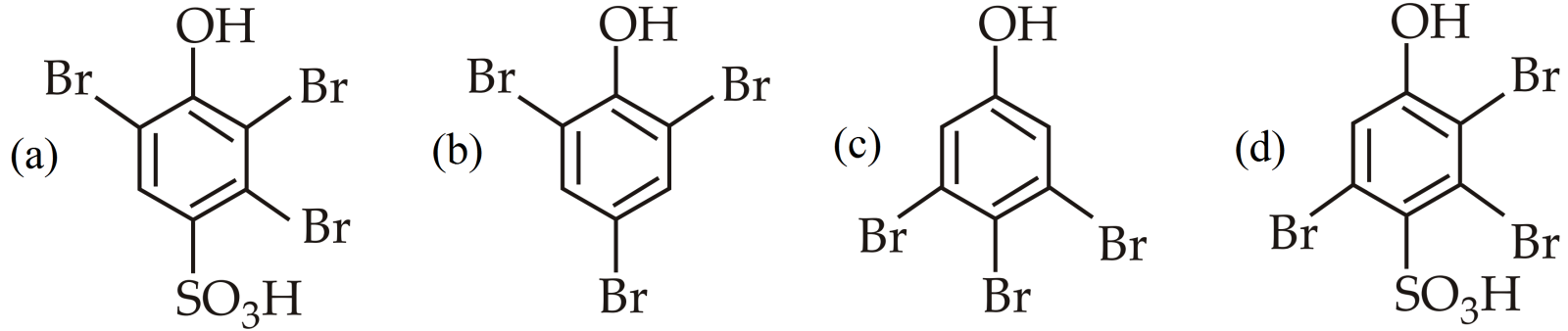
  1. The major product of the following reaction is:

Read the passage given below and answer the following questions:
Coordination compounds are formulated and named according to the IUPAC system.
Few rules for naming coordination compounds are:
  1. In ionic complex, the cation is named first and then the anion.
  2. In the coordination entity, the ligands are named first and then the central metal ion.
  3. When more than one type of ligands are present, they are named in alphabetical order of preference without any consideration of charge.
The following questions are multiple choice questions. Choose the most appropriate answer:
  1. The IUPAC name of the complex [Pt(NH3)3Br(NO2)Cl]Cl is:
  1. Triamminechlorobromonitroplatinum (IV) chloride.
  2. Triamminebromonitrochloroplatinum (IV) chloride.
  3. Triamminebromidochloridonitroplatinum (IV) chloride.
  4. Triamminenitrochlorobromoplatinum (IV) chloride.
  1. The IUPAC name of [Ni(CO)4] is:
  1. Tetracarbonylnickel (II).
  2. Tetracarbonylnickel (0).
  3. Tetracarbonylnickelate (II).
  4. Tetracarbonylnickelate (0).
  1. As per IUPAC nomenclature, the name of the complex [Co(H2O)4(NH3)2]Cl3 is:
  1. Tetraaquadiamminecobalt (II) chloride.
  2. Tetraaquadiamminecobalt (III) chloride.
  3. Diamminetetraaquacobalt (II) chloride.
  4. Diamminetetraaquacobalt (III) chloride.
  1. Which of the following represents correct formula of dichloridobis(ethane -1, 2-diamine)cobalt (III) ion?
  1. [CoCl2(en)]2+
  2. [CoCl2(en)2]2+
  3. [CoCl2(en)]+
  4. [CoCl2(en)2]+
  1. Correct formula of pentaamminenitro-O-cobalt (III) sulphate is:
  1. [Co(NO2)(NH3)5]SO4
  2. [Co(ONO)(NH3)5]SO4
  3. [Co(NO2)(NH3)4](SO4)2
  4. [Co(ONO)(NH3)4](SO4)2

Read the passage given below and answer the following questions:

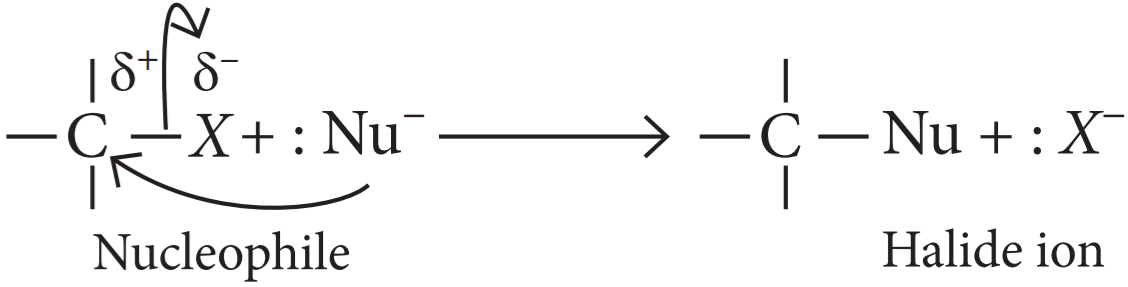
In haloalkanes, when a nucleophile stronger than the halide ion approaches the positively charged carbon atom of an alkyl halide, the halogen atom along with its bonding electron pair gets displaced and a new bond with the carbon and the nucleophile is formed. These reactions are called nucleophilic substitution reactions.

In these reactions the atom or group of atoms which loses its bond from carbon and takes on an additional pair of electrons is called leaving group. Halide ions are good leaving groups. Some important nucleophilic substitution reactions ofhaloalkanes with common nucleophiles are given in the table below.

 
Reagent
Nucleophile (Nu-)
Substitution product R-Nu
Class of main product
1.
NaOH or KOH or moist Ag2O
-OH
ROH
Alcohol
2.
H2O
H2O
ROH
Alcohol
3.
Nal
I-
R – I
Alkyl iodide
4.
R'NH2
$\text{R'}\ddot{\text{N}}\text{H}_2$
RNHR'
Sec. amine
5.
KCN
$\overline{\text{C}}\equiv\text{N}:$
RCN
Nitrile (cyanide)
6.
KNO2
O = N – O-
R – O – N = O
Alkvl nitrite

In these questions (Q. No. i-iv), a statement of assertion followed by a statement ofreason is given. Choose the correct answer out of the following choices.

  1. Assertion and reason both are correct statements and reason is correct explanation for assertion.
  2. Assertion and reason both are correct statements but reason is not correct explanation for assertion.
  3. Assertion is correct statement but reason is wrong statement.
  4. Assertion is wrong statement but reason is correct statement.
  1. Assertion: Alkyl halides are hydrolysed to alcohols by moist silver oxide.

Reason: RCI is hydrolysed to ROH easily but reactions slow down on addition of KI.

  1. Assertion: Alkyl halides fonn alkenes when heated above 300ºC.

Reason: CH3CH21 reacts slowly with strong base as compared to CD3CH2I.

  1. Assertion: RBr reacts with AgNO2 to give nitroalkane.

Reason: Silver nitrite (AgNO2) is an ionic compound, therefore the negative charge on nitrogen is the attacking site.

  1. Assertion: The nucleophilic substitution of vinyl chloride is difficult than ethyl chloride.

Reason: Vinyl group is electron donating group.

  1. Assertion: 2-Bromobutane on reaction with sodium ethoxide in ethanol gives 1-butene as the major product.

Reason: 1-Butene is less stable than 2-butene.

Read the passage given below and answer the following questions :
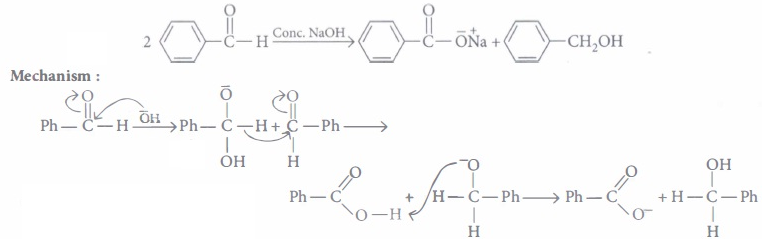
When an aldehyde with no a-hydrogen reacts with concentrated aqueous NaOH, half the aldehyde is converted to carboxylic acid salt and other half is converted to an alcohol. In other words, half of the reactant is oxidized
and other half is reduced. This reaction is known as Cannizzaro reaction

The following questions are multiple choice questions. Choose the most appropriate answer:
  1. A mixture of benzaldehyde and formaldehyde on heating with aqueous NaOH solution gives:
  1. Benzyl alcohol and sodium formate.
  2. Sodium benzoate and methyl alcohol.
  3. Sodium benzoate and sodium formate.
  4. Benzyl alcohol and methyl alcohol.
  1. Which of the following compounds will undergo Cannizzaro reaction?
  1. CH3CHO
  2. CH3COCH3
  3. C6H5CHO
  4. C6H5CH2CHO
  1. Trichloroacetaldehyde is subjected to Cannizzaro's reaction by using NaOH. The mixture of the products contains sodium trichloroacetate ion and another compound. The other compounds is:
  1. 2, 2, 2-trichloroethanol
  2. Trichloromethanol
  3. 2, 2, 2-trichloropropanol
  4. Chloroform
  1. Which of the following reaction will not result in the formation of carbon-carbon bonds?
  1. Cannizzaro reaction
  2. Wurtz reaction
  3. Reimer- Tiemann reaction
  4. Friedel - Crafts acylation

Read the passage given below and answer the following questions:

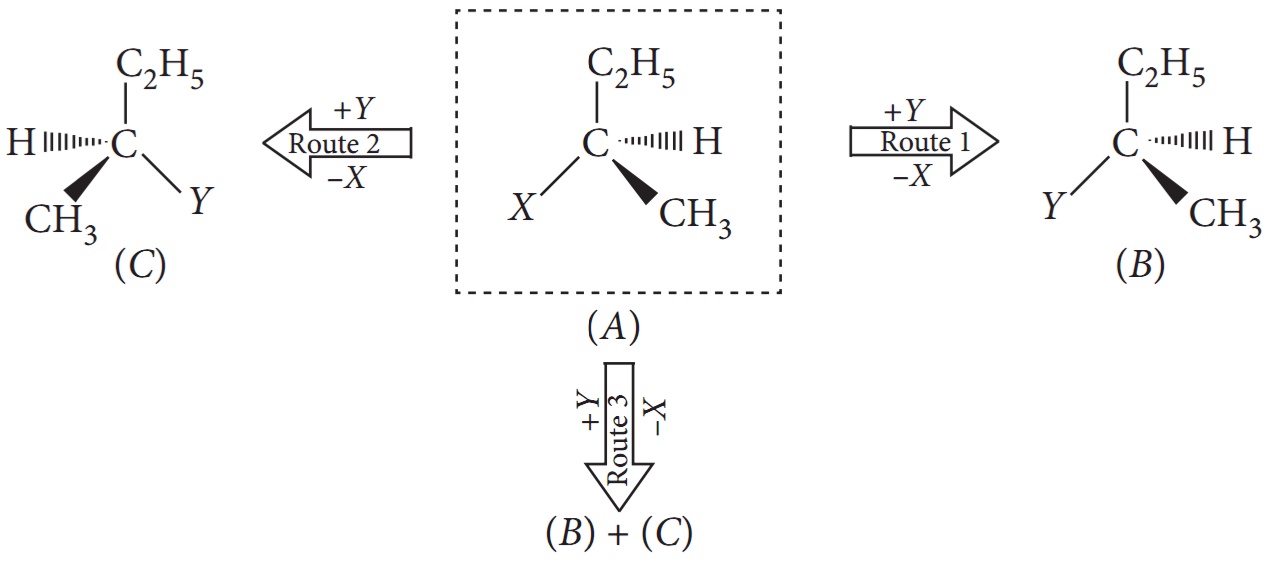
When a chemical reaction involves bond cleavage or bond formation at an asymmetric carbon atom, three different products may be formed. For example, during the substitution of a group X by Y in the following reaction, the three possible products may be shown below:

  1. If Bis the only product, the process is called retention of configuration because B has the same configuration as the starting reactant (A).
  2. If C is the only product, the process is called inversion of configuration because C has the configuration opposite to the starting reactant (A).
  3. If an equimolar mixture of Band C (r.e., a 50 : 50 mixture) is fanned, then the process is called racemisation and the product is optically inactive because one isomer will rotate the light in the direction opposite to another.

In these questions (Q. No. i-iv), a statement of assertion followed by a statement of reason is given. Choose the correct answer out of the following choices.

  1. Assertion and reason both are correct statements and reason is correct explanation for assertion.
  2. Assertion and reason both are correct statements but reason is not correct explanation for assertion.
  3. Assertion is correct statement but reason is wrong statement.
  4. Assertion is wrong statement but reason is correct statement.
  1. Assertion: A reaction is said to be stereospecific if a particular stereoisomer of the reactant produces a specific stereoisomer of the product.

Reason: Bromination of cis-2-butene gives meso-2, 3-dibromobutane which is stereospecific.

  1. Assertion: Addition of Br2 to cis-but-2-ene is stereoselective.

Reason: SN2 reactions are stereospecific as well as stereoselective.

  1. Assertion: Optically active 2-iodobutane on treatment with Nal in acetone undergoes recemization.

Reason: Repeated Walden inversions on the reactant and its product eventually gives a racemic mixture.

  1. Assertion: SN2 reaction of an optically active alkyl halide with an aqueous solution of KOH always gives an alcohol with opposite sign of rotation.

Reason: SN2 reactions always proceed with inversion of configuration.

  1. Assertion: Nudeophilic substitution reaction of an optically active alkyl halide gives a mixture of en an ti om ers.

Reason: The reaction occurs by SN2 mechanism.


Read the passage given below and answer the following questions
Few colligative properties are:
  1. Relative lowering of vapour pressure: depends only on molar concentration of solute (mole fraction) and independent of its nature.
  2. Depression in freezing point: it is proportional to the molal concentration of solution.
  3. Elevation of boiling point: it is proportional to the molal concentration of solute.
  4. Osmotic pressure: it is proportional to the molar concentration of solute
A solution of glucose is prepared with 0.052 g at glucose in 80.2 g of water.(KJ = 1.86K kg mol-1 and Kb = 5.2K kg mol-1)
The following questions are multiple choice questions. Choose the most appropriate answer:
  1. Molality of the given solution is.
  1. 0.0052m
  2. 0.0036m
  3. 0.0006m
  4. 1.29m
  1. Boiling point for the solution will be.
  1. 373.05K
  2. 373.15K
  3. 373.02K
  4. 373.02K
  1. The depression in freezing point of solution will be.
  1. 0.0187K
  2. 0.035K
  3. 0.082K
  4. 0.067K
  1. Mole fraction of glucose in the given solution is.
  1. 6.28 × 10⁻⁵
  2. 6.28 × 10⁻⁴
  3. 0.00625
  4. 0.00028
  1. If same amount of sucrose (C12 H22 O11) is taken instead of glucose, then.
  1. Elevation in boiling point will be higher.
  2. Depression in freezing point will be higher.
  3. Depression in freezing point will be lower.
  4. Both (a) and (b).