Question
Need a full question paper?
Generate a complete, print-ready paper with questions like this in minutes — across 16+ boards, with answer keys.
Explore more
Similar questions
Read the passage given below and answer the following questions: The sequence of bases along the DNA and RNA chain establishes its primary structure which controls the specific properties of the nucleic acid. An RNA molecule is usually a single chain ofribose-containing nucleotide. On the basis of X-ray analysis of DNA, J.D., Watson and EH.C. crick (shared noble prize in 1962) proposed a three dimensional secondary structure for DNA. DNA molecule is a long and highly complex, spirally twisted, double helix, ladder like structure. The two polynucleotide chains or strands are linked up by hydrogen bonding between the nitrogeneous base molecules of their nucleotide monomers. Adenine (purine) always links with thymine (pyrimidine) with the help of two hydrogen bonds and guanine (purine) with cytosine (pyrimidine) with the help of three hydrogen bonds. Hence, the two strands extend in opposite directions, i.e., are antiparallel and complimentary.
- Assertion and reason both are correct statements and reason is correct explanation for assertion.
- Assertion and reason both are correct statements but reason is not correct explanation for assertion.
- Assertion is correct statement but reason is wrong statement.
- Assertion is wrong statement but reason is correct statement.
- Assertion: DNA molecules and RNA molecules are found in the nucleus of a cell.
Reason: There are two types of nitrogenous bases, purines and pyrimidines. Adenine (A) and guanine (G) are substituted purines; cytosine (C), thymine (T) and uracil (U) are substituted pyrimidines.
- Assertion: In both DNA and RNA, heterocyclic base and phosphate ester linkages are at C-1' and C-5' respectively of the sugar molecule.
Reason: Nucleotides and nucleosides mainly differ from each other in presence of phosphate units.
- Assertion: The backbone of RNA molecule is a linear chain consisting of an alternating units of a heterocylic base, D-ribose and a phosphate.
Reason: The segment of DNA which acts as the instruction manual for the synthesis of protein is ribose.
- Assertion: The double helical structure of DNA was proposed by Emil Fischer.
Reason: A nucleoside is an N-glycoside of heterocyclic base.
- Assertion: In DNA, the complementary bases are, adenine and guanine; thymine and cytosine.
Reason: The phenomenon of mutation is chemical change in DNA molecule.
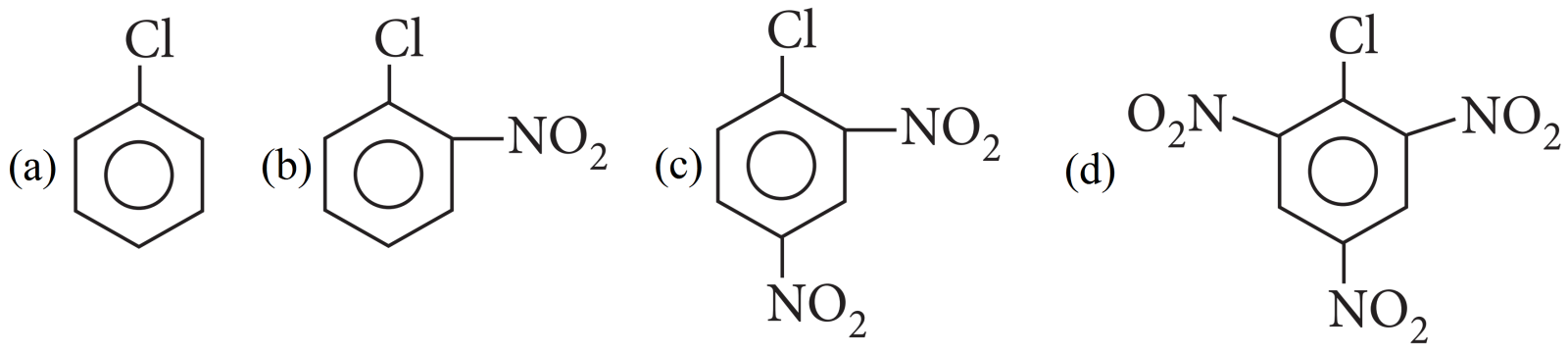
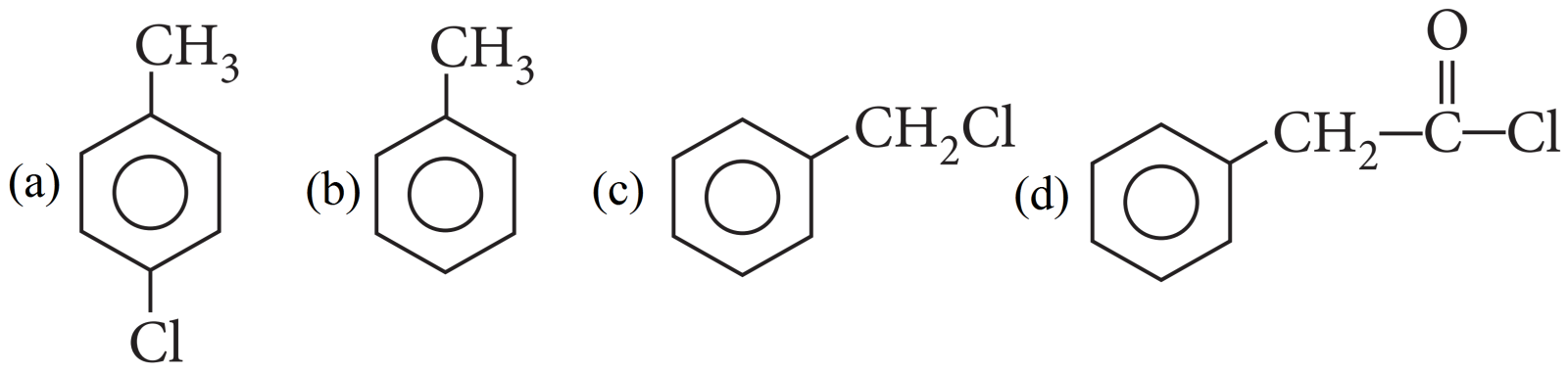
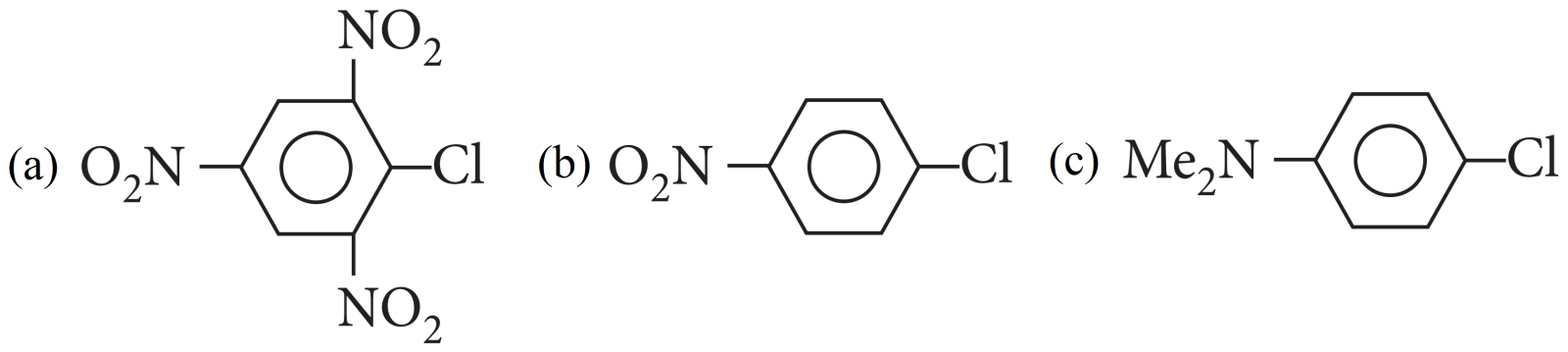
Read the passage given below and answer the following questions: The order of reactivity towards SN1 reaction depends upon the stability of carbocation in the first step. Greater the stability of the carbocation, greater will be its ease of formation from alkyl halide and hence faster will be the rate of the reaction. As we know, 3º carbocation is most stable, therefore, the tert-alkyl that halides will undergo SN1 reaction very fast. For example, it has been observed that the reaction (CH3)3CBr with OH- ion to give 2-methyl-2-propanol is about I million times as fast as the corresponding reaction of the methyl bromide to give methanol. The primary alkyl halides always react predominantly by SN2 mechanism. On the other hand, the tertiary alkyl halides react predominantly by SN1 mechanism. Secondary alkyl halides may react by either mechanism or by both the mechanisms without much preference depending upon the nature of the nucleophile and solvent. In these questions (Q. No. i-tv), a statement of assertion followed by a statement of reason is given. Choose tile correct answer out of tile following choices.
- Assertion and reason both are correct statements and reason is correct explanation for assertion.
- Assertion and reason both are correct statements but reason is not correct explanation for assertion.
- Assertion is correct statement but reason is wrong statement.
- Assertion is wrong statement but reason is correct statement.
- Assertion: Low concentration of nudeophile favours SN1 mechanism.
Reason: 2º alkyl halides are less reactive than 1º towards SN1 reactions.
- Assertion: Polar solvent slows down SN2 reactions.
Reason: CH3-Br is less reactive than CH3Cl.
- Assertion: Benzyl bromide when kept in acetone- water it produces benzyl alcohol.
Reason: The reaction follows SN2 mechanism.
- Assertion: Rate of hydrolysis of methyl chloride to methanol is higher in DMF than in water.
Reason: Hydrolysis of methyl chloride follows second order kinetics.
- Assertion: SN1 reaction is carried out in the presence of a polar protic solvent.
Reason: A polar protic solvent increases the stability of carbocation due to solvation.
The half-life of a reaction is the time required for the concentration of reactant to decrease by half, i.e.,
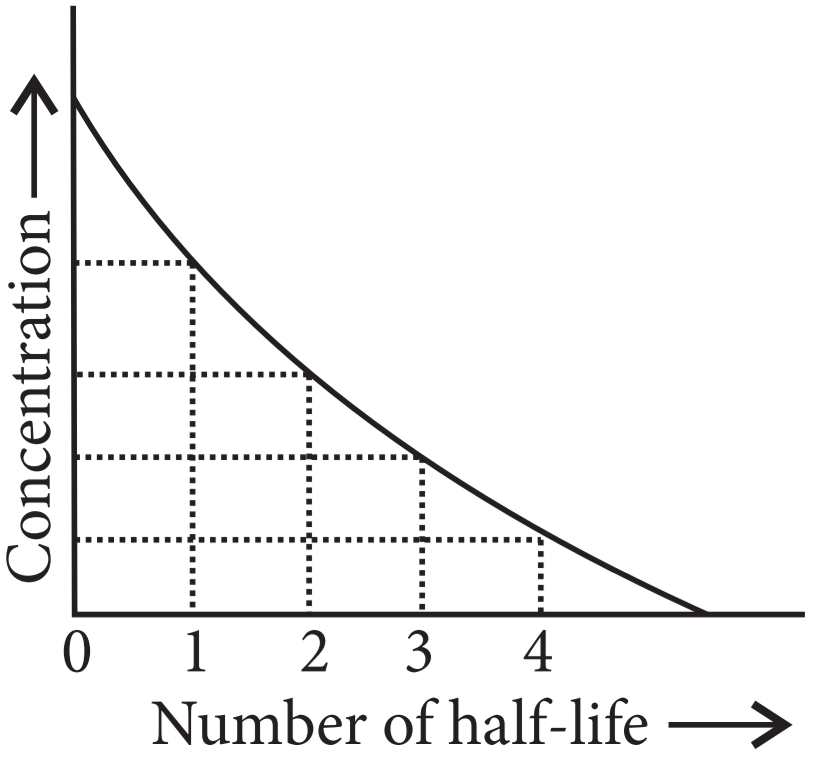
$[\text{A}]_\text{t}=\frac{1}{2}[\text{A}]$
For first order reaction,
$\text{t}_\frac{1}{2}=\frac{0.693}{\text{k}}$
this means $\text{t}\frac{1}{2}$ is independent of initial concentration. Figure shows that typical variation of concentration of reactant exhibiting first order kinetics. It may be noted that though the major portion of the first order kinetics may be over in a finite time, but the reaction will never cease as the concentration of reactant will be zero only at infinite time.
The following questions are multiple choice questions. Choose the most appropriate answer:
- A first order reaction has a rate constant k = 3.01 × 10⁻³ /s. How long it will take to decompose half of the reactant?
- 2.303s
- 23.03s
- 230.3s
- 2303s
- The rate constant for a first order reaction is 7.0 × 10⁻⁴ s-1. If initial concentration ofreactant is 0.080 M, what is the half life of reaction?
- 990s
- 79.2s
- 12375s
- 10.10 × 10⁻⁴s
- For the half-life period of a first order reaction, which one of the following statements is generally false?
- It is independent of initial concentration.
- It is independent of temperature.
- It decreases with the introduction of a catalyst.
- None of these.
- The rate of a first order reaction is 0.04 mol L-1 s-1 at 10 minutes and 0.03 mol L-1 s-1 at 20 minutes after initiation. The half-life of the reaction is:
- 4.408 min
- 44.086 min
- 24.086 min
- 2.408 min
The plot of $\text{t}_\frac{1}{2}$ vs initial concentration [A]0 for a first order reaction is given by:


Read the passage given below and answer the following questions:
When a protein in its native form, is subjected to physical changes like change in temperature or chemical changes like change in pH, the hydrogen bonds are disturbed. Due to this, globules unfold and helix get uncoiled and protein loses its biological activity. This is called denaturation of protein.
The denaturation causes change in secondary and tertiary structures but primary structures remains intact. Examples of denaturation of protein are coagulation of egg white on boiling, curdling of milk, formation of cheese when an acid is added to milk.
The following questions are multiple choice questions. Choose the most appropriate answer:
→When a protein in its native form, is subjected to physical changes like change in temperature or chemical changes like change in pH, the hydrogen bonds are disturbed. Due to this, globules unfold and helix get uncoiled and protein loses its biological activity. This is called denaturation of protein.
The denaturation causes change in secondary and tertiary structures but primary structures remains intact. Examples of denaturation of protein are coagulation of egg white on boiling, curdling of milk, formation of cheese when an acid is added to milk.
The following questions are multiple choice questions. Choose the most appropriate answer:
- Mark the wrong statement about denaturation of proteins.
- The primary structure of the protein does not change.
- Globular proteins are converted into fibrous proteins.
- Fibrous proteins are converted into globular proteins.
- The biological activity of the protein is destroyed.
- Which structure(s) of proteins remains(s) intact during denaturation process?
- Both secondary and tertiary structures.
- Primary structure only.
- Secondary structure only.
- Tertiary structure only.
- $\alpha$-helix and $\beta$-pleated structures of proteins are classified as:
- Primary structure.
- Secondary structure.
- Tertiary structure.
- Quaternary structure.
- Cheese is a:
- Globular protein.
- Conjugated protein.
- Denatured protein.
- Derived protein.
- Secondary structure of protein refers to:
- Mainly denatured proteins and structure of prosthetic groups.
- Three-dimensional structure, especially the bond between amino acid residues that are distant from each other in the polypeptide chain.
- Linear sequence of amino acid residues in the polypeptide chain.
- Regular folding patterns of continuous portions of the polypeptide chain.
Read the passage given below and answer the following questions: Werner, a Swiss chemist in 1892 prepared and characterised a large number of coordination compounds and studied their physical and chemical behaviour. He proposed that, in coordination compounds, metals possess two types of valencies, viz. primary valencies, which are normally ionisable and secondary valencies which are non-ionisable. ln a series of compounds of cobalt (III) chloride with ammonia, it was found that some of the chloride ions could be precipitated as AgCl on adding excess of AgNO3 solution in cold, but some remained in solution. The number ofions furnished by a complex in a solution can be determined by precipitation reactions. The measurement of molar conductance of solutions of coordination compounds helps to estimate the number of ions furnished by the compound in solution. In these questions (Q. No. i-iv), a statement of assertion followed by a statement ofreason is given. Choose the correct answer out of the following choices.
- Assertion and reason both are correct statements and reason is correct explanation for assertion.
- Assertion and reason both are correct statements but reason is not correct explanation for assertion.
- Assertion is correct statement but reason is wrong statement.
- Assertion is wrong statement but reason is correct statement.
- Assertion: The complex [Co(NH3)3Cl3] does not give precipitate with silver nitrate solution.
Reason: The given complex is non-ionisable.
- Assertion: The complex [Co(NH3)4Cl2]Cl gives precipitate corresponding to 2 mol of AgCl with AgNO3 solution.
Reason: It ionises as [Co(NH3)4Cl2]+ + Cl-.
- Assertion: CoCl3. 4NH3 gives 1 mol of AgCl on reacting with AgNO3, its secondary valency is 6.
Reason: Secondary valency corresponds to coordination number.
- Assertion: 1 mol of [CrCl2(H2O)4]Cl· 2H2O will give 1 mol of AgCl on treating with AgNO3.
Reason: Cl- ions satisfying secondary valanceis will not be precipitated.
- Assertion: CoCl3. 3NH3 is not conducting while CoCl3. 5NH3 is conducting.
Reason: The complex of CoCl3. 3NH3 is [CoCl3(NH3)3] while that of CoCl3· 5NH3 is [CoCl(NH3)5]Cl3.
Read the passage given below and answer the following questions:
Iron forms many complexes in its +2 and +3 oxidation states such as [Fe(H2O)6]2+ (A); [Fe(CN)6]4- (B); [Fe(H2O)6]3+ (C); [Fe(CN)6]3- (D), etc., They exhibit, different magnetic properties and undergo different hybridisation of iron.
The following questions are multiple choice questions. Choose the most appropriate answer:
→→→Iron forms many complexes in its +2 and +3 oxidation states such as [Fe(H2O)6]2+ (A); [Fe(CN)6]4- (B); [Fe(H2O)6]3+ (C); [Fe(CN)6]3- (D), etc., They exhibit, different magnetic properties and undergo different hybridisation of iron.
The following questions are multiple choice questions. Choose the most appropriate answer:
- Which of the following statements is correct?
- (B) is paramagnetic while (C) is diamagnetic.
- Both (B) and (D) are outer orbital complexe.
- Both (A) and (C) are paramagnetic.
- (A) is outer orbital complex and (C) is inner orbital complex.
- The complex having maximum magnetic moment is:
- (A)
- (B)
- (C)
- (D)
- Which of the following does not represent correct configuration of the d-orbitals in the given complexes?
- $\text{(A)}:\text{t}^4_{2\text{g}}\text{e}^2_\text{g}$
- $\text{(B)}:\text{t}^6_{2\text{g}}\text{e}^0_\text{g}$
- $\text{(C)}:\text{t}^4_{2\text{g}}\text{e}^1_\text{g}$
- $\text{(D)}:\text{t}^5_{2\text{g}}\text{e}^0_\text{g}$
- The spin only magnetic moment of complexes (A), (B), (C) and (D) are respectively (in BM).
- $2\sqrt{6},0,\sqrt{35},\sqrt{3}$
- $0,2\sqrt{6},\sqrt{35},\sqrt{3}$
- $\sqrt{15,}2\sqrt{6},\sqrt{3},0$
- $\sqrt{3},\sqrt{8},0,\sqrt{15}$
- Which of the given complexes are outer orbital complexes?
- (A) and (B) only
- (B) and (C) only
- (A) and (C) only
- (B) and (D) only