Question
Read the passage given below and answer the following questions:
Iron forms many complexes in its +2 and +3 oxidation states such as [Fe(H2O)6]2+ (A); [Fe(CN)6]4- (B); [Fe(H2O)6]3+ (C); [Fe(CN)6]3- (D), etc., They exhibit, different magnetic properties and undergo different hybridisation of iron.
The following questions are multiple choice questions. Choose the most appropriate answer:
  1. Which of the following statements is correct?
  1. (B) is paramagnetic while (C) is diamagnetic.
  2. Both (B) and (D) are outer orbital complexe.
  3. Both (A) and (C) are paramagnetic.
  4. (A) is outer orbital complex and (C) is inner orbital complex.
  1. The complex having maximum magnetic moment is:
  1. (A)
  2. (B)
  3. (C)
  4. (D)
  1. Which of the following does not represent correct configuration of the d-orbitals in the given complexes?
  1. $\text{(A)}:\text{t}^4_{2\text{g}}\text{e}^2_\text{g}$
  2. $\text{(B)}:\text{t}^6_{2\text{g}}\text{e}^0_\text{g}$
  3. $\text{(C)}:\text{t}^4_{2\text{g}}\text{e}^1_\text{g}$
  4. $\text{(D)}:\text{t}^5_{2\text{g}}\text{e}^0_\text{g}$
  1. The spin only magnetic moment of complexes (A), (B), (C) and (D) are respectively (in BM).
  1. $2\sqrt{6},0,\sqrt{35},\sqrt{3}$
  2. $0,2\sqrt{6},\sqrt{35},\sqrt{3}$
  3. $\sqrt{15,}2\sqrt{6},\sqrt{3},0$
  4. $\sqrt{3},\sqrt{8},0,\sqrt{15}$
  1. Which of the given complexes are outer orbital complexes?
  1. (A) and (B) only
  2. (B) and (C) only
  3. (A) and (C) only
  4. (B) and (D) only

Answer

  1. (c) Both (A) and (C) are paramagnetic.

Explanation:

(A): sp3d2 hybridisation (outer orbital)

No. of unpaired electrons = 4

(B): d2sp3 hybridisation (inner orbital)

No. of unpaired electrons = 0

(C): sp3d2 hybridisation (outer orbital)

No. of unpaired electrons = 5

(D): d2sp3 hybridisation (inner orbital)

No. of unpaired electron = 1

  1. (c) (C)

Explanation:

It has 5 unpaired electrons.

  1. (c) $\text{(C)}:\text{t}^4_{2\text{g}}\text{e}^1_\text{g}$

Explanation:

As H2O is a weak ligand so, it should be $\text{t}^4_{2\text{g}}\text{e}^1_\text{g}.$

  1. (a) $2\sqrt{6},0,\sqrt{35},\sqrt{3}$

Explanation:

Magnetic moments of (A), (B), (C) and (D) are respectively.

$\sqrt{4(4+2)},0,\sqrt{5(5+2)},\sqrt{1(1+2)}$

  1. (c) (A) and (C) only

Need a full question paper?

Generate a complete, print-ready paper with questions like this in minutes — across 16+ boards, with answer keys.

Start Generating Free

Similar questions

Read the passage given below and answer the following questions:

Dehydration of alcohols can lead to the formation of either alkenes or ethers. This dehydration can be carried out either with protonic acids such as cone.H2SO4, H3PO4 or catalysts such as anhydrous ZnCl2 or Al2O3. When primary alcohols are heated with cone. H2SOat 433-44 K, they undergo intramolecular dehydration to form alkenes. Secondary and tertiary alcohols undergo dehydration under milder conditions. The ease of dehydration of alcohols follows the order: 3º > 2º > 1º.

The dehydration of alcohols always occurs in accordance with the Saytzeff's rule. Primary alcohols when heated with protic acid at 413K, gives dialkyl ether.

$\text{CH}_3\text{CH}_2\text{OH}\xrightarrow[433.433\text{K}]{\text{conc. H}_2\text{SO}_4}\text{CH}_2=\text{CH}_2+\text{H}_2\text{O}$

$2\text{CH}_3\text{CH}_2\text{OH}\xrightarrow[433\text{K}]{\text{conc. H}_2\text{SO}_4}\text{CH}_3\text{CH}_2-\text{O}-\text{CH}_2\text{CH}_3+\text{H}_2\text{O}$

The following questions are multiple choice questions. Choose the most appropriate answer:

  1. Which one of the following alcohols undergoes acid-catalysed dehydration to alkenes most readily?
  1. (CH3)2CHCH2OH

  2. (CH3)3COH

  3. CH3CHOHCH3

  4. CH3CH2CH2OH

  1. Dehydration of alcohol is an example of which type of reaction?
  1. Substitution.
  2. Elimination.
  3. Addition.
  4. Rearrangment.
  1. The alcohol which does not give a stable compound on dehydration is:
  1. Ethyl alcohol.
  2. Methyl alcohol.
  3. N-propyl alcohol.
  4. N-butyl alcohol.
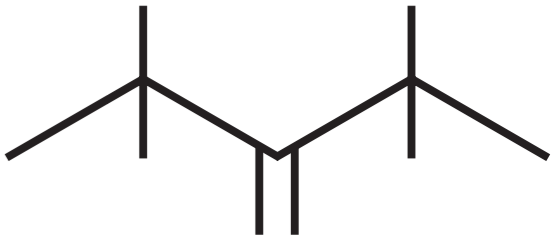
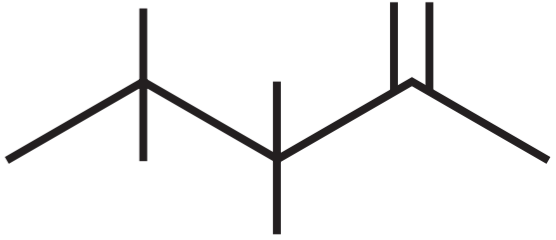
  1.  The most stable product (s) is/ are:

  1.  

  1.  

  1. Both (a) and (b)
  2. None of these.
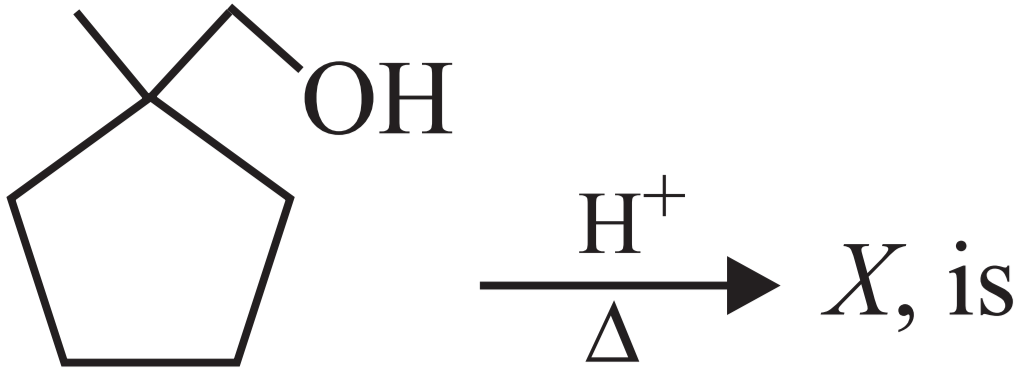
  1. The product of the reaction 

Electrical work done in unit time is equal to electrical potential multiplied by total charge passed. ln order to obtain maximum work from a cell, the charge has to be passed reversibly. The reversible work done by a cell is equal to decrease in its Gibb's energy. Hence, Gibb's energy of reaction is given by

$\Delta\text{G}=\text{nFE}_\text{cell}$

Hence, Eis the emfof the cell and nFis the amount of energy.

In these questions (Q. No. i-Iv), a statement of assertion followed by a statement ofreason is given. Choose the correct answer out of the following choices.

  1. Assertion and reason both are correct statements and reason is correct explanation for assertion.
  2. Assertion and reason both are correct statements but reason is not correct explanation for assertion.
  3. Assertion is correct statement but reason is wrong statement.
  4. Assertion is wrong statement but reason is correct statement.
  1. Assertion: $\Delta\text{G}^\circ=-\text{nFE}^\circ$

Reason: Eº should be positive for a spontaneous reaction.

  1. Assertion: An electrochemical cell can be set up only if the red ox reaction is spontaneous.

Reason: A reaction is spontaneous if free energy change is negative.

  1. Assertion: For an electrochemical cell, $\Delta\text{G}<0$ and $\text{E}_\text{cell}>0.$

Reason: The given cell is non-spontaneous.

  1. Assertion: Current stops flowing when Ecell = 0.

Reason: Equilibrium of the cell reaction is attained.

  1. Assertion: Ecell should have a positive value for the cell to function.

Reason: Ecell = Ecathode - Eanode

Read the passage given below and answer the following questions:

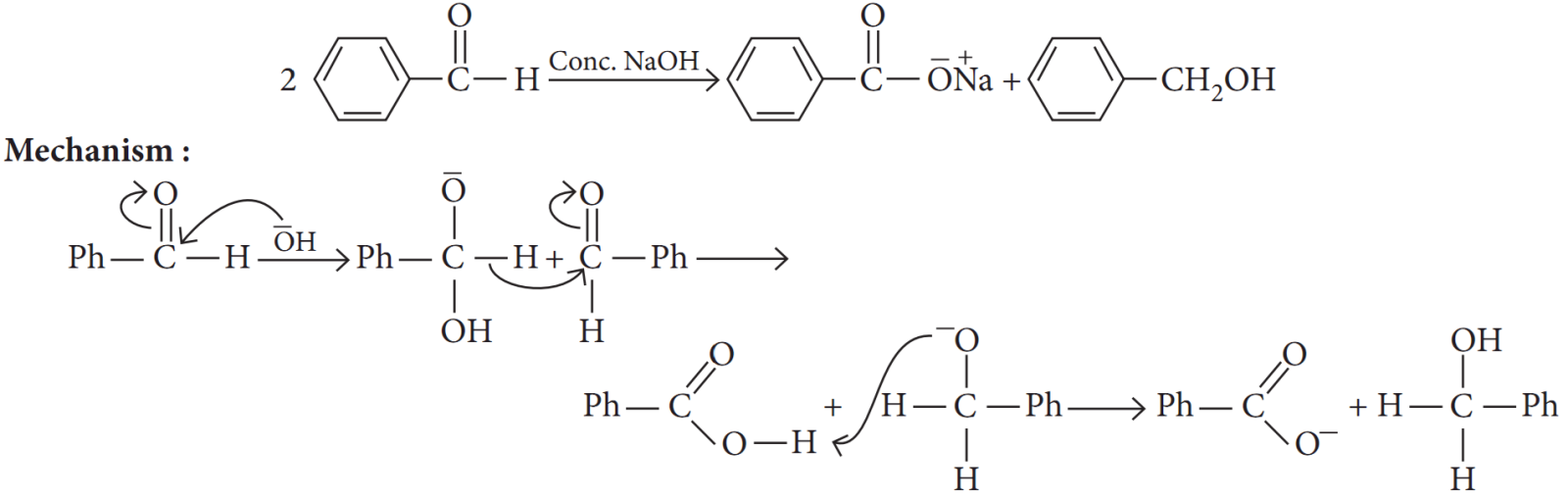
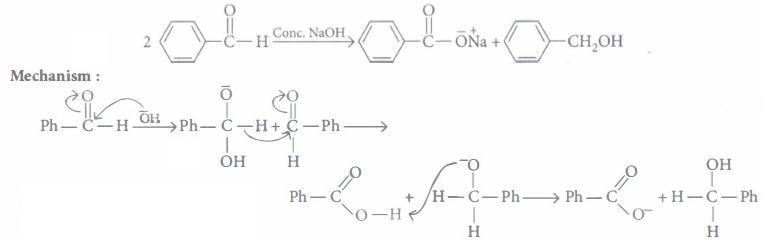
When an aldehyde with no et-hydrogen reacts with concentrated aqueous NaOH, half the aldehyde is converted to carboxylic acid salt and other half is converted to an alcohol. In other words, half of the reactant is oxidized and other half is reduced. This reaction is known as Cannizzaro reaction.

The following questions are multiple choice questions. Choose the most appropriate answer:

  1. A mixture of benzaldehyde and formaldehyde on heating with aqueous NaOH solution gives:
  1. Benzyl alcohol and sodium formate.
  2. Sodium benzoate and methyl alcohol.
  3. Sodium benzoate and sodium formate.
  4. Benzyl alcohol and methyl alcohol.
  1. Which of the following compounds will undergo Cannizzaro reaction?
  1. CH3CHO
  2. CH3COCH3
  3. C6H5CHO
  4. C6H5CH2CHO
  1. Trichloroacetaldehyde is subjected to Cannizzaro's reaction by using NaOH. The mixture of the products contains sodium trichloroacetate ion and another compound. The other compounds is:
  1. 2, 2, 2-trichloroethanol.
  2. Trichloromethanol.
  3. 2, 2, 2-trichloropropanol.
  4. Chloroform.
  1. In Cannizzaro reaction given below:

$2\text{PhCHO}\xrightarrow{\stackrel{-}{\hbox{ OH}}}\text{PhCH}_2+\text{OH}+\text{PhCO}_2^-$ the slowest step is:

  1. The attack -OH at the carboxyl group.
  2. The transfer of hydride to the carbonyl group.
  3. The abstraction of proton from the carboxylic group.
  4. The deprotonation of PhCH2OH.
  1. Which of the following reaction will not result in the formation of carbon-carbon bonds?
  1. Cannizzaro reaction.
  2. Wurtz reaction.
  3. Reimer-Tiemann reaction.
  4. Friedel-Crafts' acylation.
Two types of conductors are generally used, metallic and electrolytic. Free electrons are the current carrier in metallic and in electrolytic conductors, free ions. Specific conductance or conductivity of an electrolytic solution is given by

$\text{K}=\text{C}\times\frac{\text{l}}{\text{A}}$

where, $\text{C}\times\frac{1}{\text{R}}$ and $\frac{\text{l}}{\text{A}}=\text{G}^\star$ (cell constant)

Molar conductance $(\wedge_\text{m})$ and equivalent conductance $(\wedge_\text{e})$ of an electrolyte solution are calculated as

$\wedge_\text{m}=\frac{\text{K}\times1000}{\text{M}}$ or $\wedge_\text{e}=\frac{\text{K}\times1000}{\text{N}}$

where, M = molarity of solution and N is normality of solution. Molar conductance of strong electrolyte depends on the concentration.

$\wedge_\text{m}=\wedge^\circ_{\text{m}^-}\text{b}\sqrt{\text{C}}$

$\wedge^\circ_\text{m}=$ molar conductance at infinite dilution, b = constant, C = cone.of solution

In these questions (Q. No. i-iv), a statement of assertion followed by a statement of reason is given. Choose the correct answer out of the following choices.

  1. Assertion and reason both are correct statements and reason is correct explanation for assertion.
  2. Assertion and reason both are correct statements but reason is not correct explanation for assertion.
  3. Assertion is correct statement but reason is wrong statement.
  4. Assertion is wrong statement but reason is correct statement.
  1. Assertion: The molar conductivity of strong electrolyte decreases with increase in concentration.

Reason: At high concentration, migration ofions is slow.

  1. Assertion: The molar conductance of weak electrolyte at infinite dilution is equal to the sum of molar conductance of cations and anions.

Reason: Kohlrausch's law is applicable for strong electrolytes.

  1. Assertion: Equivalent conductance of all electrolytes increases with increasing concentration.

Reason: More number ofions are available per gram equivalent at higher concentration.

  1. Assertion: Specific conductance decreases with dilution whereas equivalent conductance increases.

Reason: On dilution, number of ions per millilitre decreases but total number ofions increases considerably.

  1. Assertion: The ratio of specific conductivity to the observed conductance does not depend upon the concentration of the solution taken in the conductivity cell.

Reason: Specific conductivity decreases with dilution whereas observed conductance increases with dilution.

Dependence of the rate of reaction on the concentration of reactants, temperature, and other factors is the most general method for weeding out unsuitable reaction mechanisms. The term mechanism means all the individual collisional or elementary processes involving molecules (atoms, radicals, and ions included) that take place simultaneously or consecutively to produce the observed overall reaction. For example, when hydrogen gas reacts with bromine, the rate of the reaction was found to be proportional to the concentration of H₂ and to the square root of the concentration of Br2. Furthermore, the rate was inhibited by increasing the concentration of HBr as the reaction proceeded. These observations are not consistent with a mechanism involving bimolecular collisions of a single molecule of each kind. The currently accepted mechanism is considerably more complicated, involving the dissociation of bromine molecules into atoms followed by reactions between atoms and molecules:
It is clear from this example that the mechanism cannot be predicted from the overall stoichiometry.
(source: Moore, J. W., & Pearson, R. G. (1981). Kinetics and mechanism. John Wiley & Sons.)
(a). Predict the expression for the rate of reaction and order for the following:
         H2 + Br2 → 2 HBr
What are the units of rate constant for the above reaction?
(b). How will the rate of reaction be affected if the concentration of Br2 is tripled?
Read the passage given below and answer the following questions :
When an aldehyde with no a-hydrogen reacts with concentrated aqueous NaOH, half the aldehyde is converted to carboxylic acid salt and other half is converted to an alcohol. In other words, half of the reactant is oxidized
and other half is reduced. This reaction is known as Cannizzaro reaction

The following questions are multiple choice questions. Choose the most appropriate answer:
  1. A mixture of benzaldehyde and formaldehyde on heating with aqueous NaOH solution gives:
  1. Benzyl alcohol and sodium formate.
  2. Sodium benzoate and methyl alcohol.
  3. Sodium benzoate and sodium formate.
  4. Benzyl alcohol and methyl alcohol.
  1. Which of the following compounds will undergo Cannizzaro reaction?
  1. CH3CHO
  2. CH3COCH3
  3. C6H5CHO
  4. C6H5CH2CHO
  1. Trichloroacetaldehyde is subjected to Cannizzaro's reaction by using NaOH. The mixture of the products contains sodium trichloroacetate ion and another compound. The other compounds is:
  1. 2, 2, 2-trichloroethanol
  2. Trichloromethanol
  3. 2, 2, 2-trichloropropanol
  4. Chloroform
  1. Which of the following reaction will not result in the formation of carbon-carbon bonds?
  1. Cannizzaro reaction
  2. Wurtz reaction
  3. Reimer- Tiemann reaction
  4. Friedel - Crafts acylation
Read the passage given below and answer the following questions:

The order of reactivity towards SN1 reaction depends upon the stability of carbocation in the first step. Greater the stability of the carbocation, greater will be its ease of formation from alkyl halide and hence faster will be the rate of the reaction. As we know, 3º carbocation is most stable, therefore, the tert-alkyl that halides will undergo SN1 reaction very fast. For example, it has been observed that the reaction (CH3)3CBr with OH- ion to give 2-methyl-2-propanol is about I million times as fast as the corresponding reaction of the methyl bromide to give methanol.

The primary alkyl halides always react predominantly by SN2 mechanism. On the other hand, the tertiary alkyl halides react predominantly by SN1 mechanism. Secondary alkyl halides may react by either mechanism or by both the mechanisms without much preference depending upon the nature of the nucleophile and solvent.

In these questions (Q. No. i-tv), a statement of assertion followed by a statement of reason is given. Choose tile correct answer out of tile following choices.

  1. Assertion and reason both are correct statements and reason is correct explanation for assertion.
  2. Assertion and reason both are correct statements but reason is not correct explanation for assertion.
  3. Assertion is correct statement but reason is wrong statement.
  4. Assertion is wrong statement but reason is correct statement.
  1. Assertion: Low concentration of nudeophile favours SN1 mechanism.

Reason: 2º alkyl halides are less reactive than 1º towards SN1 reactions.

  1. Assertion: Polar solvent slows down SN2 reactions.

Reason: CH3-Br is less reactive than CH3Cl.

  1. Assertion: Benzyl bromide when kept in acetone- water it produces benzyl alcohol.

Reason: The reaction follows SN2 mechanism.

  1. Assertion: Rate of hydrolysis of methyl chloride to methanol is higher in DMF than in water.

Reason: Hydrolysis of methyl chloride follows second order kinetics.

  1. Assertion: SN1 reaction is carried out in the presence of a polar protic solvent.

Reason: A polar protic solvent increases the stability of carbocation due to solvation.

Read the passage given below and answer the following questions:

Due to intermolecular hydrogen bonding, the boiling points of alcohols and phenols are much higher than those of corresponding haloalkanes, haloarenes, aliphatic and aromatic hydrocarbons. Among isomeric alcohols, the boiling points follow the order: primary > secondary > tertiary. Boiling points of ethers are much lower than those of isomeric alcohols. The solubility of alcohols in water decreases as the molecular mass of alcohols increases. Amongst isomeric alcohols solubility increases with branching. The solubility of phenols in water is much lower than that of alcohols. Lower ethers such as dimethyl ether and ethyl methyl ether are soluble in water, but the solubility decreases as the molecular mass increases.

In these questions (Q. No. i-iv), a statement of assertion followed by a statement of reason is given. Choose the correct answer out of the following choices.

  1. Assertion and reason both are correct statements and reason is correct explanation for assertion.
  2. Assertion and reason both are correct statements but reason is not correct explanation for assertion.
  3. Assertion is correct statement but reason is wrong statement.
  4. Assertion is wrong statement but reason is correct statement.
  1. Assertion: Alcohols have higher boiling points than ethers of comparable molecular masses.

Reason: Alcohols and ethers are isomeric in nature.

  1. Assertion: The solubility of phenols in water is much lower than that of alcohols.

Reason: Phenols do not form H-bonds with water.

  1. Assertion: Among n-butane, ethoxyethane, 1-propanol and 2-propanol, the increasing order of boiling points is, 1-butanol < 1-propanol < ethoxyethane < n-butane.

Reason: Boiling point increases with increase in molecular mass.

  1. Assertion: Dimethyl ether and diethylether are soluble in water.

Reason: As the molecular mass increases, solubility of ethers in water decreases.

  1. Assertion: Butan-2-ol has higher boiling point than 2-methylpropan-2-ol.

Reason: Amongst isomeric alcohols, the boiling points decreases with branching.

Read the passage given below and answer the following questions:
An organic compound (A) having molecular formula C6H6O gives a characteristic colour with aqueous FeCl3 solution. (A) on treatment with CO2 and NaOH at 400K under pressure gives (B), which on acidification gives a compound (C). The compound (C) reacts with acetyl chloride to give (D) which is a popular pain killer.
The following questions are multiple choice questions. Choose the most appropriate answer:
  1. Compound (A) is:
  1. 2-Hexanol.
  2. Dimethyl ether.
  3. Phenol.
  4. 2-Methyl pentanol.
  1. Compound (C) is:
  1. Salicylic acid.
  2. Salicyladehyde.
  3. Benzoic acid.
  4. Benzaldehyde.
  1. Number of carbon atoms in compound (D) is:
  1. 7
  2. 6
  3. 8
  4. 9
  1. The conversion of compound (A) to (C) is known as:
  1. Reimer-Tiemann reaction.
  2. Kolbe's reaction.
  3. Schimdt reaction.
  4. Swarts reaction.
  1. Compound (A) on heating with compound (C) in presence of POCl3 gives a compound (D) which is used:
  1. In perfumery as a ftavouring agent
  2. As an antipyretic
  3. As an analgesic
  4. As an intestinal antiseptic.