Question
Read the Source Text given below and answer any four questions:
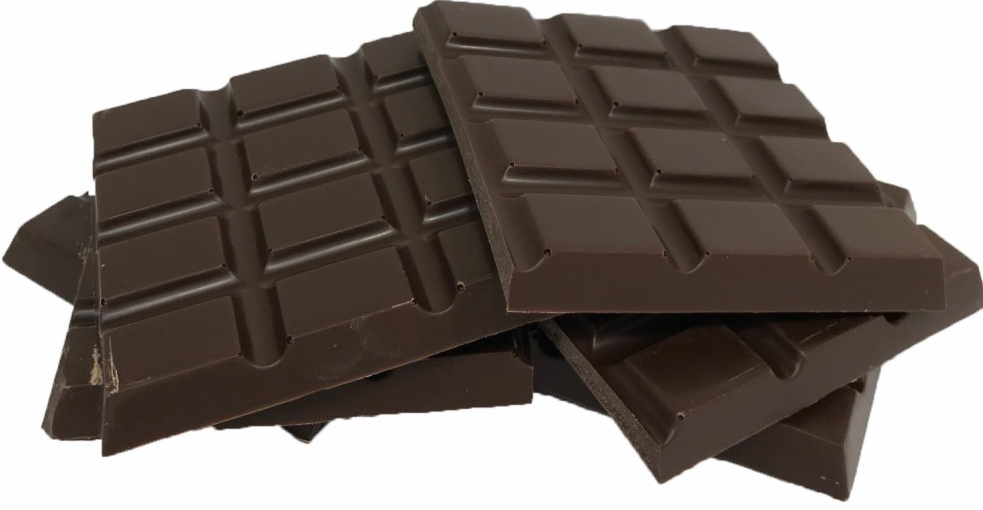
Chocolate is in the form of a quadrilateral with sides $6\ cm$ and $10\ cm, 5\ cm$ and $5\ cm($as shown in the figure$)$ is cut into two parts on one of its diagonal by a lady. Part$-I$ is given to her maid and part $II$ is equally divided among a driver and gardener.
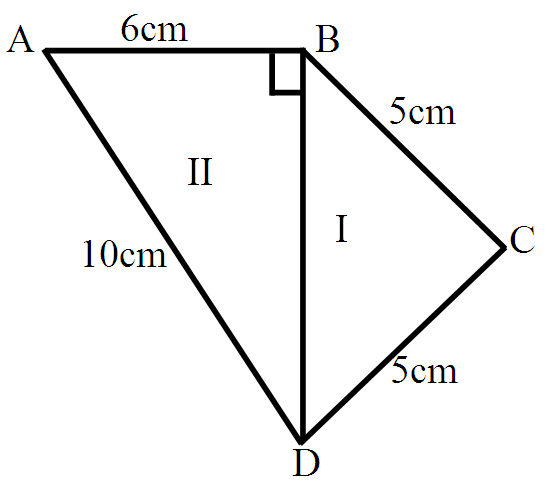
$i.$ Length of $BD:$
$a. 9\ cm$
$b. 8\ cm$
$c. 7\ cm$
$d. 6\ cm$
Area of $\triangle\text{ABC}:$
$a. 24\ cm^2$
$b. 12\ cm^2$
$c. 42\ cm^2$
$d. 21\ cm^2$
The sum of all the angles of a quadrilateral is equal to:
$a. 180^\circ$
$b. 270^\circ$
$c. 360^\circ$
$d. 90^\circ$
A diagonal of a parallelogram divides it into two congruent:
$a.$ Square.
$b.$ Parallelogram.
$c.$ Triangles.
$d.$ Rectangle.
Each angle of the rectangle is:
$a.$ More than $90^\circ$
$b.$ Less than $90^\circ$
$c.$ Equal to $90^\circ$
$d.$ Equal to $45^\circ$
Answer

$(i)$ $(b)$ $8\ cm$
$(ii)$ $(a)$ $24\ cm^2$
$(iii)$ $(c)$ $360^\circ$
$(iv)$ $(c)$ Triangles.
$(v)$ $(c)$ Equal to $90^\circ$

Need a full question paper?

Generate a complete, print-ready paper with questions like this in minutes — across 16+ boards, with answer keys.

Start Generating Free

Similar questions

Ravish and Aarushi dedcided to visit world book fair which is organised every year. During their visit Aarushi was fascinated by the cover page of a book with $\pi / e$ written on it. $\pi$ and e are mathematical constants. In Euclidean geometry $\pi$ is defined as the ratio of a circle's circumference to its diameter. It is also referred to as Archimede's constant. The constant e is known as Euler's number and it is the limiting value of $\left(1+\frac{1}{n}\right)^n$ as $n$ approches infinity. Using the knowledge of rational and irrational numbers answer the following questions.
(i) $\pi$ represents
(a) an integer
(b) a rational number
(c) an irrational number
(d) a natural number 
(ii) e represents
(a) a natural number
(b) an integer
(c) a rational number
(d) an irrational number 
(iii) The product of any two irrational numbers is
(a) always an irrational number $\quad$(b) not necessarily an irrational number $\quad$
(c) never an irrational number $\quad$ (d) always an integer $\quad$
(iv) A rational number between $\sqrt{2}$ and $\sqrt{3}$ is
(a) $\frac{\sqrt{3}-\sqrt{2}}{2}$$\quad$(b) $\frac{\sqrt{3}+\sqrt{2}}{2}$$\quad$(c) $1 . \overline{6}$ $\quad$(d) $0 . \overline{2}+0 . \overline{3}$$\quad$
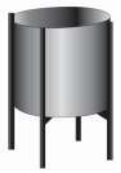
Raghav bought this planter.
Image
The radius of the rim is $14\ cm.$ The curved surface area of the planter is $1848\ cm^2$
$5.$ What is the height of the planter$?$
$6.$ What is the volume of the planter$?$
Mr. Roy, a Mathematics teacher explained some key points of unit 1 of class IX to his students. Some are given here.
• There are infinite rational numbers between any two rational numbers.
• Rationalisation of a denominator means to change the irrational denominator to rational form.
• A number is irrational if its decimal form is non-terminating and non-recurring. On the basis of these key points, choose the correct option in the following questions:
(i) What is the reciprocal of $2+\sqrt{3}$ ?
(a) $\sqrt{3}+2$ $\quad$(b) $\frac{1}{\sqrt{3}-2}$$\quad$ (c) $2-\sqrt{3}$ $\quad$(d) $\frac{1}{2}+\frac{1}{\sqrt{3}}$
(ii) Which of the following is irrational?
(a) $\frac{\sqrt{4}}{\sqrt{9}}$$\quad$ (b) $\frac{\sqrt{12}}{\sqrt{3}}$ $\quad$(c) $\sqrt{7}$ $\quad$(d) $\sqrt{81}$
(iii) Which of the following is irrational?
(a) 0.14 $\quad$(b) $0.14 \overline{16}$ $\quad$(c) $0.1 \overline{416}$ $\quad$(d) 0.401400140001......
(iv) Which of the following is value of $(\sqrt{11}+\sqrt{7})(\sqrt{11}-\sqrt{7})$ ?
(a) $\sqrt{11}$$\quad$ (b) 4 $\quad$(c) -4 $\quad$(d) $\sqrt{7}$
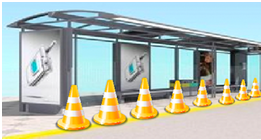
A bus stop is barricaded from the remaining part of the road, by using $50$ hollow cones made of recycled cardboard. Each cone has a base diameter of $40\  cm$ and a height of $1\  m.$
Image
$i.$ Find the curved surface area of the cone.
$ii.$ If the outer side of each of the cones is to be painted and the cost of painting is $₹ 12$ per $m^2$, what will be the cost of painting all these cones ? $($Use $\pi=3.14$ and take $\sqrt{1.04}=1.02 )$
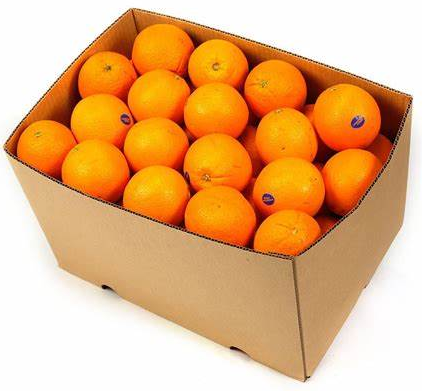
Read the Source/ Text given below and answer these questions: The following data given the weight (in grams) of $30$ oranges picked from a basket$:\ 106, 107, 76, 109, 187, 95, 125, 92, 70, 139, 128, 100, 88, 84, 99, 113, 204, 141, 136, 123, 90, 115, 110, 97, 90, 107, 75, 80,$ Frequency distribution table:
Class Interval
Tally marks
Frequency
$60 - 80$
$|||$
$3$
$80 - 100$
 
$||||\ ||||$
$10$
$100 - 120$
$||||\ ||||$
$9$
$120 - 140$
$||||$
$5$
$140 - 160$
$|$
$1$
$160 - 180$
$-$
$0$
$180 - 200$
$|$
$1$
$200 - 220$
$|$
$1$
Total
$30$
$30$

$i. $Class Size of given class data:
$a. 20$
$b. 10$
$c. 30$
$d. 15$
$ii.$ Classmark of forth class:
$a.70$
$b.130$
$c.20$
$d.15$
$iii.$ The number of oranges, whose weight is more than $180g:$
$a.1$
$b.3$
$c.2$
$d.4$
$iv.$ The number of oranges, whose weight is less than $100g:$
$a.10$
$b.3$
$c.5$
$d.13$
$v.$ The range of data is:
$a.70$
$204$
$c.134$
$d.274$
Read the following text carefully and answer the questions that follow:
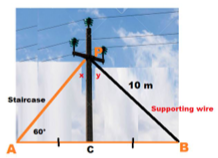
As shown In the village of Surya there was a big pole $PC$. This pole was tied with a strong wire of $10 m$ length. Once there was a big spark on this pole, thus wires got damaged very badly. Any small fault was usually repaired with the help of a rope which normal board electricians were carrying on bicycles.
This time electricians need a staircase of $10 m$ so that it can reach at point $P$ on the pole and this should make $60^{\circ}$ with line $AC. $
Image

$i.$ Show that $\triangle APC$ and $\triangle BPC$ are congruent.
$ii.$ Find the value of $\angle x$.
$iii.$ What is the value of $\angle PBC$ ?
OR
Find the value of $\angle y$.
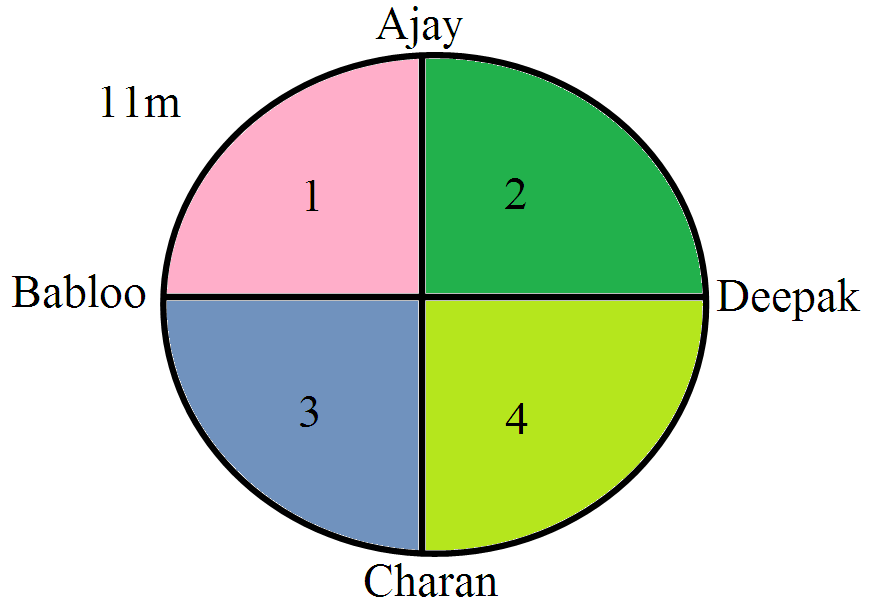
Read the Source/ Text given below and answer any four questions: Four students of class$ IX B$ with names Ajay, Babloo, Charan and Deepak are playing a game in a circular playground. All four students are holding radios with speaker and mic. These radios are connected by a wire of equal length that is $11\ m$ $($for each radio$)$. Ajay Asks a question to Babloo. If Babloo gives the correct answer he gets $10$ points and asks a new question to Charan, If he can not answer then he passes the same question to Charan and gets no points. These conditions apply to all four players. After $10$ rounds who gets maximum points, he becomes the winner.

$i.$ What is the radius of the field?
$a. 7\ m$
$b. 14\ m$
$c. 11\ m$
$d. 22\ m$
$ii.$ What is the area of the field?
$a. 70\ m^2$
$b. 154\ m^2$
$c. 110\ m^2$
$d. 220\ m^2$
$iii.$ What is the area of the part \ marked with 1 on the field?
$a. 50\ m^2$
$b. 154\ m^2$
$c. 76\ m^2$
$d. 38.5\ m^2$
$iv.$ What is the circu\ mference of the field?
$a. 22\ m$
$b. 14\ m$
$c. 44\ m$
$d. 28\ m$
4 What is the direct distance fro\ m Ajay to Charan?
$a. 7\ m$
$b. 28\ m$
$c. 15\ m$
$d. 14\ m$
Our excessive dependence on motorized road transport imposes significant economic costs on society. These include congestion, road casualties, physical inactivity and ill health caused by it eg.: obesity. Cycling could substantially reduce these risks, while strengthening local economies in both urban and rural areas, supporting local businesses and boosting the economic productivity.
A bicycle is being lent at fixed charges for the first three days of week and an additional charge of each day thereafter. If fixed charges are x and per day charges are y, then based on the above information, answer the following questions:
(i) Form the linear equation, if Mr. Sam paid 27 for a bicycle kept for 7 days.
(ii) Form the linear equation, if Mr. David paid 30 for a bicycle kept for 6 days.
(iii) If fixed charge is 15, then find the additional charge paid by Mr. Sam for each extra day.
(iv) If per day charge for lending the bicycle is 3, find the value of fixed charge paid by Mr. David.
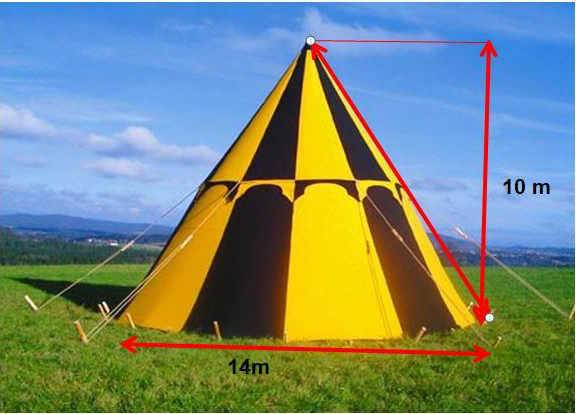
Read the passage given below and answer these questions: Once four friends Rahul, Arun, Ajay and Vijay went for a picnic at a hill station. Due to peak season, they did not get a proper hotel in the city. The weather was fine so they decided to make a conical tent at a park. They were carrying $300\ m^2$ cloth with them. As shown in the figure they made the tent with height $10\ m$ and diameter $14\ m$. The remaining cloth was used for the floor.
 
$i.$ How much Cloth was used for the floor?
$a. 31.6\ m^2$
$b. 166\ m^2$
$c. 106\ m^2$
$d. 206\ m^2$
$ii.$ What was the volume of the tent?
$a. 3006\ m^3$
$b. 1606\ m^3$
$c. 513.36\ m^3$
$d. 5006\ m^3$
$iii.$ What was the area of the floor?
$a. 506\ m^2$
$b. 1006\ m^2$
$c. 1506\ m^2$
$d. 1546\ m^2$
$iv.$ What was the total surface area of the tent?
$a. 4006\ m^2$
$b. 422.46\ m^2$
$c. 3006\ m^2$
$d. 4006\ m^2$
$v.$ What was the latent height of the tent?
$a.126\ m$
$b. 12.26\ m$
$c. 156\ m$
$d. 176\ m$