Question
Read the Source/ Text given below and answer any four questions:
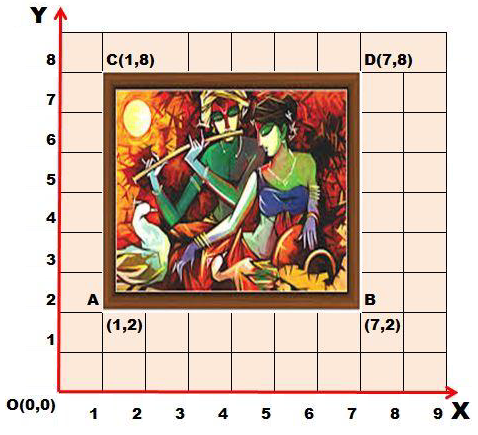
Rohit was putting up one of his paintings in his living room. Before this Rohit had put a grid on the wall where each unit measured equal to a foot. The upper$-$left corner of the frame is at point $C(1, 8)$ and the upper$-$right corner at $D(7, 8).$ The bottom$-$left corner is at $A(1, 2)$ and the bottom$-$right corner at $B(7, 2).$ Please answer the following questions:
$i.$ What is the width of the painting plus frame$?$
$a. 5$ feet
$b. 8$ feet
$c. 9$ feet
$d. 6$ feet
$ii.$ What is the length of the painting plus frame$?$
$a. 9$ feet
$b. 8$ feet
$c. 6$ feet
$d. 5$ feet
$iii.$ Which sides of the painting are parallel to $x-$axis$?$
$a. AB$ and $CD$
$c. AC$ and $BD$
$c.$ Diagonals $AD$ and $BC$
$d.$ No one
$iv.$ Which sides of the painting are parallel to $y-$axis$?$
$a. AB$ and $CD$
$b.AC$ and $BD$
$c.$ Diagonals $AC$ and $BD$
$d.$ No one
$v.$ Point $A, B, C$ and $D$ lie in which quadrant$?$
$a. I$
$b. II$
$c. III$
$d. IV$
Answer

$i$ $d$ $6$ feet
$ii$ $c$ $6$ feet
$iii$ $a$ $AB$ and $CD$
$iv$ $b$ $AC$ and $BD$
$v$ $a$ $I$

Need a full question paper?

Generate a complete, print-ready paper with questions like this in minutes — across 16+ boards, with answer keys.

Start Generating Free

Similar questions

Read the following text carefully and answer the questions that follow:
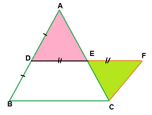
Haresh and Deep were trying to prove a theorem. For this they did the following
Image
$i.$ Draw a triangle $ABC$
$ii. \ D$ and E are found as the mid points of $AB$ and $AC$
$iii.\ DE$ was joined and $DE$ was extended to $F$ so $DE = EF$
$iv. \ FC$ was joined.
Questions :
$i. \triangle ADE$ and $\triangle EFC$ are congruent by which criteria?
$ii.$ Show that $C F \| A B$.
$iii.$ Show that $C F=B D$.
OR
Show that $D F=B C$ and $D F \| B C$.
Ravish and Aarushi dedcided to visit world book fair which is organised every year. During their visit Aarushi was fascinated by the cover page of a book with $\pi / e$ written on it. $\pi$ and e are mathematical constants. In Euclidean geometry $\pi$ is defined as the ratio of a circle's circumference to its diameter. It is also referred to as Archimede's constant. The constant e is known as Euler's number and it is the limiting value of $\left(1+\frac{1}{n}\right)^n$ as $n$ approches infinity. Using the knowledge of rational and irrational numbers answer the following questions.
(i) $\pi$ represents
(a) an integer
(b) a rational number
(c) an irrational number
(d) a natural number 
(ii) e represents
(a) a natural number
(b) an integer
(c) a rational number
(d) an irrational number 
(iii) The product of any two irrational numbers is
(a) always an irrational number $\quad$(b) not necessarily an irrational number $\quad$
(c) never an irrational number $\quad$ (d) always an integer $\quad$
(iv) A rational number between $\sqrt{2}$ and $\sqrt{3}$ is
(a) $\frac{\sqrt{3}-\sqrt{2}}{2}$$\quad$(b) $\frac{\sqrt{3}+\sqrt{2}}{2}$$\quad$(c) $1 . \overline{6}$ $\quad$(d) $0 . \overline{2}+0 . \overline{3}$$\quad$
Read the Source/ Text given below and answer these questions:

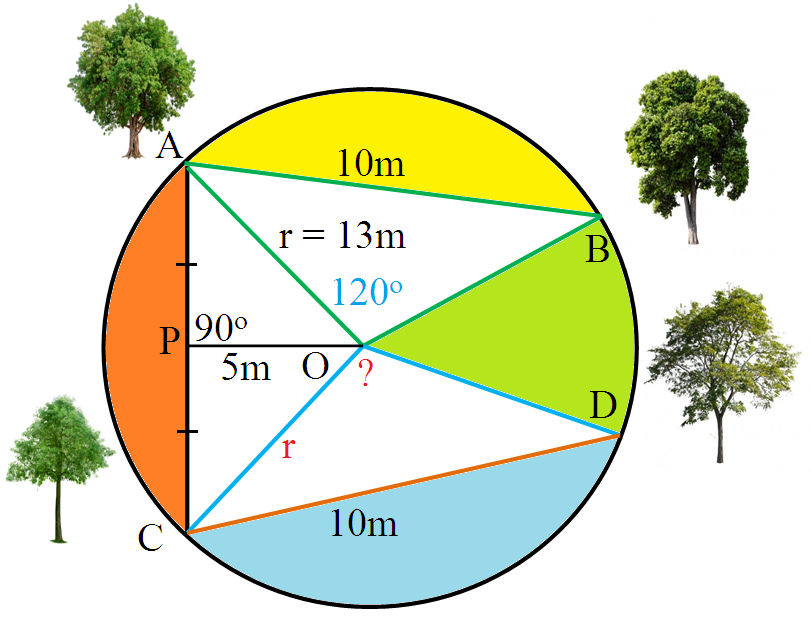
 A farmer has a circular garden as shown in the picture above. He has a different type of trees, plants and flower plants in his garden. In the garden, there are two mango trees $A$ and $B$ at a distance of $AB = 10m.$ Similarly, he has two Ashoka trees at the same distance of $10\ m$ as shown at $C$ and $D.\  AB$ subtends $\angle\text{AOB}=120^\circ$ at the center $O,$ The perpendicular distance of $AC$ from center is $5m$. The radius of the circle is $13\ m$. Now answer the following questions:
$i.$ What is the value of $\angle\text{COD}?$
$a. 60^\circ $
$b. 120^\circ $
$c. 100^\circ $
$d. 80^\circ $
$ii.$ What is the distance between mango tree $A$ and Ashok tree $C?$
$a. 12\ m$
$b. 24\ m$
$c. 13\ m$
$d. 15\ m$
$iii.$ What is the value of $\angle\text{OAB}?$
$a. 60^\circ $
$b. 120^\circ $
$c. 30^\circ $
$d. 90^\circ $
$iv.$ What is the value of $\angle\text{OCD?}$
$a. 30^\circ $
$b. 120^\circ $
$c. 60^\circ $
$d. 90^\circ $
$v.$ What is the value of $\angle\text{ODC}?$
$a. 90^\circ $
$b. 120^\circ $
$c. 60^\circ $
$d. 30^\circ $
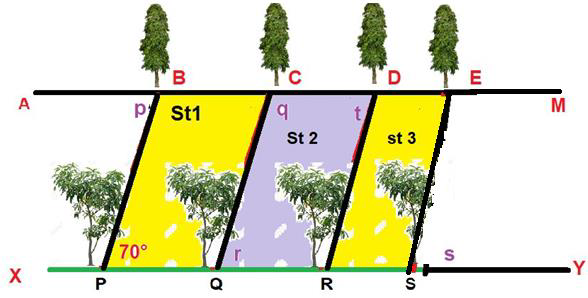
Read the Source/ Text given below and answer any four questions: There were two parallel roads $AM$ and $XY$ in New Delhi. Due to increasing pollution, $\text{MCD}$ planned to get planted trees on these roads. On the road $AM$, plants of Ashoka were planted by one company. While on the road $XY$ mango trees were planted by another company.

 Between these roads three streets $St_1, St_2$ and $St_3$​​​​​​​ were situated. During the survey, $\angle\text{BPQ}$ was measured to be $70^\circ$ and other angles $p, q, r, s$ and $t$ were also measured. Now answer the following questions:
$i.$ What is the measure of $\angle\text{p}?$
$a. 60^\circ$
$b. 70^\circ$
$c. 160^\circ$
$d. 100^\circ$
$ii.$ What is the measure of $\angle\text{q}?$
$a.60^\circ$
$b.70^\circ$
$c.160^\circ$
$d.110^\circ$
$iii.$ What is the value of $\frac{\text{p}+\text{q}+\text{t}}{5}?$
$a.50^\circ$
$b.70^\circ$
$c.160^\circ$
$d.100^\circ$
$iv.$ What is the measure of $\angle\text{EsY}?$
$a.60^\circ$
$b.140^\circ$
$c.70^\circ$
$d.110^\circ$
$v.$ What is value of ${4p - (q + r) - (r - s)}?$
$a.50^\circ$
$b.100^\circ$
$c.160^\circ$
$d.180^\circ$
Read the following text carefully and answer the questions that follow:
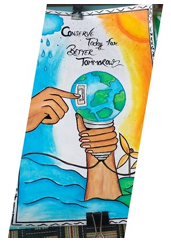
Harish makes a poster in the shape of a parallelogram on the topic $\text{SAVE ELECTRICITY}$ for an inter$-$school competition as shown in the follow figure.
Image
$i.$ If $\angle A =(4 x +3)^{\circ}$ and $\angle D =(5 x -3)^{\circ}$, then find the measure of $\angle B$.
$ii.$ If $\angle B =(2 y )^{\circ}$ and $\angle D =(3 y -6)^{\circ}$, then find the value of $y.$
$iii.$ If $\angle A=(2 x-3)^{\circ}$ and $\angle C=(4 y+2)^{\circ}$, then find how $x$ and $y$ relate.
OR
If $A B=(2 y-3)$ and $C D=5 \ cm$ then what is the value of $y$ ?
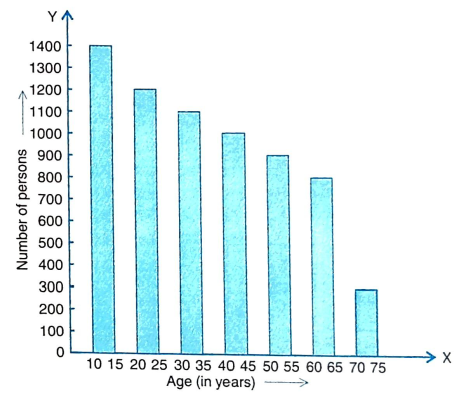
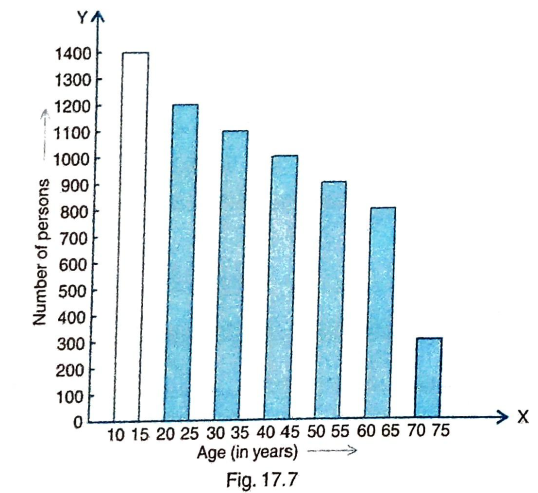
Population census in India is conducted every 10 years. The first complete census was taken in 1881 and the 15th decennial census was taken in 2011. The 16th decennial census was to be conducted in 2021 but due to COVID it will be taken in 2022. The data obtained from the census of a town has been represented by a bar graph shown in Fig. 17.2. It represents the number of persons in various age groups in the town. Observe the bar graph and answer the following questions:
Image

(i) What is the total number of persons living in the town in the age-groups 10-15 and 60 - 65?
(a) 2000$\quad$ (b) 2200$\quad$ (c) 2100$\quad$ (d) 1900
(ii) How many persons are more in the age-group 10 - 15 than in the age group 30-35?
(a) 200$\quad$ (b) 250$\quad$ (c) 300$\quad$ (d) 350
(iii) What is the total population of the town?
(a) 6700$\quad$ (b) 6400$\quad$ (c) 7700$\quad$ (d) 6600
(iv) What is the number of persons in the age-group 60-65?
(a) 900$\quad$ (b) 750$\quad$ (c) 850$\quad$ (d) 800
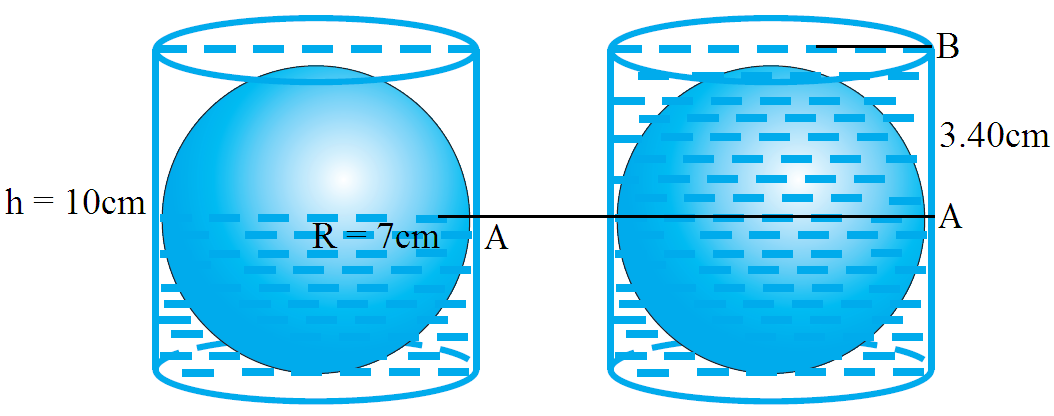
Read the passage given below and answer these questions: Dev was doing an experiment to find the radius $r$ of a sphere. For this he took a cylindrical container with radius $R = 7\ cm$ and height $10\ cm$. He filled the container almost half by water as shown in the left figure. Now he dropped the yellow sphere in the container. Now he observed as shown in the right figure the water level in the container raised from $A$ to $B$ equal to $3.40\ cm.$

$i.$ What is the approximate radius of the sphere?
$a. 7\ cm$
$b. 5\ cm$
$c. 4\ cm$
$d. 3\ cm$
$ ii.$ What is the volume of the cylinder?
$a. 700\ cm^3$
$b. 500\ cm^3$
$c. 1540\ cm^3$
$d. 2000\ cm^3$
$iii.$ What is the volume of the sphere?
$a. 700\ cm^3$
$b. 600\ cm^3$
$c. 500\ cm^3$
$d. 523.8\ cm^3$
$ iv.$ How many litres water can be filled in the full container? $($Take $1$ litre $= 1000\ cm^3):$
$a. 1.50$
$b. 1.44$
$c. 1.54$
$d. 2$
$v.$ What is the surface area of the sphere?
$a. 314.3\ m^2$
$b. 300\ m^2$
$c. 400\ m^2$
$d. 350\ m^2$
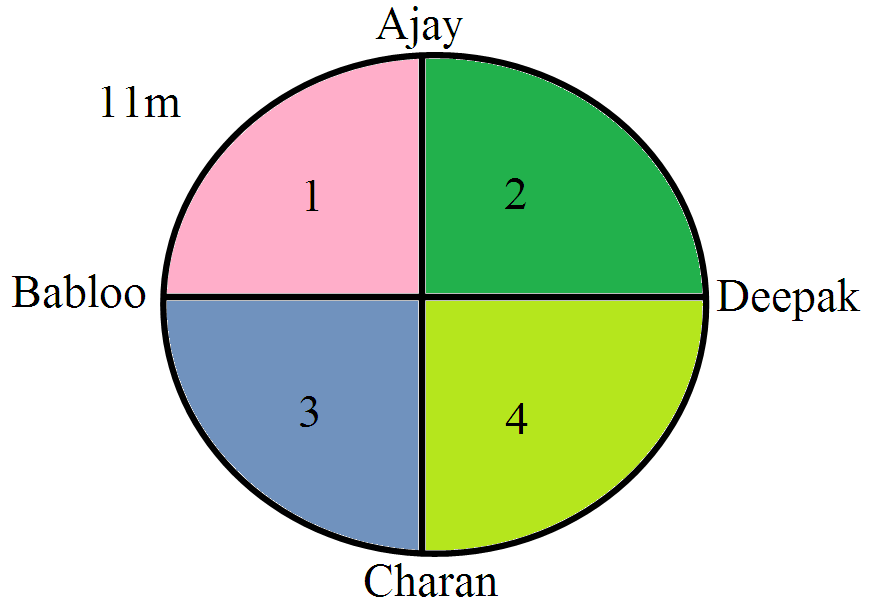
Read the Source/ Text given below and answer any four questions: Four students of class$ IX B$ with names Ajay, Babloo, Charan and Deepak are playing a game in a circular playground. All four students are holding radios with speaker and mic. These radios are connected by a wire of equal length that is $11\ m$ $($for each radio$)$. Ajay Asks a question to Babloo. If Babloo gives the correct answer he gets $10$ points and asks a new question to Charan, If he can not answer then he passes the same question to Charan and gets no points. These conditions apply to all four players. After $10$ rounds who gets maximum points, he becomes the winner.

$i.$ What is the radius of the field?
$a. 7\ m$
$b. 14\ m$
$c. 11\ m$
$d. 22\ m$
$ii.$ What is the area of the field?
$a. 70\ m^2$
$b. 154\ m^2$
$c. 110\ m^2$
$d. 220\ m^2$
$iii.$ What is the area of the part \ marked with 1 on the field?
$a. 50\ m^2$
$b. 154\ m^2$
$c. 76\ m^2$
$d. 38.5\ m^2$
$iv.$ What is the circu\ mference of the field?
$a. 22\ m$
$b. 14\ m$
$c. 44\ m$
$d. 28\ m$
4 What is the direct distance fro\ m Ajay to Charan?
$a. 7\ m$
$b. 28\ m$
$c. 15\ m$
$d. 14\ m$
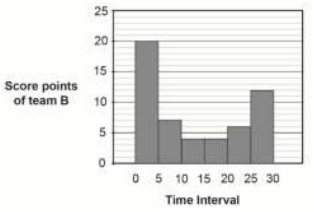
Draws a graphical representation of the points scored by team $B.$
His graphical representation is given below.
Image
$10.$ Suman says, “Arun’s graphical representation is not appropriate.”
Do you agree with Suman? Mention $YES$ or $NO.$ Give reason to justify your choice.