Question
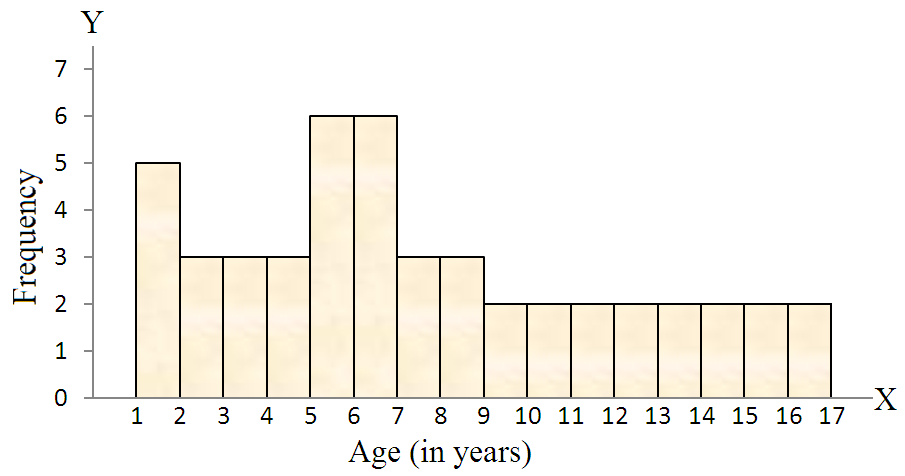
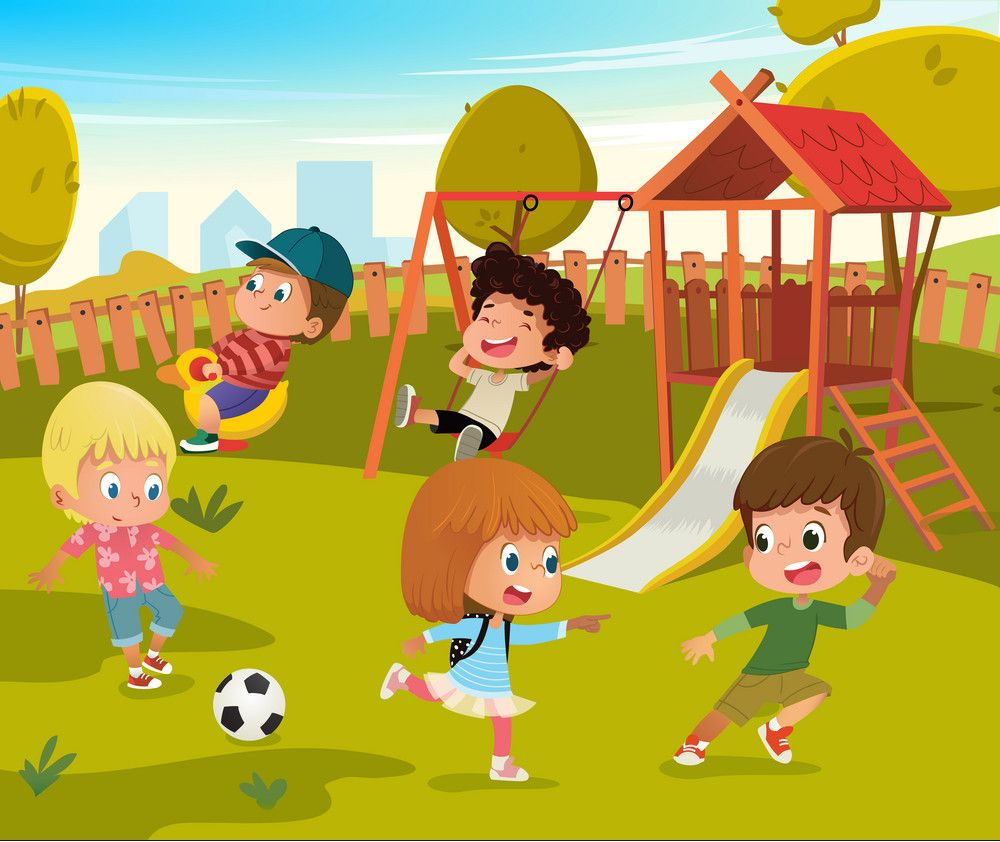
Read the Source Text given below and answer these questions: In an effort to provide high$-$quality and safe playgrounds for kids, our reputable manufacturers adhere to the playground safety guidelines set forth by the Indian Consumer Product Safety Commission $(\text{CPSC})$ and the Indian Society for Advancement of Materials and Processing Engineering $(\text{ISAMPE}).$ These organizations set the guidelines for determining the types of playground equipment that is appropriate for kids within specific age groups: $2-3$ years, $3-5$ years, $5-7$ years, $7-10$ years, $10-15$ years, and $15-17$ years. A random survey of the number of children of various age groups playing in a park was found as follows:
 
Age (in years)
Number of children
$1-2$
$5$
$2-3$
$3$
$3-5$
$6$
$5-7$
$12$
$7-10$
$9$
$10-15$
$10$ 
$15-17$
$4$
The histogram is as given below:
$i.$ In this question, the class sizes are different. So, calculate the adjusted frequency for each class by using the following formula:

Frequency density or adjusted frequency for class:

$a. \frac{\text{Minimum class size}}{\text{Class size of this class}}\times$ Its Frequency
$b. \frac{\text{Minimum class mark}}{\text{Class size of this class}}\times$ Its Frequency
$c. \frac{\text{Minimum Frequency}}{\text{Class size of this class}}\times$ Its class size
$d. \frac{\text{Minimum class mark}}{\text{Class mark of this class}}$
$ii.$ In this question the minimum class size is:
$a. 0$
$b. 1$
$c. 2$
$d. 3$
$iii.$ The class limits of third class interval $3-5:$
$a.$ Lower limit $= 5,$ upper limit $= 3$
$b.$ Lower limit $= 5,$ upper limit $= 7$
$c.$ Lower limit $= 3,$ upper limit $= 5$
$d. $Lower limit $= 7,$ upper limit $= 5$
$iv.$ Adjusted Frequency for class interval $5-7$ and $7-10:$
$a. 3, 6$
$b. 3, 3$
$c. 6, 6$
$d. 6, 3$
$v.$ Find the class mark of class $15 - 17:$
$a. 16$
$b. 12$
$c. 25$
$d. 2$
Answer

$(i)$ $(a)$ $\frac{\text{Minimum class size}}{\text{Class size of this class}}\times$Its Frequency
$(ii)$ $(b)$ $1$
$(iii)$ $(c)$ Lower limit $= 3,$ upper limit $= 5$
$(iv)$ $(d)$ $6, 3$
$(v)$ $(a)$ $16$

Need a full question paper?

Generate a complete, print-ready paper with questions like this in minutes — across 16+ boards, with answer keys.

Start Generating Free

Similar questions

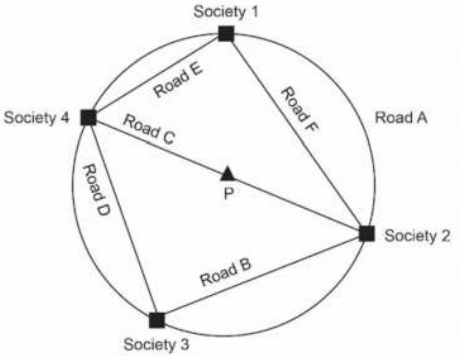
Two new roads, Road $E$ and Road $F$ were constructed between society $4$ and $1$ and society $1$ and $2.$Image
$5.$ What would be the measure of the sum of angles formed by the straight roads at society $1$ and society $3?$
$A. 60^\circ $
$B. 90^\circ $
$C. 180^\circ $
$D. 360^\circ $
$6.$ Krish says, “The distance to go from society $4$ to society $2$ using Road $D$ will be longer that the distance using Road $E”$
Is Krish correct$?$ Justify your answer with examples.
$7.$ Road $G,$ perpendicular to Road $F$ was constructed to connect the park and Road $F.$
Which of the following is true for Road $G$ and Road $F?$
$A.$ Road $G$ and road $F$ are of same length.
$B$. Road $F$ divides Road $G$ into two equal parts.
$C.$ Road $G$ divides Road $F$ into two equal parts.
$D.$ The length of road $G$ is one-fourth of the length of Road $F.$
$8.$ Priya said, “Minor arc corresponding to Road $B$ is congruent to minor arc corresponding to Road $D.”$ 
Do you agree with Priya$?$ Give reason to support your answer.
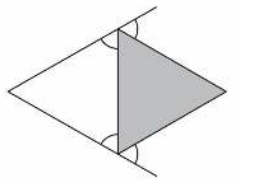
The figure below shows an equilateral triangle bounded by two straight lines.
Image
 What is the sum of the four marked angles$?$
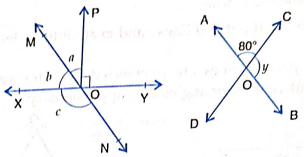
'Learning by doing' has great impact in teaching of Maths. Students also enjoy Mathematics by activity method. Mr. Paul, a Mathematics teacher has explained the topic of Lines and Angles by taking a very thin steel wire. He used steel wire and made some shapes at some specific angles and shown to students and asked questions.
Image
Choose the correct option in the following questions:
(i) What is the measure of $\angle B O D$ in figure?
(a) $90^{\circ}$$\quad$(b) $70^{\circ}$$\quad$(c) $80^{\circ}$$\quad$(d) $100^{\circ}$
(ii) What is measure of $\angle y$ in figure ?
(a) $110^{\circ}$$\quad$(b) $90^{\circ}$$\quad$(c) $140^{\circ}$$\quad$(d) $100^{\circ}$$\quad$
(iii) What is the measure of $\angle a$ and $\angle b$ respectively in Figure, if a : b = 2 : 3 and $O P \perp X Y$ ?
(a) $54^{\circ}, 36^{\circ}$$\quad$(b) $36^{\circ}, 54^{\circ}$$\quad$(c) $60^{\circ}, 90^{\circ}$$\quad$(d) $40^{\circ}, 60^{\circ}$
(iv) What is measure of $\angle c$ in figure ?
(a) $144^{\circ}$$\quad$(b) $90^{\circ}$$\quad$(c) $126^{\circ}$$\quad$(d) $120^{\circ}$
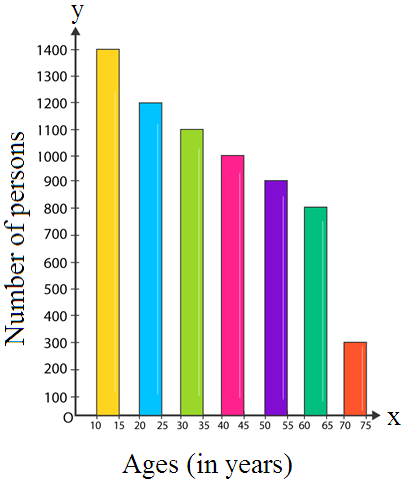
Read the Source Text given below and answer answer these questions: A healthcare survey was done by the state health and family welfare care board of the state of Punjab. The data is collected by forming age groups; i.e; $10-15, 20-25 ....$ and so on. The overall data from a town is given below in the form of a bar graph. Read the data carefully and answer the questions that follow.

$i.$ What is the percentage of the youngest age-group persons over those in the oldest age group$?$
$a. 400.56\%$
$b. 466.67\%$
$c. 500\%$
$d. 500.67\%$
$ii.$ What is the total population of the town$?$
$a. 6800$
$b. 7000$
$c. 6700$
$d. 6600$
$iii.$ How many persons are more in the age-group $10-15$ than in the age group $30-35?$
$a. 100$
$b. 200$
$c. 250$
$d. 300$
$iv.$ What is the age-group of exactly $1200$ persons living in the town$?$
$a. 20-25$
$b. 10-15$
$c. 15-20$
$d. 25-30$
$v.$ What is the total number of persons living in the town in the age$-$groups $10-15$ and $60-65?$
$a. 2100$
$b. 2000$
$c. 2200$
$d. 2400$
Read the Source/ Text given below and answer these questions: The following data given the weight (in grams) of $30$ oranges picked from a basket$:\ 106, 107, 76, 109, 187, 95, 125, 92, 70, 139, 128, 100, 88, 84, 99, 113, 204, 141, 136, 123, 90, 115, 110, 97, 90, 107, 75, 80,$ Frequency distribution table:
Class Interval
Tally marks
Frequency
$60 - 80$
$|||$
$3$
$80 - 100$
 
$||||\ ||||$
$10$
$100 - 120$
$||||\ ||||$
$9$
$120 - 140$
$||||$
$5$
$140 - 160$
$|$
$1$
$160 - 180$
$-$
$0$
$180 - 200$
$|$
$1$
$200 - 220$
$|$
$1$
Total
$30$
$30$

$i. $Class Size of given class data:
$a. 20$
$b. 10$
$c. 30$
$d. 15$
$ii.$ Classmark of forth class:
$a.70$
$b.130$
$c.20$
$d.15$
$iii.$ The number of oranges, whose weight is more than $180g:$
$a.1$
$b.3$
$c.2$
$d.4$
$iv.$ The number of oranges, whose weight is less than $100g:$
$a.10$
$b.3$
$c.5$
$d.13$
$v.$ The range of data is:
$a.70$
$204$
$c.134$
$d.274$
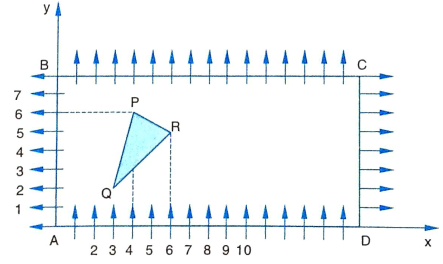
Class IX students of a school in Moti Nagar, Delhi have been allotted a rectangular plot of land, adjacent to their school, for gardening activity. Saplings of Gulmohar are planted on the boundary at a distance of 1 m from each other. There is a triangular grassy lawn in the plot as shown in Fig. The students are to sow seeds of flowering plants on the remaining area of the plot. Considering A as origin, AD along $x$-axis and AB along $y$-axis, answer the following questions:
Image
(i) The coordinates of A are
(a) $(0,1)$$\quad$(b) $(1,0)$$\quad$(c) $(0,0)$$\quad$(d) $(-1,-1)$
(ii) The coordinates of P are
(a) $(4,6)$$\quad$(b) $(6,4)$$\quad$(c) $(4,5)$$\quad$(d) $(5,4)$
(iii) The coordinates of R are
(a) $(6,5)$$\quad$(b) $(5,6)$$\quad$(c) $(6,0)$$\quad$(d) $(7,4)$
(iv) The coordinates of D are
(a) $(16,0)$$\quad$(b) $(6,0)$$\quad$(c) $(0,16)$$\quad$(d) $(16,1)$