Question
Read the Source/ Text given below and answer these questions:
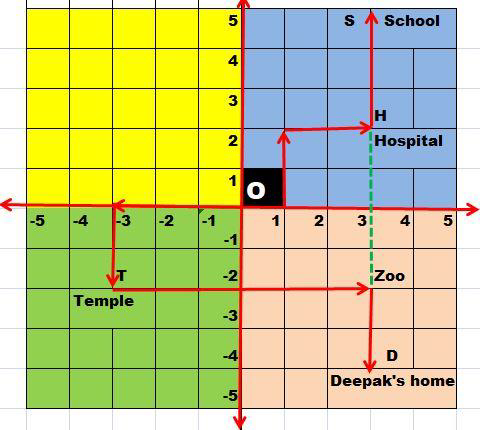
In the above picture, one small square is of size $1\ km \times 1\ km.$ From the starting point $O(0, 0)$ Deepak started to drive towards his home. He first drives $3\ km$ in left then he turned to his left and drove $2\ km,$ there he found a temple. He worshipped there and drove $6\ km$ in the left direction, there is a zoo and from the zoo, he drives $2\ km$ on the right side, then he reached his home. From $O$ Sanjay drove for his school, he drove $1\ km$ to his right then took a left turn and drives $2\ km$ then again took a right turn and drives $2\ km$. He found a hospital in the way. From Hospital he drove $3\ km$ and finally reached his school.
$i.$ What are the coordinates of the Hospital?
$a. (3, 2)$
$b. (2, 3)$
$c. (3, 3)$
$d. (5, 5)$
$ii.$ What is common abscissa of school, Hospital, Zoo and Deepak's home$?$
$a. 3$
$b. 5$
$c. -3$
$d. -5$
$iii.$ What is the common ordinate of temple and Zoo$?$
$a. 3$
$b. 5$
$c. -3$
$d. -2$
$iv.$ Deepak Drove in which quadrants$?$
$a. I$ and $II$
$b. II$ and $III$
$c. III$ and $IV$
$d. IV$ and $I$
$v.$ Sanjay Drove in which quadrants$?$
$a. I$ only
$b. II$ and $III$
$c. III$ and $IV$
$d. II$ and $I$
Answer

$(i)$ $(a)$ $(3, 2)$
$(ii)$ $(a)$ $3$
$(iii)$ $(d)$ $-2$
$(iv)$ $(c)$ $III $and $IV$
$(v)$ $(a)$ $I$ only

Need a full question paper?

Generate a complete, print-ready paper with questions like this in minutes — across 16+ boards, with answer keys.

Start Generating Free

Similar questions

Read the Source/ Text given below and answer these questions:

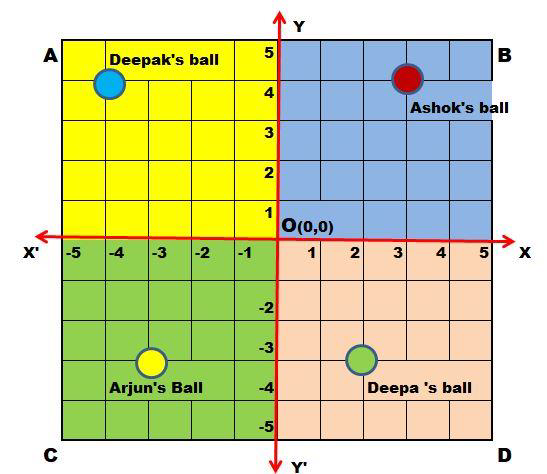
There is a square park $\text{ABCD}$ in the middle of Saket colony in Delhi.Four children Deepak, Ashok, Arjun and Deepa went to play with their balls. The colour of the ball of Ashok, Deepak, Arjun and Deepa are red, blue, yellow and green respectively. All four children roll their ball from centre point $O$ in the direction of $XOY, X'OY, X'OY'$ and $XOY'.$ Their balls stopped as shown in the above image. Answer the following questions:
$i.$ What are the coordinates of the ball of Ashok$?$
$a. (4, 3)$
$b. (3, 4)$
$c. (4, 4)$
$d. (3, 3)$
$ii.$ What are the coordinates of the ball of Deepa$?$
$a. (2, -3)$
$b. (3, 2)$
$c. (2, 3)$
$d. (2, 2)$
$iii.$ What the line $\text{XOX'}$ is called$?$
$a. y-$axis.
$b.$ ordinate.
$c. x-$axis.
$d.$ origin.
$iv.$  What the point $O(0, 0)$ is called$?$
$y-$axis.
ordinate.
$x-$axis.
origin.
$v.$ What is the ordinate of the ball of Arjun$?$
$a. -3$
$b. 3$
$c. 4$
$d. 2$
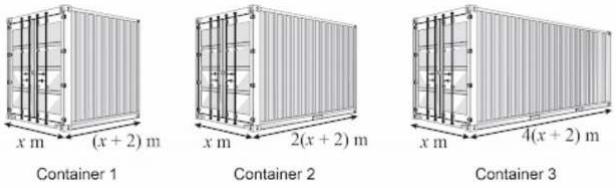
A shipment service provider uses three types of containers for shipping materials. The height and
width of the three containers are the same. The containers’ height is $0.15 m$ more than their width, and the volume of the smallest container is $652 m^3$
Image
$1.$ Write a polynomial relating Container $1’s$ length, breadth and height with its volume.
$2.$ Which of the following statements is true$?$
$A.$ The volume of the three containers is the same.
$B.$ The length of the three containers is the same.
$C.$ The volume of Container $3$ is $2,608 m^3.$
$D.$ The length of Container $3$ is $4$ times the length of Container $2.$
$3.$ What is the height of each container$?$
Read the following text carefully and answer the questions that follow:
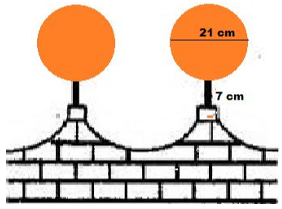
The front compound wall of a house is decorated by wooden spheres of diameter $21 \ cm,$ placed on small supports as shown in figure. $25$ such spheres are used for this purpose and are to be painted silver. Each support is a cylinder and is to be painted black.
Image
$i.$ what will be the total surface area of the spheres all around the wall?
$ii$. Find the cost of orange paint required if this paint costs $20$ paise per $\ cm^2$.
$iii.$ How much orange paint in liters is required for painting the supports if the paint required is $3 ml$ per $\ cm^2$ ?
OR
What will be the volume of total spheres all around the wall?
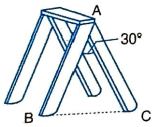
A ladder manufacturing company manufactures foldable step ladders of aluminum as shown in Fig. The lengths of two legs AB and AC are both equal to 110 cm and the angle between the two legs is $30^{\circ}$. On the basis of the above information answer the following questions:
Image
(i) $\angle A B C$ is equal to
(a) $70^{\circ}$ $\quad$(b) $75^{\circ}$(c) $85^{\circ}$ $\quad$(d) $60^{\circ}$
(ii) If $\angle B A C=60^{\circ}$, then $B C=$
(a) 120 cm $\quad$(b) 55 cm $\quad$(c) 110 cm $\quad$(d) 100 cm
(iii) $\triangle A B C$ is
(a) isosceles acute angled $\quad$ (b) right angled isosceles
(c) isosceles obtuse angled$\quad$(d) equilateral
(iv) In two triangles ABC and DEF, if $\angle A=\angle D, A B=D E$ and $A C=D F$, then the criterion by which two triangles are congruent is
(a) SSS $\quad$(b) ASA $\quad$(c) AAS $\quad$(d) SAS
 A number line consists of an ininite number of points. Points on it are associated with a rational
number.
Khushi says – ‘A point on the number line can represent different forms of a rational number.’
Akash says – ‘I think each point represents a unique rational number.’
Who is correct? Give an example to support your argument.
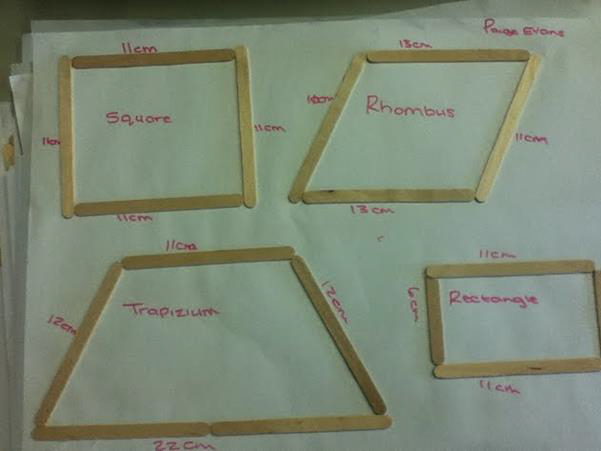
Read the Source/ Text given below and answer any four questions: During Maths Lab Activity each student was given four broomsticks of lengths $8\ cm, 8\ cm, 5\ cm, 5\ cm$ to make different types of quadrilaterals.

Using the above information answer the following questions:
$i.$ How many quadrilaterals can be formed using these sticks?
$a.$ Only One type of quadrilaterals can be formed.
$b.$ Two types of quadrilaterals can be formed.
$c.$ Three types of quadrilaterals can be formed.
$d.$ Four types of quadrilaterals can be formed.
$ii.$ Name the types of quadrilaterals formed:
$a.$Rectangle, parallelogram, kite.
$b.$ Rectangle, parallelogram, Trapizum.
$c.$, parallelogram, Square.
$d.$Rectangle, Square, kite.
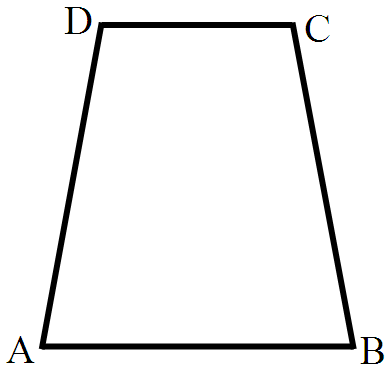
$iii.$ In a trapezium $\text{ABCD}, DC \| AB$ and $\angle\text{A}=\angle\text{B}=45^\circ,$ the teacher asked the student to find $\angle\text{D}.$ Naresh answered it is $...........$

$a. 105^\circ $
$b.108^\circ $
$c.135^\circ $
$d. 125^\circ $
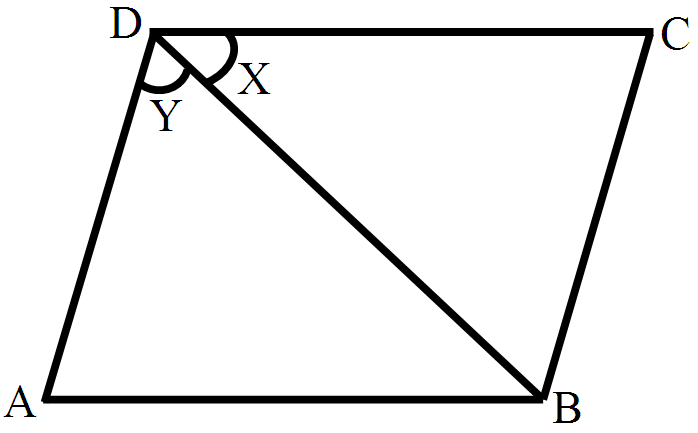
While discussing the properties of a parallelogram teacher asked about the relation between two angles x and y of a parallelogram as shown in fig. The teacher gave them $4$ options as $($if $BC < CD):$

$a.x > y$
$b. x < y$
$c.x = y$
$d.$None of these.
$P, Q, R,$ and $S$ are respectively the mid-points of sides $AB, BC, CD,$ and $DA$ of quadrilateral $ABCD$ in which $AC = BD$ and $\text{AC}\bot\text{BD}, \text{PQRS},$ is a:
$a.$ Square.
$b.$ Rhombus.
$c.$Kite.
$d.$Parallelogram.
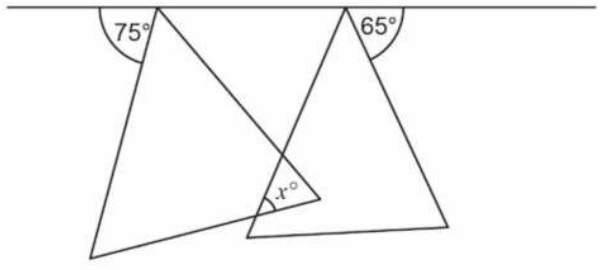
Two equilateral triangles on a straight line are shown below.What is the measure of $ 'x\ ’?$​​​​​​​
Image
 
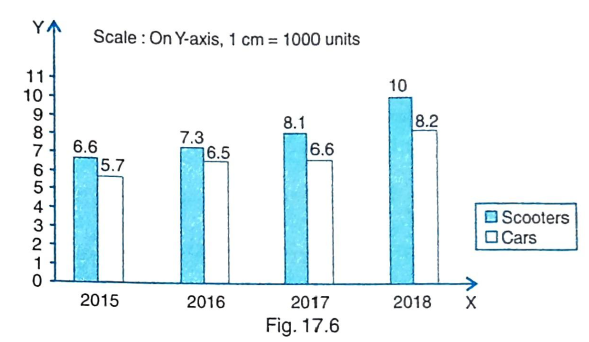
Read the following bar graph and answer the following questions:
Image
(i) In which year was the difference between the sales of the scooters and the sales of cars the least?
(a) 2015(\quad$ (b) 2016(\quad$ (c) 2017(\quad$ (d) 2018
(ii) Total number of vehicles (scooters and cars) sold in the year 2015 and 2016 was
(a) 26,100$\quad$ (b) 28,500$\quad$ (c) 25,100$\quad$ (d) 27,500
(iii) The maximum difference between the sales of scooters and cars, in any year, in the given period was
(a) 1500$\quad$ (b) 1700$\quad$ (c) 1800$\quad$ (d) 2000
(iv) The total number of scooters sold in the four years was
(a) 26,000$\quad$ (b) 27,000$\quad$ (c) 31,000$\quad$ (d) 32,000
(v) The ratio between the total number of vehicles sold (scooters and cars) in the year 2016 and that in the year 2018.
(a) 41:46$\quad$ (b) 69:91$\quad$ (c) 147:182$\quad$ (d) 46:49
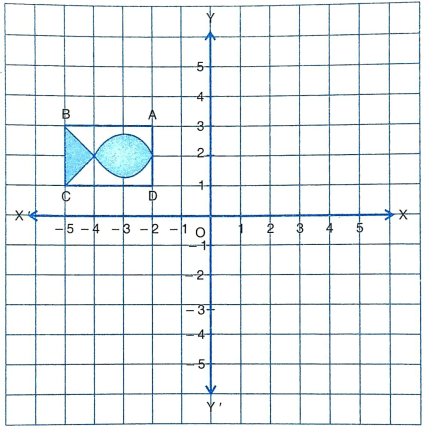
For Maths integrated project, Sonia created a symmetrical design on Cartesian plain. She drew a fish in a rectangle ABCD in the 2nd quadrant as shown in figure.
Image
Based on the above information, answer the following questions:
(i) Find the sum of abscissa of points A and B.
(ii) Find the area of rectangle ABCD.
(iii) What will be the new coordinates of A, B, C and D to draw the reflection of fish in the $3^{\text {rd }}$ quadrant across $x$-axis.
(iv) What will be the new coordinates of A, B, C and D to draw the fish by shifting each vertex of the rectangle 5 units to the right.
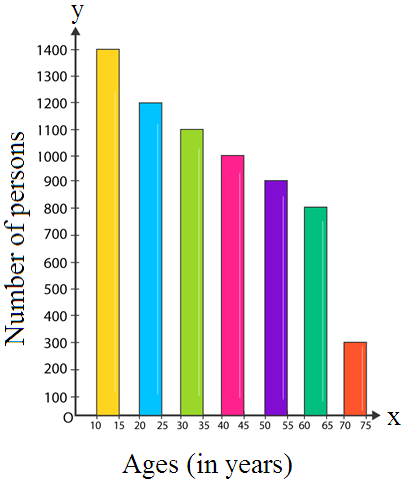
Read the Source Text given below and answer answer these questions: A healthcare survey was done by the state health and family welfare care board of the state of Punjab. The data is collected by forming age groups; i.e; $10-15, 20-25 ....$ and so on. The overall data from a town is given below in the form of a bar graph. Read the data carefully and answer the questions that follow.

$i.$ What is the percentage of the youngest age-group persons over those in the oldest age group$?$
$a. 400.56\%$
$b. 466.67\%$
$c. 500\%$
$d. 500.67\%$
$ii.$ What is the total population of the town$?$
$a. 6800$
$b. 7000$
$c. 6700$
$d. 6600$
$iii.$ How many persons are more in the age-group $10-15$ than in the age group $30-35?$
$a. 100$
$b. 200$
$c. 250$
$d. 300$
$iv.$ What is the age-group of exactly $1200$ persons living in the town$?$
$a. 20-25$
$b. 10-15$
$c. 15-20$
$d. 25-30$
$v.$ What is the total number of persons living in the town in the age$-$groups $10-15$ and $60-65?$
$a. 2100$
$b. 2000$
$c. 2200$
$d. 2400$