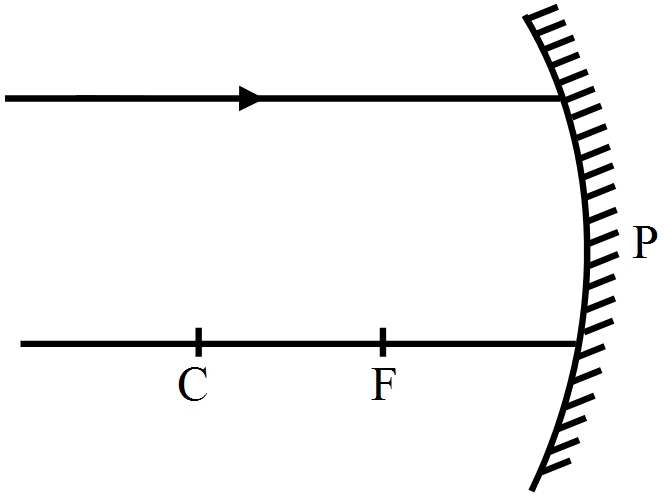
Redraw the following diagram on your answer sheet and show the path of the reflected ray. Also mark the angle of incidence $(\angle\text{i})$ and the angle of reflection $(\angle\text{r})$ on the diagram.
Download our app for free and get started
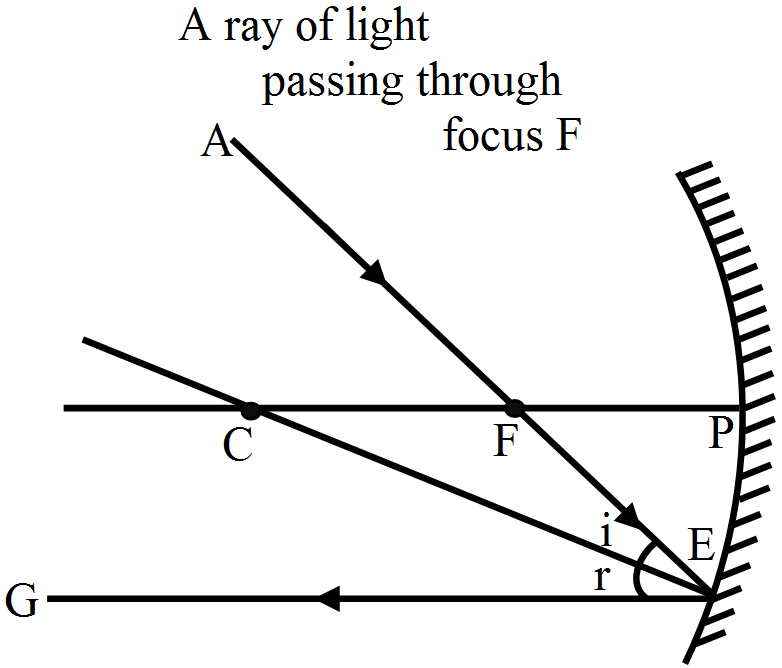
When a ray of light passes through the focus of a concave mirror then it becomes parallel to the principal axis. Here incident ray AE is passing through the focus F of concave mirror and strikes the mirror at E, then it gets reflected through path EG parallel to the axis. Also, Angle of incidence = angle of reflection$\angle\text{i}=\angle\text{r}$

Download our appand get started for free
Experience the future of education. Simply download our apps or reach out to us for more information. Let's shape the future of learning together!No signup needed.*
Similar Questions
- 1View SolutionList two properties of the images formed by convex mirrors. Draw ray diagram in support of your answer.
- 2View SolutionWhen an object is placed at a distance of 15cm from a concave mirror, its image is formed at 10cm in front of the mirror. Calculate the focal length of the mirror.
- 3The velocity of light in water is $\frac{3}{4}$ times the velocity of light in vacuum. Find the refractive index of water.View Solution
- 4View Solution‘‘A concave mirror of focal length 15cm can form a magnified erect as well as inverted image of an object placed in front of it.’’ Justify this statement stating the position of the object with respect to the pole of the mirror in both cases for obtaining the images.
- 5View SolutionDraw a diagram to represent a convex mirror. On this diagram mark principal axis, principal focus F and the centre of curvature C if the focal length of convex mirror is 3cm.
- 6View SolutionDiscuss the case when a convex lens forms a virtual and enlarged image.
- 7View SolutionAn object is placed at a distance of 15 cm from a concave lens of focal length 30 cm. List four characteristics (nature, position, etc.) of the image formed by the lens.
- 8View SolutionA lens has power 4D. Find the focal length that lens.
- 9View SolutionA lens is cut into two equal halves: Along the principal axis.
What will be the focallength of each half? - 10View SolutionThe boy walks towards the mirror at a speed of 1m/ s. At what speed does his image approach him?