A lens is cut into two equal halves: Along the principal axis.
What will be the focallength of each half?
What will be the focallength of each half?
Download our app for free and get started
If the lens can be cut on the principal axis and then there is no change in length of the focus of lens because the radius of curvature will remain the same, hence the focal length will remain unchanged.

Download our appand get started for free
Experience the future of education. Simply download our apps or reach out to us for more information. Let's shape the future of learning together!No signup needed.*
Similar Questions
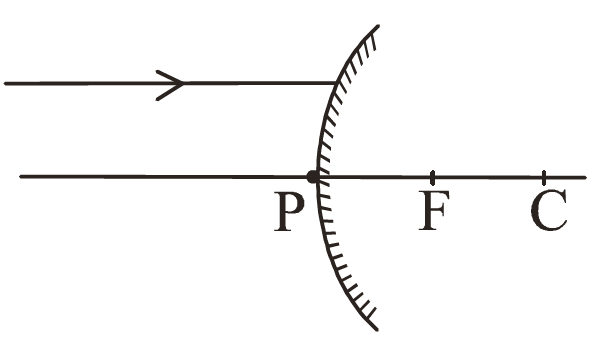
- 1View SolutionA ray of light is incident on a convex mirror as shown. Redraw the diagram and complete the path of this ray after reflection from the mirror. Mark angle of incidence and angle of reflection on it.
- 2View SolutionA boy with a mouth 5cm wide stands 2m away from a plane mirror. Where is his image and how wide is the image of his mouth?
- 3View SolutionDraw ray diagrams showing the image formation by a concave lens when an object is placed:
At the focus of the lens. - 4View SolutionWhere must the object be placed for the image formed by a converging lens to be:
- Real, inverted and smaller than the object?
- Real, inverted and same size as the object?
- Real, inverted and larger than the object?
- Virtual, upright and larger than the object?
- 5Light enters from air to glass having refractive index 1.50. What is the speed of light in the glass? The speed of light in vacuum is $3 \times 10^8 m s ^{-1}$.View Solution
- 6View SolutionWhat type of lens is shown in the diagram on the right? What will happen to the parallel rays of light? Show by completing the ray diagram.
- 7Light travels through air at 300 million $ms ^{-1}$. On entering water it slows down to 225 million $ms ^{-1}$. Calculate the refractive index of water.View Solution
- 8View SolutionA doctor has prescribed a corrective lens of power, -1.5D. Find the focal length of the lens. Is the prescribed lens diverging or converging?
- 9View SolutionName the two types of spherical mirrors. What type of mirror is represented by the:
- Back side of a shining steel spoon?
- Front side of a shining steel spoon?
- 10View SolutionTo find-the image-distance for varying object-distances in case of a convex lens, a student obtains on a screen a sharp image of a bright object placed very far from the lens. After that he gradually moves the object towards the lens and each time focuses its image of the screen.
- In which direction - towards or away from the lens, does he move the screen to focus the object?
- What happens to the size of the image - does it increase or decrease?
- What happen when he moves the object very close to the lens?