MCQ
Reduction of aromatic nitro compounds using $Fe$ and $\text{HCl}$ gives __________.
  • A
    Aromatic oxime.
  • B
    Aromatic hydrocarbon.
  • Aromatic primary amine.
  • D
    Aromatic amide.

Answer

Correct option: C.
Aromatic primary amine.

Need a full question paper?

Generate a complete, print-ready paper with questions like this in minutes — across 16+ boards, with answer keys.

Start Generating Free

Similar questions

$C{H_3} - C{H_2} - OH\xrightarrow{{PCC}}A\xrightarrow{{HCN}}B\xrightarrow[\Delta ]{{{H_3}\mathop O\limits^ +  }}C$ 

compound $'C'$ is

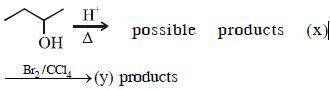
The number of possible products for $x$ and $y$ is
If the rate constant for a first order reaction is $\mathrm{k}$, the time $(t)$ required for the completion of $99 \%$ of the reaction is given by
During the nuclear explosion, one of the products is $^{90}  \mathrm{Sr}$ with half life of $6.93$ years. if $1 \;\mu g$ of $^{90} \mathrm{Sr}$ was absorbed in the bones of a newly born baby in place of $Ca$, how much time, in years, is required to reduce it by $90 \%$ if it is not lost metabolically
The beta and alpha glucose have different specific rotations. When either is dissolved in water, their rotation changes until the same fixed value results. This is called
The mass of copper deposited from a solution of $CuS{O_4}$ by passage of $ 5 A$ current for $965$ second is ............ $\mathrm{g}$ (Mol. wt. of Copper $= 63.5$)
Which of the following statements are true?
$a.$ Only type of interactions between particles of noble gases are due to weak dispersion forces.
$b.$ Ionisation enthalpy of molecular oxygen is very close to that of xenon.
$c.$ Hydrolysis of $\ce{XeF_6}$ is a redox reaction.
$d.$ Xenon fluorides are not reactive.
Which does not show mutarotation
There is very little difference in acid strength in the series ${H_3}P{O_4},$ ${H_3}P{O_3},$ and ${H_3}P{O_2}$ because
$\underset{\begin{smallmatrix} 
 symmetrical \\ 
 Ketone 
\end{smallmatrix}}{\mathop{(A)}}\,\xrightarrow{LiAl{{H}_{4}}}(B)\xrightarrow[\Delta ]{{{H}^{\oplus }}}Diastereomers$

Reactent $(A)$ is