MCQ
Relation between velocity and displacement is $v = x^2$. Find acceleration at $x = 3m$ :- ............. $\mathrm{m/s}^{2}$
  • A
    $6$
  • B
    $27$
  • $54$
  • D
    $0$

Answer

Correct option: C.
$54$
c
$\mathrm{v}=\mathrm{x}^{2}$

$\frac{\mathrm{dV}}{\mathrm{dx}}=2 \mathrm{x}$

$\frac{\mathrm{vdv}}{\mathrm{dx}}=\mathrm{v} \cdot 2 \mathrm{x}$

$a=2 v x=2 x^{2} x$

${a=2 x^{3}}$

${a=2(3)^{3}}$

${a=54 \mathrm{m} / \mathrm{s}^{2}}$

Need a full question paper?

Generate a complete, print-ready paper with questions like this in minutes — across 16+ boards, with answer keys.
Start Generating Free

Similar questions

When an ideal triatomic non-linear gas is heated at constant pressure, the fraction of the heat energy supplied which increases the internal energy of the gas is
The equation E = pc is valid:
  1. For an electron as well as for a photon.
  2. For an electron but not for a photon.
  3. For a photon but not for an electron.
  4. Neither for an electron nor for a photon.
An ideal gas is enclosed in a cylinder at pressure of $2\,atm$ and temperature, $300\,K.$ The mean time between two successive collisions is $6 \times 10^{-8}\, s.$ If the pressure is doubled and temperature is increased to $500\,K,$ the mean time between two successive collisions will be close to
If $L = 2.331\, cm$, $B = 2.1\, cm$, then $L + B =$
For a sphere of a given material, the value of the moment of inertia I about its diameter depends on its radius R
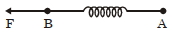
Two masses $A$ and $B ,$ each of mass $M$ are fixed together by a massless spring. $A$ force acts on the mass $B$ as shown in figure. If the mass $A$ starts moving away from mass $B$ with acceleration $'a',$ then the acceleration of mass $B$ wil be :-
A car changes speed from $18\,km/h$ to $36\,km/h$ in $5\,s$. The diameter of its wheel is $0.8\,m$ . The angular acceleration of the wheel is ........ $rad/s^2$
If the distance covered by an object is directly proportional to time, then we can say that the object :
A proton exerts a force on a proton which is:
  1. Gravitational.
  2. Electromagnetic.
  3. Nuclear.
  4. Weak.
A gas is suddenly compressed to one fourth of its original volume. What will be its final pressure, if its initial pressure is $P$