Question
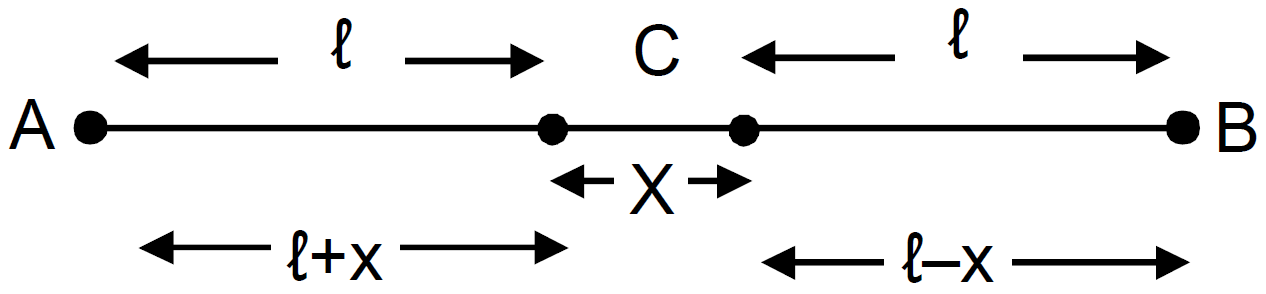
Repeat the previous problem if the particle C is displaced through a distance x along the line AB.
Answer


$\text{F}_\text{AC}=\frac{\text{KQq}}{(\ell+\text{x})^2}$
$\text{F}_\text{CA}=\frac{\text{KQq}}{(\ell-\text{x})^2}$
Net force $=\text{KQq}\Big[\frac{1}{(\ell-\text{x})^2}-\frac{1}{(\ell-\text{x})^2}\Big]$
$=\text{KQq}\bigg[\frac{(\ell+\text{x})^2-(\ell-\text{x})^2}{(\ell+\text{x})^2(\ell-\text{x})^2}\bigg]$
$=\text{KQq}\bigg[\frac{4\ell\text{x}}{(\ell^2-\text{x}^2)^2}\bigg]$
$\text{x}<<<\text{l}=\frac{\text{d}}{2}$ neglecting x w.r.t. $\ell$ We get
net $\text{F}=\frac{\text{KQq}4\ell\text{x}}{\ell^4}=\frac{\text{KQq}4\text{x}}{\ell^3}$ acceleration $=\frac{4\text{KQqx}}{\text{m}\ell^3}$
Time period $=2\pi\sqrt{\frac{\text{displacement}}{\text{acceleration}}}$
$=2\pi\sqrt{\frac{\text{xm}\ell^3}{4\text{KQqx}}}$
$=2\pi\sqrt{\frac{\text{m}\ell^3}{4\text{KQq}}}$
$=\sqrt{\frac{4\pi^2\text{m}\ell^34\pi\in_0}{4\text{Qq}}}$
$=\sqrt{\frac{4\pi^3\text{m}\ell^3\in_0}{\text{Qq}}}$
$=\sqrt{4\pi^3\text{md}^3\in_08\text{Qq}}$
$=\bigg[\frac{\pi^3\text{md}^3\in_0}{2\text{Qq}}\bigg]^{\frac{1}{2}}$

Need a full question paper?

Generate a complete, print-ready paper with questions like this in minutes — across 16+ boards, with answer keys.
Start Generating Free

Similar questions

A compound microscope consists of an objective lens of focal length $2.0 \ cm$ and an eyepiece of focal length $6.25 \ cm$ separated by a distance of $15 \ cm$. How far from the objective should an object be placed in order to obtain the final image at
(a) the least distance of distinct vision $(25 \ cm),$ and
(b) at infinity? What is the magnifying power of the microscope in each case?
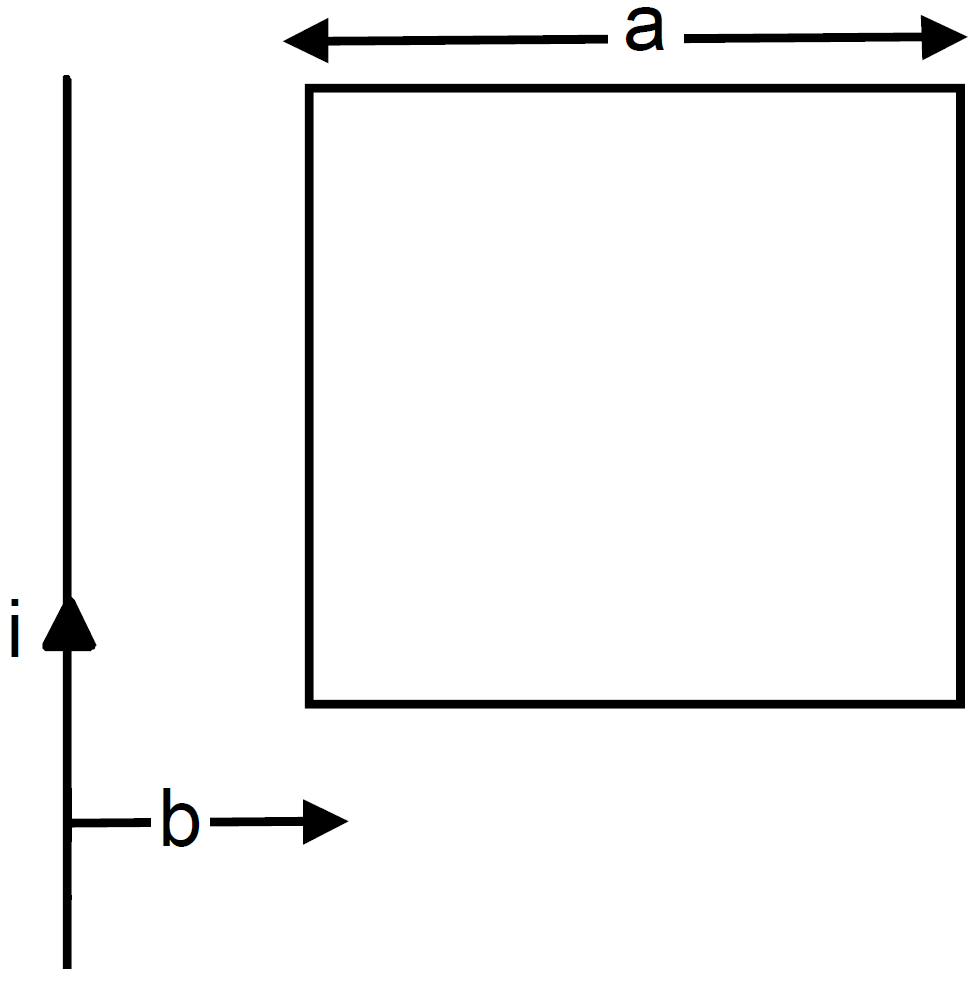
Find the mutual inductance between the straight wire and the square loop of figure.
Crystal diffraction experiments can be performed using $X-$rays, or electrons accelerated through appropriate voltage. Which probe has greater energy? $($For quantitative comparison, take the wavelength of the probe equal to $1 \mathring A ,$ which is of the order of inter$-$atomic spacing in the lattice$) (m^e = 9.11 \times 10^{–31} \ kg).$
A neutron star has a density equal to that of the nuclear matter. Assuming the star to be spherical, find the radius of a neutron star whose mass is $4.0 \times 10^{30}kg ($twice the mass of the sun$).$
Derive the expression for the magnetic field at the site of a point nucleus in a hydrogen atom due to the circular motion of the electron. Assume that the atom is in its ground state and give the answer in terms of fundamental constants.
The current in a discharging LR circuit without the battery drops from 2.0A to 1.0A in 0.10s.
  1. Find the time constant of the circuit.
  2. If the inductance of the circuit is 4.0H, what is its resistance?
A person is standing on a truck moving with a constant velocity of $14.7m/$s on a horizontal road. The man throws a ball in such a way that it returns to the truck after the truck has moved $58.8\ m$. Find the speed and the angle of projection:
  1. As seen from the truck.
  2. As seen from the road.
A disc of radius R is cut out from a larger disc of radius 2R in such a way that the edge of the hole touches the edge of the disc. Locate the centre of mass of the residual disc.
Two wires are kept tight between the same pair of supports. The tensions in the wires are in the ratio $2 : 1$, the radii are in the ratio $3 : 1$ and the densities are in the ratio $1 :2.$ Find the ratio of their fundamental frequencies.
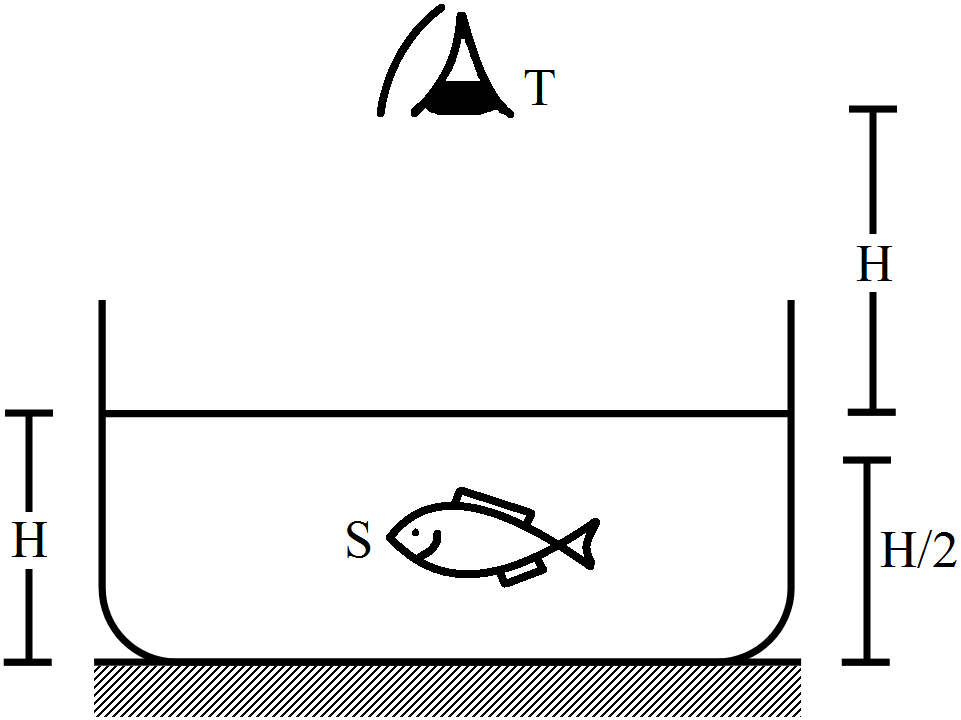
Consider the situation in figure. The bottom of the pot is a reflecting plane mirror, S is a small fish and T is a human eye. Refractive index of water is.
  1. At what distance(s) from itself will the fish see the image(s) of the eye?
  2. At what distance(s) from itself will the eye see the image(s) of the fish.