Question 15 Marks
Suppose the second charge in the previous problem is $-1.0 \times 10^{-6}C.$ Locate the position where a third charge will not experience a net force.
Answer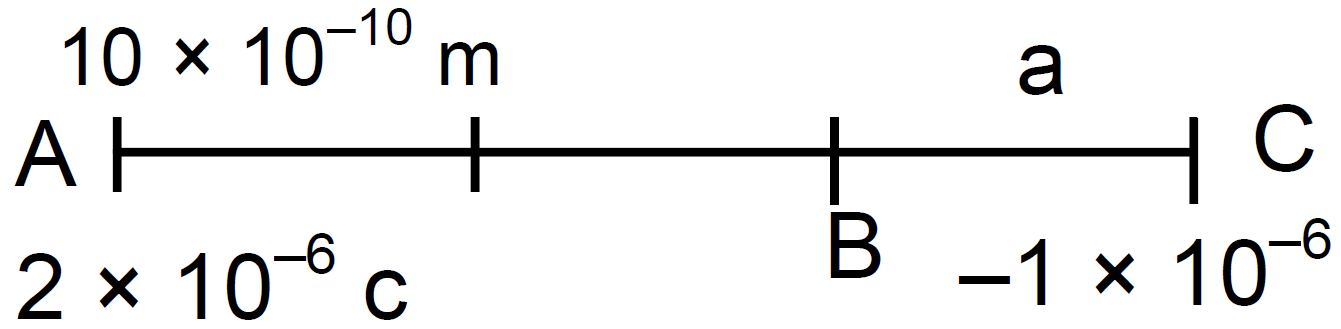
By coulomb's Law, force,
$\text{F}=\frac{1}{4\pi\epsilon_0}\frac{\text{Q}_1\text{Q}_2}{\text{r}_2}$
So, force on charge $q$ due to $q_1,$
$\text{F}=\frac{9\times10^{9}\times2.0\times10^{-6}\times\text{q}}{\text{x}^2}$
Force on charge $q$ due to $q_2$
$\text{F}'=\frac{9\times10^9\times10^{-6}\times\text{q}}{(10-\text{x})^2}$
According to the question,
$\Rightarrow\text{F}-\text{F}'=0$
$\Rightarrow\frac{9\times10^{9}\times2.0\times10^{-6}\times\text{q}}{\text{x}^2}=\frac{9\times10^9\times10^{-6}\times\text{q}}{(\text{x}-10)^2}$
$\Rightarrow\text{x}^2=2(\text{x}-10)^2$
$\Rightarrow\text{x}^2-40\text{x}+200=0$
$\Rightarrow\text{x}=20\pm10\sqrt{2}\text{m}$
$\Rightarrow\text{x}=34.14\text{cm}$ $\Big(\because\ \text{x}\neq20-10\sqrt{2}\Big)$ View full question & answer→Question 25 Marks
Two particles A and B having charges q and 2q respectively are placed on a smooth table with a separation d. A third particle C is to be clamped on the table in such a way that the particles A and B remain at rest on the table under electrical forces. What should be the charge on C and where should it be clamped?
Answer
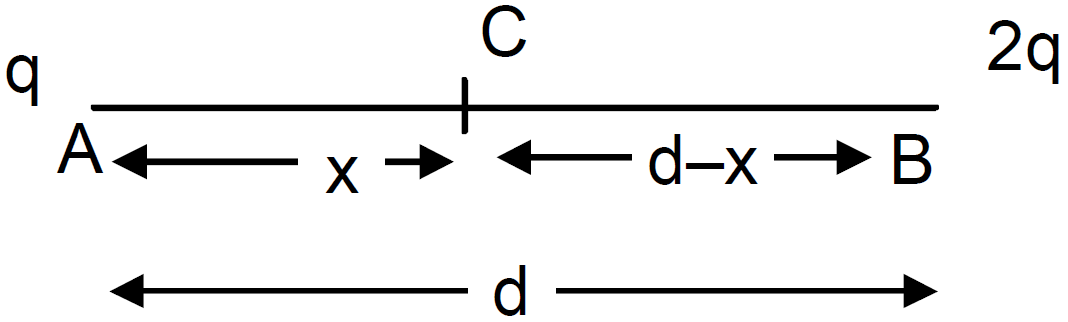 Let the charge on C = q
So, net force on c is equal to zero
So, $\text{F}_{\overline{\text{AC}}}+\text{F}_{\overline{\text{BA}}}=0,$
But $\text{F}_{\overline{\text{AC}}}=\text{F}_{\overline{\text{BC}}}$
$\Rightarrow\frac{\text{kqQ}}{\text{x}^2}=\frac{\text{k}2\text{qQ}}{(\text{d}-\text{x})^2}$
$\Rightarrow2\text{x}^2=(\text{d}-\text{x})^2$
$\Rightarrow\sqrt{2}\text{x}=\text{d}-\text{x}$
$\Rightarrow\text{x}=\frac{\text{d}}{\sqrt{2}+1}$
$=\frac{\text{d}}{\big(\sqrt{2}+1\big)}\times\frac{\big(\sqrt{2}-1\big)}{\big(\sqrt{2}-1\big)}$
$=\text{d}\big(\sqrt{2}-1\big)$
For the charge on rest, $\text{F}_\text{AC}+\text{F}_\text{AB}=0$
$(2.414)^2\frac{\text{kqQ}}{\text{d}^2}+\frac{\text{kq}(2\text{q})}{\text{d}^2}=0$
$\Rightarrow\frac{\text{kq}}{\text{d}^2}\big[(2.414)^2\text{Q}+2\text{q}\big]=0$
$\Rightarrow2\text{q}=-(2.414)^2\text{Q}$
$\Rightarrow\text{Q}=\frac{2}{-\big(\sqrt{2}+1\big)^2}\text{q}$
$=-\Big(\frac{2}{3+2\sqrt{2}}\Big)\text{q}$
$=-(0.343)\text{q}$
$=-\big(6-4\sqrt{2}\big)$ View full question & answer→Question 35 Marks
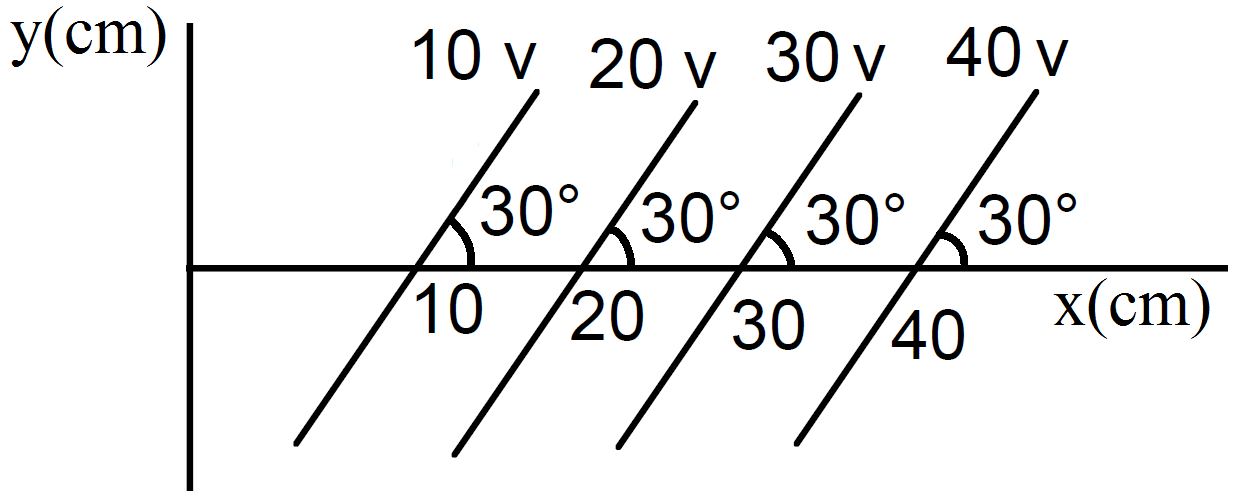
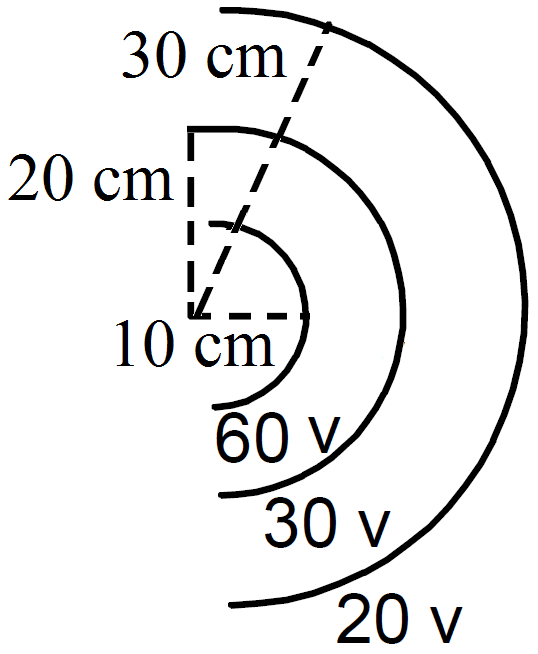
Some equipotential surfaces are shown in figure. What can you say about the magnitude and the direction of the electric field?
Answer
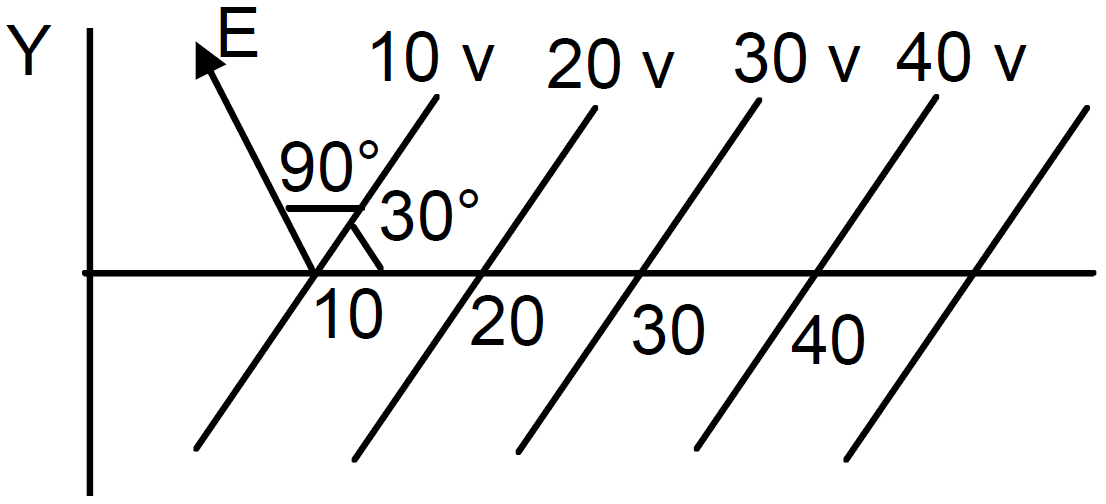
- The angle between potential $\text{E}=\text{d}\ell=\text{dv}$
Change in potential $= 10\text{V}=\text{dV}$
As $\text{E}=\bot\text{r}\text{dV} ($As potential surface$)$
So, $\text{E}(10\times10^{-2})$
$\Rightarrow\text{E}\text{d}\ell\cos(90^\circ+30^\circ)=-\text{dv}$
$\Rightarrow\text{E}=\frac{-\text{dV}}{10\times10^{-2}\cos120^\circ}$
$=-\frac{10}{10^{-1}\times\Big(\frac{-1}{2}\Big)}$
$=200\text{V/m}$ making an angle $120^\circ$ with $y-$axis
- As Electric field intensity is $\bot\text{r}$ to Potential surface
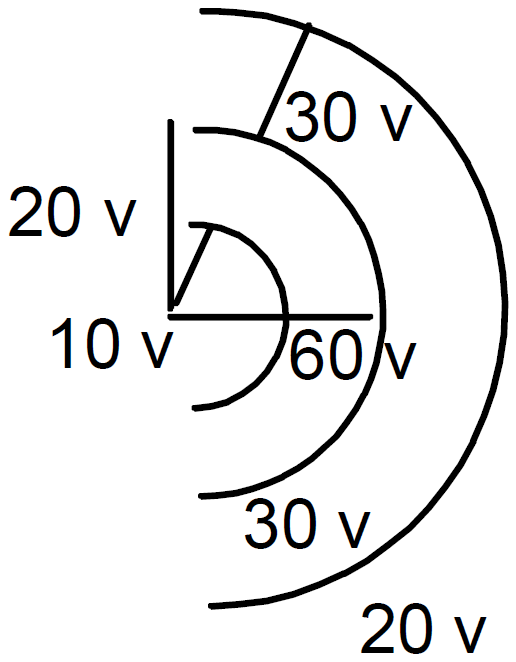
So, $\text{E}=\frac{\text{kq}}{\text{r}^2}\text{r}=\frac{\text{kq}}{\text{r}}$
$\Rightarrow\frac{\text{kq}}{\text{r}}=60\text{v}$
$\text{q}=\frac{6}{\text{K}}$
So, $\text{E}=\frac{\text{kq}}{\text{r}^2}$
$=\frac{6\times\text{k}}{\text{k}\times\text{r}^2}\text{v.m}$
$=\frac{6}{\text{r}^2}\text{v.m}$ View full question & answer→Question 45 Marks
Two identical pith balls, each carrying a charge q, are suspended from a common point by two strings of equal length l. Find the mass of each ball if the angle between the strings is $2\theta$ in equilibrium.
Answer
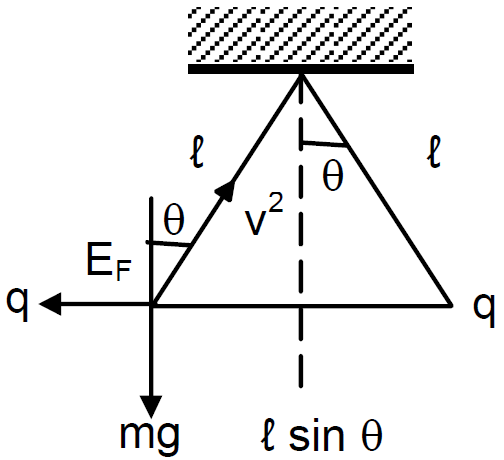 Electric force $=\frac{\text{kq}^2}{(\ell\sin\text{Q}+\ell\sin\text{Q})^2}$
$=\frac{\text{kq}^2}{4\ell^2\sin^2}$
So, $\text{T}\cos\theta=\text{ms}$ (For equilibrium) $\text{T}\sin\theta=\text{Ef},$
$\text{tan}\theta=\frac{\text{Ef}}{\text{mg}}$
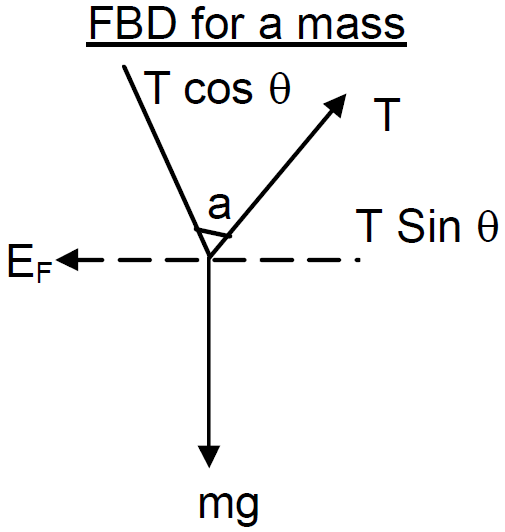
$\Rightarrow\text{mg}=\text{Ef}\cot\theta$
$=\frac{\text{kq}^2}{4\ell^2\sin^2\theta}\cot\theta$
$=\frac{\text{q}^2\cot\theta}{\ell^2\sin^2\theta16\pi\text{E}_0}$
$\text{m}=\frac{\text{q}^2\cot\theta}{16\pi\text{E}_0\ell^2\sin^2\theta\text{g}}\text{unit}$ View full question & answer→Question 55 Marks
Repeat the previous problem if the particle C is displaced through a distance x along the line AB.
Answer
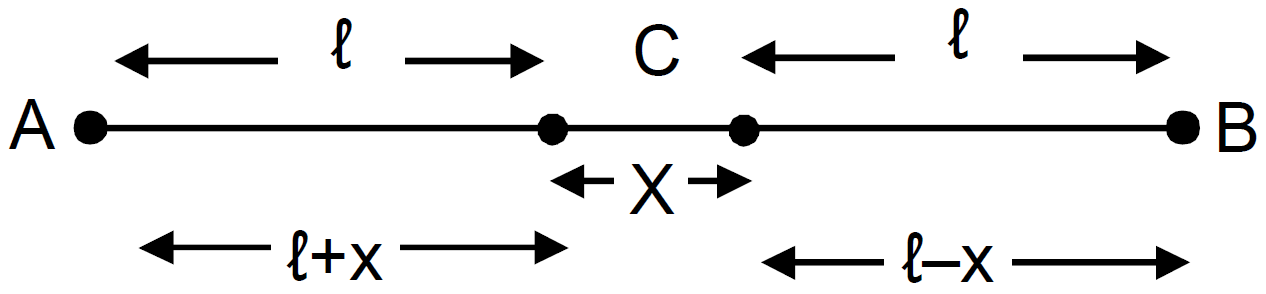 $\text{F}_\text{AC}=\frac{\text{KQq}}{(\ell+\text{x})^2}$
$\text{F}_\text{CA}=\frac{\text{KQq}}{(\ell-\text{x})^2}$
Net force $=\text{KQq}\Big[\frac{1}{(\ell-\text{x})^2}-\frac{1}{(\ell-\text{x})^2}\Big]$
$=\text{KQq}\bigg[\frac{(\ell+\text{x})^2-(\ell-\text{x})^2}{(\ell+\text{x})^2(\ell-\text{x})^2}\bigg]$
$=\text{KQq}\bigg[\frac{4\ell\text{x}}{(\ell^2-\text{x}^2)^2}\bigg]$
$\text{x}<<<\text{l}=\frac{\text{d}}{2}$ neglecting x w.r.t. $\ell$ We get
net $\text{F}=\frac{\text{KQq}4\ell\text{x}}{\ell^4}=\frac{\text{KQq}4\text{x}}{\ell^3}$ acceleration $=\frac{4\text{KQqx}}{\text{m}\ell^3}$
Time period $=2\pi\sqrt{\frac{\text{displacement}}{\text{acceleration}}}$
$=2\pi\sqrt{\frac{\text{xm}\ell^3}{4\text{KQqx}}}$
$=2\pi\sqrt{\frac{\text{m}\ell^3}{4\text{KQq}}}$
$=\sqrt{\frac{4\pi^2\text{m}\ell^34\pi\in_0}{4\text{Qq}}}$
$=\sqrt{\frac{4\pi^3\text{m}\ell^3\in_0}{\text{Qq}}}$
$=\sqrt{4\pi^3\text{md}^3\in_08\text{Qq}}$
$=\bigg[\frac{\pi^3\text{md}^3\in_0}{2\text{Qq}}\bigg]^{\frac{1}{2}}$ View full question & answer→Question 65 Marks
Two identical pith balls are charged by rubbing against each other. They are suspended from a horizontal rod through two strings of length $20\ cm$ each, the separation between the suspension points being $5\ cm.$ In equilibrium, the separation between the balls is $3\ cm.$ Find the mass of each ball and the tension in the strings. The charge on each ball has a magnitude $2.0 \times 10^{-8}C.$
Answer
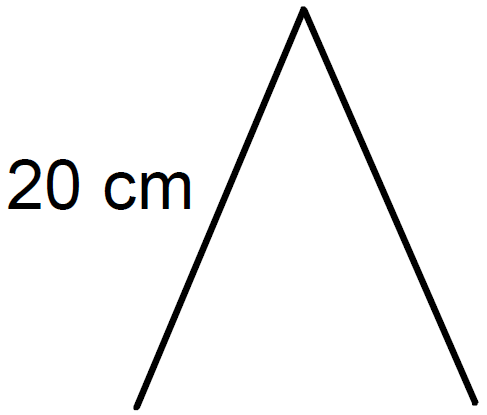 $\text{q}=2.0\times10^{-8}\text{c},\ \text{n}=?,\ \sin\theta=\frac{1}{20}$
Force between the charges
$\text{F}=\frac{\text{Kq}_1\text{q}_2}{\text{r}^2}$
$=\frac{9\times10^9\times2\times10^{-8}\times2\times10^{-8}}{\big(3\times10^{-2}\big)^2}$
$=4\times10^{-3}\text{N}$
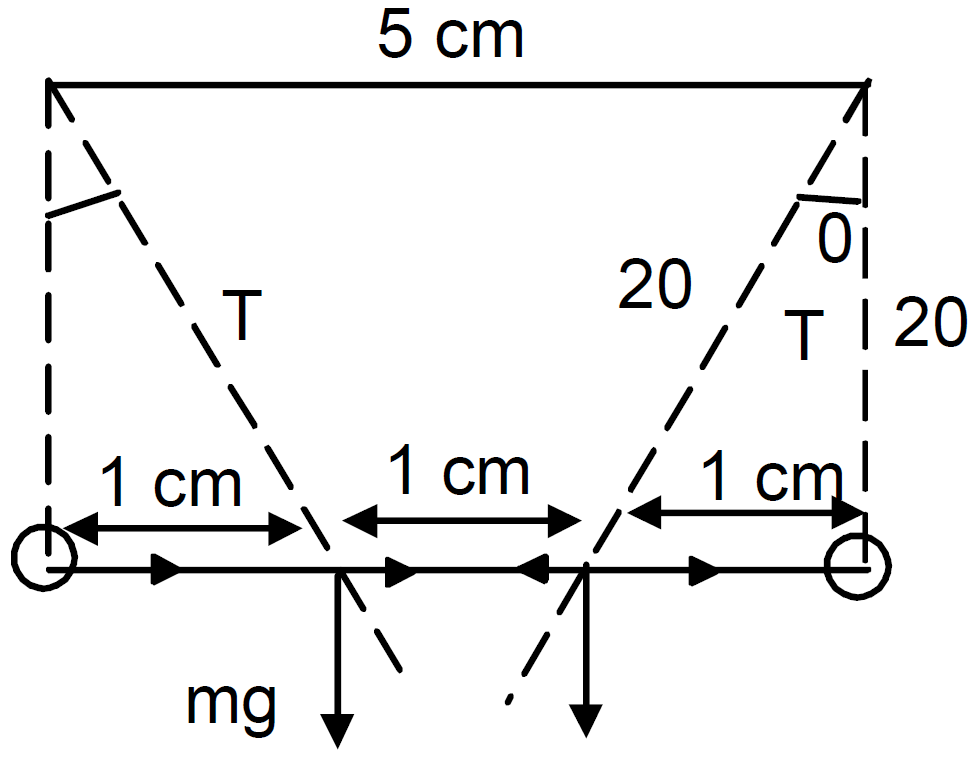
$\text{mg}\sin\theta=\text{F}$
$\Rightarrow\text{m}=\frac{\text{F}}{\text{g}\sin\theta}$
$=\frac{4\times10^{-3}}{10\times\Big(\frac{1}{20}\Big)}$
$=8\times10^{-3}$
$=8\text{gm}$
$\cos\theta=\sqrt{1-\sin^2\theta}$
$=\sqrt{1-\frac{1}{400}}$
$=\sqrt{\frac{400-1}{400}}$
$=0.99=1$
So, $\text{T}=\text{mg}\cos\theta$
$\text{T}=8\times10^{-3}10\times0.99$
$=8\times10^{-2}\text{M}$ View full question & answer→Question 75 Marks
A particle A having a charge of $2.0 \times 10^{-6}C$ and a mass of $100g$ is placed at the bottom of a smooth inclined plane of inclination $30^\circ $. Where should another particle B, having same charge and mass, be placed on the incline so that it may remain in equilibrium?
Answer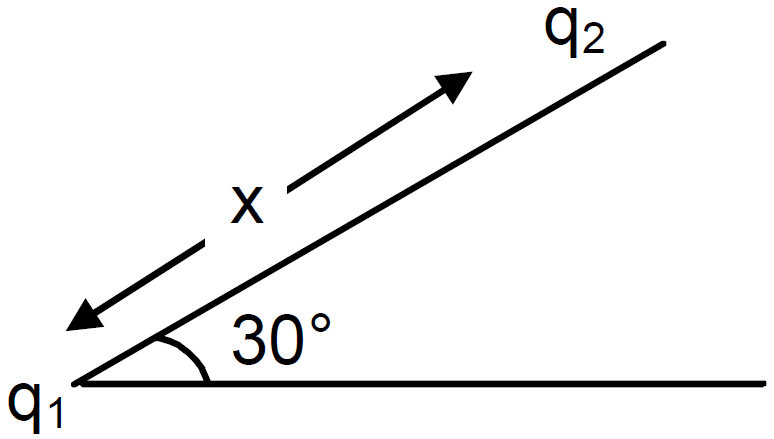
$\text{q}_1=2\times10^{-6}\text{c}$ Let the distance be $r$ unit
$\therefore\text{F}_\text{repulsion}=\frac{\text{kq}_1\text{q}_2}{\text{r}^2}$
For equilibrium $\frac{\text{kq}_1\text{q}_2}{\text{r}^2}=\text{mg}\sin\theta$
$\Rightarrow\frac{9\times10^9\times4\times10^{-12}}{\text{r}^2}=\text{m}\times9.8\times\frac{1}{2}$
$\Rightarrow\text{r}^2=\frac{18\times4\times10^{-3}}{\text{m}\times9.8}$
$=\frac{72\times10^{-3}}{9.8\times10^{-1}}$
$=7.34\times10^{-2}$ metre
$\Rightarrow\text{r}=2.70924\times10^{-1}$ metre from the bottom View full question & answer→Question 85 Marks
A particle of mass $1g$ and charge $2.5 \times 10^{-4}C$ is released from rest in an electric field of $1.2 \times 10^4NC^{-1}.$
- Find the electric force and the force of gravity acting on this particle. Can one of these forces be neglected in comparison with the other for approximate analysis?
- How long will it take for the particle to travel a distance of $40\ cm?$
- What will be the speed of the particle after travelling this distance?
- How much is the work done by the electric force on the particle during this period?
Answer$\text{m}=1\text{g}=10^{-3},\ \text{u}=0$ $\text{q}=2.5\times10^{-4}\text{C};\ \text{E}=1.2\times10^4\text{N/c};\ \text{S}=40\text{cm}=4\times10^{-1}\text{m}$
- $\text{F}=\text{qE}=2.5\times10^{-4}\times1.2\times10^4=3\text{N}$
So, $\text{a}=\frac{\text{F}}{\text{m}}$
$=\frac{3}{10^{-3}}$
$=3\times10^3$
$\text{E}_\text{q}=\text{mg}=10^{-3}\times9.8\times10^{-3}\text{N}$
- $\text{S}=\frac{1}{2}\text{at}^2$
$\text{t}=\sqrt{\frac{2\text{a}}{9}}$
$=\sqrt{\frac{2\times4\times10^{-1}}{3\times10^{3}}}$
$=1.63\times10^{-2}\text{sec}$
- $\text{v}^2=\text{u}^2+2\text{as}$
$=0+2\times3\times10^3\times4\times10^{-1}$
$=24\times10^2$
$\Rightarrow\text{v}=\sqrt{24\times10^2}$
$4.9\times10=49\text{m/sec}$
- Work done by the electric force $\text{w}=\text{F}\rightarrow\text{td}$
$=3\times4\times10^{-1}$
$=12\times10^{-1}$
$=1.2\text{J}$ View full question & answer→Question 95 Marks
The electric potential existing m space is V(x, y, z) = A(xy + yz + zx).
- Write the dimensional formula of A.
- Find the expression for the electric field.
- If A is 10 SI units, find the magnitude of the electric field at (1m, 1m, 1m).
Answer$\text{V}\text{(x, y, z)}=\text{A}\text{(xy + yz + zx)}$
- $\text{A}=\frac{\text{Volt}}{\text{m}^2}$
$=\frac{\text{ML}^2\text{T}^2}{\text{ITL}^2}$
$\big[\text{MT}^{-3}\text{I}^{-1}\big]$
- $\text{E}=\frac{\delta\text{V}\hat{\text{i}}}{\delta\text{x}}-\frac{\delta\text{V}\hat{\text{j}}}{\delta\text{y}}-\frac{\delta\text{V}\hat{\text{k}}}{\delta\text{z}}$
$=-\Big[\frac{\delta}{\delta\text{y}}\text{A}(\text{xy}+\text{yz}+\text{zx})+\frac{\delta}{\delta\text{y}}\text{A}(\text{xy}+\text{yz}+\text{zx})+\frac{\delta}{\delta\text{z}}\text{A}(\text{xy}+\text{yz}+\text{zx})\Big]$
$=-\Big[(\text{ay}+\text{Az})\hat{\text{i}}+(\text{Ax}+\text{Az})\hat{\text{i}}+(\text{Ax}+\text{Az})\hat{\text{j}}+(\text{Ay}+\text{Ax})\hat{\text{k}}\Big]$
$=-\text{A}(\text{y}+\text{z})\hat{\text{i}}+\text{A}(\text{x}+\text{z})\hat{\text{j}}+\text{A}(\text{y}+\text{x})\hat{\text{k}}$
- $\text{A}=10\text{SI unit},\ \text{r}=(1\text{m},1\text{m},1\text{m})$
$\text{E}=-10(2)\hat{\text{i}}-10(2)\hat{\text{j}}-10(2)\hat{\text{ik}}$
$=\sqrt{20^2+20^2+20^2}$
$=\sqrt{1200}$
$=34.64\approx35\text{N/C}$ View full question & answer→Question 105 Marks
An electric field of magnitude $1000NC^{-1}$ is produced between two parallel plates having a separation of $2.0\ cm$ as shown in figure.
- What is the potential difference between the plates?
- With what minimum speed should an electron be projected from the lower plate in the direction of the field so that it may reach the upper plate?
- Suppose the electron is projected from the lower plate with the speed calculated in part $(b).$ The direction of projection makes an angle of $60^\circ$ with the field. Find the maximum height reached by the electron.
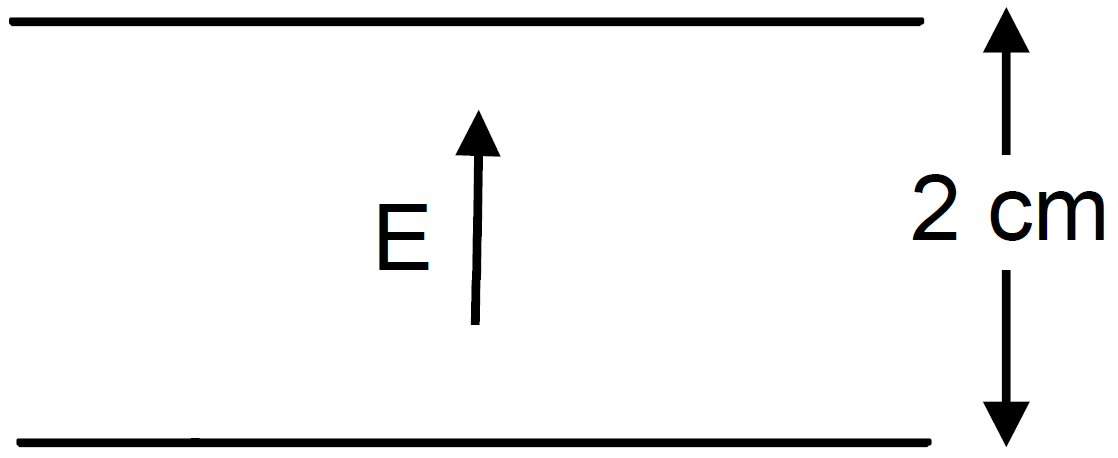
Answer$\vec{\text{E}}=100\text{N/C}$ 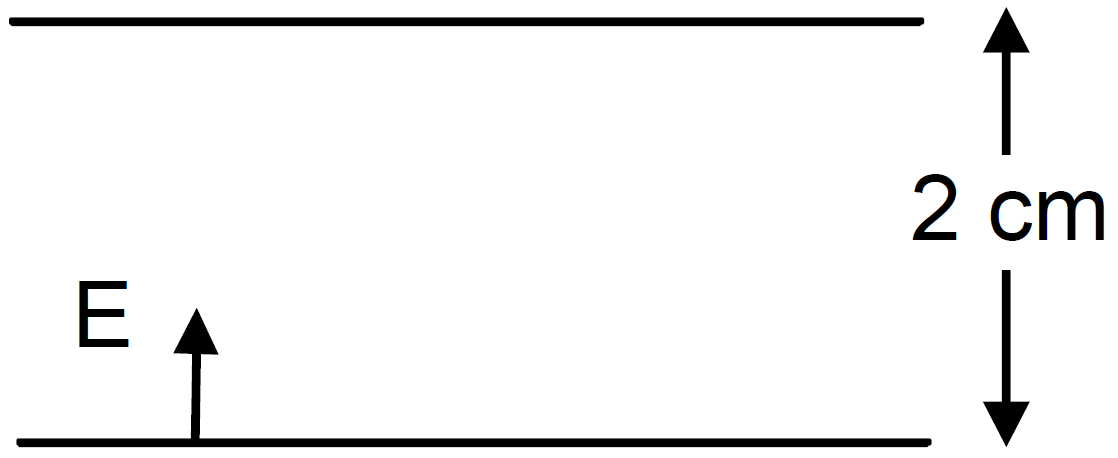
- $\text{V}=\text{E}\times\text{d}\ell$
$=1000\times\frac{2}{100}$
$=20\text{V}$
- $\text{u}=?,\ \vec{\text{E}}=1000,$
$=\frac{2}{100}\text{m}$
$\text{a}=\frac{\text{F}}{\text{m}}$
$=\frac{\text{q}\times\text{E}}{\text{m}}$
$=\frac{1.6\times10^{-19}\times1000}{9.1\times10^{-31}}$
$=1.75\times10^{14}\text{m/s}^2$
$0=\text{u}^2-2\times1.75\times10^{14}\times0.02$
$\Rightarrow\text{u}^2=0.04\times1.75\times10^{14}$
$\Rightarrow\text{u}=2.64\times10^6\text{m/s}.$
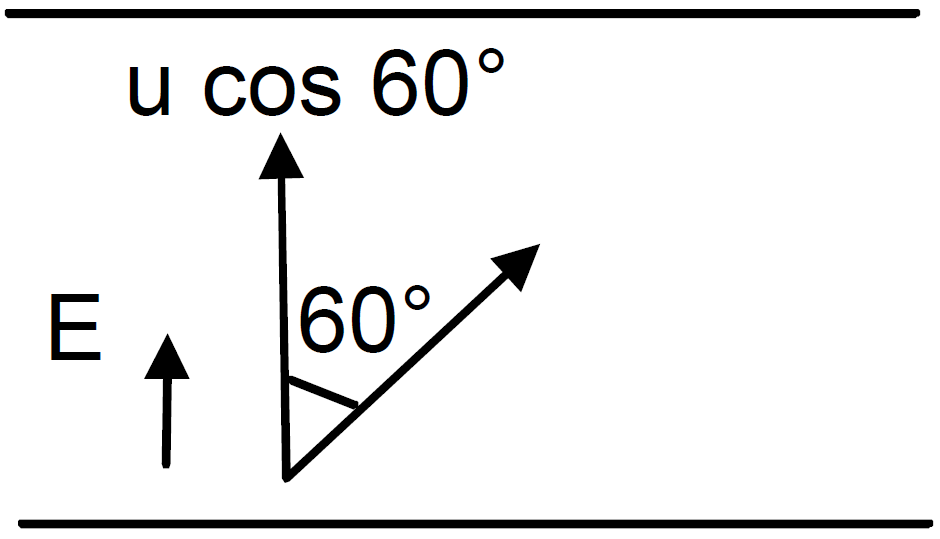
- Now, $\text{U}=\text{u}\cos60^\circ,\ \text{V}=0,\ \text{s}=?$
$\text{a}=1.75\times10^{14}\text{m/s}^2,\ \text{V}^2=\text{u}^2-2\text{as}$
$\Rightarrow\text{s}=\frac{(\text{u}\cos60^\circ)}{2\times\text{a}}$
$=\frac{\Big(2.64\times10^6\times\frac{1}{2}\Big)^2}{2\times1.75\times10^{14}}$
$=\frac{1.75\times10^{12}}{3.5\times10^{14}}$
$=0.497\times10^{-2}\approx0.005\text{m}\approx0.50\text{cm}$ View full question & answer→Question 115 Marks
Find the ratio of the electric and gravitational forces between two protons.
AnswerGiven:
mass of proton = $1.67\times10^{27}\text{kg}=\text{M}_\text{p}$
$\text{k}=9\times10^9$ Charge of proton = $1.6\times10^{-19}\text{c}=\text{C}_\text{p}$
$\text{G}=6.67\times10^{-11}$ Let the separation be ‘r’
$\text{Fe}=\frac{\text{k}(\text{C}_\text{p})^2}{\text{r}^2},\ \text{fg}=\frac{\text{G}(\text{M}_\text{p})^2}{\text{r}^2}$
Now, $\text{Fe}:\text{Fg}=\frac{\text{K}(\text{C}_\text{p})^2}{\text{r}^2}\times\frac{\text{r}^2}{\text{G}(\text{M}_\text{p})^2}$
$=\frac{9\times10^9\times(1.6\times10^{-19})^2}{6.67\times10^{-11}\times(1.67\times10^{-27})^2}$
$=9\times2.56\times10^{38}\approx1.24\times10^{38}$
View full question & answer→Question 125 Marks
Ten positively charged particles are kept fixed on the $x-$axis at points $x = 10\ cm, 20\ cm, 30\ cm, ..., 100\ cm.$ The first particle has a charge $1.0 \times 10^{-8}C,$ the second $8 \times 10^{-8}C,$ the third $27 \times 10^{-8}C$ and so on. The tenth particle has a charge $1000 \times 10^{-8}C.$ Find the magnitude of the electric force acting on a $1C$ charge placed at the origin.
AnswerElectric force feeled by $1C$ due to $1 \times 10^{-8}C.$
$\text{F}_1=\frac{\text{k}\times1\times10^{-8}\times1}{\big(10\times10^{-2}\big)^2}=\text{k}\times10^{-6}\text{N}.$ electric force feeled by $1C$ due to $8 \times 10^{-8}c$
$\text{F}_2=\frac{\text{k}\times8\times10^{-8}\times1}{\big(23\times10^{-2}\big)^2}$
$=\frac{\text{k}\times8\times10^{-8}\times10^2}{9}$
$=\frac{28\text{k}\times10^{-6}}{4}$
$=2\text{k}\times10^{-6}\text{N}.$
Similarly $\text{F}_3=\frac{\text{k}\times27\times10^{-8}\times1}{\big(30\times10^{-2}\big)^2}=3\text{k}\times10^{-6}\text{N}$
So, $\text{F}=\text{F}_1+\text{F}_2+\text{F}_3+_{\dots}+\text{F}_{10}\\\ \ =\text{k}\times10^{-6}(1+2+3+_{\dots}+10)\text{N}$
$=\text{k}\times10^{-6}\times\frac{10\times11}{2}$
$=55\text{k}\times10^{-6}$
$=55\times9\times10^9\times10^{-6}\text{N}$
$=4.95\times10^3\text{N}$
View full question & answer→Question 135 Marks
A ball of mass $100g$ and having a charge of $4.9 \times 10^{-5}C$ is released from rest in a region where a horizontal electric field of $2.0 \times 10^4NC^{-1}$ exists.
- Find the resultant force acting on the ball.
- What will be the path of the ball?
- Where will the ball be at the end of $2s?$
Answer$\text{m}=100\text{g},\ \text{q}=4.9\times10^{-5},$ $\text{F}_\text{g}=\text{mg},\ \text{F}_\text{e}=\text{qE}$ $\vec{\text{E}}=2\times10^4\text{N/C}$
So, the particle moves due to the et resultant $R$
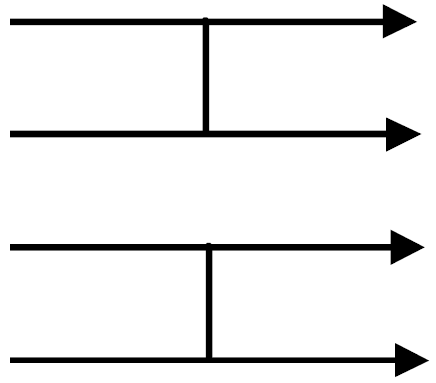
- $\text{R}=\sqrt{\text{F}_\text{g}^2+\text{F}_\text{e}^2}$
$\sqrt{(0.1\times9.8)^2+(4.9\times10^{-5}\times2\times10^4)^2}$
$=\sqrt{0.9604+96.04\times10^{-2}}$
$=\sqrt{1.9208}$
$=1.3859\text{N}$
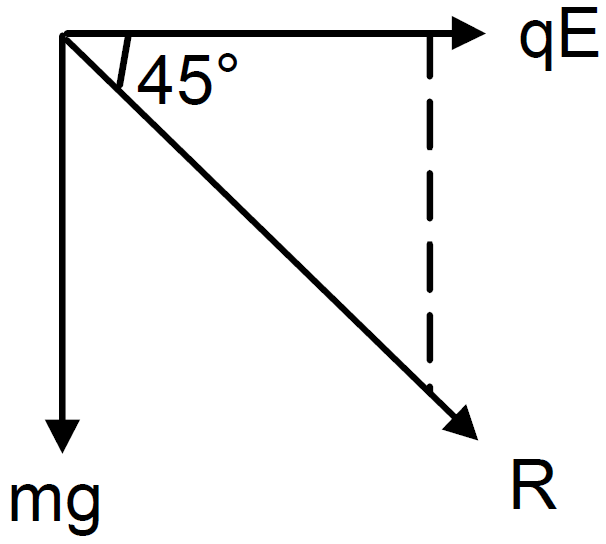
- $\tan\theta=\frac{\text{F}_\text{g}}{\text{F}_\text{e}}$
$=\frac{\text{mg}}{\text{qE}}$
$=1$
So, $\theta=45^\circ$
$\therefore\ $Hence path is straight along resultant force at an angle $45^\circ$ with horizontal
Disp. Vertical $=\Big(\frac{1}{2}\Big)\times9.8\times2\times2$
$=19.6\text{m}$
- Disp. Horizontal $= \text{S}=\Big(\frac{1}{2}\Big)\text{at}^2$
$=\frac{1}{2}\times\frac{\text{qE}}{\text{m}}\times\text{t}^2$
$=\frac{1}{2}\times\frac{0.98}{0.1}\times2\times2$
$=19.6\text{m}$
Net Dispt. $=\sqrt{(19.6)^2+(19.6)^2}$
$=\sqrt{768.32}$
$=27.7\text{m}$ View full question & answer→Question 145 Marks
How much work has to be done in assembling three charged particles at the vertices of an equilateral triangle as shown in figure?
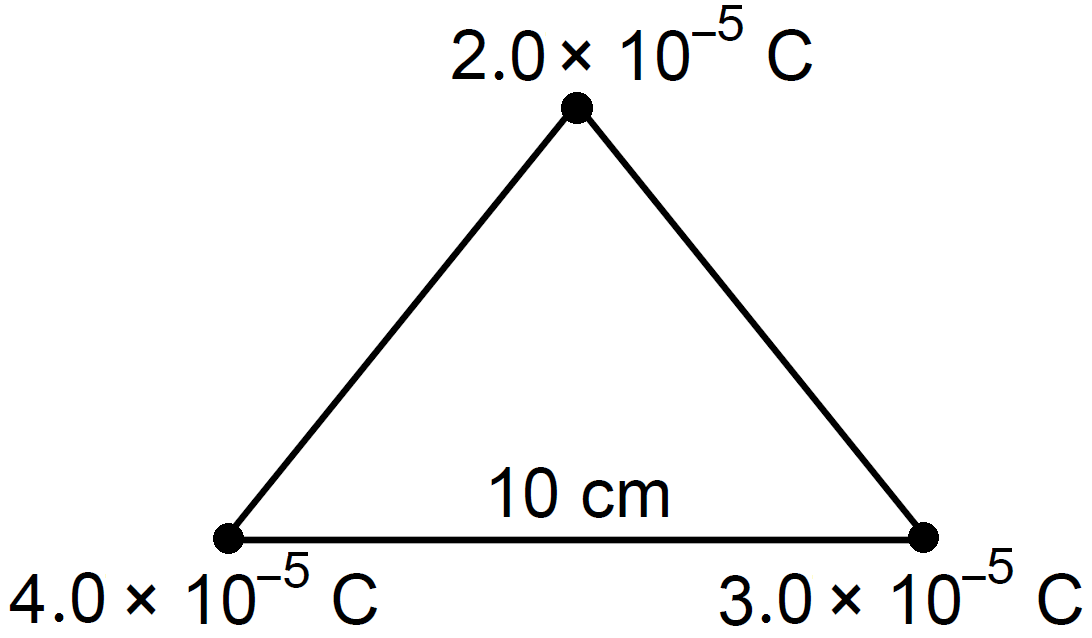
AnswerAmount of work done is assembling the charges is equal to the net potential energy
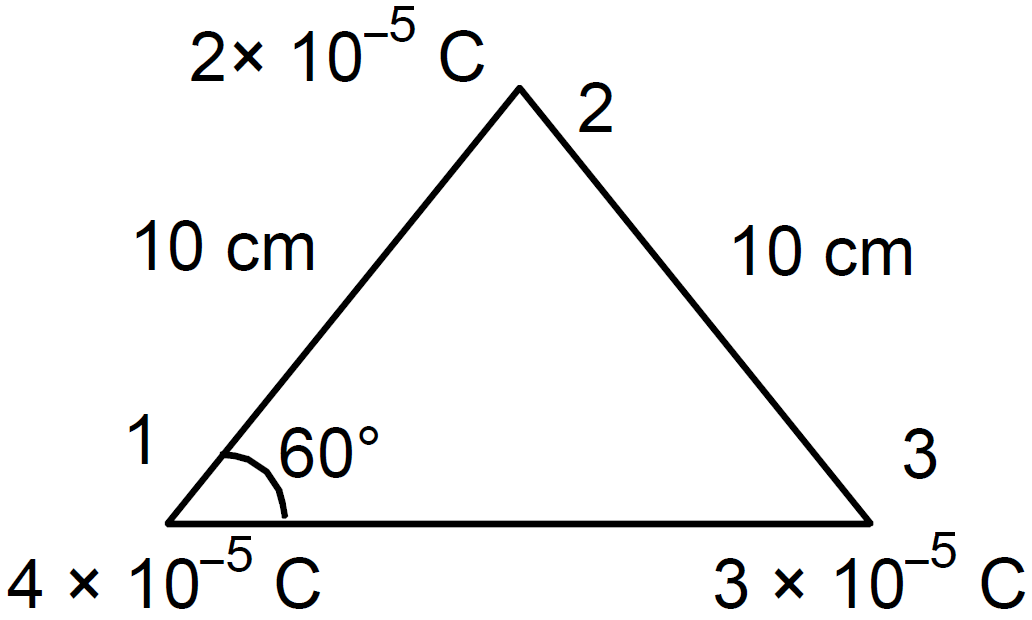
So, P.E. $=\text{U}_{12}+\text{U}_{13}+\text{U}_{23}$
$=\frac{\text{Kq}_1\text{q}_2}{\text{r}_{12}}+\frac{\text{Kq}_1\text{q}_3}{\text{r}_{13}}+\frac{\text{Kq}_2\text{q}_3}{\text{r}_{23}}$
$=\frac{\text{K}+10^{10}}{\text{r}}[4\times2+4\times3+3\times2]$
$=\frac{9\times10^9\times10^{10}}{10^{-1}}(8+12+6)$
$=9\times26$
$=234\text{J}$ View full question & answer→Question 155 Marks
A uniform field of $2.0NC^{-1}$ exists in space in $x-$direction.
- Taking the potential at the origin to be zero, write an expression for the potential at a general point $(x, y, z).$
- At which points, the potential is $25V?$
- If the potential at the origin is taken to be $100V,$ what will be the expression for the potential at a general point?
- What will be the potential at the origin if the potential at infinity is taken to be zero? Is it practical to choose the potential at infinity to be zero?
Answer$\text{E}=2\text{N/C}$ in $x-$direction
- Potential aat the origin is $O.$
$\text{dV}=-\text{E}_\text{x}\ \text{dx}-\text{E}_\text{y}\ \text{dy}-\text{E}_\text{z}\text{dz}$
$\Rightarrow\text{V}-0=-2\text{x}$
$\Rightarrow\text{V}=-2\text{x}$
- $(25-0)=-2\text{x}$
$\Rightarrow\text{x}=-12.5\text{m}$
- If potential at origin is $100 v, $
$\Rightarrow\text{V}-100=-2\text{x}$
$\Rightarrow\text{V}=-2\text{x}+100$
$=100-2\text{x}$
- Potential at $\infty$ is $0,$
$\Rightarrow\text{V}'=-2\text{x}$
$\Rightarrow\text{V}'=\text{V}+2\text{x}$
$=0+2\infty$
$\Rightarrow\text{V}'=\infty$
Potential at origin is $\infty.$
No, it is not practical to take potential at $\infty$ to be zero. View full question & answer→Question 165 Marks
Two charges $2.0 \times 10^{-6}C$ and $1.0 \times 10^{-6}C$ are placed at a separation of $10\ cm.$ Where should a third charge be placed such that it experiences no net force due to these charges?
AnswerGiven:
$\text{q}_1=2.0\times10^{-6}\text{C}$
$\text{q}_2=1.0\times10^{-6}\text{C}$
Let the third charge, $q,$ be placed at a distance of $x\ cm$ from charge $q_1$, as shown in the figure.
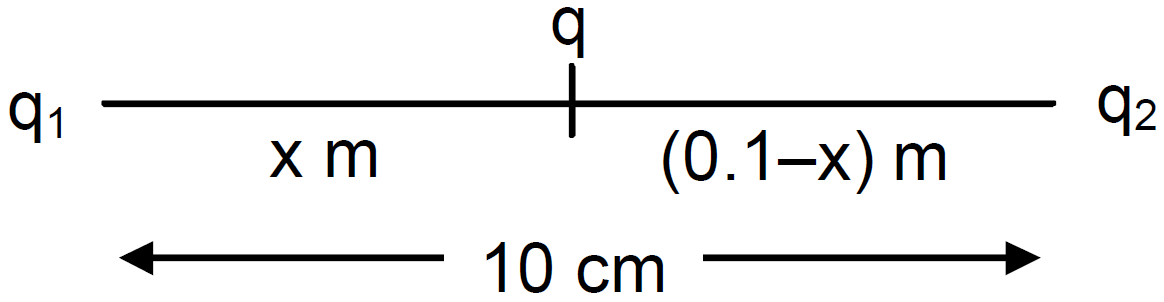
By Coulomb's Law, force,
$\text{F}=\frac{1}{4\pi\in_0}\frac{\text{Q}_1\text{Q}_2}{\text{r}^2}$
Force on charge $q$ due to $q_1,$
$\text{F}=\frac{9\times10^9\times2.0\times10^{-6}\times\text{q}}{\text{x}^2}$
Force on charge $q$ due to $q_2,$
$\text{F}\ '=\frac{9\times10^9\times10^{-6}\times\text{q}}{(10-\text{x})^2}$
According to the question,
$\text{F}-\text{F}\ '=0$
$\Rightarrow\text{F}=\text{F}\ '$
$\Rightarrow\frac{9\times10^9\times2\times10^{-6}\times\text{q}}{\text{x}^2}=\frac{9\times10^9\times10^{-6}\times\text{q}}{(10-\text{x})^2}$
$\Rightarrow\text{x}^2=2(10-\text{x})^2$
$\Rightarrow\text{x}^2-40\text{x}+200=0$
$\Rightarrow\text{x}=20\pm10\sqrt{2}$
$\Rightarrow\text{x}=5.9\text{cm}$ $\Big(\because\text{x}\neq20+10\sqrt{2}\Big)$
So, the third charge should be placed at a distance of $5.9\ cm$ from $q_1.$ View full question & answer→Question 175 Marks
Suppose all the electrons of $100g$ water are lumped together to form a negatively charged particle and all the nuclei are lumped together to form a positively charged particle. If these two particles are placed $10.0\ cm$ away from each other, find the force of attraction between them. Compare it with your weight.
AnswerMolecular weight of $\text{H}_2\text{O}=2\times1\times16=16$
No. of electrons present in one molecule of $\text{H}_2\text{O}=10$
$18\ gm$ of $H_2O$ has $6.023\times1023\times10\text{ electrons}$
$100\ gm$ of $H_2O$ has $\frac{6.023\times10^{-24}}{18}\times100\text{ electrons}$
So number of protons $=\frac{6.023\times10^{26}}{18}\text{protons}$ (since atom is electrically neutral)
Charge of protons $=\frac{1.6\times10^{-19}\times6.023\times10^{26}}{18}\text{coulomb}=\frac{1.6\times6.023\times10^7}{18}\text{coulomb}$
Charge of electrons $=\frac{1.6\times6.023\times10^7}{18}\text{coulomb}$
Hence Electrical force $=\frac{9\times10^9\Big(\frac{1.6\times6.023\times10^7}{18}\Big)\times\Big(\frac{1.6\times6.023\times10^7}{18}\Big)}{(10\times10^{-2})^2}$
$=\frac{8\times6.023}{18}\times16.\times6.023^{25}$
$=2.56\times10^{25}\text{ Newton}$
View full question & answer→Question 185 Marks
Two small spheres, each having a mass of 20g, are suspended from a common point by two insulating strings of length 40cm each. The spheres are identically charged and the separation between the balls at equilibrium is found to be 4cm. Find the charge on each sphere.
Answer
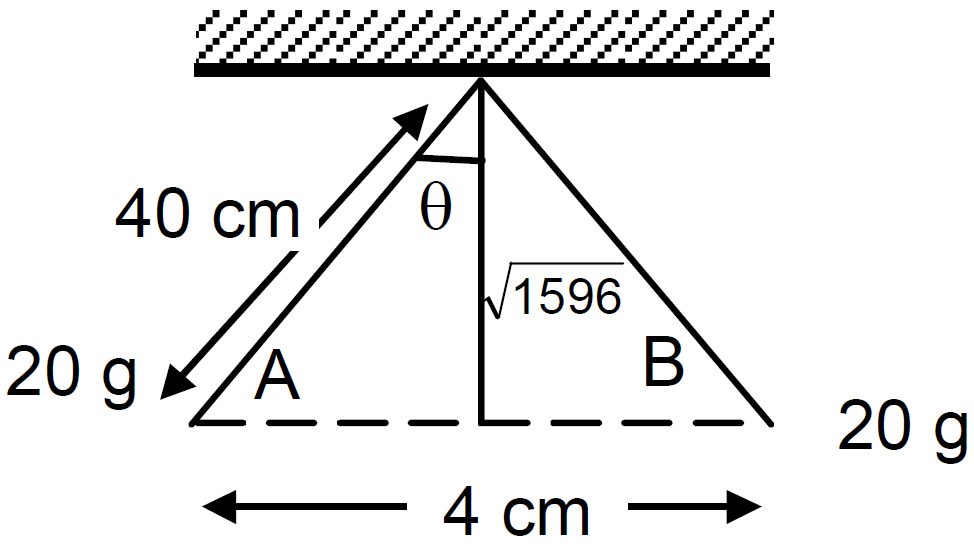 $\text{T}\cos\theta=\text{mg}\ \dots(1)$
$\text{T}\sin\theta=\text{Fe}\ \dots(2)$
Solving, $\frac{(2)}{(1)}$ we get, $\tan\theta=\frac{\text{Fe}}{\text{mg}}$
$=\frac{\text{kq}^2}{\text{r}}\times\frac{1}{\text{mg}}$
$\Rightarrow\frac{2}{\sqrt{1596}}=\frac{9\times10^9\times\text{q}^2}{(0.04)^2\times0.02\times9.8}$
$\Rightarrow\text{q}^2=\frac{(0.04)^2\times0.02\times9.8\times2}{9\times10^9\times\sqrt{1596}}$
$=\frac{6.27\times10^{-4}}{9\times10^9\times39.95}$
$=17\times10^{-16}\text{c}^2$
$\Rightarrow\text{q}=\sqrt{17\times10^{-16}}$
$=4.123\times10^{-8}\text{c}$ View full question & answer→Question 195 Marks
Two identical balls, each having a charge of $2.00 \times 10^{-7}C$ and a mass of $100g$, are suspended from a common point by two insulating strings each $50\ cm$ long. The balls are held at a separation $5.0\ cm$ apart and then released. Find,
- The electric force on one of the charged balls.
- The components of the resultant force on it along and perpendicular to the string.
- The tension in the string.
- The acceleration of one of the balls. Answers are to be obtained only for the instant just after the release.
Answer
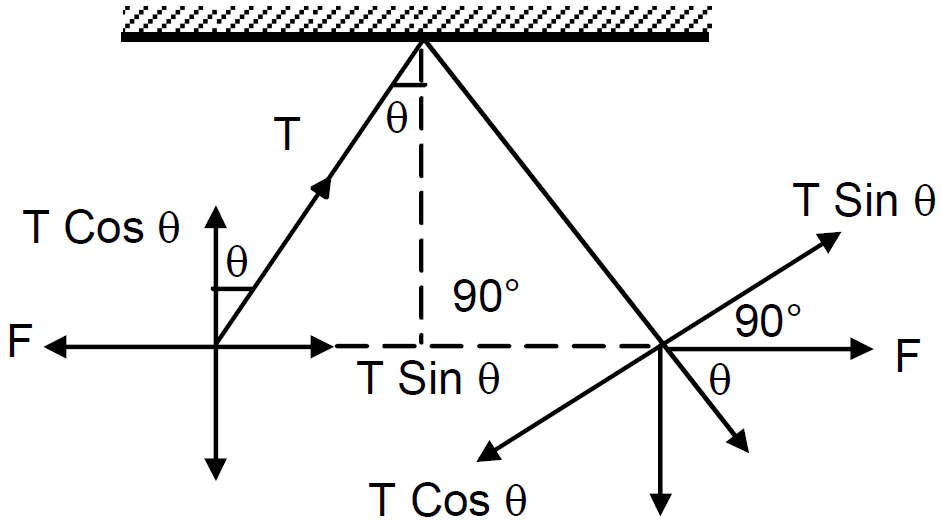
$\text{q}_1=\text{q}_2=2\times10^{-7}\text{c},\ \text{m}=100\text{g}$
$\text{l}=50\text{cm}=5\times10^{-2}\text{m},\ \text{d}=5\times10^{-2}\text{m}$
- Now Electric force
$\text{F}=\text{K}\frac{\text{q}^2}{\text{r}^2}$
$=\frac{9\times10^9\times4\times10^{-14}}{25\times10^{-4}}\text{N}$
$=14.4\times10^{-2}\text{N}$
$=0.144\text{N}$
- The components of Resultant force along it is zero, because mg balances $\text{T}\cos\theta$ and so also.
$\text{F}=\text{mg}=\text{T}\sin\theta$
- Tension on the string
$\text{T}\sin\theta=\text{F},\ \text{T}\cos\theta=\text{mg}$
$\text{Tan}\theta=\frac{\text{F}}{\text{mg}}$
$=\frac{0.144}{100\times10^{-3}\times9.8}$
$=0.14693$
- But $\text{T}\cos\theta=10^2\times10^{-3}\times10=1\text{N}$
$\Rightarrow\text{T}=\frac{1}{\cos\theta}=\sec\theta$
$\Rightarrow\text{T}=\frac{\text{F}}{\sin\theta},$
$\sin\theta=0.145369$
$\cos\theta=0.989378$ View full question & answer→Question 205 Marks
Two particles A and B, each carrying a charge Q, are held fixed with a separation d between them. A particle C having mass m and charge q is kept at the middle point of the line AB.
- If it is displaced through a distance x perpendicular to AB, what would be the electric force experienced by it.
- Assuming x << d, show that this force is proportional to x.
- Under what conditions will the particle C execute simple harmonic motion if it is released after such a small displacement?
Find the time period of the oscillations if these conditions are satisfied.
Answer
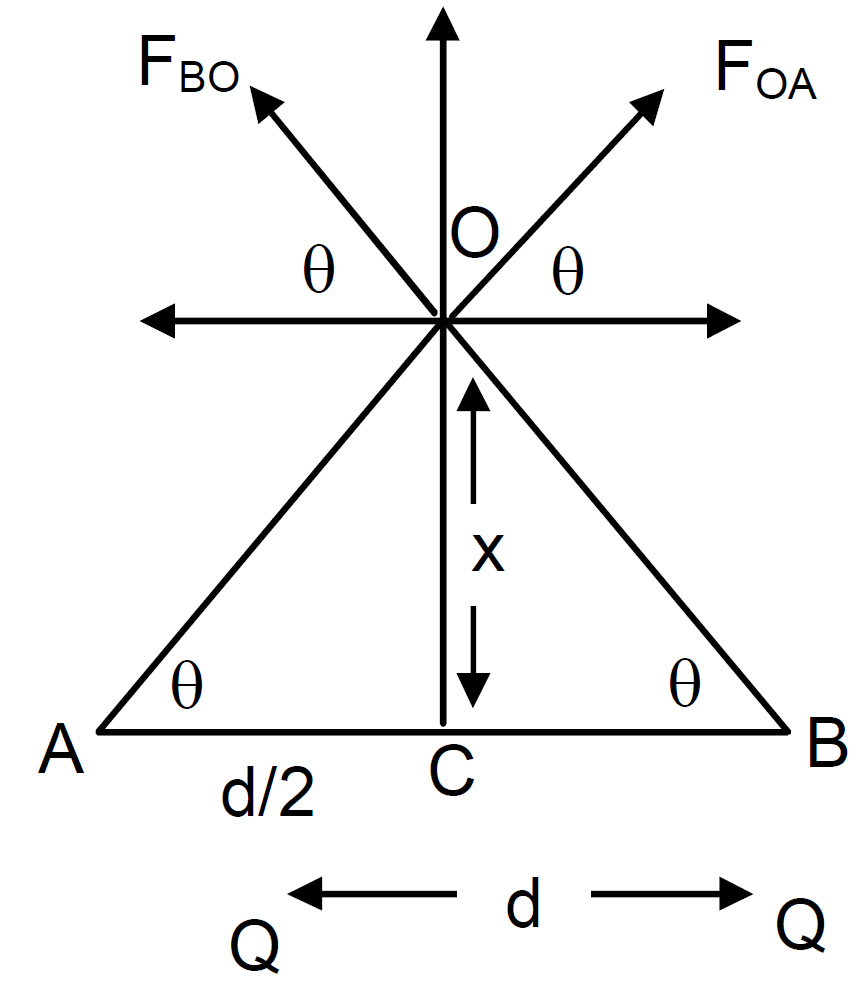
- Let Q = charge on A & B Separated by distance d
q = charge on c displaced $\bot$ to -AB
So, force on $0=\overline{\text{F}}_\text{AB}+\overline{\text{F}}_\text{BO}$
But $\text{F}_\text{AO}\cos\theta=\text{F}_\text{BO}\cos\theta$
So, force on ‘0’ in due to vertical component.
$\overline{\text{F}}=\text{F}_\text{AO}\sin\theta+\text{F}_\text{BO}\sin\theta$ $|\text{F}_\text{AO}|=|\text{F}_\text{BO}|$
$=2\frac{\text{KQq}}{\Big(\frac{\text{d}}{2^2+\text{x}^2}\big)}\sin\theta$
$\text{F}=\frac{2\text{KQq}}{\Big(\frac{\text{d}}{2}\Big)^2+\text{x}^2}\sin\theta$
$=\frac{4\times2\times2\text{KQq}}{(\text{d}^2+4\text{x}^2)}\times\frac{\text{x}}{\Big[\big(\frac{\text{d}}{2}\big)^2+\text{x}^2\Big]^{\frac{1}{2}}}$
$=\frac{2\text{kQq}}{\Big[\big(\frac{\text{d}}{2}\big)^2+\text{x}^2\Big]^{\frac{3}{2}}}\text{x}$ = Electric force $\Rightarrow\text{F}\propto\text{x}$
- When x << d
$\text{F}=\frac{2\text{kQq}}{\Big[\big(\frac{\text{d}}{2}\big)^2+\text{x}^2\Big]^{\frac{3}{2}}}\text{x}$ x << d
$\Rightarrow\text{F}=\frac{2\text{kQq}}{\Big(\frac{\text{d}^2}{4}\Big)^{\frac{3}{2}}}\text{x}\Rightarrow\text{F}\propto\text{x}$
$\text{a}=\frac{\text{F}}{\text{m}}=\frac{1}{\text{m}}\Bigg[\frac{2\text{kQqx}}{\Big[\big(\frac{\text{d}^2}{4}\big)+\ell^2}\Bigg]$
So time period $\text{T}=2\pi\sqrt{\frac{\ell}{\text{g}}}$
$=2\pi\sqrt{\frac{\ell}{\text{a}}}$ View full question & answer→Question 215 Marks
A pendulum bob of mass $80\ mg$ and carrying a charge of $2 \times 10^{-8}C$ is at rest in a uniform, horizontal electric field of $20\ kVm^{-1}.$ Find the tension in the thread.
Answer
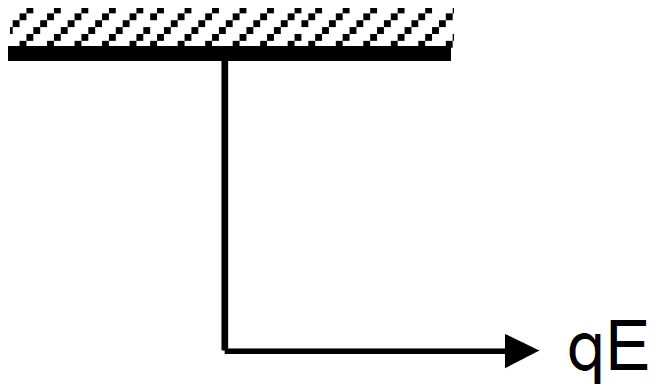 $\text{E}=20\text{Kv/m}=20\times10^3\text{v/m},$
$\text{m}=80\times10^{-5}\text{kg},\ \text{c}=20\times10^{-5}\text{C}$
$\tan\theta=\Big(\frac{\text{qE}}{\text{mg}}\Big)^{-1}$ $\big[\text{T}\sin\theta=\text{mg},\ \text{T}\cos\theta=\text{qe}\big]$
$\tan\theta=\Big(\frac{2\times10^{-8}\times20\times10^3}{80\times10^{-6}\times10}\Big)$
$=\Big(\frac{1}{2}\Big)^{-1}$
$1+\tan^2\theta=\frac{1}{4}+1=\frac{5}{4}$ $\Big[\cos\theta=\frac{1}{\sqrt{5}},\sin\theta=\frac{2}{\sqrt{5}}\Big]$
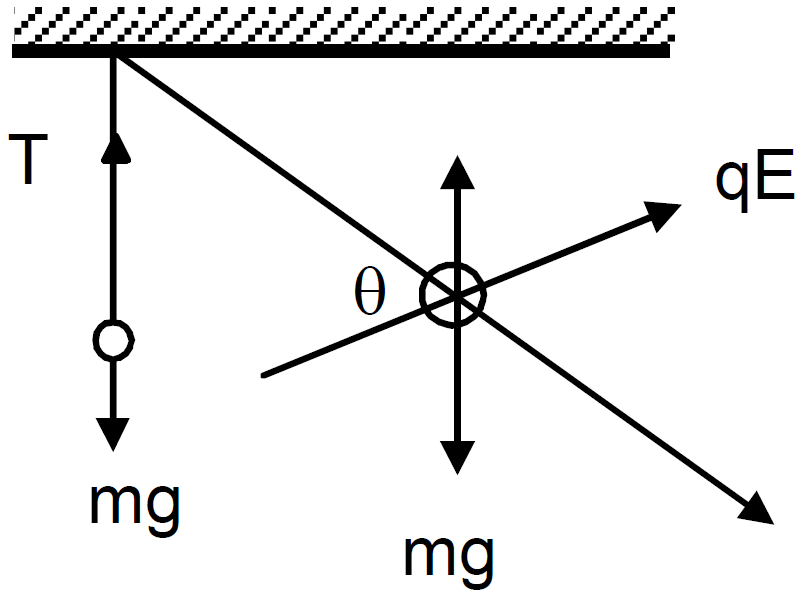
$\text{T}\sin\theta=\text{mg}$
$\Rightarrow\text{T}\times\frac{2}{\sqrt{5}}=80\times10^{-6}\times10$
$\Rightarrow\text{T}=\frac{8\times10^{-4}\times\sqrt{5}}{2}=4\times\sqrt{5}\times10^{-4}$
$=8.9\times10^{-4}$ View full question & answer→Question 225 Marks
Two particles A and B, each having a charge Q, are placed a distance d apart. Where should a particle of charge q be placed on the perpendicular bisector of AB so that it experiences maximum force What is the magnitude of this maximum force?
Answer
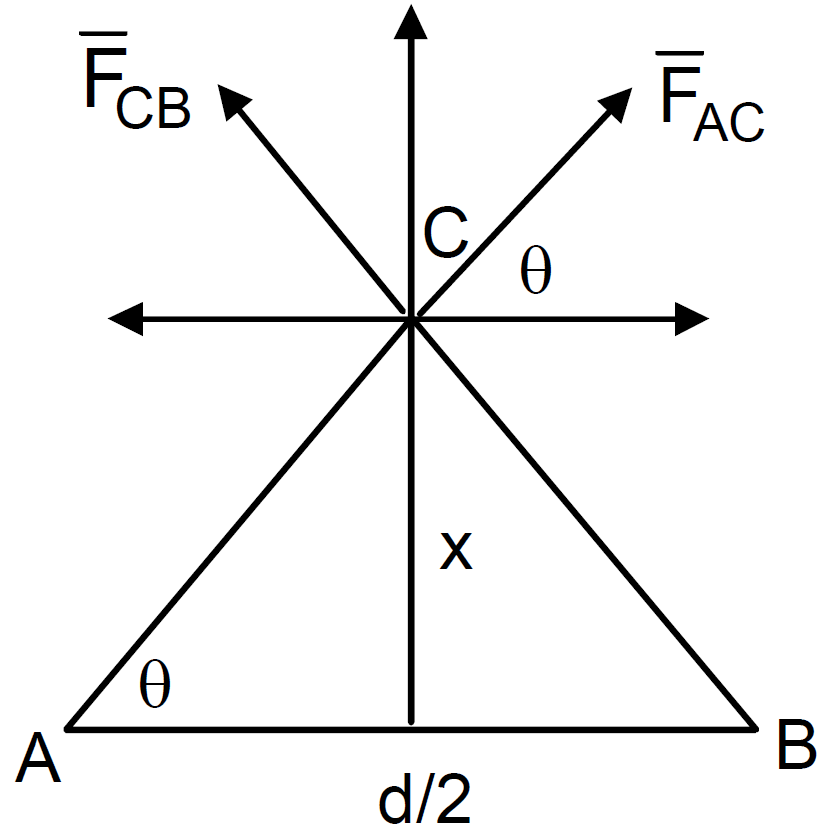 Force on the charge particle ‘q’ at ‘c’ is only the x component of 2 forces
So, $\text{F}_\text{on c}=\text{F}_\text{CB}\sin\theta+\text{F}_\text{AC}\sin\theta$
But $|\bar{\text{F}}_\text{CB}|=|\bar{\text{F}}_\text{AC}|$
$2\text{F}_\text{CB}\sin\theta$
$=2\frac{\text{KQq}}{\text{x}^2+\Big(\frac{\text{d}}{2}\Big)^2}\times\frac{\text{x}}{\Big[\frac{\text{x}^2+\text{d}^2}{4}\Big]^{\frac{1}{2}}}$
$=\frac{2\text{k}\theta\text{qx}}{\Big(\frac{\text{x}^2+\text{d}^2}{4}\Big)^{\frac{3}{2}}}$
$=\frac{16\text{kQq}}{\big(4\text{x}^2+\text{d}^2\big)^{\frac{3}{2}}}\text{x}$
For maximum force $\frac{\text{dF}}{\text{dx}}=0$
$\frac{\text{d}}{\text{dx}}\Bigg(\frac{16\text{kQqx}}{\big(4\text{x}^2+\text{d}^2\big)^{\frac{3}{2}}}\Bigg)=0$
$\Rightarrow\text{K}\begin{bmatrix}\frac{(4\text{x}^2+\text{d}^2)-\text{x}\bigg[\frac{3}{2\big[4\text{x}^2+\text{d}^2\big]^{\frac{1}{2}}}8\text{x}\bigg]}{\big[4\text{x}^2+\text{d}^2\big]^3}\end{bmatrix}=0$
$\Rightarrow\frac{\text{K}\big(4\text{x}^2+\text{d}^2\big)^{\frac{1}{2}}\Big[(4\text{x}^2+\text{d}^2)^3-12\text{x}^2\Big]}{\big(4\text{x}^2+\text{d}^2\big)^3}=0$
$\Rightarrow\big(4\text{x}^2+\text{d}^2\big)^3=12\text{x}^2$
$\Rightarrow16\text{x}^4+\text{d}^4+8\text{x}^2\text{d}^2=12\text{x}^2$ $[\text{d}^4+8\text{x}^2\text{d}^2=0]$
$\Rightarrow\text{d}^2=0$ $[\text{d}^2+8\text{x}^2=0]$
$\Rightarrow\text{d}^2=8\text{x}^2$
$\text{d}=\frac{\text{d}}{2\sqrt{2}}$ View full question & answer→Question 235 Marks
Consider a uniformly charged ring of radius R. Find the point on the axis where the electric field is maximum.
Answer
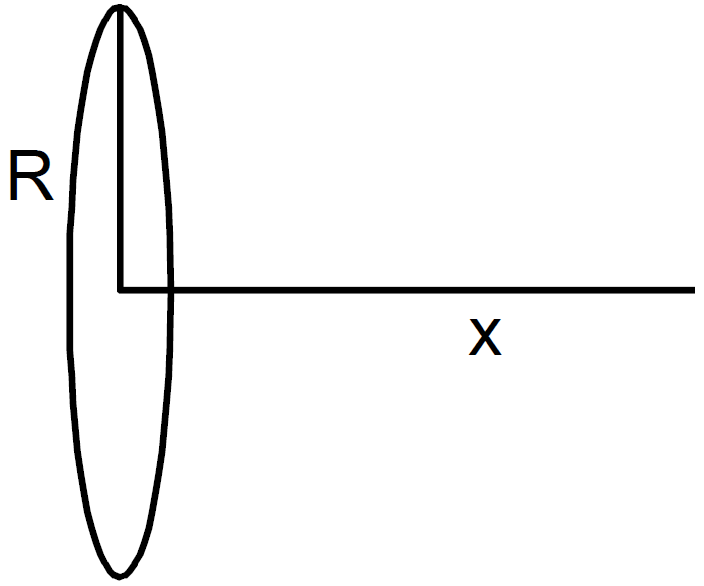 Electric field at any point on the axis at a distance x from the center of the ring is
$\text{E}=\frac{\text{xQ}}{4\pi\in_0\big(\text{R}^2+\text{x}^2\big)^{\frac{3}{2}}}$
$=\frac{\text{KxQ}}{\big(\text{R}^2+\text{x}^2\big)^{\frac{3}{2}}}$
Differentiating with respect to x
$\frac{\text{dE}}{\text{dx}}=\frac{\text{KQ}\big(\text{R}^2+\text{x}^2\big)-\text{KxQ}\big(\frac{3}{2}\big)\big(\text{R}^2+\text{x}^2\big)^{\frac{11}{2}}2\text{x}}{\big(\text{r}^2+\text{x}^2\big)^3}$
Since at a distance x, Electric field is maximum.
$\frac{\text{dE}}{\text{dx}}=0$
$\Rightarrow\text{KQ}\big(\text{R}^2+\text{x}^2\big)^{\frac{3}{2}}-\text{Kx}^2\text{Q}^3\big(\text{R}^2+\text{x}^2\big)^{\frac{1}{2}}=0$
$\Rightarrow\text{KQ}\big(\text{R}^2+\text{x}^2\big)^{\frac{3}{2}}=\text{Kx}^2\text{Q}3\big(\text{R}^2+\text{x}^2\big)^{\frac{1}{2}}$
$\Rightarrow\text{R}^2+\text{x}^2=3\text{x}^2$
$\Rightarrow2\text{x}^2=\text{R}^2$
$\Rightarrow\text{x}^2=\frac{\text{R}^2}{2}$
$\Rightarrow\text{x}=\frac{\text{R}}{\sqrt{2}}$ View full question & answer→Question 245 Marks
Find the magnitude of the electric field at the point P in the configuration shown in figure for d >> a. Take 2qa = p.
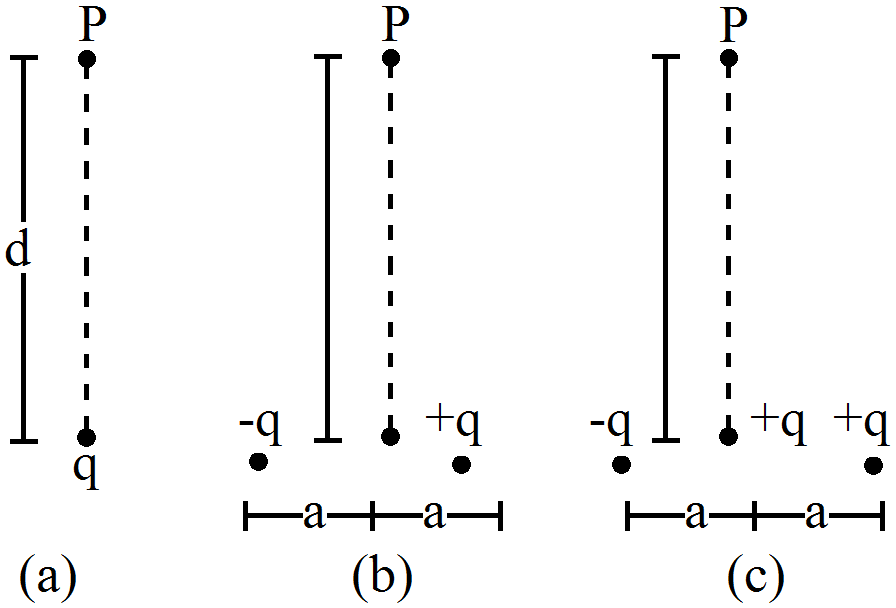
Answer
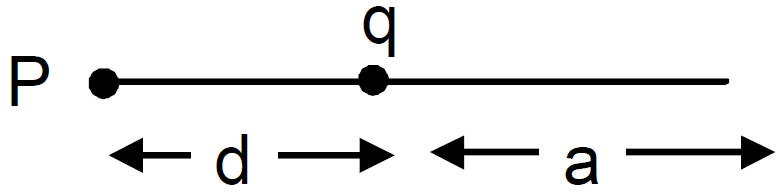
- $\text{p}=2\text{qa}$
- $\text{E}_1\sin\theta=\text{E}_2\sin\theta$ Electric field intensity
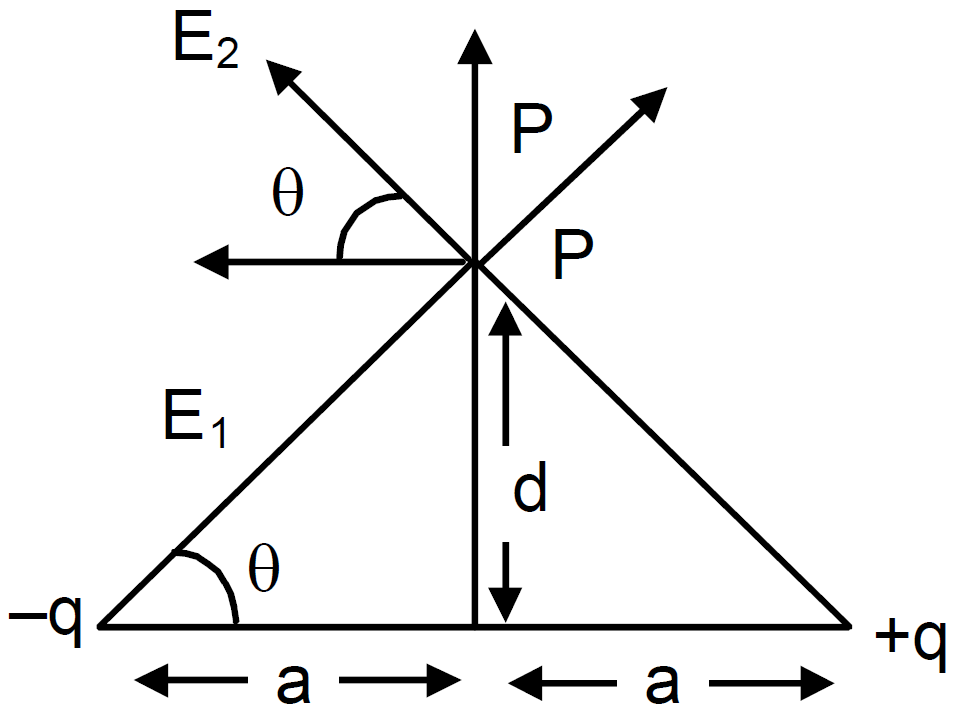
$=\text{E}_1=\frac{\text{Kqp}}{\text{a}^2+\text{d}^2}$
So, $\text{E}=\frac{2\text{KPQ}}{\text{a}^2+\text{d}^2}\frac{\text{a}}{\big(\text{a}^2+\text{d}^2\big)^{\frac{1}{2}}}$
$=\frac{2\text{Kq}\times\text{a}}{\big(\text{a}^2+\text{d}^2\big)^{\frac{3}{2}}}$
When a << d
$=\frac{2\text{Kqa}}{\big(\text{d}^2\big)^{\frac{3}{2}}}$
$=\frac{\text{PK}}{\text{d}^3}$
$=\frac{1}{4\pi\in_0}\frac{\text{p}}{\text{d}^3}$ View full question & answer→Question 255 Marks
Consider a circular ring of radius r, uniformly charged with linear charge density $\lambda.$ Find the electric potential at a point on the axis at a distance x from the centre of the ring. Using this expression for the potential, find the electric field at this point.
Answer
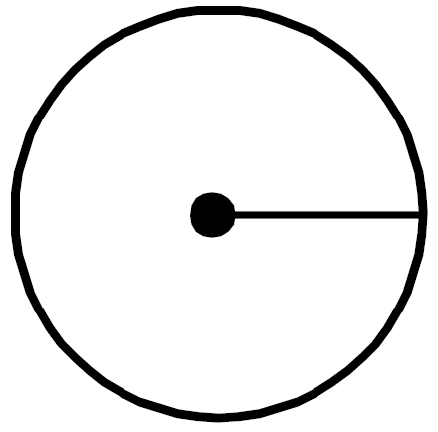 Radius = r
So, $2\pi\text{r}=$ Circumference
Charge density $=\lambda$
Total charge $=2\pi\text{r}\times\lambda$
Electric potential $=\frac{\text{Kq}}{\text{r}}$
$=\frac{1}{4\pi\in_0}\times\frac{2\pi\text{r}\lambda}{\big(\text{x}^2+\text{r}2\big)^{\frac{1}{2}}}$
$=\frac{\text{r}\lambda}{2\in_0\big(\text{x}^2+\text{r}^2\big)^{\frac{1}{2}}}$
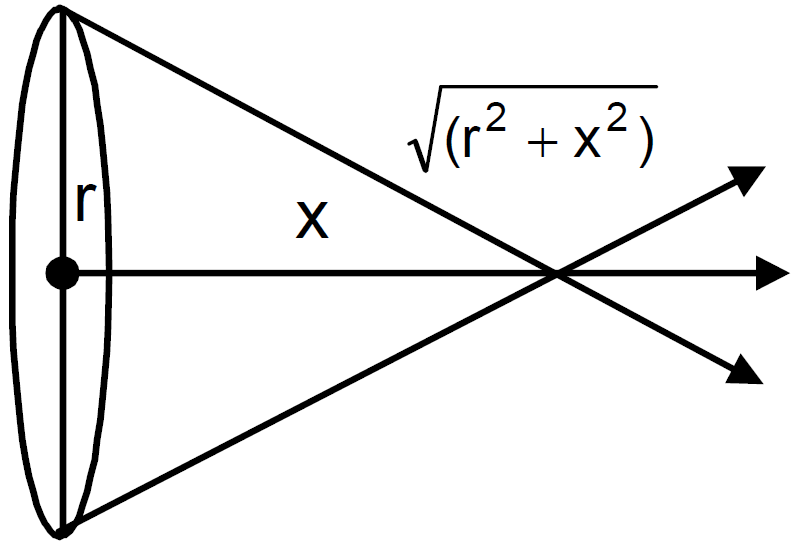
So, Electric field $=\frac{\text{V}}{\text{r}}\cos\theta$
$=\frac{\text{r}\lambda}{2\in_0\big(\text{x}^2+\text{r}^2\big)^{\frac{1}{2}}}\times\frac{\text{x}}{\big(\text{x}^2+\text{r}^2\big)^{\frac{1}{2}}}$
$=\frac{\text{r}\lambda\text{x}}{2\in_0\big(\text{x}^2+\text{r}^2\big)^{\frac{3}{2}}}$ View full question & answer→Question 265 Marks
A particle A having a charge of $2.0 \times 10^{-6}C$ is held fixed on a horizontal table. A second charged particle of mass $80g$ stays in equilibrium on the table at a distance of $10\ cm$ from the first charge. The coefficient of friction between the table and this second particle is $\mu=0.2.$ Find the range within which the charge of this second particle may lie.
Answer
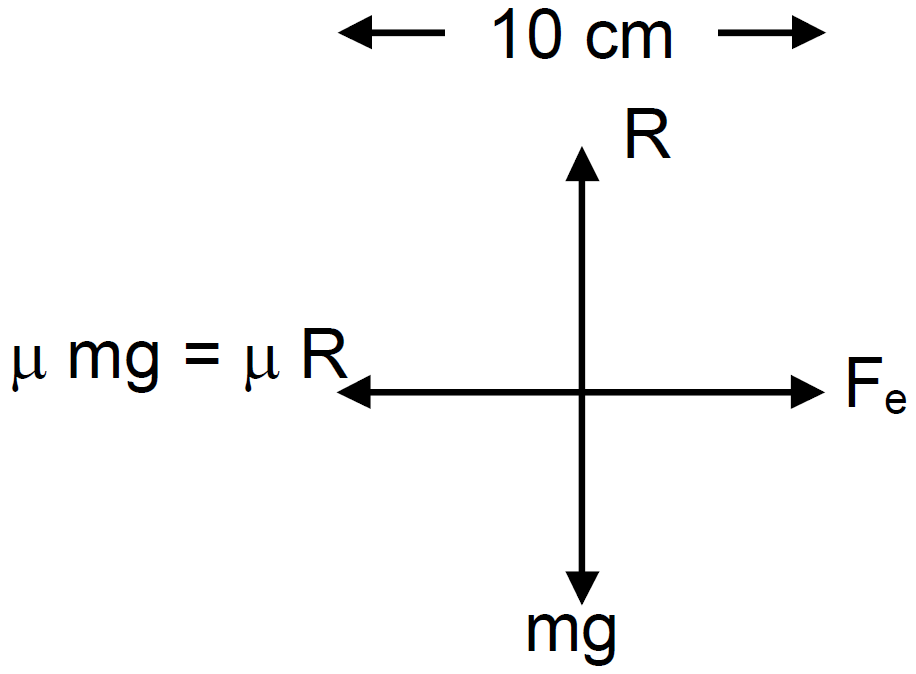 $\text{q}_\text{A}=2\times10^{-6}\text{C},\ \text{M}_\text{b}=80\text{g},\ \mu=0.2$
Since B is at equilibrium,
So, $\text{Fe}=\mu\text{R}$
$\Rightarrow\frac{\text{Kq}_\text{A}\text{q}_\text{B}}{\text{r}^2}=\mu\text{R}=\mu\text{m}\times\text{g}$
$\Rightarrow\frac{9\times10^9\times2\times10^{-6}\times\text{q}_\text{B}}{0.01}=0.2\times0.08\times9.8$
$\Rightarrow\text{q}_\text{B}=\frac{0.2\times0.08\times9.8\times0.01}{9\times10^9\times2\times10^{-6}}$
$=8.7\times10^{-8}\text{C}$
Range $=\pm8.7\times10^{-8}\text{C}$ View full question & answer→Question 275 Marks
The bob of a simple pendulum has a mass of $40g$ and a positive charge of $4.0 \times 10^{-6}C$. It makes $20$ oscillations in $45s$. A vertical electric field pointing upward and of magnitude $2.5 \times 10^4NC^{-1}$ is switched on. How much time will it now take to complete $20$ oscillations?
Answer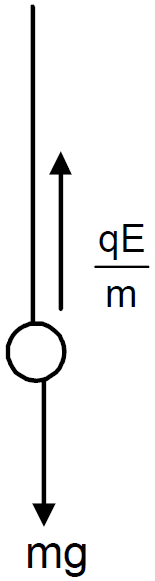
$\text{m}=40\text{g},\ \text{q}=4\times10^{-6}\text{C}$
Time for $20$ oscillations $=45\sec.$ Time for $1$ oscillation $=\frac{45}{20}\sec$
When no electric field is applied, $\text{T}=2\pi\sqrt{\frac{\ell}{\text{g}}}$
$\Rightarrow\frac{45}{20}=2\pi\sqrt{\frac{\ell}{10}}$
$\Rightarrow\frac{\ell}{10}=\Big(\frac{45}{20}\Big)^2\times\frac{1}{4\pi^2}$
$\Rightarrow\ell=\frac{(45)^2\times10}{(20)^2\times4\pi^2}$
$=1.2836$
Time for $1$ oscillation $= 2.598$
Time for $20$ oscillation $=2.598\times20$
$=51.96\sec$
$=52\sec.$ View full question & answer→Question 285 Marks
Three identical charges, each having a value $1.0 \times 10^{-8}C,$ are placed at the corners of an equilateral triangle of side $20\ cm.$ Find the electric field and potential at the centre of the triangle.
Answer
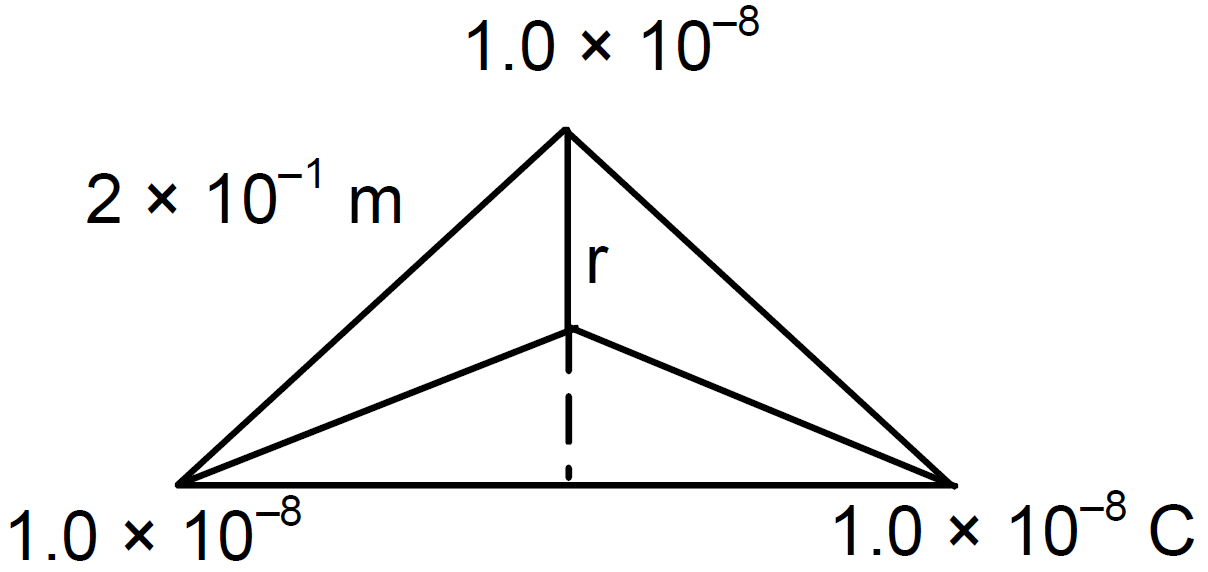
$\text{q}=1.0\times10^{-8}\text{C},\ \ell=20\ \text{cm}$
$\text{E}=?,\ \text{V}=?$
Since it forms an equipotential surface.
So the electric field at the centre is Zero.
$\text{r}=\frac{2}{3}\sqrt{\big(2\times10^{-1}\big)^2-\big(10^{-1}\big)^2}$
$=\frac{2}{3}\sqrt{4\times10^{-2}-10^{-2}}$
$=\frac{2}{3}\sqrt{10^{-2}(4-1)}$
$=\frac{2}{3}\times10^{-2}\times1.732$
$=1.15\times10^{-1}$
$\text{V}=\frac{3\times9\times10^9\times1\times10^{-8}}{1\times10^{-1}}$
$=23\times10^2$
$2.3\times10^3\text{V}$ View full question & answer→Question 295 Marks
Positive charge Q is distributed uniformly over a circular ring of radius R. A particle having a mass m and a negative charge q, is placed on its axis at a distance x from the centre. Find the force on the particle. Assuming x << R, find the time period of oscillation of the particle if it is released from there.
Answer
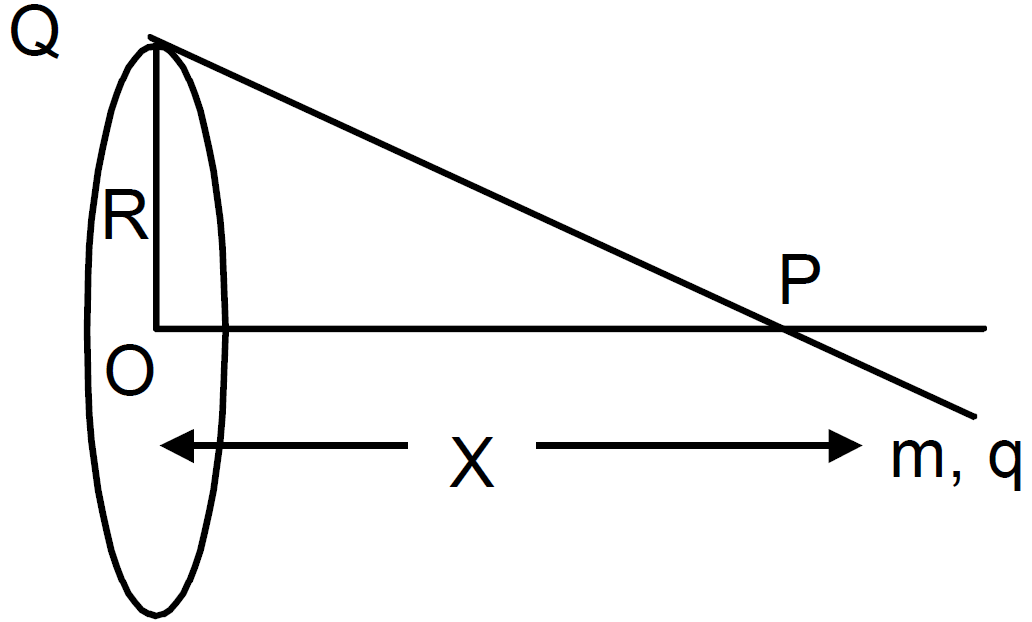 We know: Electric field ‘E’ at ‘P’ due to the charged ring
$=\frac{\text{KQx}}{\big(\text{R}^2+\text{x}^2\big)^{\frac{3}{2}}}$
$=\frac{\text{KQx}}{\text{R}^3}$
Force experienced ‘F’ $=\text{Q}\times\text{E}=\frac{\text{q}\times\text{K}\times\text{Qx}}{\text{R}^3}$
Now, amplitude = x
So, $\text{T}=2\pi\sqrt{\frac{\text{x}}{\frac{\text{KQqx}}{\text{mR}^3}}}$
$=2\pi\sqrt{\frac{\text{mR}^3\text{x}}{\text{KQqx}}}$
$=2\pi\sqrt{\frac{4\pi\in_0\text{mR}^3}{\text{Qq}}}$
$=\sqrt{\frac{4\pi^2\times4\pi\in_0\text{mR}^3}{\text{qQ}}}$
$\Rightarrow\text{T}=\bigg[\frac{16\pi^3\in_0\text{mR}^3}{\text{qQ}}\bigg]^{\frac{1}{2}}$ View full question & answer→Question 305 Marks
A particle of mass m and charge $q$ is thrown at a speed u against a uniform electric field $E$. How much distance will it travel before coming to momentary rest?
Answer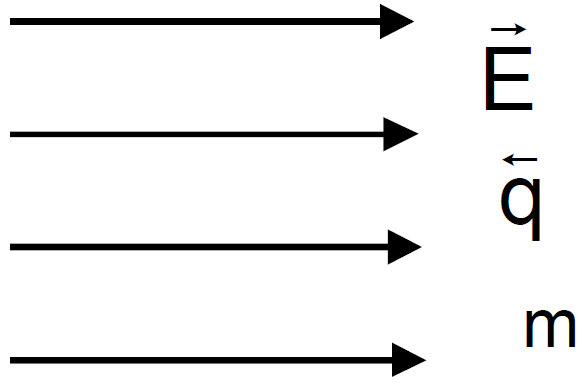
Given,
$u =$ Velocity of projection, $\vec{\text{E}}$ = Electric field intensity
$q =$ Charge; $m =$ mass of particle
We know, Force experienced by a particle with charge $'q\ ’$ in an electric field $\vec{\text{E}}=\text{qE}$
$\therefore\ $acceleration produced $=\frac{\text{qE}}{\text{m}}$
As the particle is projected against the electric field, hence deceleration $=\frac{\text{qE}}{\text{m}}$
So, let the distance covered be $'s\ '$
Then, $v^2 = u^2 + 2as [$where $a =$ acceleration, $v =$ final velocity$]$
Here $0=\text{u}^2-2\times\frac{\text{qE}}{\text{m}}\times\text{S}$
$\Rightarrow\text{S}=\frac{\text{u}^2\text{m}}{2\text{qE}}\text{units}$ View full question & answer→Question 315 Marks
A rod of length $L$ has a total charge $Q$ distributed uniformly along its length. It is bent in the shape of a semicircle. Find the magnitude of the electric field at the centre of curvature of the semicircle.
Answer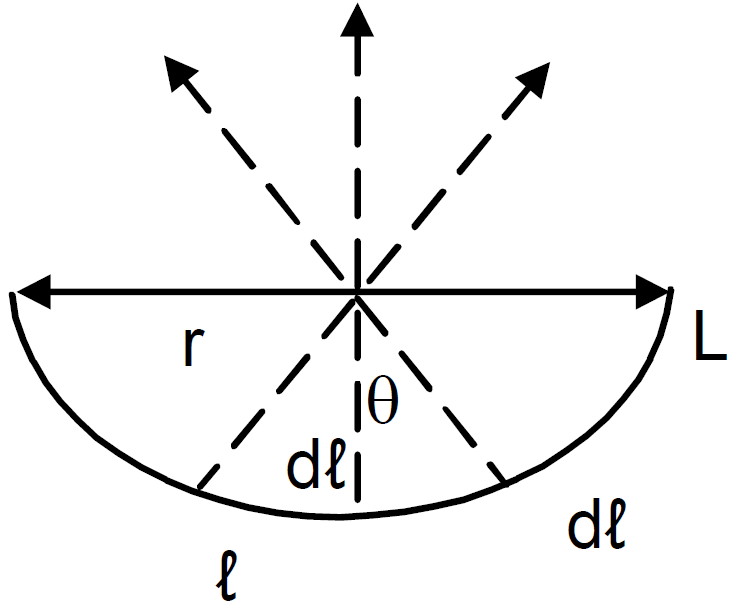
$\lambda=$ Charge per unit length $=\frac{\text{Q}}{\text{L}}$
$dq_1$ for a length d $=\lambda\times\text{dl}$
Electric field at the centre due to charge $=\text{k}\times\frac{\text{dq}}{\text{r}^2}$
The horizontal Components of the Electric field balances each other. Only the vertical components remain.
$\therefore\ $Net Electric field along vertical
$\text{d}_\text{E}=2\text{E}\cos\theta$
$=\frac{\text{Kdq}\times\cos\theta}{\text{r}^2}$
$=\frac{2\text{k}\cos\theta}{\text{r}^2}\times\lambda\times\text{dl}$ $\Big[$but $\text{d}\theta=\frac{\text{d}\ell}{\text{r}}=\text{d}\ell=\text{rd}\theta\Big]$
$\Rightarrow\frac{2\text{k}\lambda}{\text{r}^2}\cos\theta\times\text{rd}\theta=\frac{2\text{k}\lambda}{\text{r}}\cos\theta\times\text{d}\theta$
$\text{E}=\int\limits^{\frac{\pi}{2}}_0\frac{2\text{k}\lambda}{\text{r}}\cos\theta\times\text{d}\theta$
$=\int\limits_0^{\frac{\pi}{2}}\frac{2\text{k}\lambda}{\text{r}}\sin\theta$
$=\frac{2\text{k}\lambda\text{l}}{\text{r}}$
$=\frac{2\text{K}\theta}{\text{Lr}}$
but $\text{L}=\pi\text{R}\Rightarrow\text{r}=\frac{\text{L}}{\pi}$
So, $\text{E}=\frac{2\text{k}\theta}{\text{L}\times\big(\frac{\text{L}}{\pi}\big)}$
$=\frac{2\text{k}\pi\theta}{\text{L}^2}$
$=\frac{2}{4\pi\in_0}\times\frac{\pi\theta}{\text{L}^2}$
$=\frac{\theta}{2\in_0\text{L}^2}$ View full question & answer→Question 325 Marks
Two particles $A$ and $B$, having opposite charges $2.0 \times 10^{-6}C$ and $2.0 \times 10^{-6}C$, are placed at a separation of $1.0\ cm.$
- Write down the electric dipole moment of this pair.
- Calculate the electric field at a point on the axis of the dipole $1.0m$ awa.y from the centre.
- Calculate the electric field at a point on the perpendicular bisector of the dipole and $1.0m$ away from the centre.
Answer
- Dipolemoment $=\text{q}\times\ell$
(Where q = magnitude of charge $\ell=$ Separation between the charges)

$=2\times10^{-6}\times10^{-2}\text{cm}$
$=2\times10^{-8}\text{cm}$
- We know, Electric field at an axial point of the dipole
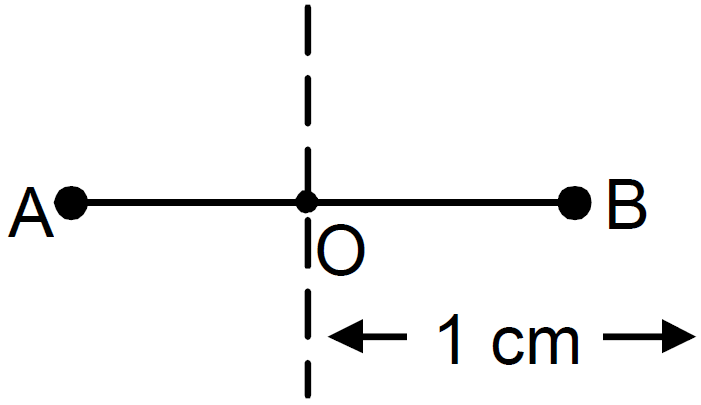
$=\frac{2\text{KP}}{\text{r}^3}$
$=\frac{2\times9\times10^9\times2\times10^{-8}}{\big(1\times10^{-2}\big)^3}$
$=36\times10^7\text{N/C}$
- We know, Electric field at a point on the perpendicular bisector about $1m$ away from centre of dipole.
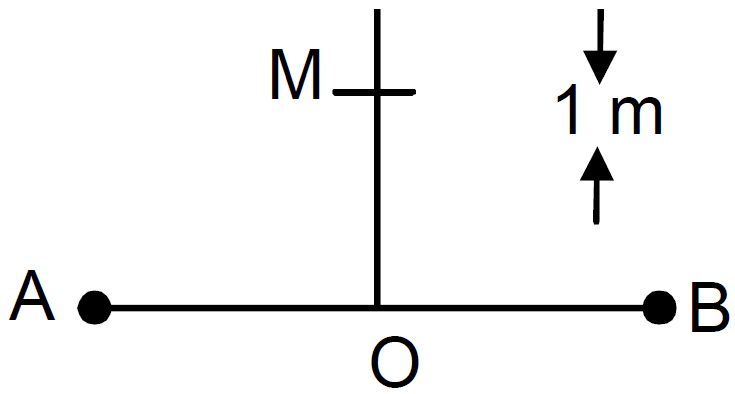
$=\frac{\text{KP}}{\text{r}^3}$
$=\frac{9\times10^9\times2\times10^{-8}}{1^3}$
$=180\text{N/C}$ View full question & answer→Question 335 Marks
Two equal charges, $2.0 \times 10^{-7}C$ each, are held fixed at a separation of $20\ cm.$ A third charge of equal magmtude is placed midway between the two charges. It is now moved to a point $20\ cm$ from both the charges. How much work is done by the electric field durmg the process?
Answer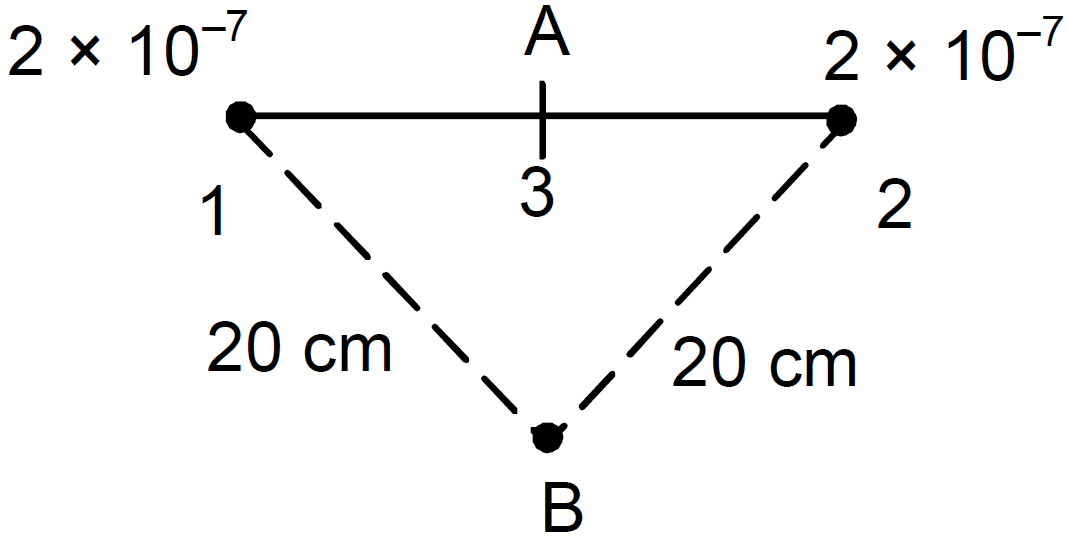
When the charge is placed at $A,$
$\text{E}_1=\frac{\text{Kq}_1\text{q}_2}{\text{r}}+\frac{\text{Kq}_3\text{q}_4}{\text{r}}$
$=\frac{9\times10^9(2\times10^{-7})^2}{0.1}+\frac{9\times10^9(2\times10^{-7})^2}{0.1}$
$=\frac{2\times9\times10^9\times4\times10^{-14}}{0.1}$
$=72\times10^{-4}\text{J}$
When charge is placed at $B,$
$\text{E}_2=\frac{\text{Kq}_1\text{q}_2}{\text{r}}+\frac{\text{Kq}_3\text{q}_4}{\text{r}}$
$=\frac{2\times9\times10^9\times4\times10^{-14}}{0.2}$
$=36\times10^{-4}\text{J}$ View full question & answer→Question 345 Marks
Consider the situation of the previous problem. A charges of $-2.0 \times 10^{-4}C$ is moved from the point $A$ to the point $B.$ Find the change in electrical potential energy $U_B - U_A$ for the cases $(a), (b)$ and $(c).$
Answer
- The Electric field is along $x-$direction
Thus potential difference between,
$\text{A}=(0, 0);\ \text{B}=(4, 2)$
$\Rightarrow\delta\text{V}=-\text{E}\times\delta\text{x}$
$=-20\times(40)$
$=-80\text{V}$
Potential energy $(U_B - U_A)$ between the points $=\delta\text{V}\times\text{q}$
$=-80\times(-2)\times10^{-4}$
$=160\times10^{-4}$
$=0.016\text{J}$
- $\text{A}=(4\text{m},2\text{m});\ \text{B}=(6\text{m},5\text{m})$
$\Rightarrow\delta\text{V}=-\text{E}\times\delta\text{x}$
$=-20\times2$
$=-40\text{V}$
Potential energy $(U_B - U_A)$ between the points $=\delta\text{V}\times\text{q}$
$=-40\times(-2)\times10^{-4})$
$=80\times10^{-4}$
$=0.008\text{J}$
- $\text{A}=(0,0);\ \text{B}=(6\text{m}, 5\text{m})$
$\Rightarrow\delta\text{V}=-\text{E}\times\delta\text{x}$
$=-20\times6$
$=-120\text{V}$
Potential energy $(U_B - U_A)$ between the points $A$ and $B$
$\Rightarrow\delta\text{V}\times\text{q}$
$=-120\times(-2\times10^{-4})$
$=240\times10^{-4}$
$=0.024\text{J}$ View full question & answer→Question 355 Marks
Four equal charges $2.0 \times 10^{-6}C$ each are fixed at the four corners of a square of side $5\ cm$. Find the Coulomb force experienced by one of the charges due to the rest three.
Answer
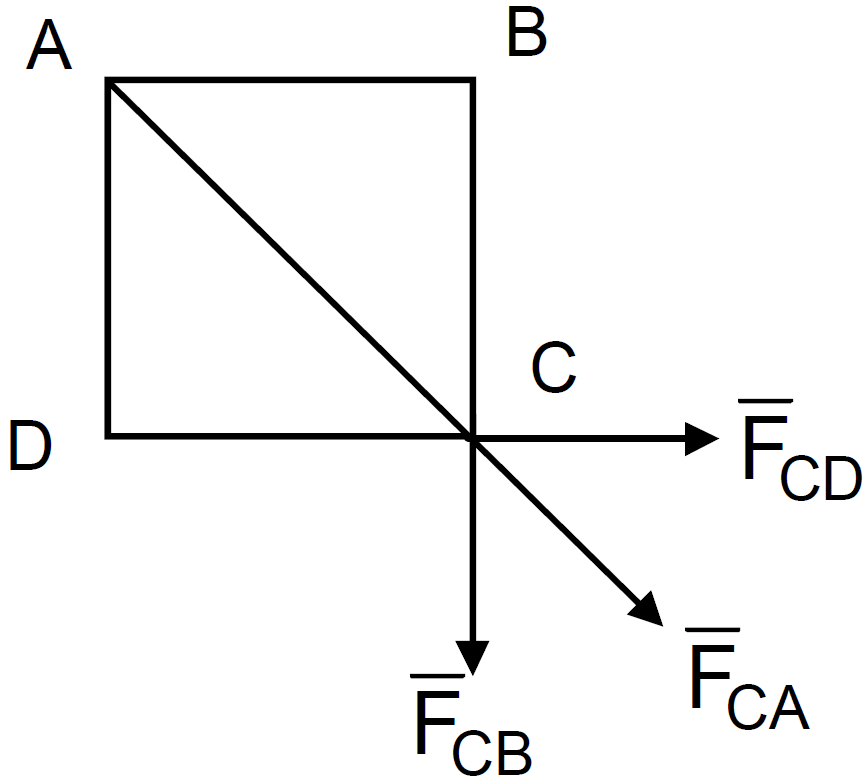
$q^1 = q^2 = q^3 = q^4 = 2 \times 10^{-6}C$
$\text{v}=5\text{cm}=5\times10^{-2}\text{m}$
So force on $\bar{\text{C}}=\bar{\text{F}}_\text{CA}+\bar{\text{F}}_\text{CB}+\bar{\text{F}}_\text{CD}$
So Force along $\times $ Component $=\bar{\text{F}}_\text{CD}+\bar{\text{F}}_\text{CA}\cos45^\circ+0$
$=\frac{\text{k}\big(2\times10^{-6}\big)^2}{\big(5\times10^{-2}\big)^2}+\frac{\text{k}\big(2\times10^{-6}\big)^2}{\big(5\times10^{-2}\big)^2}\frac{1}{2\sqrt{2}}$
$=\text{kq}^2\Big(\frac{1}{25\times10^{-4}}+\frac{1}{50\sqrt{2}\times10^{-4}}\Big)$
$\frac{9\times10^9\times4\times10^{12}}{24\times10^{-4}}\Big(1+\frac{1}{2\sqrt{2}}\Big)$
$=1.44(1.35)=19.49$ Force along % component = 19.49
So, Resultant $\text{R}=\sqrt{\text{Fx}^2+\text{Fy}^2}$
$=19.49\sqrt{2}$
$=27.56$ View full question & answer→