Question
Represent the potential energy/enthalpy change in the following processes graphically.
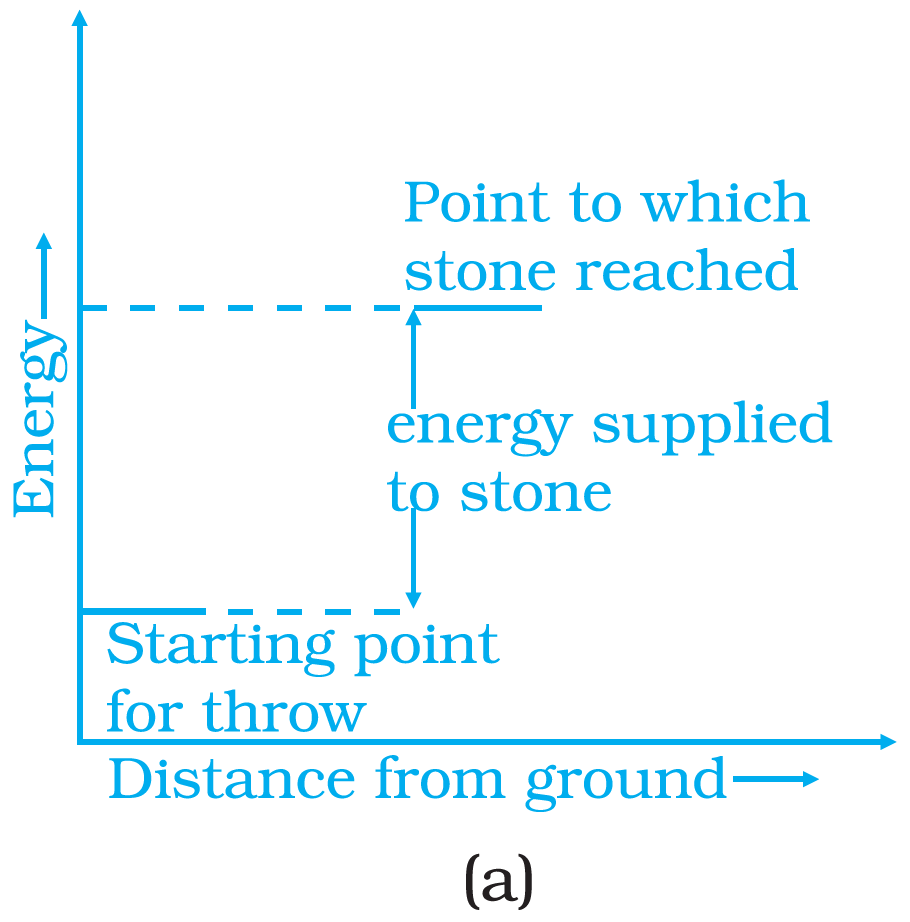
  1. Throwing a stone from the ground to roof.
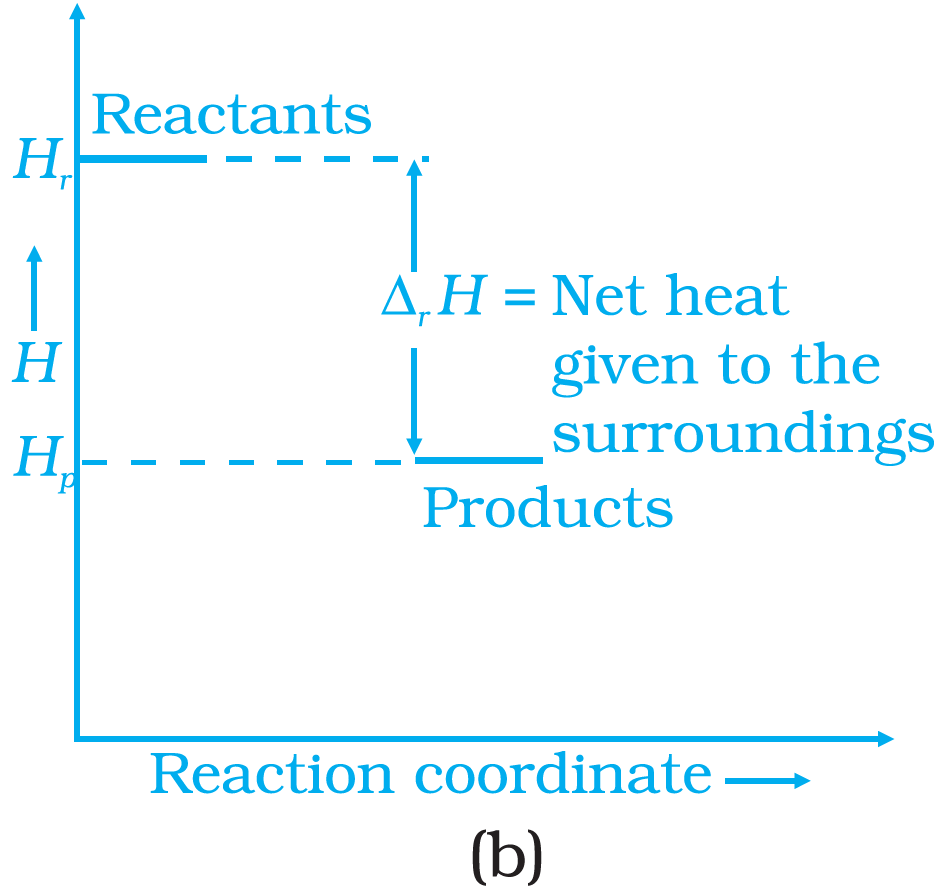
  2. $\frac{1}{2}\text{H}_2(\text{g})+\frac{1}{2}\text{Cl}_2(\text{g})\rightleftharpoons\text{HCl}(\text{g})$ $\Delta_\text{r}\text{H}^\ominus=-92.32\text{kJ}\ \text{mol}^{-1}$​​​​​​
In which of the processes potential energy/enthalpy change is contributing factor to the spontaneity?

Answer

  1. On throwing stone from ground to the roof we need to suply energy to the stone Graphically, it can be represented as:
  2. In the reaction heat is evvolved it means the process is followed by decrease in energy. It can be represented as

Energy increase in (a) part and decrease in (b). Hence, in process (b), the enthalpy change is the contributing factor to the spontaneity.

Need a full question paper?

Generate a complete, print-ready paper with questions like this in minutes — across 16+ boards, with answer keys.

Start Generating Free

Similar questions

$\mathrm{BCl}_3$ exists as monomer whereas $\mathrm{AlCl}_3$ is dimerised through halogen bridging. Give reason. Explain the structure of the dimer of $\mathrm{AlCl}_3$ also.
Determine the molecular formula of an oxide of iron, in which the mass per cent of iron and oxygen are $69.9$ and $30.1$, respectively.
Note: Given that the molar mass of the oxide is $159.69g\ mol^{-1}$
What is common ion effect? Explain with examples.
i. A vessel of $1.00 dm ^3$ capacity contains $16.00$ g of oxygen and $8.00$ g of hydrogen at $17^{\circ} C$. Calculate the partial
ii. According to kinetic molecular theory, explain why gases exert pressure?
iii. How is isotherm at critical temperature of a gas different from those at lower temperatures?
Explain different types of isomerism in alkenes with example.
In the Solvay process, can we obtain sodium carbonate directly by treating the solution containing $\left(\mathrm{NH}_4\right)_2 \mathrm{CO} 3$ with sodium chloride? Explain.
What do you expect the nature of hydrides is, if formed by elements of atomic numbers $15, 19, 23$ and $44$ with dihydrogen? Compare their behaviour towards water.
Give a brief description of the principles of the following techniques taking an example in each case.
Distillation.
Discuss the factors affecting electron gain enthalpy and the trend in its variation in the periodic table.
Sodium carbonate, $Na_2CO_3$ can be obtained by heating sodium hydrogen carbonate, $NaHCO_3​​​​​​​$​​​​​​​ as $2NaHCO_3(s) → Na_2CO_3(s) + H_2O(g) + CO_2(g).$
The essential data are,
 
$NaHCO_3(s)$
$Na_2CO_3(s)$
$CO_2(g)$
$H_2O(g)$
$\ \ \ \ \Delta_\text{f}\text{H}^\circ\$\text{kJ mol}^{-1})$
$-947.7$
$-1130.9$
$-393.51$
$-241.82$
$\ \ \ \ \ \text{S}^\circ_\text{m}\$\text{J mol}^{-1})$
$102.1$
$136$
$188.83$
$213.74$
Calculate the temperature above which $NaHCO_3$ decomposes to give products at 1 bar.