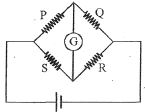
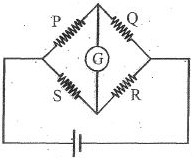
Resistances are arranged in a cyclic order to form a balanced wheatstone bridge as shown in figure. Ratio of power consumed in the branches $P + Q$ and $R + S$ is
Medium
Download our app for free and get started
$\frac{{{{\rm{P}}_{\rm{P}}} + {\rm{Q}}}}{{{{\rm{P}}_{\rm{R}}} + {\rm{S}}}} = \frac{{{\rm{R}} + {\rm{S}}}}{{{\rm{P}} + {\rm{Q}}}} = \frac{{\rm{R}}}{{\rm{Q}}}\left( {\frac{{1 + \frac{{\rm{S}}}{{\rm{R}}}}}{{1 + \frac{{\rm{P}}}{{\rm{Q}}}}}} \right) = \frac{{\rm{R}}}{{\rm{Q}}}$

Download our appand get started for free
Experience the future of education. Simply download our apps or reach out to us for more information. Let's shape the future of learning together!No signup needed.*
Similar Questions
- 1In an electrolyte $3.2 \times {10^{18}}$ bivalent positive ions drift to the right per second while $3.6 \times {10^{18}}$ monovalent negative ions drift to the left per second. Then the current isView Solution
- 2A wire of resistance $x$ ohm is drawn out, so that its length is increased to twice its original length, and its new resistance becomes $20 \,\Omega$, then $x$ will be ........ $\Omega$View Solution
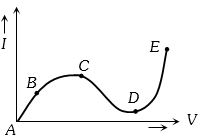
- 3From the graph between current $I$ and voltage $V$ shown below, identify the portion corresponding to negative resistanceView Solution
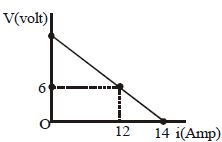
- 4$10\,Cells$, each of emf $'E'$ and internal resistance $'r'$, are connected in series to a variable external resistance. Figure shows the variation of terminal potential difference of their combination with the current drawn from the combination.$Emf$ of each cell is ............. $V$View Solution
- 5A silver and zinc voltameter are connected in series and a current $i$ is passed through them for a time $t$ liberating $W\, gm$ of zinc. The weight of silver deposited is nearly ..............$W$View Solution
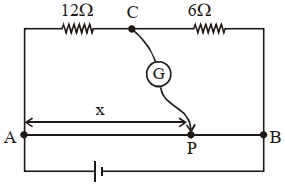
- 6Consider a $72\, cm$ long wire $AB$ as shown in the figure. The galvanometer jockey is placed at $P$ on $A B$ at a distance $x cm$ from $A$. The galvanometer shows zero deflection.View Solution
The value of $x,$ to the nearest integer, is ..... $cm$
- 7The resistance of $10\, metre$ long potentiometer wire is $1\,ohm/meter$. A cell of $e.m.f.$ $2.2\, volts$ and a high resistance box are connected in series to this wire. The value of resistance taken from resistance box for getting potential gradient of $2.2\, millivolt/metre$ will be ............... $\Omega $View Solution
- 8You are given a resistance wire of length $50\, cm$ and a battery of negligible resistance. In which of the following cases is largest amount of heat generatedView Solution
- 9A potentiometer wire has length $10\, m$ and resistance $20\,\Omega $. A $2. 5\, V$ battery of negligible internal resistance is connected across the wire with an $80\,\Omega $ series resistance. The potential gradient on the wire will beView Solution
- 10Three resistances of magnitude $2$, $3$ and $5$ $ohm$ are connected in parallel to a battery of $10\, volts$ and of negligible resistance. The potential difference across $3\,\Omega $ resistance will be ............... $volts$View Solution