Three resistances of magnitude $2$, $3$ and $5$ $ohm$ are connected in parallel to a battery of $10\, volts$ and of negligible resistance. The potential difference across $3\,\Omega $ resistance will be ............... $volts$
Easy


Download our appand get started for free
Experience the future of education. Simply download our apps or reach out to us for more information. Let's shape the future of learning together!No signup needed.*
Similar Questions
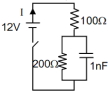
- 1Find the charge in steady state of the capacitor. (in $nC)$View Solution
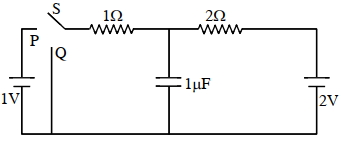
- 2In the circuit shown below, the switch $S$ is connected to position $P$ for a long time so that the charge on the capacitor becomes $q _1 \mu C$. Then $S$ is switched to position $Q$. After a long time, the charge on the capacitor is $q _2 \mu C$.View Solution
($1$) The magnitude of $q_1$ is
($2$) The magnitude of $q _2$ is
Give the answer of question ($1$) and ($2$)
- 3A battery of $3.0\, V$ is connected to a resistor dissipating $0.5\, W$ of power. If the terminal voltage of the battery is $2.5\, V$ the power dissipated within the internal resistance is$.......W$View Solution
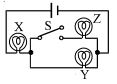
- 4If $X, Y$ and $Z$ in figure are identical lamps, which of the following changes to the brightnesses of the lamps occur when switch $S$ is closed?View Solution
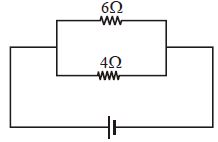
- 5In the circuit shown, the power developed in the $6\,\Omega $ resistor is $6\,W.$ The power developed in the $4\,\Omega $ resistor is .............. $W$View Solution
- 6Electric bulb $50\, W$ - $100\, V$ glowing at full power are to be used in parallel with battery $120\, V$, $10 \,\Omega$. Maximum number of bulbs that can be connected so that they glow in full power isView Solution
- 7A new flashlight cell of $e.m.f.$ $1.5\, volts$ gives a current of $15\, amps$, when connected directly to an ammeter of resistance $0.04\,\Omega $. The internal resistance of cell is ........... $\Omega$View Solution
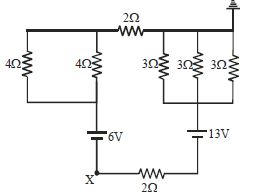
- 8Find potential at point $'x'$ in given circuit ............... $V$View Solution
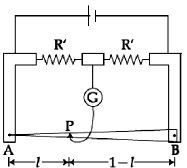
- 9In a meter bridge, the wire of length $1\, m$ has a nonuniform cross-section such that, the variation $\frac{{dR}}{{d\ell }}$ of its resistance $R$ with length $\ell $ is $\frac{{dR}}{{d\ell }} \propto \frac{1}{{\sqrt \ell }}$ Two equal resistances are connected as shown in the figure. The galvanometer has zero deflection when the jockey is at point $P$. What is the length $AP$ ? ................ $m$View Solution
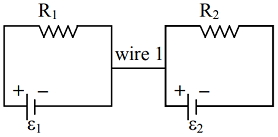
- 10In the circuit, wire $1$ is of negligible resistance. Then,View Solution