A silver and zinc voltameter are connected in series and a current $i$ is passed through them for a time $t$ liberating $W\, gm$ of zinc. The weight of silver deposited is nearly ..............$W$
Medium


Download our appand get started for free
Experience the future of education. Simply download our apps or reach out to us for more information. Let's shape the future of learning together!No signup needed.*
Similar Questions
- 1View SolutionIn meter bridge or Wheatstone bridge for measurement of resistance, the known and the unknown resistances are interchanged. The error so removed is
- 2There are two wires of the same length and of the same material and radii $r$ and $2r$ . The ratio of their specific resistance isView Solution
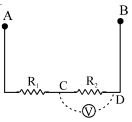
- 3Resistances $R_1$ and $R_2$ each $60\,\Omega$ are connected in series as shown in figure. The Potential difference between $A$ and $B$ is kept $120$ volt. Then what ............. $V$ will be the reading of voltmeter connected between the point $C$ and $D$ if resistance of voltmeter is $120\,\Omega .$View Solution
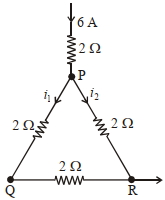
- 4A current of $6\, A$ enters one corner $P$ of an equilateral triangle $PQR$ having $3$ wires of resistance $2 \,\Omega$ each and leaves by the corner $R$. The currents $i_{1}$ in ampere is ........ .View Solution
- 5On giving $220\,V$ to a resistor the power dissipated is $40\,W$ then value of resistance is ............... $\Omega$View Solution
- 6Calculate the amount of charge flowing in $2$ minutes in a wire of resistance $10$ $\Omega$ when a potential difference of $20\,V$ is applied between its ends ............ $C$View Solution
- 7The heat generated through $2 \,ohm$ and $8\, ohm$ resistances separately, when a condenser of $200\,\mu F$ capacity charged to $200\, V$ is discharged one by one, will beView Solution
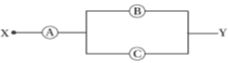
- 8$A, \,B$ and $C$ are voltmeters of resistance $R, \,1 .5R$ and $3R$ respectively as shown in the figure. When some potential difference is applied between $X$ and $Y,$ the voltmeter readings are $V_A, \,V_B$ and $V_C$ respectively. ThenView Solution
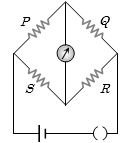
- 9In the Wheatstone's bridge shown, $P = 2\,\Omega ,$ $Q = 3\,\Omega ,$ $R = 6\,\Omega $ and $S = 8\,\Omega $. In order to obtain balance, shunt resistance across '$S$' must be .............. $\Omega$View Solution
- 10For a wire $\frac{R}{l}=\frac{1}{2}$ and length of wire is $l=5\, cm .$ If potential difference $1\, V$ is applied across it, current through wire will be: $( R =$ Resistance $)$ (in $A$)View Solution