MCQ
Reversibility is not possible because of:
  • Resistive force present everywhere.
  • B
    Every process around us is Quasi$-$static.
  • C
    Gases are viscous.
  • D
    Gases have density.

Answer

Correct option: A.
Resistive force present everywhere.

Need a full question paper?

Generate a complete, print-ready paper with questions like this in minutes — across 16+ boards, with answer keys.
Start Generating Free

Similar questions

In an organ pipe whose one end is at $x = 0$, the pressure is expressed by $p = {p_0}\cos \frac{{3\pi x}}{2} \,\,sin\,\, 300\pi t$  where $x$ is in meter and $t$ in $sec$. The organ pipe can be
If the length of a stretched string is shortened by $40\%$ and the tension is increased by $44\%$, then the ratio of the final and initial fundamental frequencies is
A particle is fastened at the end of a string and is whirled in a vertical circle with the other end of the string being fixed. The motion of the particle is:
What is the fractional error in $g$ calculated from $T = 2\pi \sqrt {l/g} $ ? Given fraction errors in $T$ and $l$ are $ \pm x$ and $ \pm y$ respectively?
A solid ball is completely immersed in a liquid. The coefficients of volume expansion of the ball and liquid are $3 × 10^{-6}$ and $8 × 10^{-6} per ^o C$ respectively. The percentage change in upthrust when the temperature is increased by $100 ^o C$ is ....... $\%$
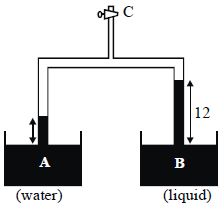
The limbs of a $U$ -tube glass are lowered into vessels $A$ and $B, A$ containing water. Some air is pumped out through the top of the tube $C$. The liquids in the left hand limb $A$ and the right hand limb $B$ rise to heights of $10\, cm$ and $12\, cm$ respectively. The density of liquid $B$ is ........ $g/cm^3$
The force on a particle as the function of displacement x (in $x-$ direction) is given by $F = 10 + 0.5x$ The work done corresponding to displacement of particle from $x = 0$ to $x = 2$ unit is
A cricketer can throw a ball to a maximum horizontal distance of $100 \,m$. With the same effort, he throws the ball vertically upwards. The maximum height attained by the ball is  ......... $m$
Two small spherical metal balls, having equal masses, are made from materials of densities $\rho_{1}$ and $\rho_{2}\left(\rho_{1}=8 \rho_{2}\right)$ and have radii of $1\; \mathrm{mm}$ and $2\; \mathrm{mm}$, respectively. They are made to fall vertically (from rest) in a viscous medum whose coefficient of viscosity equals $\eta$ and whose denstry is $0.1 \mathrm{\rho}_{2} .$ The ratio of their terminal velocitites would be 
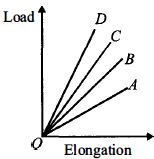
The load versus elongation graphs for four wires of same length and made of the same material are shown in the figure. The thinnest wire is represented by the line