Question
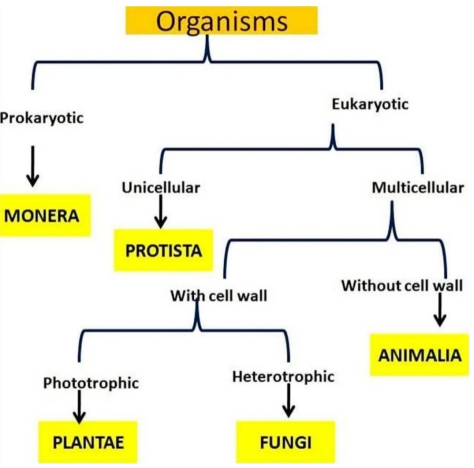
✓
Answer
i. All organisms are multicellular, eukaryotes with heterotrophic mode of nutrition.
ii.
iii. Linnaeus used artificial system kingdom of classification.
• Drawbacks of Linnaeus two kingdom classification:
Linnaeus developed a Two Kingdom system of classification with Plantae and Animalia kingdoms.
• This system did not distinguish between eukaryotes and prokaryotes, unicellular and multicellular organisms, photosynthetic (green algae) and non-photosynthetic (fungi) organisms.
OR
No, Fungi-Autotrophic (Photosynthetic) and Heterotrophic is not correct match. The walls of the fungi were made of chitin, whereas the green plants had a cellulose cell wall.
ii.
| Prokaryotic cell | Eukaryotic cell |
| Genetic material is not enclosed in a nuclear envelope and is present suspended in the cytoplasm in a region called nucleoid. | Genetic material is enclosed within the nucleus by a nuclear envelope and is not present in direct contact with cytoplasm. |
| Cell wall is made up of peptidoglycan. | Cell wall is made up of chitin in fungi and cellulose in plants. |
| Nucleolus is absent. | Nucleolus is present. |
• Drawbacks of Linnaeus two kingdom classification:
Linnaeus developed a Two Kingdom system of classification with Plantae and Animalia kingdoms.
• This system did not distinguish between eukaryotes and prokaryotes, unicellular and multicellular organisms, photosynthetic (green algae) and non-photosynthetic (fungi) organisms.
OR
No, Fungi-Autotrophic (Photosynthetic) and Heterotrophic is not correct match. The walls of the fungi were made of chitin, whereas the green plants had a cellulose cell wall.
Need a full question paper?
Generate a complete, print-ready paper with questions like this in minutes — across 16+ boards, with answer keys.
Explore more
Similar questions
Describe the evolutionary change in the pattern of heart among the vertebrates.
Write any four differences between bacteria and cyanobacteria?
Try to collect all the currently accepted meanings for the word ‘species’. Discuss with your teacher the meaning of species in case of higher plants and animals on one hand, and bacteria on the other hand.
Cell membrane, also called plasma membrane, thin membrane that surrounds every living cell, delimiting the cell from the environment around it. Enclosed by this cell membrane are the cell’s constituents, large, water-soluble, highly charged molecules such as proteins, nucleic acids, carbohydrates, and substances involved in cellular metabolism. Cell membranes are composed primarily of fatty-acid based lipids and proteins. Membrane lipids are principally of two types, phospholipids and sterols (generally cholesterol). Both types share the defining characteristic of lipids—they dissolve readily in organic solvents—but in addition they both have a region that is attracted to and soluble in water.
(1).Plasma membrane is made up of
(a) A protein, a lipid and a cellulose layer
(b) Bimolecular lipid layer surrounded by protein layers
(c) A protein layer between two lipid layers
(d) A lipid layer between two protein layers
(2) Fluid mosaic model of cell was put forward by –
(a) Danielli and Dawson
(b) Singer and Nicolson
(c) Garner and Allard
(d) Watson and Crick
(3) Which of the following statements best describes the chemical composition of
plasma-membrane?
(a) Plasma membrane is composed of two layers—one layer of phospholipids and one layer
of proteins.
(b) Plasma membrane is composed of equal numbers of phospholipids, proteins, and
carbohydrates.
(c) Plasma membrane is bilayers of proteins with associated lipids and carbohydrates.
(d) Plasma membrane is bilayers of phospholipids with associated proteins and
carbohydrates.
(4) Most abundant lipid in the cell membrane is
(a) phospholipids (b) cerebrosides (c) glycolipids (d) None of these
(1).Plasma membrane is made up of
(a) A protein, a lipid and a cellulose layer
(b) Bimolecular lipid layer surrounded by protein layers
(c) A protein layer between two lipid layers
(d) A lipid layer between two protein layers
(2) Fluid mosaic model of cell was put forward by –
(a) Danielli and Dawson
(b) Singer and Nicolson
(c) Garner and Allard
(d) Watson and Crick
(3) Which of the following statements best describes the chemical composition of
plasma-membrane?
(a) Plasma membrane is composed of two layers—one layer of phospholipids and one layer
of proteins.
(b) Plasma membrane is composed of equal numbers of phospholipids, proteins, and
carbohydrates.
(c) Plasma membrane is bilayers of proteins with associated lipids and carbohydrates.
(d) Plasma membrane is bilayers of phospholipids with associated proteins and
carbohydrates.
(4) Most abundant lipid in the cell membrane is
(a) phospholipids (b) cerebrosides (c) glycolipids (d) None of these
Structures of the bacterial ribosome have provided a framework for understanding universal mechanisms of protein synthesis. However, the eukaryotic ribosome is much larger than it is in bacteria, and its activity is fundamentally different in many key ways. All ribosomes are composed of two subunits, both of which are built from RNA and protein. Bacterial ribosomes, for example of Escherichia coli, contain a small subunit (SSU) composed of one 16S ribosomal RNA (rRNA) and 21 ribosomal proteins (r-proteins) and a large subunit (LSU) containing 5S and 23S rRNAs and 33 rproteins. In contrast to their bacterial counterparts, eukaryotic ribosomes are much larger and more complex, containing additional rRNA in the form of so-called expansion segments (ES) as well as many additional r-proteins and r-protein extensions.
(1).Ribosomes are present in
(a) Eukaryotes only
(b) Eukaryotes and prokaryotes
(c) Prokaryotes only
(d) Eukaryotes, prokaryotes and viruses
(2) In 70S ribosomes, ‘S’ stands for
(a) SI unit (b) Solubility factor (c) Svedberg unit (d) all of these
(3) 80 S ribosomes occur in
(a) Eukaryotic cells of animals
(b) Eukaryotic cells of animals and plants
(c) Both Eukaryotic cells and prokaryotic cells
(d) all of these
(4) Ribosomes are made up of
(a) RNA only (b) RNA and proteins (c) RNA, DNA and proteins (d) Nucleic acids, proteins and lipids
(5) Polysomes are
(a) multiple units of ribosomes
(b) attachment of many ribosomes to a common mRNA
(c) attachment of many mRNA to a common ribosome
(d) lysosomal aggregations
(1).Ribosomes are present in
(a) Eukaryotes only
(b) Eukaryotes and prokaryotes
(c) Prokaryotes only
(d) Eukaryotes, prokaryotes and viruses
(2) In 70S ribosomes, ‘S’ stands for
(a) SI unit (b) Solubility factor (c) Svedberg unit (d) all of these
(3) 80 S ribosomes occur in
(a) Eukaryotic cells of animals
(b) Eukaryotic cells of animals and plants
(c) Both Eukaryotic cells and prokaryotic cells
(d) all of these
(4) Ribosomes are made up of
(a) RNA only (b) RNA and proteins (c) RNA, DNA and proteins (d) Nucleic acids, proteins and lipids
(5) Polysomes are
(a) multiple units of ribosomes
(b) attachment of many ribosomes to a common mRNA
(c) attachment of many mRNA to a common ribosome
(d) lysosomal aggregations
Differentiate between
Aerobic respiration and Fermentation
Aerobic respiration and Fermentation
John was reading a chapter on different parts of a green plant. His mother asked him about the functions of roots. He replied that roots are meant for anchorage and absorbing water and minerals from soil. Then mother showed him carrot, radish and turnip and asked him about the additional functions that the roots perform. John was surprised to find that roots in some plants change their shape and structure and become modified to perform additional functions like support, storage of food and respiration.
(1). Carrot is a
(a) Tap root (b) Fibrous root (c) Adventitious root (d) Stilt root.
(2). Hanging structures that support a banyan are
(a) Prop (b) Tuber (c) Rhizome (d) Stilt
(3). Supporting structures coming out of the lower nodes of the stems of maize and sugarcane are
(a) Stilt (b) Tendrils (c) Runner (d) Prop
(4). Which function is performed by the modified roots of Asparagus?
(a) Storage (b) Support (c) Respiration (d) Transpiration.
(5). Pneumatophores are found in
(a) Rhizophora (b) Asparagus (c) Sugarcane (d) Maize.
(1). Carrot is a
(a) Tap root (b) Fibrous root (c) Adventitious root (d) Stilt root.
(2). Hanging structures that support a banyan are
(a) Prop (b) Tuber (c) Rhizome (d) Stilt
(3). Supporting structures coming out of the lower nodes of the stems of maize and sugarcane are
(a) Stilt (b) Tendrils (c) Runner (d) Prop
(4). Which function is performed by the modified roots of Asparagus?
(a) Storage (b) Support (c) Respiration (d) Transpiration.
(5). Pneumatophores are found in
(a) Rhizophora (b) Asparagus (c) Sugarcane (d) Maize.
Polysaccharides or the macro molecules consisting of long chains of sugar. Only carbohydrates they are not sweet and are insoluble in water. The two ends of the polysaccharide chain are called reducing and non-reducing ends. Based upon their monomeric units these are homo polysaccharides or heteropolysaccharides. Depending upon their location polysaccharides play multiple functions in living world few examples of polysaccharides include Cellulose, chitin, inulin etc.
(1) All the listed polysaccharides are homopolymers except
(a) Starch (b) glycogen (c) Chitin (d) Cellulose
(2) Inulin is a polymer of
(a) glucose (b) fructose (c) glucose and sucrose (d) fructose and galactans
(3) Murein is a heteropolysaccharide like
(a) araban (b) xylan (c) hyaluronic acid (d) agar
(4) A polysaccharide found in the exoskeleton of crabs is
(a) Cellulose (b) pectin (c) murine (d) chitin
(5) The right end of the polysaccharide chain is called
(a) reducing end (b) non-reducing end (c) right end (d) none of these
(1) All the listed polysaccharides are homopolymers except
(a) Starch (b) glycogen (c) Chitin (d) Cellulose
(2) Inulin is a polymer of
(a) glucose (b) fructose (c) glucose and sucrose (d) fructose and galactans
(3) Murein is a heteropolysaccharide like
(a) araban (b) xylan (c) hyaluronic acid (d) agar
(4) A polysaccharide found in the exoskeleton of crabs is
(a) Cellulose (b) pectin (c) murine (d) chitin
(5) The right end of the polysaccharide chain is called
(a) reducing end (b) non-reducing end (c) right end (d) none of these
Draw a standard ECG and explain the different segments in it.