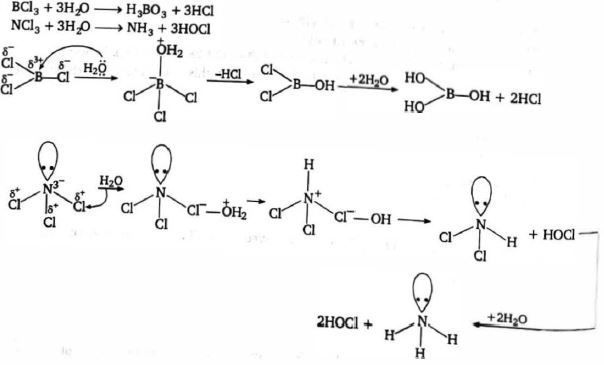
- A$NCl_3$ is hydrolysed and gives $HOCl$ but $BCl_3$ is not hydrolysed
- BBoth $NCl_3$ and $BCl_3$ on hydrolysis gives $HCl$
- ✓$NCl_3$ on hydrolysis gives $HOCl$ but $BCl_3$ gives $HCl$
- DBoth $NCl_3$ and $BCl_3$ on hydrolysis gives $HOCl$
Generate a complete, print-ready paper with questions like this in minutes — across 16+ boards, with answer keys.
${C_6}{H_6}\left( \ell \right) + \frac{{15}}{2}{O_2} \to 6C{O_2}\left( g \right) + 3{H_2}O\left( \ell \right)\,\,\,\,\Delta H = - 3271\,kJ$
What is the value of $\Delta U$ for combustion of $1.5\, mol$ benzene at $27\,^oC$ ? .....$kJ$
$6CO_2 + 6H_2O + solar energy \to C_6H_{12}O_6+6O_2$
A blue whales gain $75\ kg$ of mass per day by feeding on krill. The whale must consume ten times this mass of krill each day. The krill must consume $10.0\ kg$ of diatoms to produce $1.0\ kg$ of krill. Assuming that the mass gain of a whale's life is due to the consumption of carbohydrates $(C_6H_{12}O_6)$ , calculate the moles of $CO_2$ that must be used by the diatoms to produce the carbohydrates consumed by a blue whale in a day
