MCQ
Select the correct alternative$(s)$
  • Elastic forces are not always conservative
  • B
    Elastic forces are always conservative
  • C
    Elastic forces are conservative only when Hooke's law is obeyed
  • D
    Elastic forces are not conservative

Answer

Correct option: A.
Elastic forces are not always conservative
a
(a)

Since at every value of force material is not able to gain its shape. Therefore elastic forces are not always conservative.

Need a full question paper?

Generate a complete, print-ready paper with questions like this in minutes — across 16+ boards, with answer keys.
Start Generating Free

Similar questions

Which of the following is not an example of perfectly inelastic collision
The vectors $\overrightarrow A $ and $\overrightarrow B$  lie in a plane. Another vector $\overrightarrow C $ lies outside this plane. The  resultant $\overrightarrow A + \overrightarrow B + \overrightarrow C$ of these three vectors
A particle starts moving from rest in a straight line with constant acceleration. After time $t_0$, acceleration changes its sign (just opposite to the initial direction), remaining the same in magnitude. Determine the time from the beginning of motion in which the particle returns to the initial position.
When 1 m, 1 kg and 1 min are taken as the fundamental units, the magnitude of the force is 36 units. What will be the value of this force in CGS system?
Two masses of 1gm and of 4gm are moving with equal linear momenta. The ratio of their kinetic energies is:
The ratio of surface tensions of mercury and water is given to be $7.5$ while the ratio of their densities is $13.6$. Their contact angles, with glass, are close to $135^o$ and $0^o$, respectively. It is observed that mercury gets depressed by an amount $h$ in a capillary tube of radius $r_1$, while water rises by the same amount $h$ in a capillary tube of radius $r_2$. The ratio, $(r_1/r_2)$, is then close to
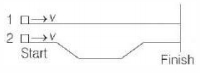
Two small blocks slide without losing contact with the surface along two frictionless tracks $1$ and $2$ , starting at the same time with same initial speed $v$. Track $1$ is perfectly horizontal, while track $2$ has a dip in the middle, as shown in the figure.Which block reaches the finish line first?[Hint: Use velocity-time graph to solve]
The motion of a particle of mass m is given by $\text{x}=0$ for $\text{t} < 0\ \text{s},$ $\text{x}(\text{t})=\text{A}\sin4\text{p}\ \text{t}$ for $0<\text{t}<(1/ 4)\ \text{s}(\text{A}>\text{o}),$ and $\text{x}=0$ for $\text{t}>(1/4)\ \text{s}.$ Which of the following statements is true?
A point starts moving in a straight line with a certain acceleration. At a time $t$after beginning of motion the acceleration suddenly becomes retardation of the same value. The time in which the point returns to the initial point is
Water rises in a vertical capillary tube upto a length of 10cm. If the tube is inclined at 45°, the length of water risen in the tube will be:

  1. $10\text{cm}$

  2. $10\sqrt{2}\text{cm}$

  3. $\frac{10}{\sqrt{2}}\text{cm}$

  4. None of these.