Question
Select the correct statements:
  1. A simple harmonic motion is necessarily periodic.
  2. A simple harmonic motion is necessarily oscillatory.
  3. An oscillatory motion is necessarily periodic.
  4. A periodic motion is necessarily oscillatory.
Answer

  1. A simple harmonic motion is necessarily periodic.
  2. A simple harmonic motion is necessarily oscillatory.

Explanation:

A periodic motion need not be necessarily oscillatory.

For example: The moon revolving around the earth.

Also, an oscillatory motion need not be necessarily periodic.

For example: Damped harmonic motion.

Need a full question paper?

Generate a complete, print-ready paper with questions like this in minutes — across 16+ boards, with answer keys.

Start Generating Free

Similar questions

A point moves such that its displacement as a function of time is given by $x^3$ = $t^3 + 1$. Its acceleration as a function of time $t$ will be
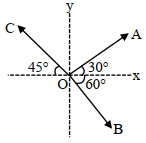
The magnitude of vectors $\overrightarrow{ OA }, \overrightarrow{ OB }$ and $\overrightarrow{ OC }$ in the given figure are equal. The direction of $\overrightarrow{ OA }+\overrightarrow{ OB }-\overrightarrow{ OC }$ with $x$-axis will be
A p-type semiconductor is:
  1. Positively charged.
  2. Negatively charged.
  3. Uncharged.
  4. Uncharged at 0K but charged at higher ternperatures.
Dimensions of luminous flux are
A viscous fluid is flowing through a cylindrical tube. The velocity distribution of the fluid is best represented by the diagram
Water rises in a vertical capillary tube upto a length of 10cm. If the tube is inclined at 45°, the length of water risen in the tube will be:

  1. $10\text{cm}$

  2. $10\sqrt{2}\text{cm}$

  3. $\frac{10}{\sqrt{2}}\text{cm}$

  4. None of these.

A particle revolves round a circular path. The acceleration of the particle is
A medium can carry a longitudinal wave because it has the property of
Rank in order, from highest to lowest, the liquid heights $h_a$ to $h_d$ .The air flow is from left to right. The liquid columns are not drawn to scale
A highly rigid cubical block $A$ of small mass $M$ and side $L$ is fixed rigidly onto another cubical block $B$ of the same dimensions and of low modulus of rigidity $\eta $ such that the lower face of $A$ completely covers the upper face of $B$. The lower face of $B$is rigidly held on a horizontal surface. A small force $F$ is applied perpendicular to one of the side faces of $A$. After the force is withdrawn block $A$ executes small oscillations. The time period of which is given by