MCQ
Select wrong statement about simple,harmonic motion
  • The body is uniformly accelerated
  • B
    The velocity of the body changes smoothly at all instants
  • C
    The amplitude of oscillation is symmetric about the equilibrium position
  • D
    The frequency of oscillation is independent of amplitude
Answer

Correct option: A.
The body is uniformly accelerated
a
(a)

In $S.H.M.$

$a=-\omega^2 x$

Thus acceleration varies linearly with time.

Need a full question paper?

Generate a complete, print-ready paper with questions like this in minutes — across 16+ boards, with answer keys.

Start Generating Free

Similar questions

A tuning fork sends sound waves in air. If the temperature of the air increases, which of the following parameters will change?
  1. Displacement amplitude.
  2. Frequency.
  3. Wavelength.
  4. Time period.
A gas in an airtight container is heated from $25°C$ to $90°C$. The density of the gas will
A liquid is kept in a cylindrical vessel. When the vessel is rotated about its axis, the liquid rises at its sides. If the radius of the vessel is $0.05\,\, m$ and the speed of rotation is $2$ revolutions per second, the difference in the heights of the liquid at the centre and at the sides of the vessels will be ...... $cm.$ $($ take $g = 10\,\, ms^{-2}$ and $\pi^2 = 10)$
A mass $m$ attached to a spring oscillates every $2\, sec$. If the mass is increased by $2 \,kg$, then time-period increases by $1\, sec$. The initial mass is ..... $kg$
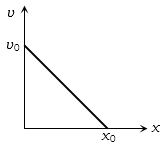
The given graph shows the variation of velocity with displacement. Which one of the graph given below correctly represents the variation of acceleration with displacement
Which of the following factors affect the thermal conductivity of a rod?
The maximum velocity of a simple harmonic motion represented by $y = 3\sin \,\left( {100\,t + \frac{\pi }{6}} \right)$is given by
A particle is executing $SHM$ of amplitude $A,$ about the mean position $x = 0.$ Which of the following cannot be a possible phase difference between the positions of the particle at $x = +\,A/2$ and $x = - A/\sqrt {2} .$
The maximum horizontal range of a projectile is $400\;m$.The maximum height atteined by it?
A smooth sphere $A$ is moving on a frictionless horizontal plane with angular speed $\omega $ and center of mass with velocity $v$. It collides elastically and head-on with an identical sphere $B$ at rest. Neglect friction everywhere. After the collision, their angular speeds are ${\omega _A}$ and ${\omega _B}$ respectively. Then