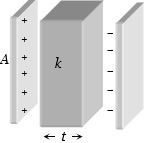
Separation between the plates of a parallel plate capacitor is $d$ and the area of each plate is $A$. When a slab of material of dielectric constant $k$ and thickness $t(t < d)$ is introduced between the plates, its capacitance becomes
Diffcult
Download our app for free and get started
(c) Potential difference between the plates $V$ = $V_{air}$ + $V_{medium}$
$ = \frac{\sigma }{{{\varepsilon _0}}} \times (d - t) + \frac{\sigma }{{K{\varepsilon _0}}} \times t$
$==>$ $V = \frac{\sigma }{{{\varepsilon _0}}}(d - t + \frac{t}{K})$
$ = \frac{Q}{{A{\varepsilon _0}}}(d - t + \frac{t}{K})$
Hence capacitance $C = \frac{Q}{V} = \frac{Q}{{\frac{Q}{{A{\varepsilon _0}}}(d - t + \frac{t}{K})}}$
$ = \frac{{{\varepsilon _0}A}}{{(d - t + \frac{t}{k})}} = \frac{{{\varepsilon _0}A}}{{d - t\,\left( {1 - \frac{1}{k}} \right)}}$
$ = \frac{\sigma }{{{\varepsilon _0}}} \times (d - t) + \frac{\sigma }{{K{\varepsilon _0}}} \times t$
$==>$ $V = \frac{\sigma }{{{\varepsilon _0}}}(d - t + \frac{t}{K})$
$ = \frac{Q}{{A{\varepsilon _0}}}(d - t + \frac{t}{K})$
Hence capacitance $C = \frac{Q}{V} = \frac{Q}{{\frac{Q}{{A{\varepsilon _0}}}(d - t + \frac{t}{K})}}$
$ = \frac{{{\varepsilon _0}A}}{{(d - t + \frac{t}{k})}} = \frac{{{\varepsilon _0}A}}{{d - t\,\left( {1 - \frac{1}{k}} \right)}}$

Download our appand get started for free
Experience the future of education. Simply download our apps or reach out to us for more information. Let's shape the future of learning together!No signup needed.*
Similar Questions
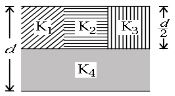
- 1A parallel-plate capacitor of area $A,$ plate separation $d$ and capacitance $C$ is filled with four dielectric materials having dielectric constants $K_1,K_2,K_3$ and $K_4$ as shown in the figure. If a single dielectric material is to be used to have the same capacitance $C$ in this capacitor, then its dielectric constant $K$ is given byView Solution
- 2A parallel plate capacitor has potential $20\,kV$ and capacitance $2\times10^{-4}\,\mu F$. If area of plate is $0.01\,m^2$ and distance between the plates is $2\,mm$ then find dielectric constant of mediumView Solution
- 3A neutral spherical copper particle has a radius of $10 \,nm \left(1 \,nm =10^{-9} \,m \right)$. It gets charged by applying the voltage slowly adding one electron at a time. Then, the graph of the total charge on the particle versus the applied voltage would look likeView Solution
- 4The electric potential in a region is represented as $V = 2x + 3y -z$ ; then the expression of electric field strength isView Solution
- 5A proton and an anti-proton come close to each other in vacuum such that the distance between them is $10 \,cm$. Consider the potential energy to be zero at infinity. The velocity at this distance will be ........... $\,m / s$View Solution
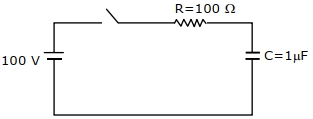
- 6A capacitor of capacitance $C=1\, \mu \,{F}$ is suddenly connected to a battery of $100\, volt$ through a resistance ${R}=100\, \Omega$. The time taken for the capacitor to be charged to get $50 \,{V}$ is $....\,\times \,10^{-4}\,s.$View Solution
[Take $\ln 2=0.69]$
- 7In Millikan's experiment, an oil drop having charge $q$ gets stationary on applying a potential difference $V$ in between two plates separated by a distance $d$. The weight of the drop isView Solution
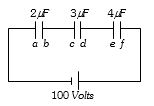
- 8Three capacitors are connected to $D.C.$ source of $100\;volts$ shown in the adjoining figure. If the charge accumulated on plates of ${C_1},\;{C_2}$ and ${C_3}$ are ${q_a},\;{q_b},\;{q_c},{q_d}.{q_e}$ and ${q_f}$ respectively, thenView Solution
- 9View SolutionA table tennis ball which has been covered with conducting paint is suspended by a silk thread so that it hang between two plates, out of which one is earthed and other is connected to a high voltage generator. This ball
- 10Two spherical conductors $A$ and $B$ of radii $1\ mm$ and $2\ mm$ are separated by a distance of $5\ cm$ and are uniformly charged. If the spheres are connected by a conducting wire then in equilibrium condition, the ratio of the magnitude of the electric fields at the surfaces of spheres $A$ and $B$ isView Solution