Three capacitors are connected to $D.C.$ source of $100\;volts$ shown in the adjoining figure. If the charge accumulated on plates of ${C_1},\;{C_2}$ and ${C_3}$ are ${q_a},\;{q_b},\;{q_c},{q_d}.{q_e}$ and ${q_f}$ respectively, then
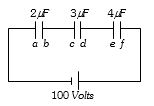
Medium


Download our appand get started for free
Experience the future of education. Simply download our apps or reach out to us for more information. Let's shape the future of learning together!No signup needed.*
Similar Questions
- 1Two capacitors of capacitance $2C$ and $C$ are joined in parallel and charged to potential $V$. The battery is now removed and the capacitor $C$ is filled with a medium of dielectric constant $K$. The potential difference across each capacitor will beView Solution
- 2Assume that an electric field $\vec E = 30{x^2}\hat i$ exists in space. Then the potential difference $V_A-V_O$ where $V_O$ is the potential at the origin and $V_A$ the potential at $x = 2\ m$ is....$V$View Solution
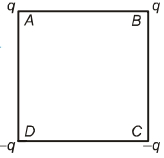
- 3Charges are placed on the vertices of a square as shown Let $\vec E$ be the electric field and $V$ the potential at the centre. If the charges on $A$ and $B$ are interchanged with those on $D$ and $C$ respectively, thenView Solution
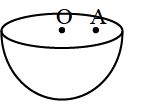
- 4Charge is uniformly distributed on the surface of a hollow hemisphere. Let $O$ and $A$ be two points on the base of the hemisphere and $V_0$ and $V_A$ be the electric potentials at $O$ and $A$ respectively. Then,View Solution
- 5Three capacitances of capacity$10\,\mu F,\;5\,\mu F$ and $5\,\mu F$ are connected in parallel. The total capacity will be........$\mu F$View Solution
- 6A slab of dielectric constant $K$ has the same crosssectional area as the plates of a parallel plate capacitor and thickness $\frac{3}{4}\,d$, where $d$ is the separation of the plates. The capacitance of the capacitor when the slab is inserted between the plates will be.(Given $C _{0}=$ capacitance of capacitor with air as medium between plates.)View Solution
- 7The election field in a region is given by $\vec E = (Ax + B)\hat i$ where $E$ is in $N\,C^{-1}$ and $x$ in meters. The values of constants are $A = 20\, SI\, unit$ and $B = 10\, SI\, unit$. If the potential at $x =1$ is $V_1$ and that at $x = -5$ is $V_2$ then $V_1 -V_2$ is.....$V$View Solution
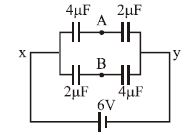
- 8What is the potential difference between $A$ and $B$ in the circuit shown.......$V$View Solution
- 9The diagram shows a small bead of mass $m$ carrying charge $q$. The bead can freely move on the smooth fixed ring placed on a smooth horizontal plane. In the same plane a charge $+Q$ has also been fixed as shown. The potential atthe point $P$ due to $+Q$ is $V$. The velocity with which the bead should projected from the point $P$ so that it can complete a circle should be greater thanView Solution

- 10Uniform electric field of magnitude $100$ $V/m$ in space is directed along the line $y = 3 + x$. Find the potential difference between point $A$ $ (3, 1)$ $\&$ $B$ $(1, 3)$.......$V$View Solution