MCQ
Shape of eye ball is:
  • A
    Flat
  • B
    Spherical
  • C
    Oval
  • D
    Fish shaped

Answer

  1. Spherical

Explanation:

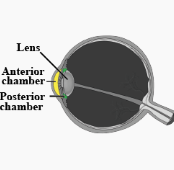
Human eyeball is spherical in shape. Its diameter is varies as 2.1 cm−2.7 cm, hence option B is correct.

Need a full question paper?

Generate a complete, print-ready paper with questions like this in minutes — across 16+ boards, with answer keys.

Start Generating Free

Similar questions

Choose the correct option.
The magnetic field inside a long straight solenoid-carrying current,
When a ray of light travelling in glass enters into water obliquely:
Which of the following changes occur when you walk out of bright sunshine into a poorly lit room?
  1. The pupil becomes larger.
  2. The lens becomes thicker.
  3. The ciliary muscle relaxes.
  4. The pupil becomes smaller.
Which of the following is the most likely temperature of the filament of an electric light bulb when it is working on the normal 220V supply line?
  1. 500°C
  2. 1500°C
  3. 2500°C
  4. 4500°C
Though a woman can see the distant object clearly, she cannot see the nearby objects clearly. She is suffering from the defect of vision called:
Which of the following statements is/are incorrect?
A. A neutron has a positive charge of $+1.6 \times 10^{-19} C$
B. An ammeter is a low resistance device.
C. The resistance of semiconductors decreases with temperature.
D. One ampere is equal to $10^{-6} uA$.
The magnification produced by a spherical lens and a spherical mirror is +2.0.
  1. The lens and mirror are both concave.
  2. The lens and mirror are both convex.
  3. The lens is convex but the mirror is concave.
  4. The lens is concave but the mirror is convex.
If you are to determine to focal length of a convex lens, you should have
The refractive index of glass for light going from air to glass is $\frac{3}{2}.$ The refractive index for light going from glass to air will be:
The 'coolants' which can be used in the reactor of a nuclear power station are:
  1. Liquid mercury and nitrogen dioxide.
  2. Liquid sodium and carbon dioxide.
  3. Liquid ammonia and carbon monoxide.
  4. Liquid boron and uranium oxide.