Questions · Page 1 of 4

M.C.Q-[Phy-1M]

🎯

Test yourself on this topic

50 questions · timed · auto-graded

MCQ 11 Mark
The change in focal length of an eye lens is caused by the action of the.
  • A
    Pupil.
  • B
    Retina.
  • C
    Cilliary muscles.
  • D
    Iris.
Answer
  1. Cilliary muscles.
View full question & answer
MCQ 21 Mark
The least distance of distinct vision for a young adult with normal vision is about.
  • A
    25 m.
  • B
    2.5 cm.
  • C
    25 cm.
  • D
    2.5 m.
Answer
  1. 25 cm.
View full question & answer
MCQ 41 Mark
The human eye can focus objects at different distances by adjusting the focal length of the eye lens. This is due to.
  • A
    presbyopia.
  • B
    accommodation.
  • C
    near-sightedness.
  • D
    far-sightedness.
Answer
  1. accommodation.
View full question & answer
MCQ 51 Mark
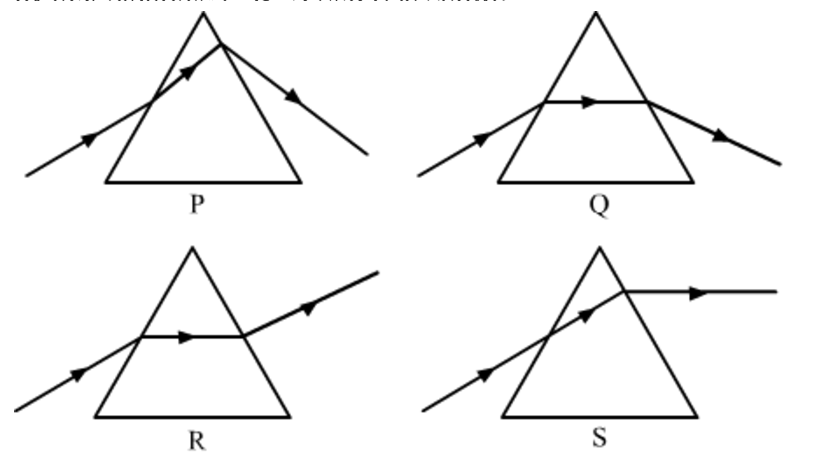
Study the following diagrams in which the path of a ray of light passing through a glass prism as traced by four students P, Q, R and S is shown:

The student who has traced the path correctly is
  • A
    P
  • B
    Q
  • C
    R
  • D
    S
Answer
  1. Q.

​​​​​​​Explanation:

Student Q has traced the path correctly.
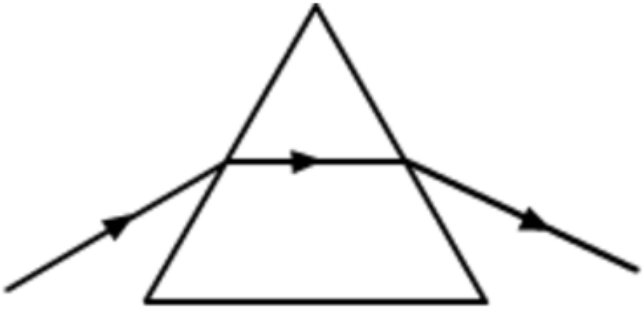


When light is travelling from a rarer medium to a denser medium, it bends towards the normal to the surface, while the light from a denser medium to a rarer medium bends away from the normal to the surface.

Hence, the correct option is B.
View full question & answer
MCQ 61 Mark
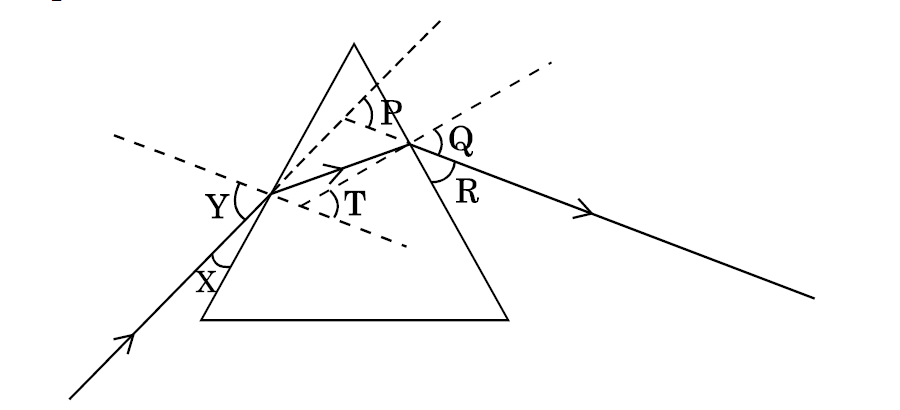
In the following diagram, the path of a ray of light passing through a glass prism is shown:

In this diagram the angle of incidence, the angle of emergence and the angle of deviation respectively are (select the correct option):
  • A
    X, R and T.
  • B
    Y, Q and T.
  • C
    X, Q and P.
  • D
    Y, Q and P.
Answer
  1. Y, Q and P.

​​​​​​​​​​​​​​​​​​​​​Explanation:

The angle made by the incident ray with the normal to the first face of the prism is called incident angle, which is angle Y here.

The angle made by the emergent ray with the normal to the surface when it comes out from the prism after refraction is called emergent angle, which is angle Q here.

The angle between the incident ray and the emergent ray is called angle of deviation, which is angle P here.

Hence, the correct option is D.
View full question & answer
MCQ 71 Mark
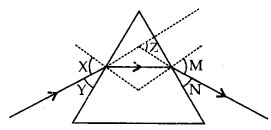
For the refraction of a ray of light through a glass prism, the path of a ray of light is shown below:

The angle of incidence, the angle of emergence and the angle of deviation respectively have been represented by
  • A
    Y, N, Z.
  • B
    X, Z, M.
  • C
    X, N, Z.
  • D
    X, M, Z.
Answer
  1. X, M, Z.
View full question & answer
MCQ 81 Mark
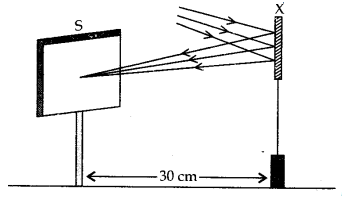
A student focussed the image of a distant object using a device X on a white screen S as shown in the figure. If the distance of the screen from the device is 30 cm, select the correct statement about the device X.
  • A
    The device X is a concave mirror of focal length 15 cm
  • B
    The device X is a concave mirror of focal length 30 cm.
  • C
    The device X is a concave mirror of radius of curvature 30 cm.
  • D
    The device X is a convex mirror of focal length 30 cm.
Answer
  1. The device X is a concave mirror of focal length 30 cm.
View full question & answer
MCQ 91 Mark
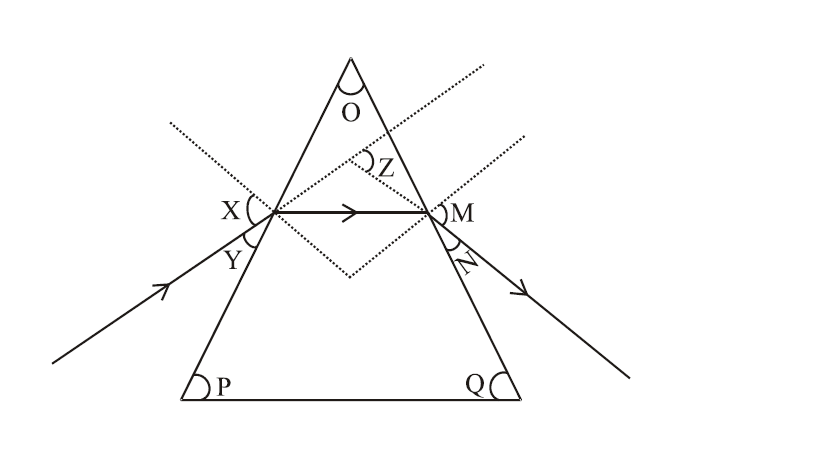
The path of a ray of light passing through a glass prism is shown below:

In this diagram the angle of prism, angle of incidence, angle of emergence and angle of deviation respectively have been represented by:
  • A
    O, Y, Z and N.
  • B
    P, Y, M and Z.
  • C
    O, X, M and Z.
  • D
    P, X, Z and N.
Answer
  1. O, X, M and Z.

​​​​​​​​​​​​​​​​​​​​​​​​​​​​Explanation:

O is the angle of prism.

Angle of incidence is the angle made by the incident ray with the normal to the surface of the prism. Here, X represents the angle of incidence.

Angle of emergence is the angle made by the emerging ray with the normal to the surface of the prism. Here, M represents the angle of emergence.

Angle of deviation is the angle made by the emerging ray with the incident ray. Here, Z represents the angle of deviation.

Hence, the correct option is C.

View full question & answer
MCQ 101 Mark
A student is observing the diagram showing the path of a ray of light passing through a glass prism. He would find that for all angles of incidence the ray of light bends:
  • A
    Towards the normal while entering into the prism and away from the normal while emerging out of the prism.
  • B
    Away from the normal while entering into the prism and towards the normal while emerging out of the prism.
  • C
    Away from the normal while entering as well as while emerging out of the prism.
  • D
    Towards the normal while entering as well as while emerging out of the prism.
Answer
  1. Towards the normal while entering into the prism and away from the normal while emerging out of the prism.

​​​​​​​​​​​​​​​​​​​​​​​​​​​​​​​​​​​​​​​​​​Explanation:

When a ray of light enters a glass prism, it travels from a rarer medium to a denser medium. So, the ray of light bends towards the normal.

When the ray of light emerges from the glass prism, it travels from a denser medium to a rarer medium. So, the ray of light bends away from the normal.

Hence, the correct option is A.
View full question & answer
MCQ 111 Mark
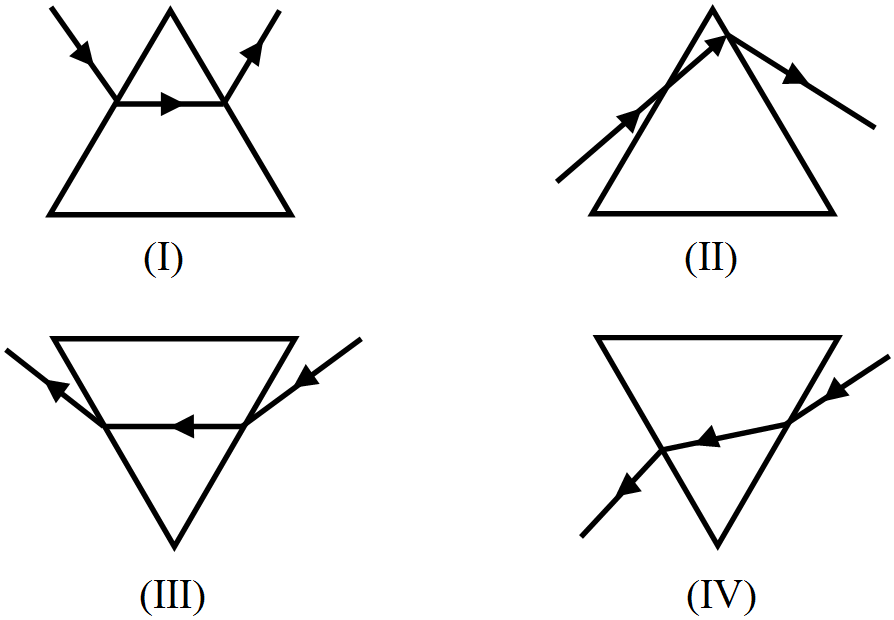
While performing the experiment to trace the path of a ray of light passing through a glass prism, four students marked the incident ray and the emergent ray in their diagrams in the manner shown below:
  • A
    I
  • B
    II
  • C
    III
  • D
    IV
Answer
  1. III.

Explanation:

When light goes from rarer medium to denser medium it bends towards the normal. The light bends away from the normal when it goes from a denser medium to rarer medium.

This condition is fulfilled in figure (III).
View full question & answer
MCQ 121 Mark
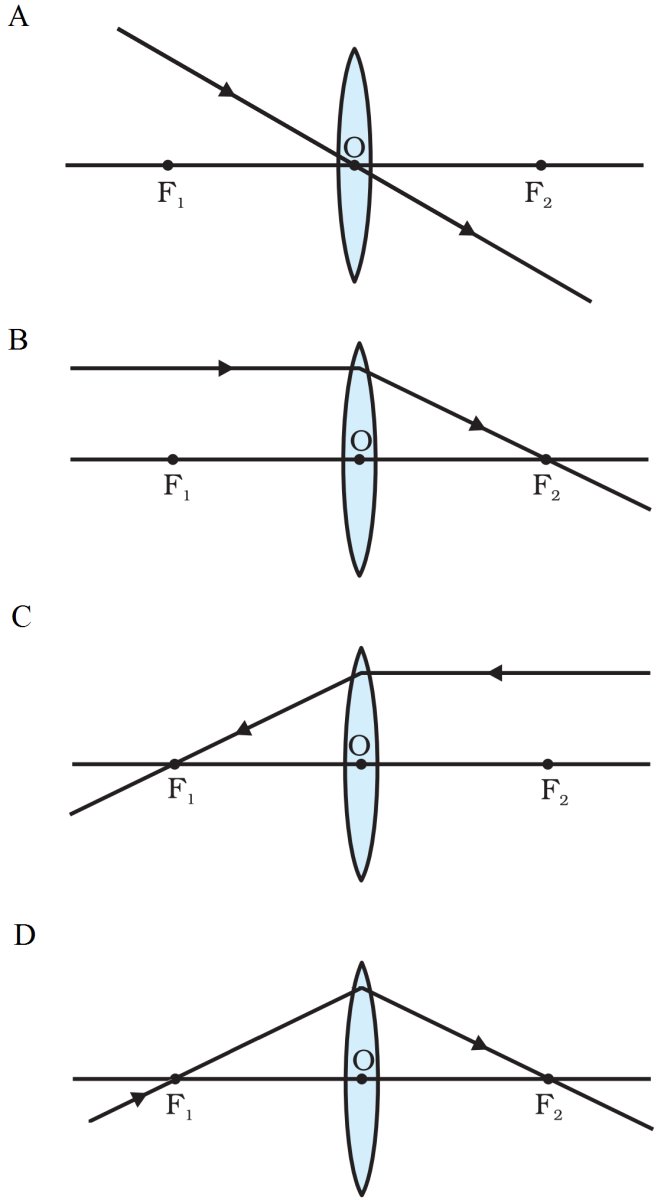
Study the following ray diagrams:
  • A
    II and III only
  • B
    I and II only
  • C
    I, II and III
  • D
    I, II and IV
Answer
  1. I, II and III.
View full question & answer
MCQ 131 Mark
Consider the following properties of virtual images:

  1. Cannot be projected on the screen.
  2. Are formed by both concave and convex lens.
  3. Are always erect.
  4. Are always inverted.

The correct properties are:

Answer
  1. (A) and (B).

Explanation:

Virtual Images are images which can only be seen in a mirror but cannot be obtained on the screen. They are formed when light rays after getting reflected from a mirror appear to meet at a point. A virtual image is erect with respect to the object.

View full question & answer
MCQ 141 Mark
A real image is formed by the light rays after reflection or refraction when they:

  1. Actually meet or intersect with each other.
  2. Actually converge at a point.
  3. Appear to meet when they are produced in the backward direction.
  4. Appear to diverge from a point. Which of the above statements are correct?

Which of the above statements are correct?

  • A
    (A) and (D).
  • B
    (B) and (D).
  • C
    (A) and (B).
  • D
    (B) and (C).
Answer
  1. (A) and (B).

Explanation:

Real Images are images which can be obtained on the screen. They are formed when light rays after getting reflected from a mirror actually meet at a point. A real image is inverted with respect to the object.

View full question & answer
MCQ 151 Mark
With both eyes open, a person's field of view is about:
  • A
    90°
  • B
    50°
  • C
    180°
  • D
    360°
Answer
  1. 180o

Explanation:

A person's field of view with both eyes open is about 180o.

View full question & answer
MCQ 161 Mark
With age Near point and Far point receeds due to:
A: Weakening of ciliary muscles.
B: Reducing ability to change the focal length.
  • A
    'A' is correct.
  • B
    'B' is correct.
  • C
    Both 'A' and 'B' are correct.
  • D
    Neither 'A' nor 'B' is correct.
Answer
  1. Both 'A' and 'B' are correct

Explanation:

The young human eye can change focus from distance (infinity) to as near as 6.5cm from the eye. This dramatic change in focal power of the eye of approximately 15

dioptres (the reciprocal of focal length in metres) occurs as a consequence of areduction in zonular tension induced by ciliary muscle contraction.

View full question & answer
MCQ 171 Mark
Which of the following statements is correct regarding the propagation of light of different colours of white light in air?
  • A
    Red light moves fastest.
  • B
    Blue light moves faster than green light.
  • C
    All the colours of the white light move with the same speed.
  • D
    Yellow light moves with the mean speed as that of the red and the violet light.
Answer
  1. All the colours of the white light move with the same speed.

Explanation:

Speed of light is a constant value regardless of its color.

View full question & answer
MCQ 181 Mark
Which of the following statement is correct?
  • A
    A person with myopia can see distant objects clearly.
  • B
    A person with hypermetropia can see nearby objects clearly.
  • C
    A person with myopia can see nearby objects clearly.
  • D
    A person with hypermetropia cannot see distant objects clearly.
Answer
  1. A person with myopia can see nearby objects clearly.

Explanation:

Hypermetropia: A person suffering from this defect can see far off objects clearly but cannot see nearby objects clearly.

Myopia: A person suffering from th is defect can see nearby objects clearly but cannot see far off objects clearly.

View full question & answer
MCQ 191 Mark
Which of the following statement is correct:
  • A
    Vitreous fluid helps to maintain the shape of the retina
  • B
    Crystalline eye lens helps in focusing the image
  • C
    Aqueous humour helps to maintain the pressure in the eye
  • D
    All of the above
Answer
  1. All of the above

Explanation:

Vitreous humour is a clear gelatinous gel like fluid that fills the space between the lens and the retina.

It helps in maintaining the shape of the retina by holding the retina in its place.

The crystalline lens helps in finer adjustments of focal length required to focus objects at different distances and forms an inverted real image of the object on the retina.

Aqueous humour is present between the lens and the cornea and helps in maintaining the pressure in the eye.

View full question & answer
MCQ 201 Mark
Which of the following phenomenon contributes significantly to the reddish appearance of the sun at sunrise or sunset?
  • A
    Dispersion of light
  • B
    Scattering of light
  • C
    Total internal Reflection
  • D
    Reflection of light from the earth
Answer
  1. Scattering of light
View full question & answer
MCQ 211 Mark
Which of the following phenomena of light are involved in the formation of a rainbow?
  • A
    Reflection, refraction and dispersion.
  • B
    Refraction, dispersion and total internal reflection.
  • C
    Refraction, dispersion and internal reflection.
  • D
    Dispersion, scattering and total internal reflection.
Answer
  1. Refraction, dispersion and internal reflection.

Explanation: Dispersion results in white light getting segregated into its component colours. Refraction bends the incident light to an angle that is causes internal reflection; and finally rainbow is formed.

View full question & answer
MCQ 221 Mark
Which of the following phenomena is based on atmospheric refraction?
  • A
    Tyndall effect.
  • B
    Colour of sun at sunrise.
  • C
    Twinkling of stars.
  • D
    None of these.
Answer
  1. Twinkling of stars.

Explanation:

Atmospheric refraction is the phenomenon of bending of light on passing through the earth's atmosphere. Twinkling of stars Stars twinkle on account of atmospheric refraction. Starlight undergoes refraction many times before reaching the earth.

View full question & answer
MCQ 231 Mark
Which of the following phenomena contributes significantly to the reddish appearance of the sun at sunrise or sunset?
  • A
    Dispersion of light.
  • B
    Scattering of light.
  • C
    Total internal reflection of light.
  • D
    Reflection of light from the earth.
Answer
  1. Scattering of light.

Explanation: Red colour scatters the least and hence travels the farthest. During sunset or sunrise, light has to travel a longer distance to reach us. Hence, only red light reaches to us and the sky appears reddish.

View full question & answer
MCQ 241 Mark
Which of the following is not caused by the atmospheric refraction of light?
  • A
    Twinkling of stars at night.
  • B
    Sun appearing higher in the sky than it actually is.
  • C
    Sun becoming visible two minutes before actual sunrise.
  • D
    Sun appearing red at sunset.
Answer
  1. Sun appearing red at sunset.

Explantion:

The sun appears red at sunset not because of the atmospheric refraction of light but because of the scattering effect of light.

View full question & answer
MCQ 251 Mark
Which of the following is a natural phenomenon which is caused by the dispersion of sunlight in the sky?
  • A
    Twinkling of stars
  • B
    Stars seem higher than they actually are
  • C
    Advanced sunrise and delayed sunset
  • D
    Rainbow
Answer
  1. Rainbow
View full question & answer
MCQ 261 Mark
Which of the following controls the amount of light entering the eye?
  • A
    Ciliary muscles.
  • B
    Lens.
  • C
    Iris.
  • D
    Cornea.
Answer
  1. Iris.

Explanation:

The iris controls the amount of light entering the eye.

View full question & answer
MCQ 271 Mark
Which of the following colour of white light is least deviated by the prism?
  • A
    Green.
  • B
    Violet.
  • C
    Indigo.
  • D
    Yellow.
Answer
  1. Yellow.

Explanation:

Yellow is the colour of white light that is the least deviated by a prism because it has the largest wavelength of the colours given in the alternatives.

View full question & answer
MCQ 281 Mark
Which of the following colour of white light has the least wavelength?
  • A
    Red.
  • B
    Orange.
  • C
    Violet.
  • D
    Blue.
Answer
  1. Violet.

Explanation:

Violet is the colour of white light that has the least wavelength.

View full question & answer
MCQ 291 Mark
Which of the following coloured light has the least speed in glass prism?
  • A
    Violet.
  • B
    Yellow.
  • C
    Red.
  • D
    Green.
Answer
  1. Violet

Explanation:

The colour violet travels the slowest in a glass prism owing to its short wavelength.

View full question & answer
MCQ 301 Mark
Which of the following changes occur when you walk out of bright sunshine into a poorly lit room?
  • A
    The pupil becomes larger.
  • B
    The lens becomes thicker.
  • C
    The ciliary muscle relaxes.
  • D
    The pupil becomes smaller.
Answer
  1. The pupil becomes larger.

Explanation:

The pupil becomes larger when you walk out of bright sunshine into a poorly lit room, to allow more light to enter the eye.

View full question & answer
MCQ 321 Mark
Which one of the following sets includes all homologous organs?
  • A
    Hind legs of pig, duck and kangaroo
  • B
    Wings of bats, butterfly and bird
  • C
    Sting of honey bee, scorpion and snake
  • D
    Tail of rat, peacock and cockroach
Answer
  1. Hind legs of pig, duck and kangaroo

Explanation:

Homologous structures means that they had come from a common ancestor, e.g., hind legs of pig, duck and kangaroo.

View full question & answer
MCQ 331 Mark
Which amongst the given radiation is preferred for taking photographs in fog?
  • A
    Ordinary visible light.
  • B
    Infrared.
  • C
    Microwave.
  • D
    X-rays.
Answer
  1. Infrared.

Explanation:

Infrared radiation has the maximum wavelength and minimum frequency. Energy is directly proportional to frequency; hence energy associated with them is also low. Thus the infrared radiation gets least scattered by the tiny particles in the fog.

That is why infrared wave is preferred over all others which have a higher frequency and gets scattered hence can’t be focused.

View full question & answer
MCQ 341 Mark
When white light enters a prism, it gets split into its constituent colours. This is due to:
  • A
    Different refractive index for different wavelength of each colour
  • B
    Each colours has same velocity in the prism.
  • C
    Prism material have high density.
  • D
    Scattering of light.
Answer
  1. Different refractive index for different wavelength of each colour
View full question & answer
MCQ 351 Mark
When the power of eye lens increases, the defect of vision is produced.This  defect of vision is known as
  • A
    Shortsightedness
  • B
    Longsightedness
  • C
    Colourblindness
  • D
    None of the above
Answer
  1. Shortsightedness

Explanation:

When the power of eye lens increases, the object kept at the far point can not be seen clearly because the focal distance of eye lens decreases.

View full question & answer
MCQ 361 Mark
When the light rays enters the eye, most of the refraction occurs at the:
  • A
    Crystalline lens
  • B
    Outer surface of cornea
  • C
    Iris
  • D
    Pupil
Answer
  1. Outer surface of cornea
View full question & answer
MCQ 371 Mark
When the light is very bright, the diameter of pupil:
  • A
    Expends
  • B
    Contract
  • C
    Remain same
  • D
    All of these
Answer
  1. Contract
View full question & answer
MCQ 381 Mark
When objects at different distances are seen by the eye, which of the following remains constant?
  • A
    The focal length of the eye lens
  • B
    The object distance from the eye lens
  • C
    The radii of curvature of the eye lens
  • D
    The image distance from the eye lens
Answer
  1. The image distance from the eye lens

Explanation:

In the eye, image is always formed at retina which is at a fixed distance in eye.

So, when objects at different distances are seen by the eye, the image distance from the eye lens remains constant by changing radii of curative of the eye lens leading to change in focal length.

View full question & answer
MCQ 391 Mark
When light rays enter the eye, most of the refraction occurs at the:
  • A
    Crystalline lens
  • B
    Outer surface of the cornea
  • C
    Iris
  • D
    Pupil
Answer
  1. Outer surface of the cornea

Explanation:

Cornea is the transparent spherical part of the eye covering the iris and pupil.

When an object appears in front of the eye, the rays from the object enter through this transparent cornea and refraction occurs at the outer

View full question & answer
MCQ 401 Mark
When light rays enter the eye, most of the refraction occurs at the.
  • A
    Crystalline lens.
  • B
    Outer surface of the cornea.
  • C
    Iris.
  • D
    Pupil.
Answer
  1. Outer surface of the cornea.

Explanation:

Most refraction in the eye occurs when light rays travel through the curved, clear front surface of the eye (cornea). The eye's natural lens also bends light rays.

View full question & answer
MCQ 411 Mark
When a person is myopic, he/ she can clearly see:
  • A
    Both nearby and far off objects
  • B
    Only nearby objects
  • C
    Only far off objects
  • D
    Neither nearby nor far off objects
Answer
  1. Only nearby objects
View full question & answer
MCQ 421 Mark
What type of image is formed by the eye lens on the retina?
  • A
    Real and erect
  • B
    Virtual and inverted
  • C
    Real and inverted
  • D
    Virtual and erect
Answer
  1. Real and inverted
View full question & answer
MCQ 431 Mark
What happens when white light passes through a glass prism:
  • A
    Light dispersion and formation of a 7 colors spectrum.
  • B
    Light dispersion and formation of a  6 colors spectrum.
  • C
    Light reflection and a formation of a 6 colors spectrum.
  • D
    Light reflection and a formation of a 7 colors spectrum.
Answer
  1. Light dispersion and formation of a 7 colors spectrum.

Explanation:

Upon passage through the prism, the white light is separated into its component colors - red, orange, yellow, green, blue, indigo and violet.

View full question & answer
MCQ 441 Mark
What are the colours of the Sun observed most during sunrise/ sunset and noon? 
  • A
    White and red
  • B
    Reddish and orange
  • C
    Yellow and reddish
  • D
    Orange and blue
Answer
  1. Reddish and orange

Explanation:

During sunrise and sunset the sun rays have to pass through a larger distance and also a greater thickness of air since it is low in the sky.

At these positions, the sky looks orange-red colour because photons of red and orange light are least scattered through the atmosphere and are able to reach our eyes.

View full question & answer
MCQ 451 Mark
Variable focal length of eye is responsible for:
  • A
    Accommodation of eye
  • B
    Persistence of vision
  • C
    Colour blindness
  • D
    Least distance of distinct vision
Answer
  1. Accommodation of eye
View full question & answer
MCQ 461 Mark
Tyndall effect is colloidal solution is due to:
  • A
    Reflection of light.
  • B
    Absorption of light.
  • C
    Scattering of light.
  • D
    Refraction of light.
Answer
  1. Scattering of light.

Explanation:

The Tyndall effect is the scattering of light as a light beam passes through a colloid. The individual suspension particles scatter and reflect light, making the beam visible.

View full question & answer
MCQ 471 Mark
Twinkling of stars is due to atmospheric:
  • A
    Dispersion of light by water droplets.
  • B
    Refraction of light by different layers of varying refractive indices.
  • C
    Scattering of light by dust particles.
  • D
    Internal reflection of light by clouds.
Answer
  1. Refraction of light by different layers of varying refractive indices.

Explanation: The twinkling of a star is due to atmospheric refraction of light of stars.

View full question & answer
MCQ 481 Mark
Transparent front part of eye is:
  • A
    Pupil
  • B
    Cornea
  • C
    Iris
  • D
    Retina
Answer
  1. Cornea

Explanation:

Light enters the eye through a curved front surface known as cornea. It is transparent in nature.

View full question & answer
MCQ 491 Mark
To focus the image of a nearby object on the retina of an eye:
  • A
    The distance between eye-lens and retina is increased.
  • B
    The distance between eye-lens and retina is decreased.
  • C
    The thickness of eye-lens is decreased.
  • D
    The thickness of eye-lens is increased.
Answer
  1. The thickness of the eye lens is increased.

Explanation:

The thickness of the eye lens is increased to focus the image of a nearby object on the retina of the eye.

View full question & answer
MCQ 501 Mark
Though a woman can see the distant object clearly, she cannot see the nearby objects clearly. She is suffering from the defect of vision called:
  • A
    Long-sight.
  • B
    Short-sight.
  • C
    Hind-sight.
  • D
    Mid-sight.
Answer
  1. Long sight.

Explanation:

As the woman can see distant objects clearly, but not nearby objects, she is suffering from the defect of vision called long sight.

View full question & answer
M.C.Q-[Phy-1M] - Science STD 10 Questions - Vidyadip