Question
Short Note on dry cell ### Explain Leclanche cell.

Answer

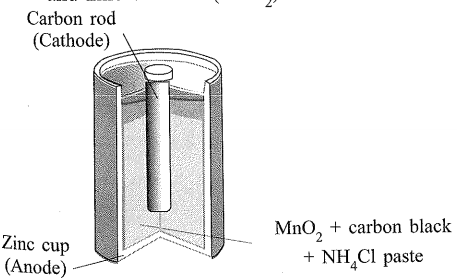
→ The cell consists of a zinc container that also acts as anode, while the cathode is a carbon (graphite) rod surrounded by powered manganese dioxide and carbon.
→ The space between the electrodes is filled with a moist of paste of ammonium chloride $\left( NH _4 Cl \right)$ and zinc chloride $\left( ZnCl _2\right)$
Image
→ Dry cells are often used in devices like transistors, toys and clocks.
→ The electrode reactions are complex, by they can be written approximately as follows :
Anode $: Zn ( s ) \rightarrow Zn ^{2+}+2 e ^{-}$
Cathode : $MnO _2+ NH _4^{+}+ e ^{-} \rightarrow MnO ( OH )+ NH _3$
→ In the reaction at cathode, manganese is reduced from the +4 oxidation state to the +3 state.
→ Ammonia produced in the reaction forms a complex with $Zn ^{+2}$ to give $\left[ Zn \left( NH _3\right)_4\right]^{+2}$. The cell has a potential of nearly 1.5 V .

Need a full question paper?

Generate a complete, print-ready paper with questions like this in minutes — across 16+ boards, with answer keys.
Start Generating Free

Similar questions

Write a note on esterification of alcohols and phenols.
Why Haloarenes undergo electrophilic substitution reactions at o and p - position? Why it is less reactive than benzene ?
A decimolar solution of potassium ferrocyanide is $50\%$ dissociated at $300K.$ Calculate the osmotic pressure of the solution. $(R = 8.314\ J\ K^{-1}\ mol^{-1}).$
earrange the compounds of each of the following sets in order of reactivity towards $S_N2$ displacement:
  1. $2-$Bromo$-2-$methylbutane, $1-$Bromopentane, $2-$Bromopentane.
  2. $1-$Bromo$-3-$methylbutane, $2-$Bromo$-2-$methylbutane, $3-$Bromo$-2-$methylbutane.
  3. $1-$Bromobutane, $1-$Bromo$-2, 2-$dimethylpropane, $1-$Bromo$-2-$methylbutane.
On what basis can you say that scandium $(Z = 21)$ is a transition element but zinc $(Z = 30)$ is not?
The rate constant for the decomposition of ethyl iodide $\ce{C_2H_5l(g) \rightarrow C_2H_4(g)+Hl(g)}$
at $600K$ is $1.60 \times 10^{-5} s^{-1} .$ Its energy of activation is $\ce{209 kJ/mol}.$ Calculate the rate constant of the reaction at $700K.$
Give reasons for the following:
  1. Aniline does not undergo Friedal$-$Crafts reaction.
  2. $(CH_3)_2 NH$ is more basic than $(CH_3)_3 N$ in an aqueous solution.
  3. Primary amines have higher boiling point than tertiary amines.
Describe the following:
i. Acetylation
ii. Cannizzaro reaction
iii. Cross aldol condensation
iv. Decarboxylation
Why is the vapour pressure of an aqueous solution of glucose lower than that of water?
Calculate the mass of ascorbic acid $($Molar mass $= 176\text{g mol}^{-1})$ to be dissolved in $75g$ of acetic acid, to lower its freezing point by $1·5^\circ C. (K_f = 3.9K \ \text{kg mol}^{-1})$