Question
Should a transaction be first recorded in a journal or ledger? Why?

Answer

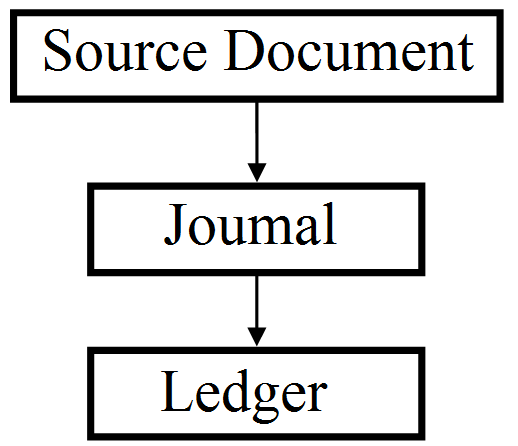
A transaction should be recorded first in a journal because journal provides complete details of a transaction in one entry. Further, a journal forms the basis for posting the transactions into their respective accounts into ledger. Transactions are recorded in journal in chronological order, i.e. in the order of occurrence with the help of source documents. Journal is also known as ‘book of original entry’, because with the help of source document, transactions are originally recorded in books.
The process of recording the transactions in journal and then in ledger is presented in the below-given flow chart.

Need a full question paper?

Generate a complete, print-ready paper with questions like this in minutes — across 16+ boards, with answer keys.

Start Generating Free

Similar questions

Enter the following transaction in a two column cash book
2013 Amt (Rs.)
Feb-01Cash in hand75,000
Feb-05Paid to Kartik15,000
 Discount allowed by Kartik500
Feb-08Goods purchased20,000
Feb-10Received from Parth49,000
 Discount allowed to Parth1,000
Feb-16Goods sold20,000
Feb-21Paid to Aroha14,750
 Discount allowed by him250
Feb-28Paid wages for the month25,000
 Paid in full settlement of Rs. 20,000 to Amit19,500
Distinguish between an accomodation bill and a trade bill.
Elucidate the following statement:
‘Only cash transactions are recorded in Cash Book'.
Mr. Gopal started business for buying and selling of readymade garments with ₹ 8,00,000 as an initial investment. Out of this he paid ₹ 4,00,000 for the purchase of garments and ₹ 50,000 for furniture and ₹ 50,000 for computers and the remaining amount was deposited into the bank. He sold some of the ladies and kids garments for ₹ 3,00,000 for cash and some garments for ₹ 1,50,000 on credit to Mr. Rajesh.
Subsequently, he bought men's garments of ₹ 2,00,000 from Mr. Satish. In the first week of the next month, a fire broke out in his office and stock of garments worth ₹ 1,00,000 was destroyed. Later on, some garments which cost ₹ 1,20,000 were sold for ₹ 1,30,000. Expenses paid during the same period were ₹ 15,000. Mr. Gopal withdrew ₹ 20,000 from business for his domestic use.
From the above, answer the following:
  1. What is the amount of capital with which Mr. Gopal started the business?
  2. What fixed assets did he buy?
  3. What is the value of the goods purchased?
  4. Who is the creditor and state the amount payable to him?
  5. Who is the debtor and what is the amount receivable from him?
  6. What is the total amount of expenses?
  7. What is the amount of drawings of Mr. Gopal?
Distinguish between Cash Book and Cash A/c.
Distinguish between Bills of Exchange and Promissory note on the following basis:
  1. Order or Promise and Parties.
  2. Acceptance.
  3. Parties.
  4. Noting.
What is CGST? Give an example.
What are Accounting Vouchers?
From the following particulars, prepare a Bank Reconciliation Statement of Sh. Yadav on 31st December 2014:-
Balance as per Pass Book on 31st December, 2014 is ₹ 11,000. Cheques for ₹ 6,200 were issued during the month of December but of these cheques for ₹ 900 were presented in the month of January, 2015 and one cheque for ₹ 500 was not presented for payment. Cheque and cash amounting to ₹ 5,700 were deposited in bank during December but credit was given for ₹ 4,700 only. A customer had deposited ₹ 850 into the bank directly. The bank has credited the merchant for ₹ 150 as interest and has debited him for ₹ 30 as bank charges, for which there are no corresponding entries in Cash Book.
Prepare an imaginary specimen of a promissory note.