Questions

4 Marks Question

🎯

Test yourself on this topic

37 questions · timed · auto-graded

Question 14 Marks
Show the effect of the following transactions on Assets, Liabilities and Capital through accounting equation:
a.
Started business with cash
₹ 1,20,000
b.
Rent received
₹ 10,000
c.
Invested in shares
₹ 50,000
d.
Received dividend
₹ 5,000
e.
Purchase goods on credit from Ragani
₹ 35,000
f.
Paid cash for house hold Expenses
₹ 7,000
g.
Sold goods for cash (costing ₹ 10,000)
₹ 14,000
h.
Cash paid to Ragani
₹ 35,000
i. Deposited into bank ₹ 20,000
(Ans: Assets = Cash ₹ 37,000 + Shares ₹ 50,000 + Goods ₹ 25,000 + Bank ₹ 20,000 = ₹ 1,32,000; Liabilities = Capital ₹ 1,32,000)
View full question & answer
Question 24 Marks
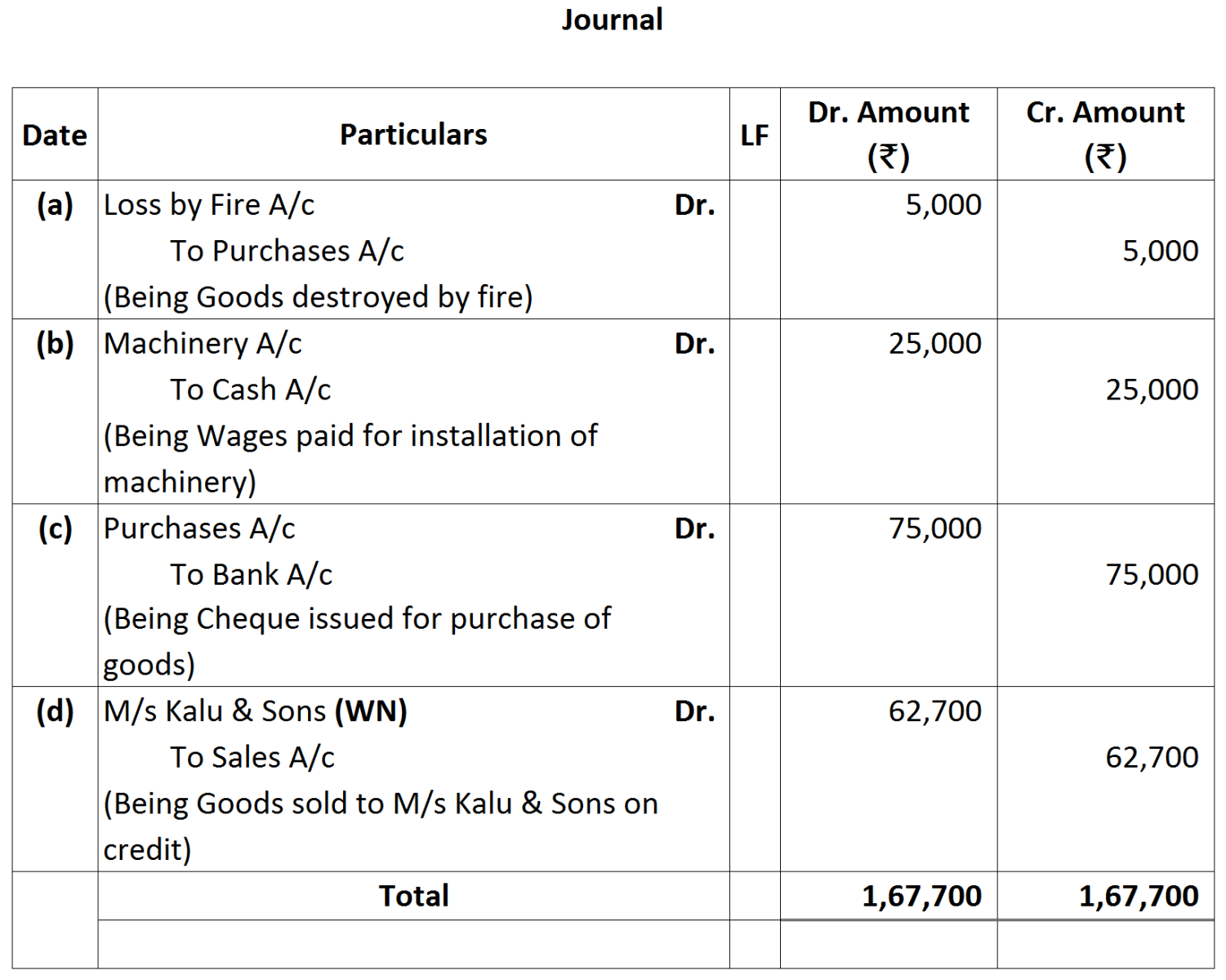
Journalise the following transactions:
  1. Goods destroyed by Fire for ₹ 5,000.
  2. Paid by cheque ₹ 25,000 as wages on installation of a Machinery.
  3. Issued a cheque in favour of M/s Parmatma Saran & Sons on account of purchase of goods ₹ 75,000.
  4. Goods sold costing ₹ 60,000 to M/s Kalu Sons at an invoice price 10% above cost less 5% Trade discount.
Answer

Working Notes: Calculation of goods sold to M/s Kalu & Sons.
Cost
=
60,000
Add: Profit (10% on 60,000)
=
6,000
 
=
$\overline{66,000}$
Less: Trade Discount (5% on 66,000)
=
3,300
Sale Price
=
$\overline{62,700}$
View full question & answer
Question 34 Marks
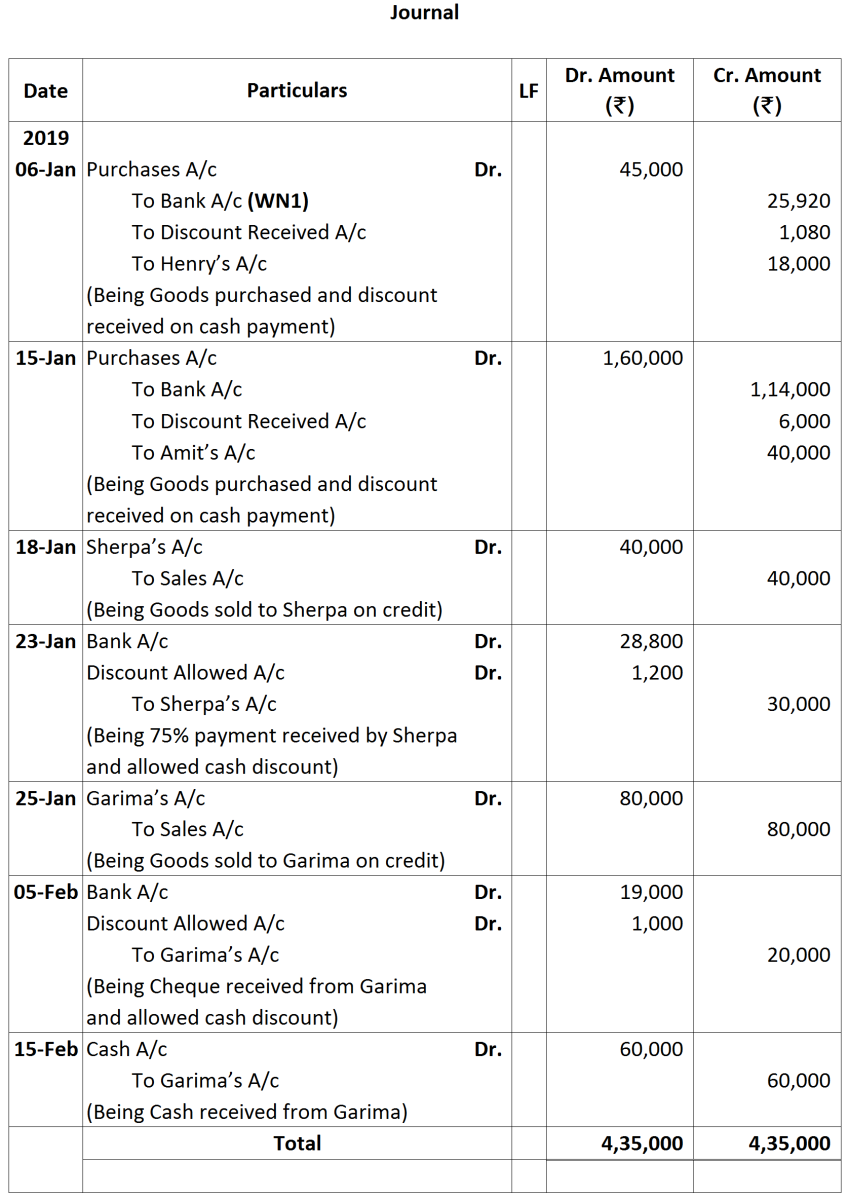
Pass journal entries for the following:
2019
 
Jan. 6
Purchased goods from Henry for ₹ 50,000 on 10% trade discount and 4% cash discount and paid 60% amount by cheque.
Jan. 15
Bought goods from Amit for ₹ 2,00,000 at terms 5% cash discount and 20% trade discount. Paid $\frac{3}{4}\text{th}$ of the amount in cash at the time of purchase.
Jan. 18 Sold goods to Sherpa at the list price of ₹ 50,000 less 20% trade discount and 4% cash discount if the payment is made within 7 days. 75% payment is received by cheque on Jan. 23rd.
Jan. 25 Sold goods to Garima for ₹ 1,00,000, allowed her 20% trade discount and 5% cash discount if the payment is made within 15 days. She paid $\frac{1}{4}\text{th}$ of the amount by cheque on Feb. 5th and 60% of the remainder on Feb. 15th in cash.
Answer

Working Notes:
WN 1: Calculation of Payment made to Henry.
Cost Price of Goods
=
50,000
Less: 10% Trade Discount
=
5,000
Purchase Price
=
$\overline{₹\ 45,000}$
Payment in Cash = 45,000 × 60%
=
27,000
Less: Cash Discount = 27,000 × 4%
=
1,080
Cash Paid
=
$\overline{₹\ 25,920}$
WN 2: Calculation of Payment made to Amit.
Cost Price of Goods
=
2,00,000
Less: 20% Trade Discount
=
40,000
Purchase Price
=
$\overline{₹\ 1,60,000}$
Payment in Cash $=1,60,000\times\frac{3}{4}$
=
₹ 1,20,000
Less: Cash Discount = 1,20,000 × 5%
=
₹ 6,000
Cash Paid
=
$\overline{₹\ 1,14,000}$
View full question & answer
Question 44 Marks
Y started a business on $1^{\text {st }}$ April, $2013 $with a Capital of $₹ 2,00,000$ and a loan of $₹ 75,000$ from the bank. During the year, he had introduced additional capital of ₹ $60,000 $and had withdrawn ₹ $36,000 $for personal purposes. On $31^{\text {st }}$ March, $2014 $his assets were ₹ $3,80,000$. Find out his Capital as on $31^{\text {st }}$ March, $2014$ and profit earned during the year $2013-14$.
Answer
Opening Capital (Capital as on$ 1^{st} $April, $2013) = ₹ 2,00,000$
Calculation of Closing Capital (Capital as on March $31, 2014)$
Assets = Liabilities + Capital
$3,80,000 = 75,000 + $Capital
Capital $= ₹ 3,05,000$​​​​​​​
Calculation of Profit Earned during the year
Closing Capital = Opening Capital + Additional Capital + Profit - Drawings
$3,05,000 = 2,00,000 + 60,000 + $Profit $- 36,000$
$3,05,000 = 2,24,000 +$ Profit
Profit $= 3,05,000 - 2,24,000$
$= ₹ 81,000$
View full question & answer
Question 54 Marks
Distinguish between Trade Discount and Cash Discount.
Answer
No.
Basic
Trade Discount
Cash Discount
1.
Nature
It is allowed on sale or purchase of certain quantity.
It is allowed on payment being made on or before a certain date.
2.
Nature of Transaction
It is allowed on both cash and credit sales or puechases.
It is allowed only on payment.
3.
Recording
Trade discount is not recorded separately in the books of account.
Cash discount is recorded separately in the books of account.
4.
Deduction from Invoice
The amount of the trade discount is deducted from the invoice.
It is not deducted from the invoice.
5.
Consideration
The consideration for allowance is purchases.
The consideration for allowance is payment.
6.
Relation
It is related to sale and purchase of goods.
It is related to payment.
View full question & answer
Question 64 Marks
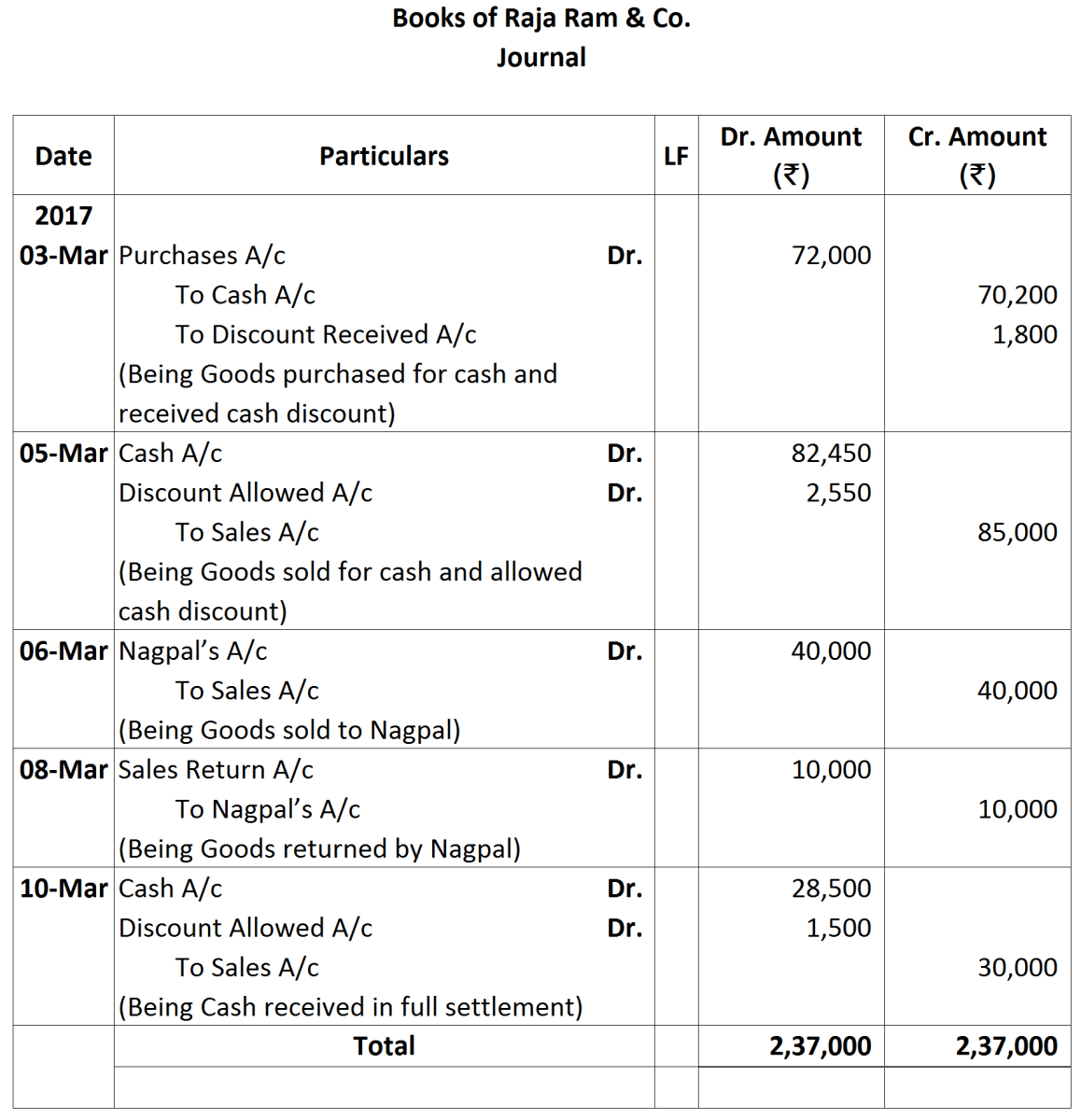
Give Journal Entries for the following transactions in the books of Raja Ram & Co.:
2017
 
March 3
Bought goods for cash of the list price of ₹ 80,000 at 10% trade discount and $2\frac{1}{2}\%$ cash discount.
March 5
Sold goods for cash of the list price of ₹ 1,00,000 at 15% trade discount and 3% cash discount.
March 6
Sold goods to Nagpal of the list price of ₹ 50,000 at 20% trade discount.
March 8
Nagpal returned one-fourth of the above goods.
March 10
Nagpal settled the account by paying cash under a discount of 5%.
Answer
Solution is as follow:
View full question & answer
Question 74 Marks
What is the purpose of posting J.F numbers that are entered in the journal at the time entries are posted to the accounts.
Answer
J.F. number is the number that is entered in the ledger at the time of posting entries into their respective accounts. It helps in determining whether all transactions are properly posted in their accounts. It is recorded at the time of posting and not at the time of recording the transactions.
The purpose of entering J.F. number in the ledger is because of the below given benefits.
  1. J.F. number helps in locating the entries of accounts in the journal book. In other words, J.F number helps to locate the position of the related journal entry and subsidiary book in the journal book.
  2. J.F. number in accounts ensures that recording in the books of original entry has been posted or not.
View full question & answer
Question 84 Marks
From the following transactions, state the nature of accounts and state the accounts which will be debited and credited:
  1. Ganesh started business with Cash ₹ 2,00,000.
  2. Purchased goods for Cash ₹ 60,000.
  3. Sold goods for cash ₹ 75,000.
  4. Purchased goods from Nakul on Credit for ₹ 80,000.
  5. Sold goods to Bhushan on Credit for ₹ 50,000.
  6. Paid Cash to Nakul ₹ 20,000.
  7. Received Cash from Bhushan ₹ 10,000.
  8. Paid salary ₹ 20,000.
Answer
 
Transactions
Nature of Account
i.
Ganesh started business with cash
Cash A/c- Debit (Asset)
Capital A/c- Credit (Liability)
ii.
Purchased goods for cash
Purchases- Debit (Expense)
Cash A/c- Credit (Asset)
iii.
Sold goods for cash
Cash A/c- Debit (Asset)
Sales A/c- Credit (Revenue)
iv.
Purchased goods from Nakul on credit
Purchases A/c- Debit (Expense)
Nakul A/c- Credit (Liability)
v. Sold goods to Bhushan on credit Bhushan A/c- Debit (Asset)
Sales A/c- Credit (Revenue)
vi. Paid cash to Nakul Nakul A/c- Debit (Liability)
Cash A/c- Credit (Asset)
vii. Received Cash from Bhushan Cash A/c- Debit (Asset)
Bhushan A/c- Credit (Asset)
viii. Paid salary Salary A/c- Debit (Expense)
Cash A/c- Credit (Asset)
View full question & answer
Question 94 Marks
What is IGST? Give an example.
Answer
IGST: It is levied on inter-state sales, i. e. sales of goods and services outside the state. It is also levied on import of goods and services into India and export of goods and services from India. For example, a dealer of Rajasthan sells goods to a dealer in Madhya Pradesh worth 50,000. Suppose, the IGST rate is 12%. In such a case, the seller will charge 36,000 as IGST and this entire amount will go to Central Government.
GST collected under IGST is divided between Central and State Governments as per the rates specified by the Government.
View full question & answer
Question 104 Marks
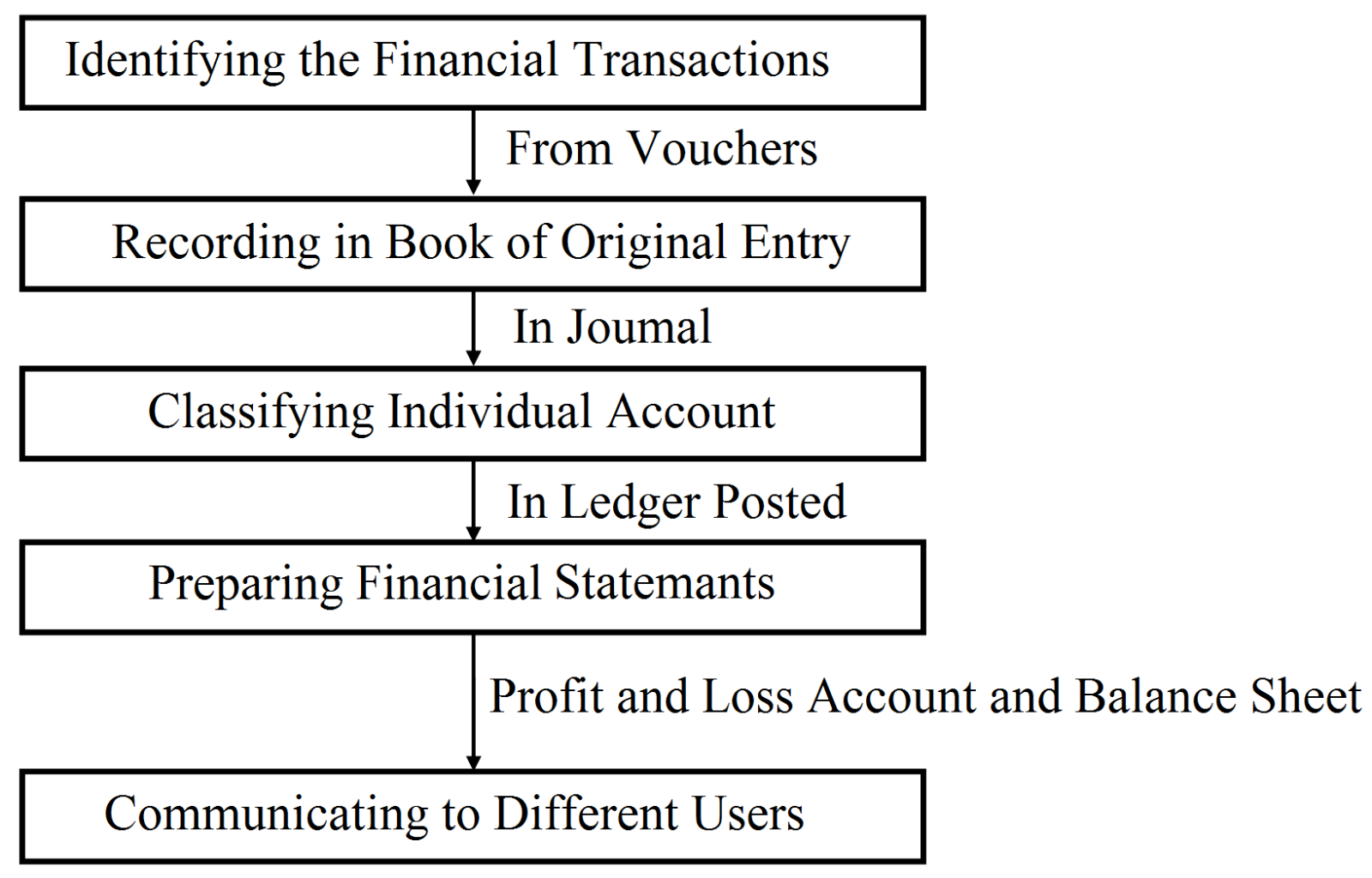
State the three fundamental steps in the accounting process.
Answer
The fundamental steps in the accounting process are diagrammatically presented below.
View full question & answer
Question 114 Marks
Prepare accounting equation from the following:
 
 
(a)
Kunal started business with cash
2,50,000
(b)
He purchased furniture for cash
35,000
(c)
He paid commission
2,000
(d)
He purchases goods on credit
40,000
(e)
He sold goods (costing ₹ 20,000) for cash
26,000
Asset = Cash ₹ 2,39,000 + Furniture ₹ 35,000 + Goods ₹ 20,000 = ₹ 2,94,000; Liabilities = Creditors ₹ 40,000 + Capital ₹ 2,54,000 = ₹ 2,94,000
View full question & answer
Question 124 Marks
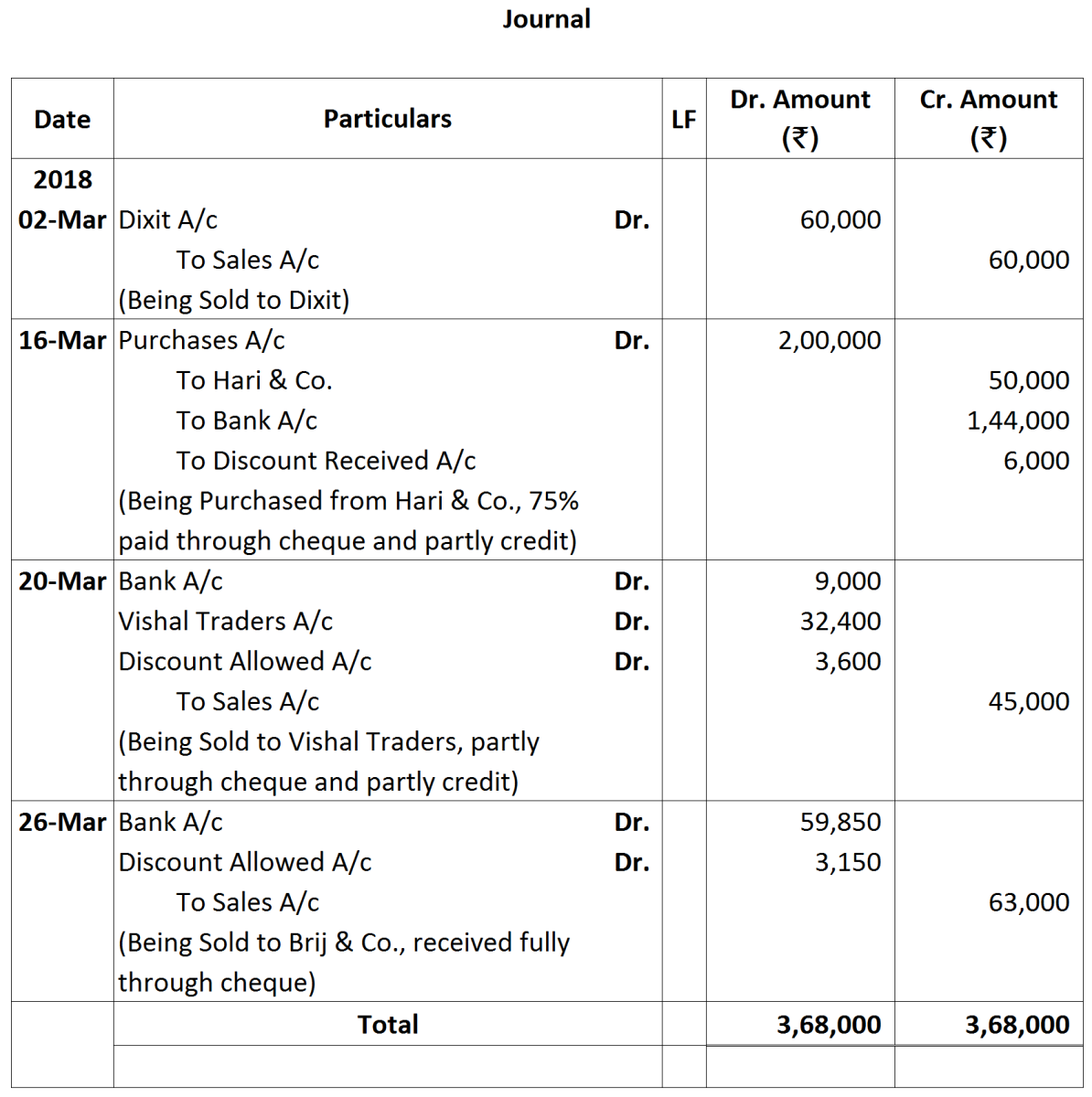
Journalise the following transactions in the books of Dixit & Sons.:
2018
 
March 2
Sold goods to Dilip of the list price of ₹ 62,000 for ₹ 60,000.
March 16
Purchased goods costing ₹ 2,00,000 from Hari & Co. Paid 75% immediately by cheque to avail 4% discount.
March 20 Sold goods to Vishal Traders costing ₹ 40,000 at 25% profit, allowing 10% trade discount and 10% cash discount. Received 80% payment immediately by cheque.
March 26 Sold goods to Brij & Co. costing ₹ 50,000 at 40% profit, allowing 10% trade discount and 5% cash discount. Brij & Co. paid the full amount by cheque and availed cash discount.
Answer
Solution is as follow:
View full question & answer
Question 134 Marks
If in the above case, the proprietor had introduced fresh capital of ₹ $40,000 $and had withdrawn ₹ $10,000 $for personal purposes, calculate his profits.
Answer
Opening Capital (Capital as on $1^{\text {st }}$ April, $2011$) $=₹ 5,00,000$
Calculation of Closing Capital (Capital as on March $31, 2012)$
Assets = Liabilities + Capital
$8,00,000 = 1,00,000 + $Capital
Capital =$ ₹ 7,00,000$​​​​​​​
Calculation of Profit Earned during the year
Closing Capital = Opening Capital + Additional Capital + Profit - Drawings
$7,00,000 = 5,00,000 + 40,000 +$ Profit $- 10,000$
$7,00,000 = 5,30,000 +$ Profit
$= ₹ 1,70,000$
View full question & answer
Question 144 Marks
Prepare accounting equation on the basis of the following:
  1. Harsha started business with cash ₹ 2,00,000
  2. Purchased goods from Naman for cash ₹ 40,000
  3. Sold goods to Bhanu costing ₹ 10,000/- ₹ 12,000
  4. Bought furniture on credit ₹ 7,000
View full question & answer
Question 154 Marks
What are Accounting Vouchers?
Answer
Voucher is a document evidencing a business transaction. It flows from the above definition that when a transaction is entered into, an evidence to that effect is also established. Such evidences are Source Documents. On the basis of Source Documents, a voucher detailing the accounts that are debited and credited is prepared.
View full question & answer
Question 164 Marks
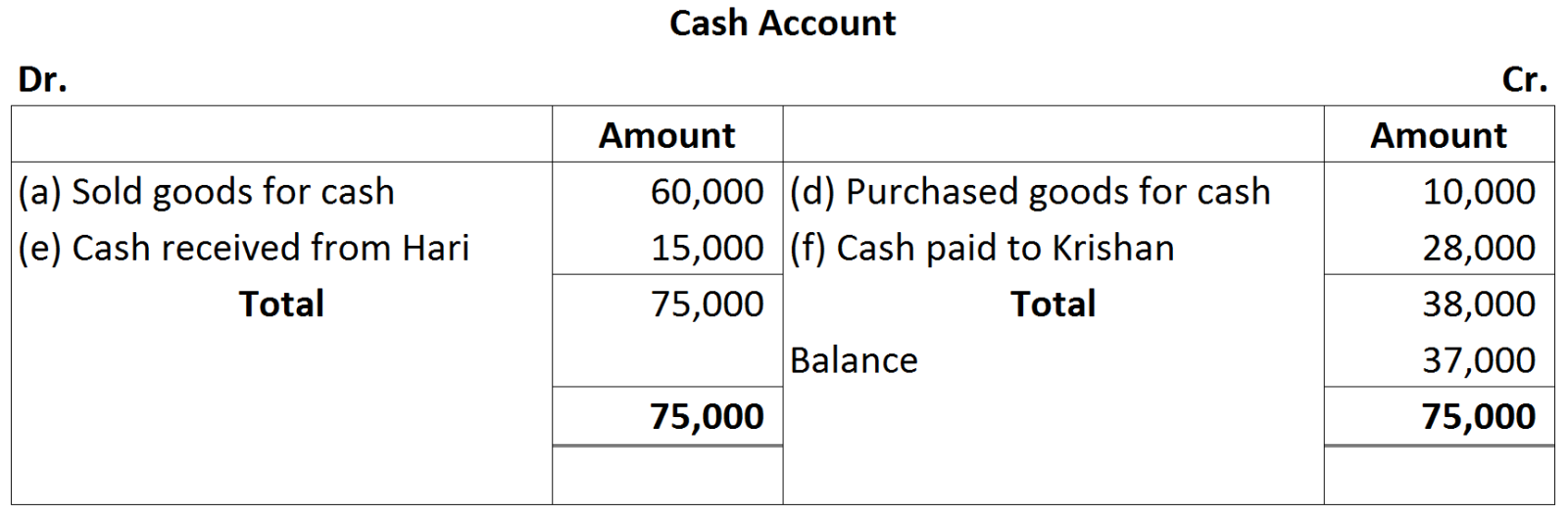
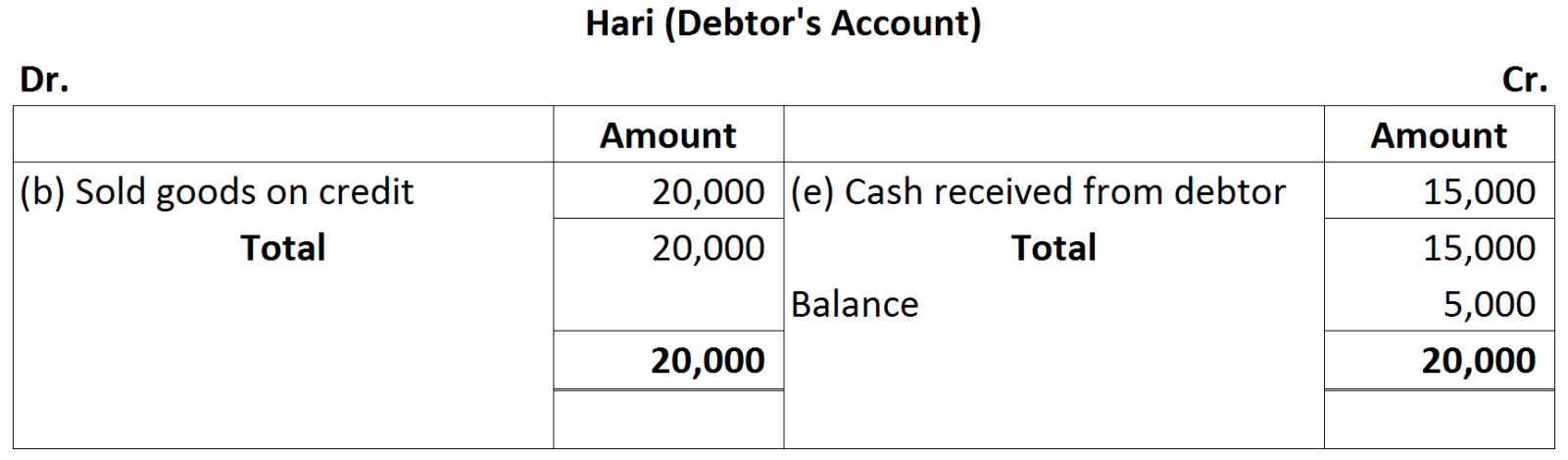
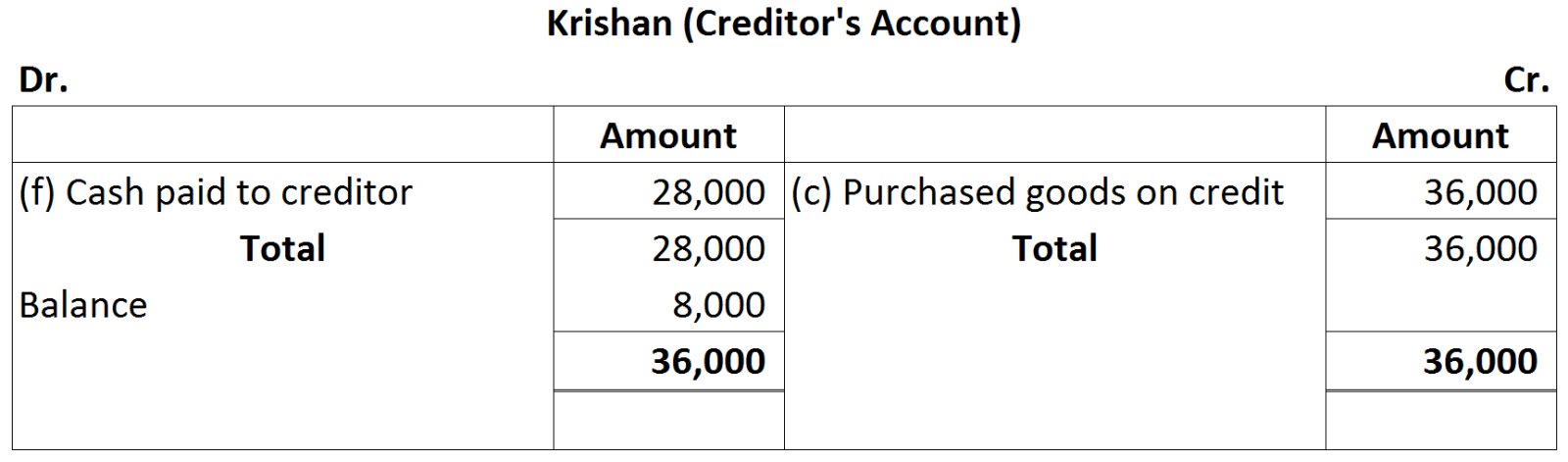
Put the following on the proper side of Cash account, Debtor's account and Creditor's account:
  1. Sold goods for cash ₹ 60,000.
  2. Sold goods to Hari on credit ₹ 20,000.
  3. Purchased goods from Krishan on credit ₹ 36,000.
  4. Purchased goods from Krishan for cash ₹ 10,000.
  5. Cash received from Hari ₹ 15,000.
  6. Cash paid to Krishan ₹ 28,000.
Answer
Increase in Cash (being an asset) will be shown on the debit side and decrease in cash will be recorded on the credit side of the Cash Account.

Increase in Debtors (being an asset) will be shown on the debit side and decrease in them will be recorded on the credit side of the Debtors Account.

Increase in Creditors (being a liability) will be shown on the credit side and decrease in the creditors will be recorded on the debit side of the Creditors Account.
View full question & answer
Question 174 Marks
Prepare accounting equation from the following:
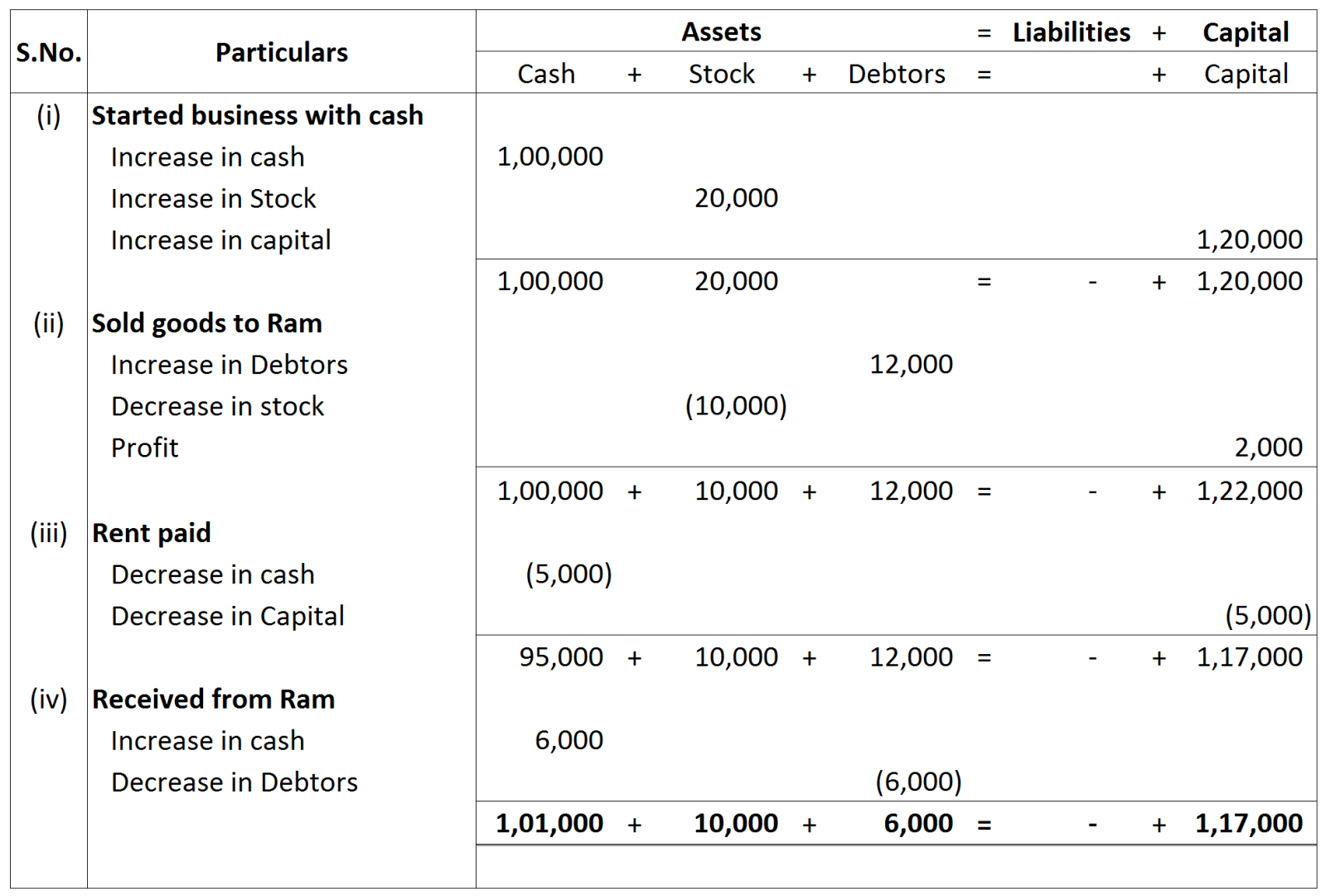
  1. Started a business with cash ₹ 1,00,000 and goods worth ₹ 20,000.
  2. Sold 50% of above goods at a profit of ₹ 2,000 on credit to Ram.
  3. Rent paid ₹ 5,000.
  4. Ram paid 50% of his balance in cash.
Answer
Solution is as follows.
View full question & answer
Question 184 Marks
Yogesh commenced business on $1st$ April,$ 2011 $with a Capital of ₹ $5,00,000 $and a loan of ₹ $1,00,000 $borrowed from Citi Bank. On $31st $March, $2012$, his assets were ₹ $8,00,000$. Calculate his closing capital and profits earned during the year.
Answer
Opening Capital (Capital as on $1^{\text {st }}$ April, 2011) $=₹ 5,00,000$
Calculation of Closing Capital (Capital as on March 31, 2012)
Assets $=$ Liabilities + Capital
$8,00,000=1,00,000^*+$ Capital
Capital = ₹ 7,00,000
Calculation of Profit Earned during the year
Closing Capital = Opening Capital + Additional Capital + Profit - Drawings
$7,00,000 = 5,00,000 + 0 +$ Profit $- 0$
Profit =$ 7,00,000 - 5,00,000$
$= ₹ 2,00,000$
*It is assumed that loan borrowed from Citi Bank has not been paid till the end of the accounting year.
View full question & answer
Question 194 Marks
Should a transaction be first recorded in a journal or ledger? Why?
Answer
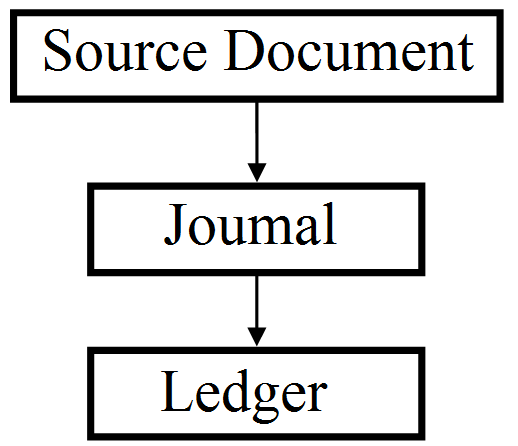
A transaction should be recorded first in a journal because journal provides complete details of a transaction in one entry. Further, a journal forms the basis for posting the transactions into their respective accounts into ledger. Transactions are recorded in journal in chronological order, i.e. in the order of occurrence with the help of source documents. Journal is also known as ‘book of original entry’, because with the help of source document, transactions are originally recorded in books.
The process of recording the transactions in journal and then in ledger is presented in the below-given flow chart.
View full question & answer
Question 204 Marks
Journalise the following transactions:
2019
 
March 5
Sold goods to Shruti for ₹ 80,000 at 15% trade discount and 4% cash discount. Received 75% amount immediately through a cheque.
March 10
Purchased goods from Richa for ₹ 60,000 at 10% trade discount and 5% cash discount. 60% amount paid by cheque immediately.
View full question & answer
Question 214 Marks
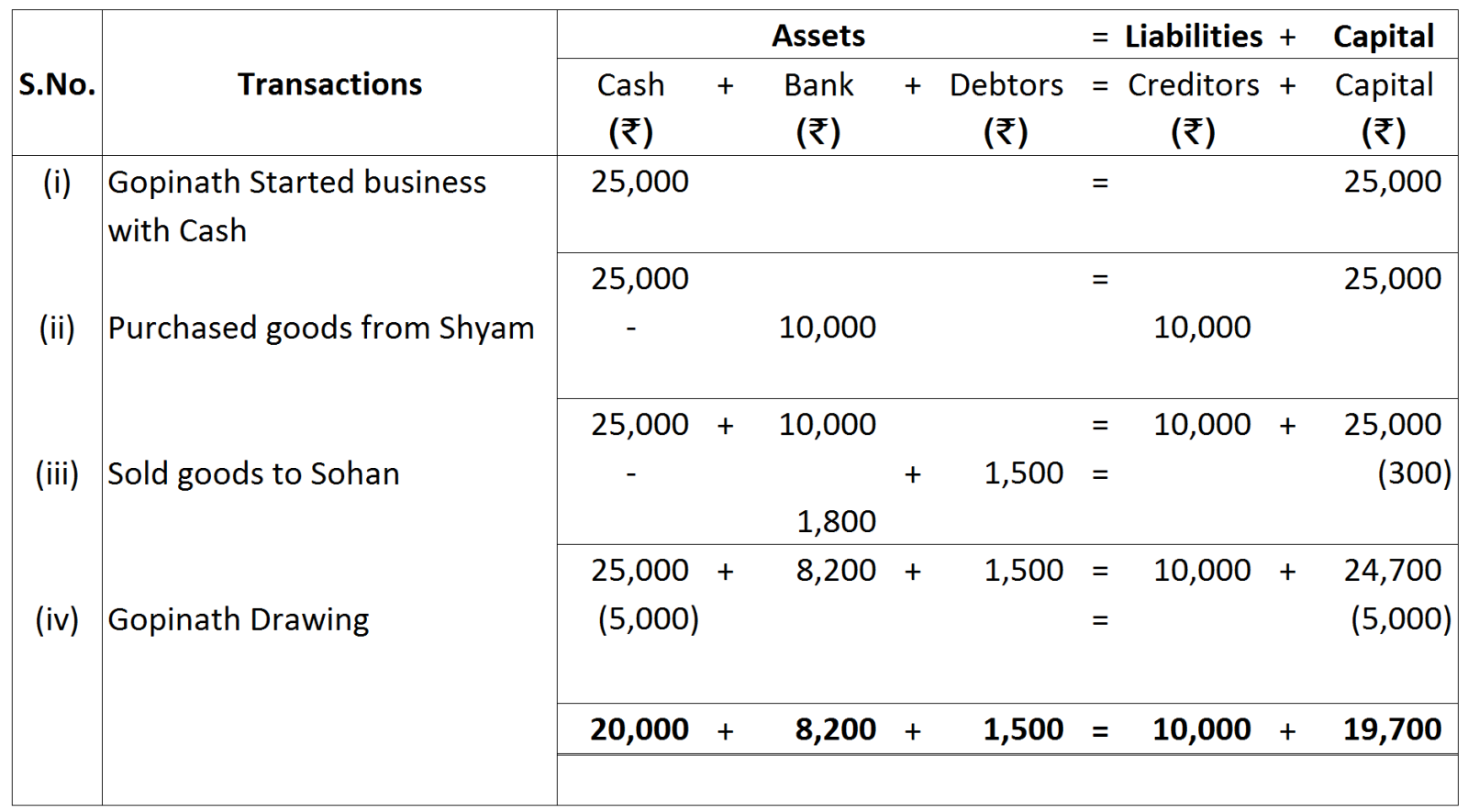
Show the Accounting Equation for the following transactions:
S.no  
(i) Gopinath started business with cash 25,000
(ii) Purchased goods from Shyam 10,000
(iii) Sold goods to Sohan costing ₹ 1,800 1,500
(iv) Gopinath withdrew from business 5,000
Answer

Assets = 20,000 + 8,200 + 1,500 = ₹ 29,700
Liabilities = ₹ 10,000
Capital = ₹ 19,700
View full question & answer
Question 224 Marks
Are debits or credits listed first in journal entries? Are debits or credits indented?
Answer
As per the rule of double entry system, there are two columns of ‘Amount’ in the journal format namely ‘Debit Amount’ and ‘Credit Amount’. The way of recording in a journal is quite different from normal recording. Journal entry is recorded in journal format in which the ‘Debit Amount’ column is listed before the ‘Credit Amount’ column.
Credits are indented. Indentation is leaving a space before writing any word. Journal entry has its own jargon. While journalising, in the ‘Particulars’ column of journal format, debited account is written first and credited account is in the next line leaving some space, which is indentation.
View full question & answer
Question 234 Marks
a. Mohan started a business on $1^{\text {st }}$ April, $2018 $with a capital of $₹ 10,000$ and borrowed $₹ 3,000$ from a friend. He earned a profit of $₹ 5,000$ during the year ended $31^{\text {st }}$ March, $2019 $and withdrew cash $₹ 4,000$ for personal use. What is his capital on $31^{\text {st }}$ March, $2019?$
b. Mahesh started a business with a capital of ₹ 15,000 on $1^{\text {st }}$ April, $2018$. During the year, he made a profit of ₹ $3,000$. He owes ₹ $2,500 $to suppliers of goods. What is the total of assets in his business on $31^{\text {st }}$ March, $2019?$
Answer
  1. Capital on March 31, 2019 = Capital on April 01, 2018 + Profit - Drawings
$= 10,000 + 5,000 - 4,000 = ₹ 11,000$
  1. Total Assets on March 31, 2019 = Capital on April 01, 2018 + Profit + Creditors
$= 15,000 + 3,000 + 2,500 = ₹ 20,500$
View full question & answer
Question 244 Marks
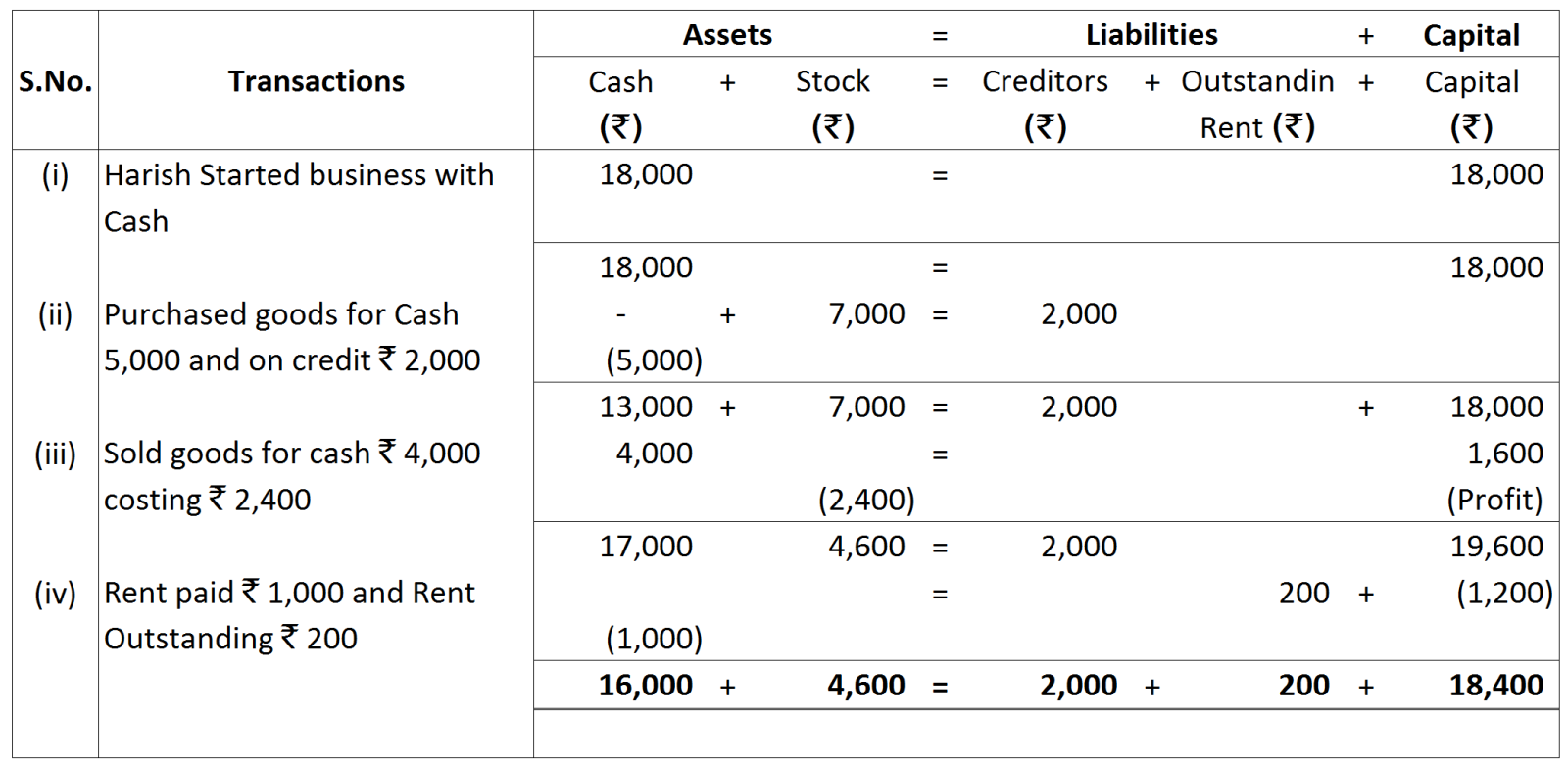
What will be the effect of the following on the Accounting Equation?
  1. Harish started business with cash ₹ 18,000
  2. Purchased goods for Cash ₹ 5,000 and on credit ₹ 2,000
  3. Sold goods for cash ₹ 4,000 (costing ₹ 2,400)
  4. Rent paid ₹ 1,000 and rent outstanding ₹ 200
Answer

Assets = 16,000 + 4,600 = ₹ 20,600
Liabilities = 2,000 + 200 = ₹ 2,200
Capital = ₹ 18,400
View full question & answer
Question 254 Marks
Prepare the Accounting Equation on the basis of the following:
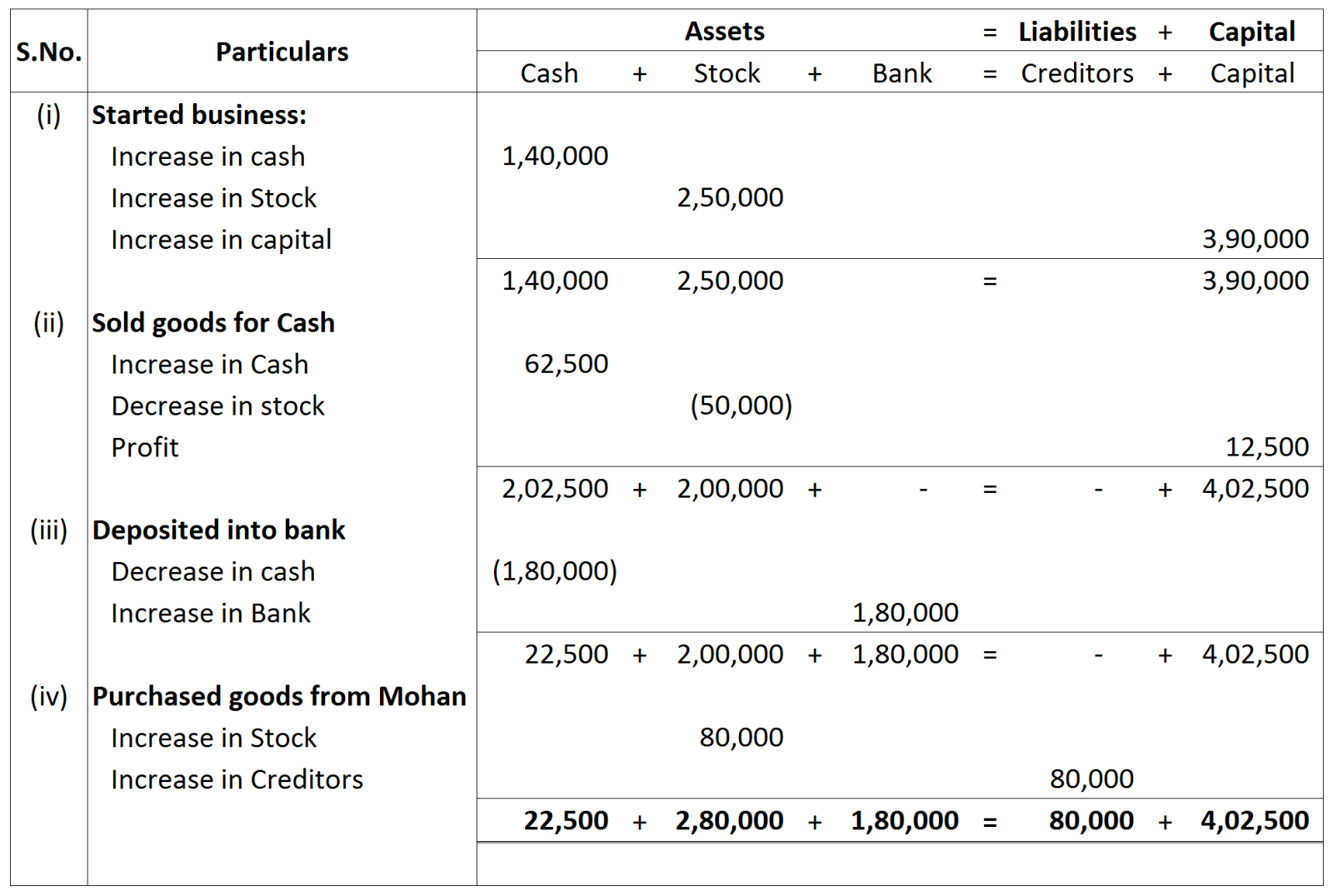
  1. Started business with cash ₹ 1,40,000 and Stock ₹ 2,50,000.
  2. Sold goods (costing ₹ 50,000) at a profit of 25% on the cost.
  3. Deposited into bank account ₹ 1,80,000.
  4. Purchased goods from Mohan ₹ 80,000.
Answer

Working Note:
Calculation of Selling Price
Cost of Goods Sold = 50,000
Add: Profit 25% of ₹ 50,000 = 12,500
$\therefore$ Sales = $\overline{62,500}$
View full question & answer
Question 264 Marks
Prepare Accounting Equation from the following:
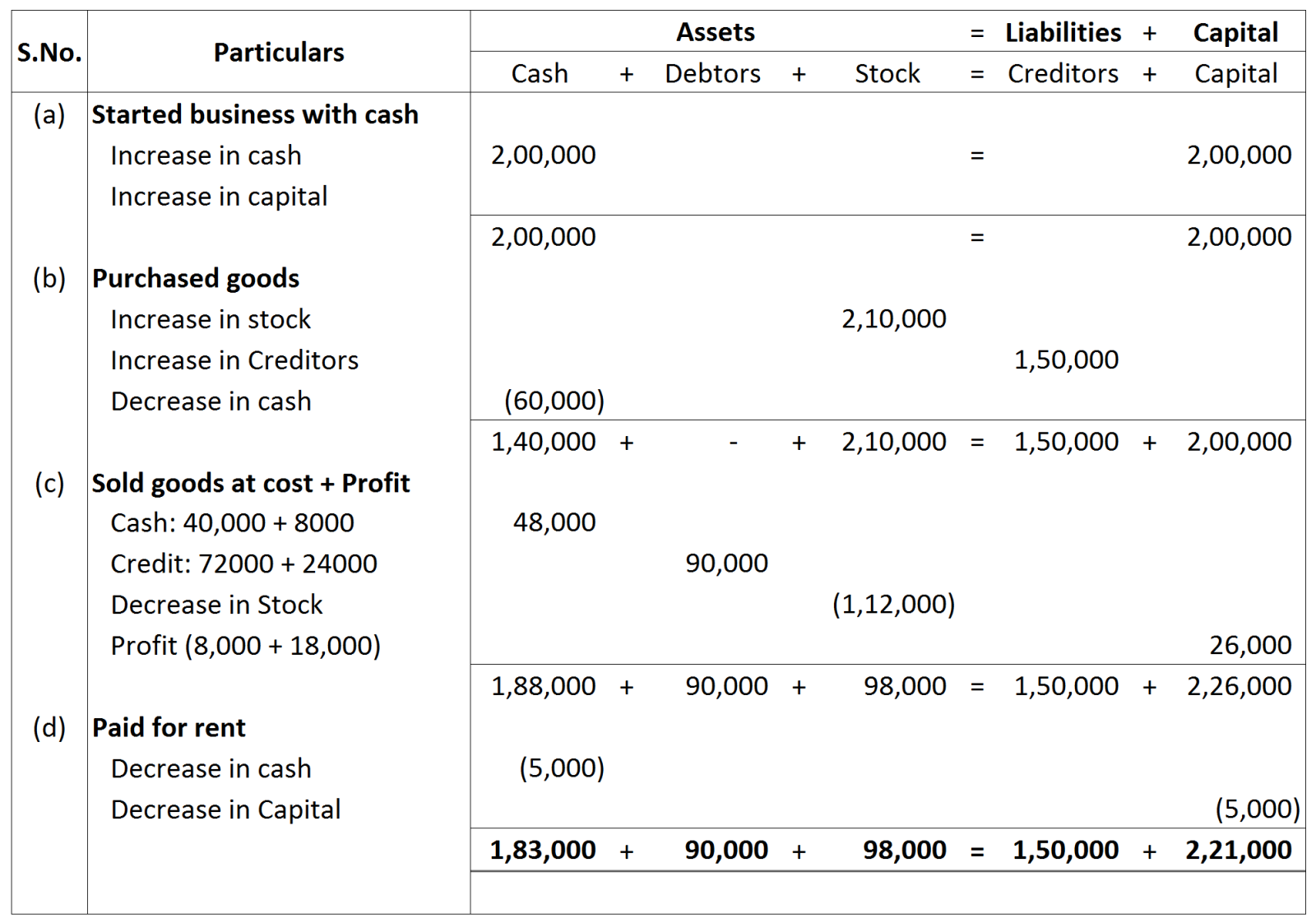
  1. Started business with Cash ₹ 2,00,000.
  2. Purchased goods for Cash ₹ 60,000 and on Credit ₹ 1,50,000.
  3. Sold goods for Cash costing ₹ 40,000 at a profit of 20% and on Credit costing ₹ 72,000 at a profit of 25%.
  4. Paid for Rent ₹ 5,000.
Answer

Working Note:
Calculation of Selling Price of Goods Sold
Cost of Goods Sold
=
40,000
Add: Profit 20% of ₹ 40,000
=
8,000
$\therefore$ Selling Price for goods sold for cash
=
$\overline{48,000}$


Cost of Goods Sold
=
72,000
Add: Profit 25% of ₹ 72,000
=
18,000
$\therefore$ Selling Price for goods sold for credit
=
$\overline{90,000}$
Total profit = 8,000 + 18,000 = ₹ 26,000
Total Cost of Goods Sold = 40,000 + 72,000 = ₹ 1,12,00
View full question & answer
Question 274 Marks
What is CGST? Give an example.
Answer
These taxes are levied on intra-state sales, i.e. within the same state. For example, a dealer of Rajasthan sells goods to a dealer (or consumer) in Rajasthan worth 50,000. Suppose, the GST rate on the goods is 12%. This rate will comprise of CGST at 6% and SGST at 6%. The seller has to collect 12% of ₹ 50,000 i.e. ₹ 36,000 out of which ₹ 3,000 will be CGST which will go to the Central Government and ₹ 33,000 will be SGST which will go to the Rajasthan Government.
View full question & answer
Question 294 Marks
Prepare Accounting Equation from the following:
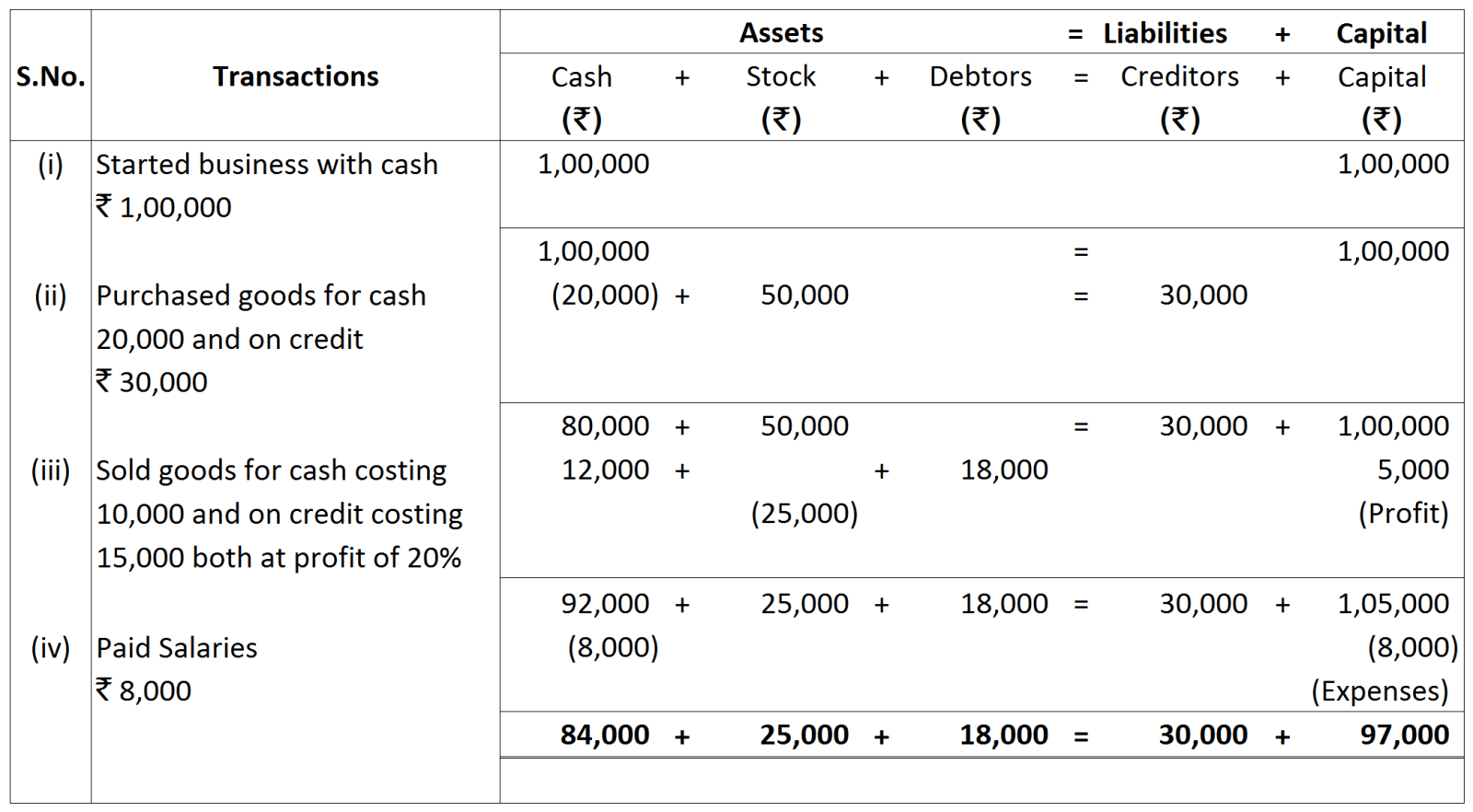
  1. Started business with cash ₹ 1,00,000.
  2. Purchased goods for cash ₹ 20,000 and on credit ₹ 30,000.
  3. Sold goods for cash costing ₹ 10,000 and on credit costing ₹ 15,000 both at a profit of 20%.
  4. Paid salaries ₹ 8,000.
Answer

Assets = 84,000 + 25,000 + 18,000 = ₹ 1,27,000
Liabilities = ₹ 30,000
Capital = ₹ 97,000
View full question & answer
Question 304 Marks
What is a Source Document?
Answer
Document is an evidence of a transaction or an event and are known as Source Documents based on which accounts are debited or credited with the transacted amount. Source document is of prime importance in accounting because accounting is based on factual financial information, i.e., evidence. For example, a cash memo showing cash sales, an invoice showing sales of goods on credit, bills of purchases showing purchases of goods on credit, a receipt made out by the receiver for cash received, etc. These documents are Source Documents and are evidence in support of a transaction. They are also sometimes called supporting documents.
View full question & answer
Question 314 Marks
Give two advantages of GST.
Answer
  1. Developing Common National Market by having One Indirect Tax: GST is a step towards development of Common National Market by levy of one Indirect Tax (GST) and thus, facilitating free flow of goods and/or services across India.
  2. Decrease in Cost of Goods by Removing Cascading Effect of Indirect Taxes: GST Paid (Input GST) is set off against GST Collected (Output GST). Thus, in effect, GST is charged on the value added in the subsequent sales. As a result, cascading effect is removed. With the removal of cascading effect of indirect taxes (tax on tax effect) and allowing credit of GST Paid against GST Collected, goods and/or services shall cost less.
  3. Ease of Doing Business: GST is a comprehensive indirect tax meaning that almost all the indirect taxes (except tax on petroleum, duties on alcohol for human consumption, customs duty and taxes levied by local bodies) are merged into it. Also, with improved harmonised indirect tax administration, setting up and carrying on of business has become easier.
  4. Attracting Foreign Direct Investment (FDI): GST will attract foreign investment as a major barrier for attracting FDI is removed.
View full question & answer
Question 324 Marks
If a transaction has the effect of decreasing an asset, is the decrease recorded as a debit or as a credit? If the transaction has the effect of decreasing a liability, is the decrease recorded as a debit or as a credit?
Answer
If a transaction has a decreasing effect on an asset, then this decrease is recorded as credit. This is because, as all assets have debit balance and if assets decrease, then it is credited. For example, sale of furniture results in decrease in furniture (asset); so, the sale of furniture will be credited.
If a transaction has a decreasing effect on a liability, then this decrease is recorded as debit. This is because all liabilities have credit balance. If the liability increases, then it is credited and if the liability decreases, then it is debited. For example, payment to the creditors results in a decrease in the creditors (liability); so, the creditors account will be debited.
View full question & answer
Question 334 Marks
Prepare a debit voucher for furniture purchased for ₹ 60,000 from Globe Furniture Mart on 02-01-2017.
View full question & answer
Question 344 Marks
Prepare Accounting Equation on the basis of the following transactions:
  1. Started business with cash ₹ 70,000.
  2. Credit purchase of goods ₹ 18,000.
  3. Payment made to creditors in full settlement ₹ 17,500.
  4. Purchase of machinery for cash ₹ 20,000.
View full question & answer
Question 354 Marks
Journalise the following trasactions:
2019
 
March 1
Started business with cash
50,000
March 2
Purchased Machinery for cash
20,000
Paid installation charges on machinery
2,000
March 5
Purchased goods from X of the list price of ₹ 25,000, Trade Discount 20% and cash discount 5%. Payment was made in cash immediately
 
March 10
Sold goods to Y costing ₹ 10,000 at 30% profit on cost less 10% trade discount
 
March 15
Paid Rent
1,000
March 20
Goods stolen from business
2,000
March 22
Gave as charity: Cash
100
Goods
200
March 31
Purchased Post Cards and Envelopes
50
March 31
Purchased a Computer for business
25,000
View full question & answer
Question 364 Marks
Jouranlise the following transactions in the books of Harpreet Bros:
  1. ₹ 1,000 due from Rohit are now bad debts.
  2. Goods worth ₹ 2,000 were used by the proprietor.
  3. Charge depreciation @ 10% p.a for two month on machine costing ₹ 30,000.
  4. Provide interest on capital of ₹ 1,50,000 at 6% p.a. for 9 months.
  5. Rahul become insolvent, who owed is ₹ 2,000 a final dividend of 60 paise in a rupee is received from his estate.
View full question & answer
Question 374 Marks
Explain any two Source Documents.
Answer
  1. Cash Memo: Cash Memo is prepared by the seller when goods are sold against cash. It has details of goods sold, quantity, rate of each item and the total amount received, besides the date of transaction and other terms and conditions, if any. It is an evidence for the purchaser for, goods purchased against cash, and for the seller, it is an evidence of sales for cash.
A specimen of a Cash Memo is as follows:
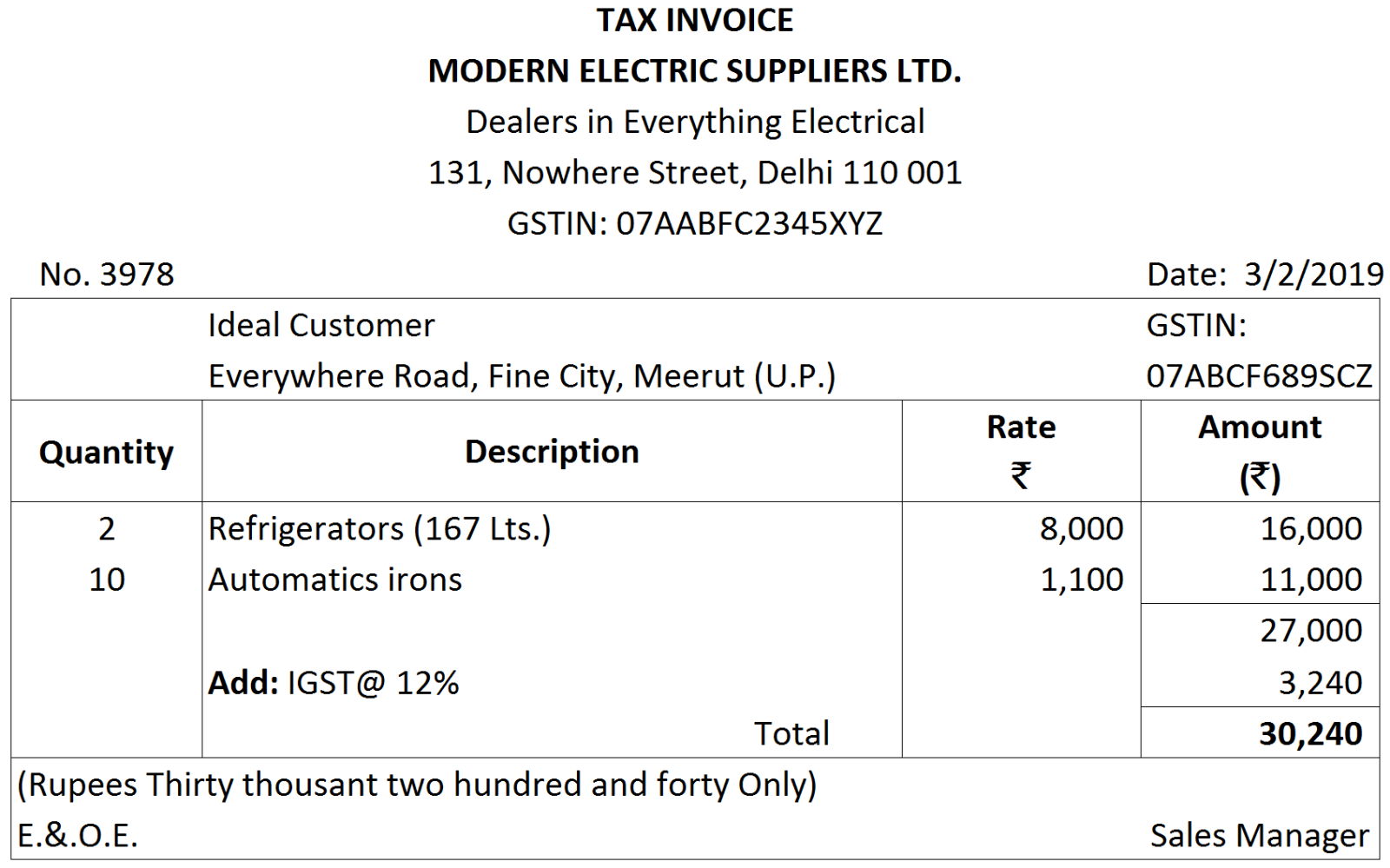
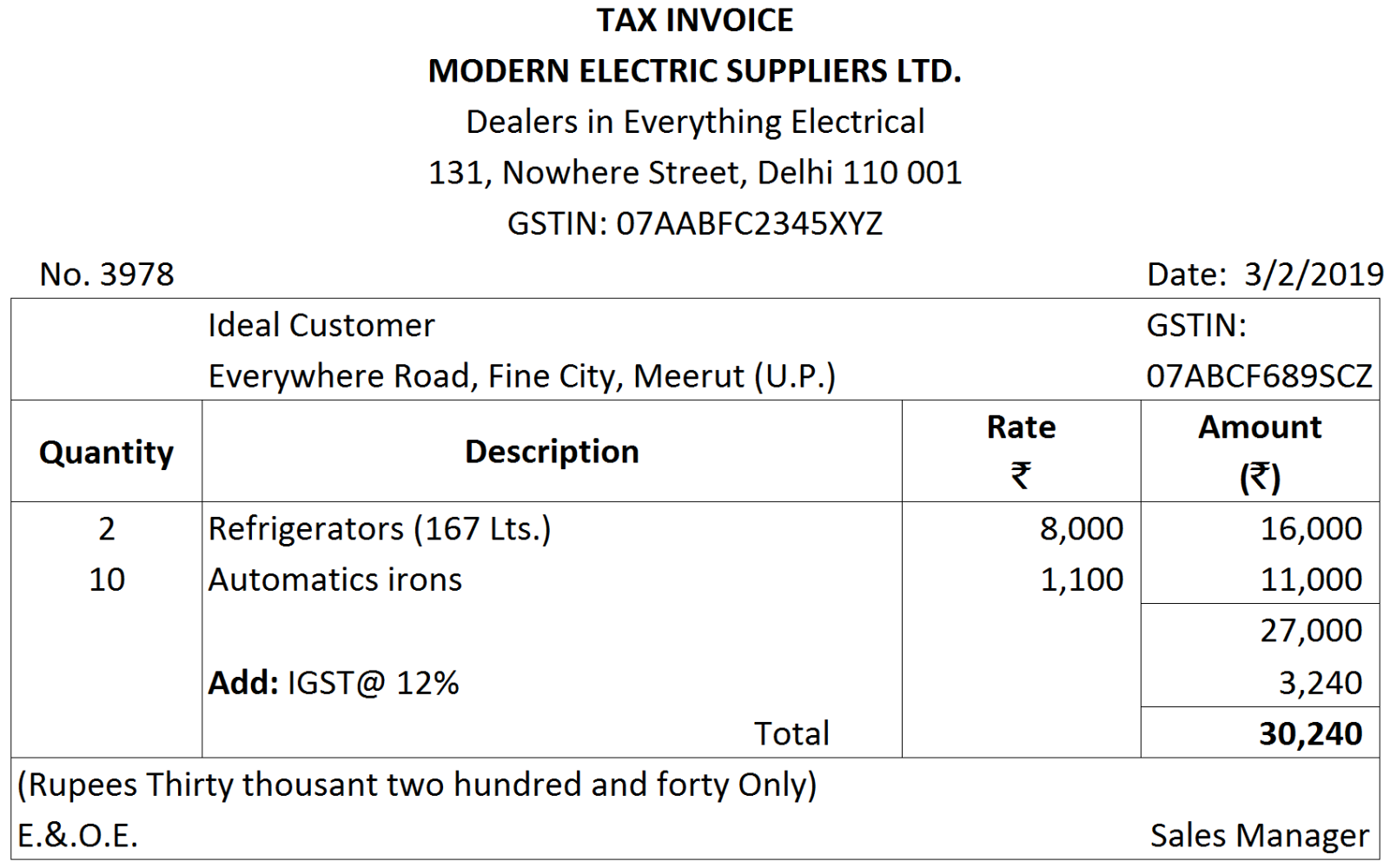
  1. Invoice or Bill: An Invoice or Bill is prepared by the seller when the goods are sold on credit. It has details of the party to whom goods are sold, goods sold and the total sale amount. The original copy of the sales invoice is sent to the purchaser and a duplicate copy is retained as an evidence of the sales for recording it in the books of account and for future reference. For the purchaser, credit purchases are evidenced by bill received from the supplier. A specimen of a Invoice or a Bill is as follows:
View full question & answer
4 Marks Question - Account STD 11 Commerce Questions - Vidyadip