Question
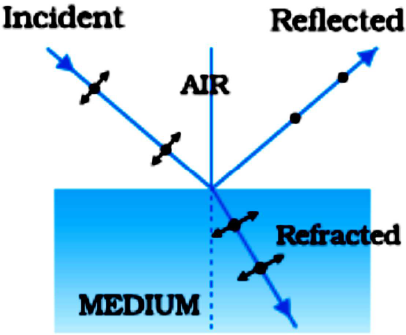
  1. Show, giving a suitable diagram, how unpolarized light can be polarised by reflection.
  2. Two polaroids $P_1$ and $P_2$  are placed with their pass axes perpendicular to each other. Unpolarised light of intensity $I_o$ is incident on $P_1$ A third polaroid $P_3$ is kept in between $P_1$ and $P_2$ such that its pass axis makes an angle of $60^{\circ}$with that of $P_1$. Determine the intensity of light transmitted through $P_1$, $P_2$ and $P_3$.
Answer

  1. When unpolarised light is incident on the boundary between two transparent media, the reflected light gets plane polarized with its electric vector perpendicular to the plane of incidence.

The polarization is complete when the reflected and refracted rays are at right angles to each other. This condition occurs for an angle of incidence, $i_p,$ where \tan $i_p = \mu$
  1. Intensity of light through $\text{P}_1=\frac{I_0}{2}$
Intensity of light through $\text{P}_2=\frac{I_0}{2}\cos^260$
$\frac{I_0}{2}.\bigg(\frac{1}{2}\bigg)^2=\frac{I_0}{8}$
Intensity of light through $ \text{P}_3=\frac{I_0}{8}\cos^230=\frac{I_0}{8}\times\bigg(\frac{\sqrt{3}}{2}\bigg)^2=\frac{3I_0}{32}$

Need a full question paper?

Generate a complete, print-ready paper with questions like this in minutes — across 16+ boards, with answer keys.

Start Generating Free

Similar questions

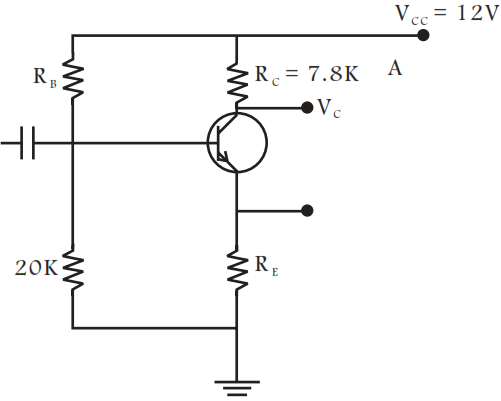
For the transistor circuit shown in Fig, evaluate $V_E, R_B, R_E$ given $I_C = 1 mA, V_{CE} = 3V, V_{BE} = 0.5 V$ and $V_{CC} = 12 V, \beta = 100.$​​​​​​​
Write and explain principle of superposition for stationary electric forces.
A horizontal straight wire $10 m$ long extending from east to west is falling with a speed of $5.0 ms^{-1}$, at right angles to the horizontal component of the earth's magnetic field, $0.30 \times 10^{-4} Wb m ^{-2}$.
$a$. What is the instantaneous value of the emf induced in the wire?
$b$. What is the direction of the emf?
$c$. Which end of the wire is at the higher electrical potential?
A spherical volume contains a uniformly distributed charge of density $2.0 \times 10^{-4}Cm^{-3}.$ Find the electric field at a point inside the volume at a distance $4.0\ cm$ from the centre.
A circular coil of radius $10 cm , 500$ turns and resistance $2 \Omega$ is placed with its plane perpendicular to the horizontal component of the earth's magnetic field. It is rotated about its vertical diameter through $180^{\circ}$ in $0.25 s$. Estimate the magnitudes of the emf and current induced in the coil. Horizontal component of the earth's magnetic field at the place is $3.0 \times 10^{-5} T$.
Explain the construction of refracting telescope by figure and obtain the equation of magnification.
The band gap for silicon is 1.1eV.
  1. Find the ratio of the band gap to kT for silicon at room temperature 300K.
  2. At what temperature does this ratio become one tenth of the value at 300K?
(Silicon will not retain its structure at these high temperatures.)
Write Einstein's photoelectric equation and explain each term used in it.
Two small bodies of masses 2.00kg and 4.00kg are kept at rest at a separation of 2.0m. Where should a particle of mass 0.10kg be placed to experience no net gravitational force from these bodies? The particle is placed at this point. What is the gravitational potential energy of the system of three particles with usual reference level?
  1. Derive the relation between the decay constant and half life of a radioactive substance.
  2. A radioactive element reduces to 25% of its initial mass in 1000 years. Find its half life.