Electric Charges and Fields — Physics STD 12 Science — Question
Rajasthan BoardEnglish MediumSTD 12 SciencePhysicsElectric Charges and Fields3 Marks
Question
Write and explain principle of superposition for stationary electric forces.
✓
Answer
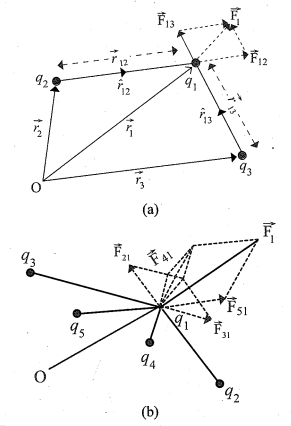
►The mutual electric force between two charges is given by Coulomb's law. ►But if more than two charges are present Super position principle is needed in addition to the Coulomb's law, to find the force exerted on one of the charges by the remaining charges. ►To better understand the concept, consider a system of three charges $q_1, q_2$ and $q_3$, as shown in Fig. (a). The force on one charge, say $q_1$, due to two ►other charges $q _2, q _3$ can therefore be obtained by performing a vector addition of the forces due to each one of these charges. Thus, if the force on $q _1$ due to $q _2$ is denoted by $F _{12}$. Thus, $\overrightarrow{ F }_{12}=\frac{1}{4 \pi \varepsilon_0} \frac{q_1 q_2}{r_{12}^2} \hat{r}_{12}$ ►In the same way, the force on $q_1$ due to $q_3$, denoted by $\vec{F}_{13}$, is given by $\overrightarrow{ F }_{13}=\frac{1}{4 \pi \varepsilon_0} \frac{q_1 q_3}{r_{13}^2} \hat{r}_{13}$
►which again is the Coulomb force on $q_1$ due to $q_3$, even though other charge $q_2$ is present. ►Thus the total force $\vec{F}_1$ on $q_1$ due to the two charges $q_2$ and $q_3$ is given as : $\begin{aligned} \overrightarrow{ F }_1 & =\overrightarrow{ F }_{12}+\overrightarrow{ F }_{13} \\ & =\frac{1}{4 \pi \varepsilon_0}\left(\frac{q_1 q_2}{r_{12}^2} \hat{r}_{12}+\frac{q_1 q_3}{r_{13}^2} \hat{r}_{13}\right) \end{aligned}$
►The principle of superposition says that in a system of charges $q_1, q_2, \ldots q_n$, the force on $q_1$ due to $q_2$ is the same as given by Coulomb's law, i.e., it is unaffected by the presence of the other charges $q_3, q_4, \ldots, q_n$
►The total force $\overrightarrow{ F }_1$ on the charge $q_1$, due to all other charges, is then given by the vector sum of the forces $\overrightarrow{ F }_{12}, \overrightarrow{ F }_{13}, \ldots, \overrightarrow{ F }_{1 n}$. i.e., $\begin{aligned} \overrightarrow{ F }_1 & =\overrightarrow{ F }_{12}+\overrightarrow{ F }_{13}+\ldots \ldots \ldots \ldots . .+\overrightarrow{ F }_{1 n} \\ & =\frac{1}{4 \pi \varepsilon_0}\left[\frac{q_1 q_2}{r_{12}^2} \hat{r}_{12}+\frac{q_1 q_3}{r_{13}^2} \hat{r}_{13}+\ldots \ldots+\frac{q_1 q_n}{r_{1 n}^2} \hat{r}_{1 n}\right] \\ & =\frac{q_1}{4 \pi \varepsilon_0} \sum_{i=2}^n \frac{q_i}{r_{1 i}^2} \hat{r}_{1 i} \end{aligned}$
Need a full question paper?
Generate a complete, print-ready paper with questions like this in minutes — across 16+ boards, with answer keys.