Question
Show mathematically how Bohr's postulate of quantization of orbital angular momentum in hydrogen atom is explained by de$-$Broglie's hypothesis.

Answer

de Broglie wavelength, $\lambda = \frac{\text{h}}{\text{mv}}$
For electron moving in the $n^{th}$ orbit, $2 \pi\text{r} = \text{n}\lambda$
$\therefore2\pi\text{r} = \frac{\text{nh}}{\text{mv}}$
$\therefore\text{mvr} = \frac{\text{nh}}{2\pi} = \text{L}\ ($orbital angular momentum$)$
This is Bohr’s Postulate of quantization of orbital angular momentum.

Need a full question paper?

Generate a complete, print-ready paper with questions like this in minutes — across 16+ boards, with answer keys.
Start Generating Free

Similar questions

An extended object is placed at a distance of 5.0cm from a convex lens of focal length 8.0cm.
  1. Draw the ray diagram (to the scale) to locate the image and from this, measure the distance of the image from the lens.
  2. Find the position of the image from the lens formula and see how close the drawing is to the correct result.
Sketch the magnetic field lines for a current-carrying circular loop near its centre. Replace the loop by an equivalent magnetic dipole and sketch the magnetic field lines near the centre of the dipole. Identify the difference.
How does the power of a convex lens vary, if the incident red light is replaced by violet light?
Write and explain the law of conservation of electric charge.
The wavelength of light in a medium is $\lambda=\frac{\lambda_0}{\mu},$ where $\lambda$ is the wavelength in vacuum. A beam of red light $(\lambda_0=720\text{nm})$ enters into water. The wavelength in water is $\lambda=\frac{\lambda_0}{\mu}=540\text{nm}.$ To a person under water does this light appear green?
What is the principle of superposition of charges?
An electric bulb marked 220V, 100W will get fused if it is made to consume 150W or more. What voltage fluctuation will the bulb withstand?
What is electric current ? Explain about it.
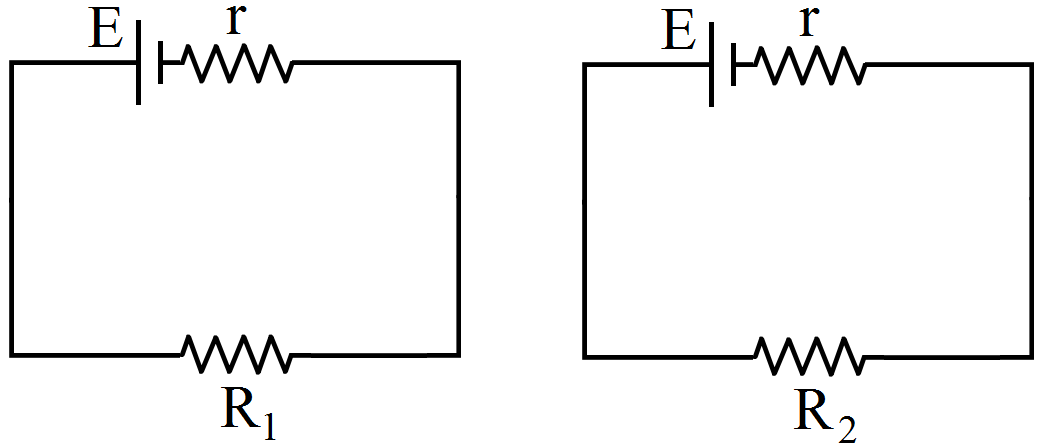
Two unequal resistances $R_1$ and $R_2$ are connected across two identical batteries of emf $\varepsilon$ and internal resistance $r$. Can the thermal energies developed in $R_1$ and $R_{2}$ be equal in a given time. If yes, what will be the condition?
Explain J J. Thomson's plum pudding model of atom.