Question
Show that a force that does no work must be a velocity dependent force.

Answer

To show that a force that does no work must be a velocity dependent force, then we have to assume that work done by force is zero. As shown by the equation below:
$\text{dW}=\vec{\text{F}}.\vec{\text{dI}}=0$
We can write, $\vec{\text{dI}}=\vec{\text{v}}\text{dt But}\text{ dt}\neq0 $
$\Rightarrow\ \vec{\text{F}}.\vec{\text{v}}\text{dt}=0$
$\Rightarrow\ \vec{\text{F}}.\vec{\text{v}}=0$
So we can say that force F must be velocity dependent, this implies that angle between F and v is 90°. If the direction of velocity changes, then direction of force will also change.

Need a full question paper?

Generate a complete, print-ready paper with questions like this in minutes — across 16+ boards, with answer keys.
Start Generating Free

Similar questions

A bar magnet M is dropped so that it falls vertically through the coil C. The graph obtained for voltage produced across the coil versus time is showing in figure (b).
  1. Explain the shape of the graph.
  2. Why is the negative peak longer than the positive peak?
  1. Define torque acting on a dipole of dipole moment $\overrightarrow{p}$ placed in a uniform electric field $\overrightarrow{\text{E}}$. Express it in the vector form and point out the direction along which it acts
  2. What happens if the field is non-uniform?
  3. What would happen if the external field $\overrightarrow{\text{E}}$ is increasing (i) parallel to $\overrightarrow{p}$ and (ii) anti-parallel to $\overrightarrow{p}$?
A man has to go 50m due north, 40m due east and 20m due south to reach a field.
  1. What distance he has to walk to reach the field?
  2. What is his displacement from his house to the field?
An electric toaster uses nichrome for its heating element. When a negligibly small current passes through it, its resistance at room temperature $\left(27.0^{\circ} C \right)$ is found to be $75.3 \Omega$. When the toaster is connected to a $230 V$ supply, the current settles, after a few seconds, to a steady value of $2.68 A$. What is the steady temperature of the nichrome element? The temperature coefficient of resistance of nichrome averaged over the temperature range involved, is $1.70 \times 10^{-4}{ }^{\circ} C ^{-1}$.
A particle of mass m moves on a straight line with its velocity varying with the distance travelled according to the equation $\text{v}=\text{a}\sqrt{\text{x}},$ where a is a constant. Find the total work done by all the forces during a displacement from x = 0 to x = d.
An experimenter's diary reads as follows: "A charged particle is projected in a magnetic field of $(7.0\vec{\text{i}}-3.0\vec{\text{j}})\times10^{-3}\text{T}.$ The acceleration of the particle is found to be $(\vec{\text{i}}+7.0\vec{\text{j}})\times10\text{m/s}^{2\text{n}}.$ The number to the left of $\vec{\text{i}}$ in the last expression was not readable. What can this number be?
A point object is placed on the principal axis of a convex lens (f = 15cm) at a distance of 30cm from it. A glass plate $(\mu=1.50)$ of thickness 1cm is placed on the other side of the lens perpendicular to the axis. Locate the image of the point object.
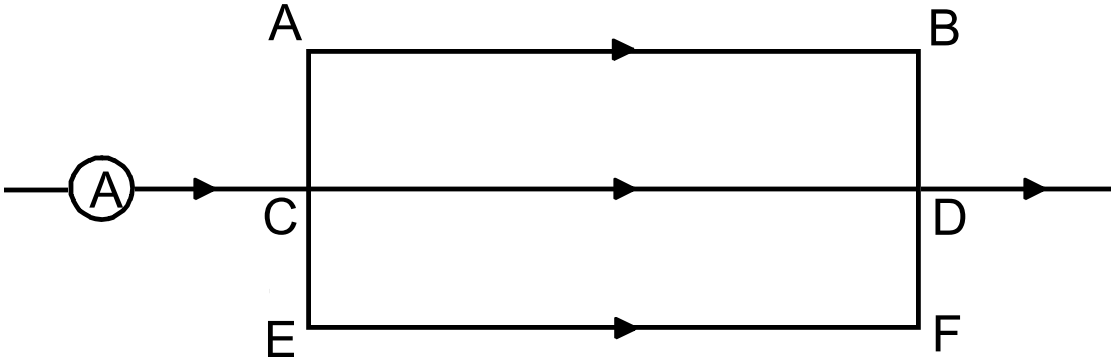
Figure shows a part of an electric circuit. The wires AB, CD and EF are long and have identical resistances. The separation between the neighbouring wires is 1.0cm. The wires AE and BF have negligible resistance and the ammeter reads 30A. Calculate the magnetic force per unit length of AB and CD.
Two charged particles, having equal charges of $2.0 \times 10^{-5}C$ each, are brought from infinity to within a separation of 10cm. Find the increase in the electric potential energy during the process.
An inductor 200mH, a capacitor $100\mu\text{F}$ and a resistor $10\Omega$ are connected in series to an a.c. source of 100V, having variable frequency.
  1. At what frequency of the applied voltage will the power factor of the circuit be 1?
  2. What will be the current amplitude at this frequency?
  3. Calculate the Q-factor of the circuit.