Question
Show that every positive odd integer is of the form (4q + 1) or (4q + 3) for some integer q.

Answer

Let 'a' be a given positive od integer.
On dividing 'a' by 4, let q be the quotient and r be the remainder.
Then, by euclid's algorithm, we have
a = 4q + r, where 0 ≤ r < 4
⇒ a = 4q + r, where r = 0, 1, 2, 3
⇒ a = 4q or a = 4q + 1 or a = 4q + 2 or a = 4q + 3
But, a = 4q and a = 4q + 2 = 2(2q + 1) are clearly even.
Thus, when 'a' is odd, it is of the form:
a = (4q + 1) or (4q + 3) for some integer q.

Need a full question paper?

Generate a complete, print-ready paper with questions like this in minutes — across 16+ boards, with answer keys.
Start Generating Free

Similar questions

Two identical cubes each of volume $64cm^3 $are joined together end to end. What is the surface area of the resulting cuboid?
There are two poles, one each on either bank of a river just opposite to each other. One pole is 60 m high. From the top of this pole, the angle of depression of the top and foot of the other pole are $30^{\circ}$ and $60^{\circ}$ respectively. Find the width of the river and height of the other pole.
Solve the following system of linear equation graphically and shade the region between the two lines and x-axis:
3x + 2y -11 = 0,
2x - 3y + 10 = 0.
As observed from the top of a lighthouse, 100m above sea level, the angle of depression of a ship, sailing directly towards it, changes from 30° to 60°. Determine the distance travelled by the ship during the period of observation. $\big[\text{Use}\sqrt{3}=1.732\big]$
Solve the following quadratic equations by factorization:
$ax^2 + (4a^2 - 3b)x - 12ab = 0$
The numerator of a fraction is 3 less than its denominator. If 1 is added to the denominator, the fraction is decreased by $\frac{1}{15}.$ Find the fraction.
Solve for $x$ :
$\frac{1}{x+1}+\frac{3}{5 x+1}=\frac{5}{x+4}, x \neq-1,-\frac{1}{5},-4$
If $\sec\theta+\tan\theta=\text{p},$ prove that:$\sin\theta=\frac{\text{p}^2-1}{\text{p}^2+1}$
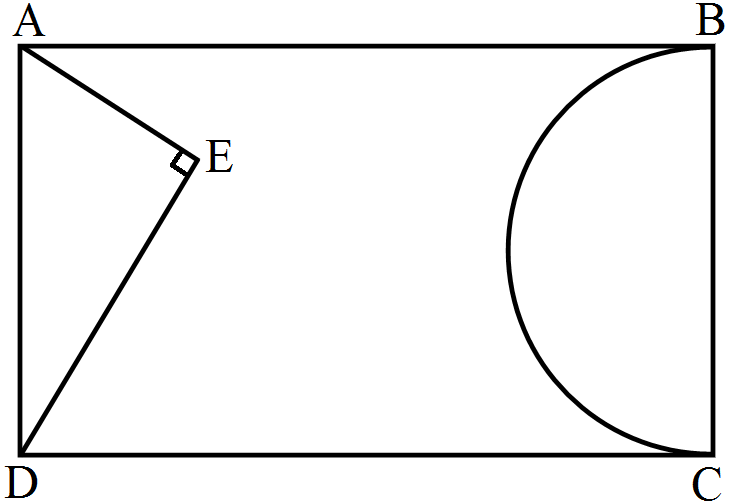
In the given figure, ABCD is a rectangle with $\text{AB}=80\text{cm}$ and $\text{BC}=70\text{cm},$ $\angle\text{AED}=90^\circ$ and $\text{DE}=42\text{cm}$ A semicircle is dn wn, taking BC as diameter. Find the area o the shaded region.
Find the coordinates of the points which divide the line segment joining A(-2, 2) and B(2, 8) into four equal parts.