Question
Show that for a projectile the angle between the velocity and the x-axis as a function of time is given by,
$\theta(\text{t})=\tan^{-1}\Big(\frac{\text{u}_\text{oy}-\text{gt}}{\text{u}_\text{ox}}\Big)$
Answer

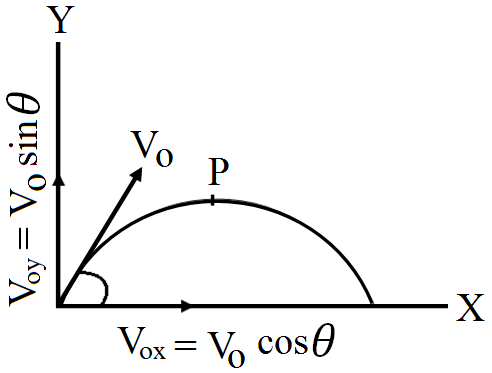
Let vox and v0y respectively be the initial components of the velocity of the projectile along horizontal (x) and vertical (y) directions.
Let vx and vy respectively be the horizontal and vertical components of velocity at a point P.

Time taken by the projectile to reach point P = t
Applying the first equation of motion along the vertical and horizontal directions, we get:
vy = voy = gt
And vx = vox
$\therefore\tan\theta=\frac{\text{v}_\text{y}}{\text{v}_\text{x}}=\frac{\text{v}_\text{oy}-\text{gt}}{\text{v}_\text{ox}}$
$\theta=\frac{\tan^{-1}(\text{v}_\text{oy}-\text{gt})}{\text{v}_\text{ox}}$

Need a full question paper?

Generate a complete, print-ready paper with questions like this in minutes — across 16+ boards, with answer keys.

Start Generating Free

Similar questions

The unit of length convenient on the nuclear scale is a fermi: 1 f = 10–15m. Nuclear sizes obey roughly the following empirical relation:
$\text{r}=\text{r}_0\text{A}^{1/3}$
where r is the radius of the nucleus, A its mass number, and r o is a constant equal to about, 1.2 f. Show that the rule implies that nuclear mass density is nearly constant for different nuclei. Estimate the mass density of sodium nucleus. Compare it with the average mass density of a sodium atom obtained in Exercise. 2.27.
What is capillarity? Establish the formula for the height of water column rising in the capillary tube.
Find the velocity of source of sound, when the frequency appears to be:
  1. Double.
  2. Half, the original frequency to a stationary listener.
Establish the following vector inequalities:
i. $|\vec{a}+\vec{b}| \leq|\vec{a}|+|\vec{b}|$
ii. $|\vec{a}-\vec{b}| \leq|\vec{a}|+|\vec{b}|$
When does the equality sign apply?
If the nucleons of a nucleus are separated from each other, the total mass is increased. Where does this mass come from?
Which of the following symptoms is likely to afflict an astronaut in space (a) swollen feet, (b) swollen face, (c) headache, (d) orientational problem.
A 100kg block is started with a speed of 2.0ms-1 on a long, rough belt kept fixed in a horizontal position. The coefficient of kinetic friction between the block and the belt is 0.20.
  1. Calculate the change in the internal energy of the block-belt system as the block comes to a stop on the belt.
  2. Consider the situation from a frame of reference moving at 2.0ms-1 along the initial velocity of the block. As seen from this frame, the block is gently put on a moving belt and in due time the block starts moving with the belt at 2.0ms-1 Calculate the increase in the kinetic energy of the block as it stops slipping past the belt.
  3. Find the work done in this frame by the external force holding the belt.
The bob of a stationary pendulum is given a sharp hit to impart it a horizontal speed of $\sqrt{3\text{gl}}.$ Find the angle rotated by the string before it becomes slack.
1 litre of an ideal gas $(\gamma=1.5)$ at 300K is suddenly compressed to half its original volume.
  1. Find the ratio of the final pressure to the initial pressure.
  2. If the original pressure is 100kPa, find the work done by the gas in the process.
  3. What is the change in internal energy?
  4. What is the final temperature?
  5. The gas is now cooled to 300K keeping its pressure constant. Calculate the work done during the process.
  6. The gas is now expanded isothermally to achieve its original volume of 1 litre. Calculate the work done by the gas.
  7. Calculate the total work done in the cycle.
An object of mass 0.2kg executes simple harmonic oscillations along the x-axis with a frequency of $\frac{25}{\pi}$ Hertz. At the position x = 0.04m, the object has kinetic energy of 0.5J and potential energy of 0.4J. Find the amplitude of oscillations.