Question
Show that for small oscillations the motion of a simple pendulum is simple harmonic. Derive an expression for its time period. Does it depend on the mass of the bob?
Answer

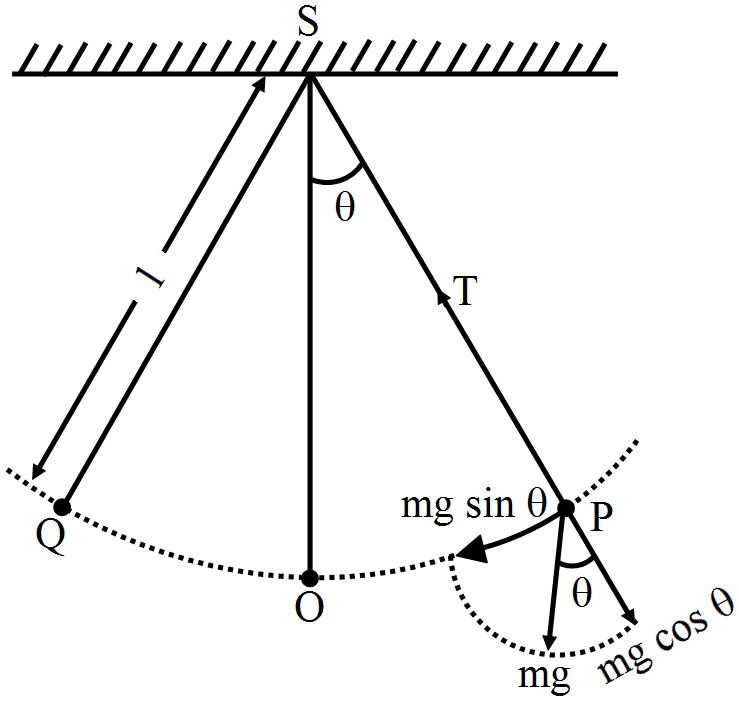
Expression for time period:

Let m = Mass of the bob

l = Length of the simple pendulum

OP = x

When the bob is displaced to point P through small angle $\theta.$

Two forces acting on the bob are:

  1. Weight mg of the bob acting vertically downward.
  2. Tension T in string along PS, resolving mg into two components.
  1. $\text{mg}\cos\theta$ opposite to tension T
  2. $\text{mg}\sin\theta$ directed towards O.

Tension in the string, T $=\text{mg}\cos\theta$

The force mg sin tends to bring back the bob to its mean position O.

$\therefore$ Restoring force acting on bob is $\text{F}=-\text{mg}\sin\theta-\text{ve}$ sign shows force is directed towards mean position: If $\theta$ is small, then

$\sin\theta=\theta\frac{(\text{arc OP})}{\text{l}}=\frac{\text{x}}{\text{l}}$

$\text{F = -mg}\theta=-\text{mg}\frac{\text{x}}{\text{l}}$

$\text{F}\propto$ displacement (x) and F is directed towards mean position O.

In S.H.M., Restoring force

$\text{F}=-\text{kx} \ ...(\text{ii})$

Comparing (i) and (ii)

$\text{k}=\frac{\text{mg}}{\text{l}}$

Inertia factor = Mass of bob = m

$\text{T}=2\pi\sqrt{\frac{\text{Inertia factor}}{\text{Spring factor}}}$

$=2\pi\sqrt{\frac{\text{m}}{\frac{\text{mg}}{\text{l}}}}=2\pi\sqrt{\frac{\text{l}}{\text{g}}}$

$\text{T}=2\pi\sqrt{\frac{\text{l}}{\text{g}}}$

No. T does not depend on the mass of the bob.

Need a full question paper?

Generate a complete, print-ready paper with questions like this in minutes — across 16+ boards, with answer keys.

Start Generating Free

Similar questions

A girl is swining in a sitting position. If it becomes vertical, how will the period of the swing change?
Derive an expression for the excess pressure inside a liquid drop.
Imagine what would happen if the value of G becomes:
  1. 100 times of its present value.
  2. Times of its present value.
Can you add two vectors representing physical quantities having different dimensions? Can you multiply two vectors representing physical quantities having different dimensions?
A vertical rod is hit at one end. What kind of wave propagates in the rod if:
  1. The hit is made vertically.
  2. The hit is made horizontally?
An astronaut inside a small spaceship orbiting around the earth cannot detect gravity. If the space station orbiting around the earth has a large size, can he hope to detect gravity?
The intensity maxima due to two interfering waves of equal amplitude a1 = a2 = a is 4a2. Does this violate the law of conservation of energy? Justify. 
The binding energy of a particle of mass m attached with the earth of mass M and radius R is $\frac{\text{GMm}}{\text{R}}.$ How much energy must be supplied to the particle so that it may escape the gravitational field of the earth? In what form this energy is supplied to the particle?
A point source emitting 628 lumen of luminous flux uniformly in all directions is placed at the origin. Calculate the illuminance on a small area placed at (1.0m, 0, 0) in such a way that the normal to the area makes an angle of 37º with the X-axis.
The velocity of an object of mass 5 kg changes from $0.85 m / s$ to $0.25 m / s$ in 0.03 sec . Find the resistance force required to do this