A man with a wristwatch on his hand falls from the top of a tower. Does the watch give correcttime during the free fall?
50 questions · self-marked practice — reveal the answer and mark yourself.
A man with a wristwatch on his hand falls from the top of a tower. Does the watch give correcttime during the free fall?
Time period of a particle in SHM depends on the force constant k and mass m of the particle: $\text{T}=2\pi\sqrt{\frac{\text{m}}{\text{k}}}.$ A simple pendulum executes SHM approximately. Why then is the time period of a pendulum independent of the mass of the pendulum?
For a simple pendulum, k is expressed in terms of mass m, as:
$\text{k}\propto\text{m}$ $\frac{\text{m}}{\text{k}}=\text{Constant}$Hence, the time period T, of a simple pendulum is independent of the mass of the bob.
At the maximum stretched position.
In what way do these functions for SHM differ from each other, in frequency, in amplitude or the initial phase?At maximum stretched position, the body is at the extreme right position, with an intial phase of
$\frac{\pi}{2}$ rad. Then, $\text{x}=\text{a}\sin\Big(\omega\text{t}+\frac{\pi}{2}\Big)=\text{a}\cos\omega\text{t}=2\cos20\text{t}$As time is noted from the mean position, hence using
$\text{x}=\text{a}\sin\omega\text{t},$ we have $\text{x}=2\sin20\text{t}$This function represents SHM as it can be written in the form:
$\text{a}\sin(\omega\text{t}+\phi)$ Its period is: $\frac{2\pi}{\omega}.$At the maximum compressed position.
In what way do these functions for SHM differ from each other, in frequency, in amplitude or the initial phase?At maximum compressed position, the body is at left position, with an intial phase of $\frac{3\pi}{2}$
rad. Then, $\text{x}=\text{a}\sin\Big(\omega\text{t}+\frac{3\pi}{2}\Big)=-\text{a}\cos\omega\text{t}=-2\cos20\text{ t}$The functions neither differ in amplitude nor in frequency. They differ in intial phase.
The terms
$\sin\omega\text{t}$ and $\sin\omega\text{t}$ individually represent simple harmonic motion (SHM).However, the superposition of two SHM is periodic and not simple harmonic.
$\text{KE}=\frac{1}{2}\text{m}\omega^2(\text{A}^2-\text{x}^2)$
$\frac{1}{2}\text{m}\omega^2[\text{A}^2-(\frac{\text{A}}{2})^2]$
$=\frac{1}{2}\times\frac{3}{4}[\text{m}\omega^2\text{A}^2]$
$=\frac{3}{4}(\text{KE})_\text{max}$
It is $\frac{3}{4}\text{th}$ of maximum KE.
$=\text{T}\propto\sqrt{\text{l}}$
$\therefore$ % increase in time period
$=\frac{\Delta\text{T}}{\text{T}}\times100$
$=\frac{1}{2}\frac{\Delta\text{l}}{\text{l}}\times100$
$=\frac{1}{2}\times25$
$=125\%$
$\text{T}=2\pi\sqrt{\frac{\text{l}}{\text{g}}}$
i.e. $=\text{T}\propto\sqrt{\text{l}}$
Clearly, if the length is increased four times, the time period gets doubles.

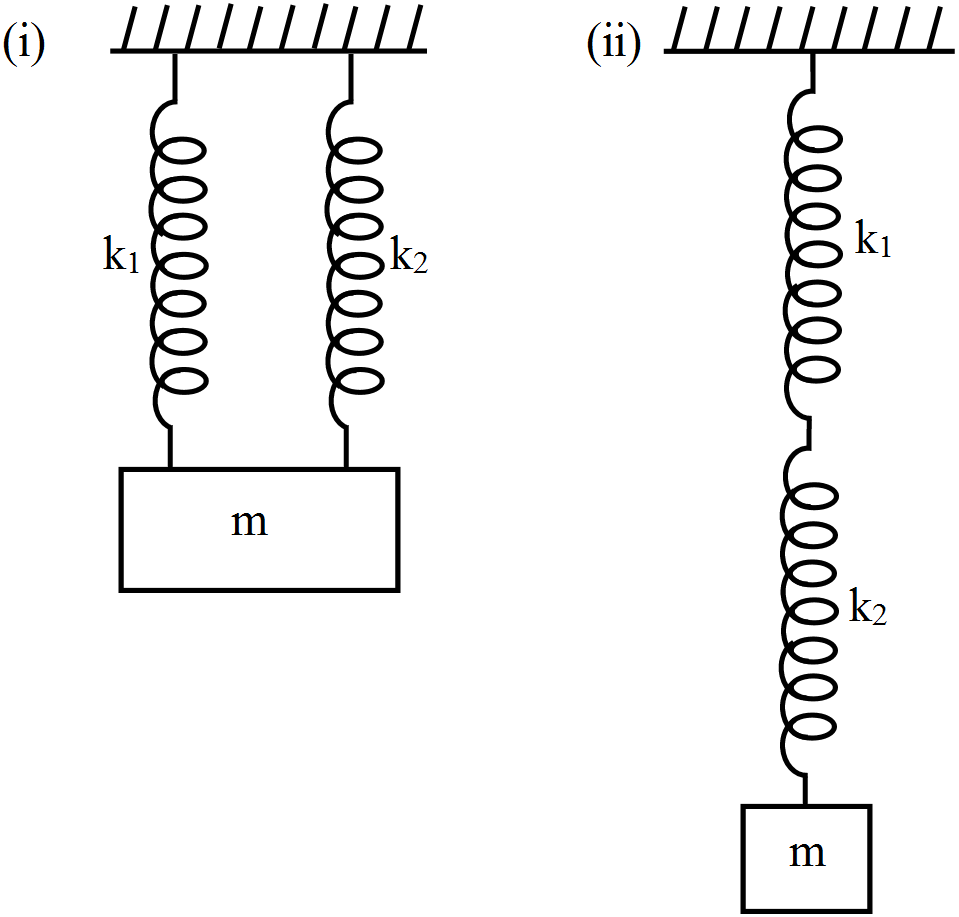
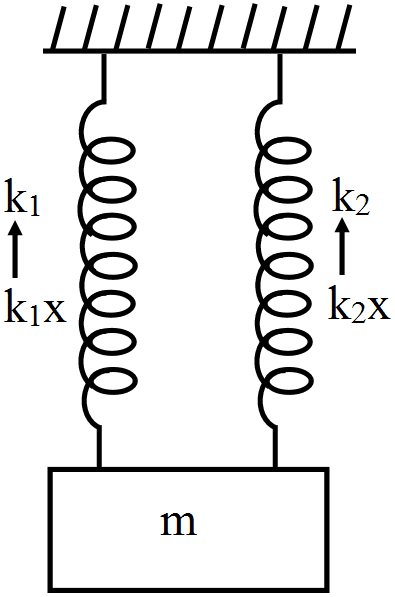
$\therefore$ Restoring force

$=-\text{k}_1\text{x}-\text{k}_2\text{x}$
$\text{k}_{\text{eq}}=\text{k}_1+\text{k}_2$
$\therefore\text{f}=\frac{1}{2\pi}\sqrt{\frac{\text{k}_1+\text{k}_2}{\text{m}}}$

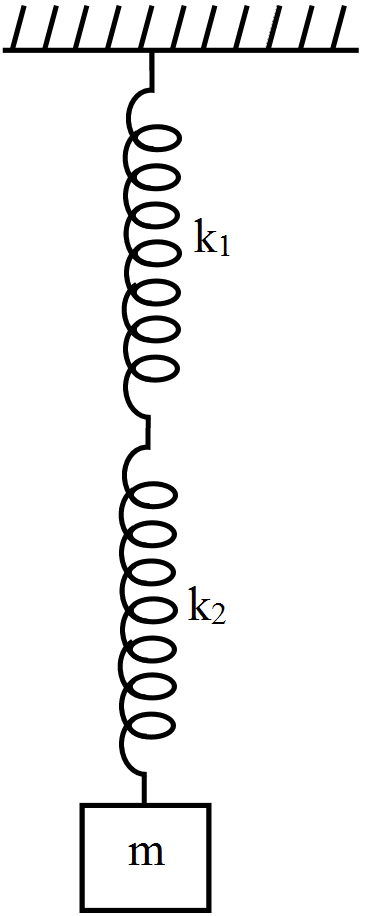
$\therefore\text{x = x}_1+\text{x}_2$
$\frac{1}{\text{k}_{\text{eq}}}=\frac{1}{\text{k}_1}+\frac{1}{\text{k}_2}$
$\frac{1}{\text{k}_{\text{eq}}}=\frac{\text{k}_2+\text{k}_1}{\text{k}_1\text{k}_2}$
$\text{f}=\frac{1}{2\pi}\sqrt{\frac{\text{k}_1\text{k}_2}{\text{m}(\text{k}_1+\text{k}_2)}}$
Amplitude of $\text{x}_1=10$
If A is doubled, total energy becomes four times.
If A is doubled, maximum velocity becomes double.
So, $\text{l}=\frac{\text{gT}^2}{4\pi^2}=\frac{9.8\times(2)^2}{4\times\frac{22}{7}\times\frac{22}{7}}=1\text{m}$
Time period of a particle in SHM depends on the force constant k and mass m of the particle: $\text{T}=2\pi\sqrt{\frac{\text{m}}{\text{k}}}.$ A simple pendulum executes SHM approximately. Why then is the time period of a pendulum independent of the mass of the pendulum?
For a simple pendulum, k is expressed in terms of mass m, as:
$\text{k}\propto\text{m}$
$\frac{\text{m}}{\text{k}}=\text{Constant}$
Hence, the time period T, of a simple pendulum is independent of the mass of the bob.
$\theta_2=\theta_0\sin(\omega\text{t}+\delta_2)$
For the first, $\theta=2^\circ,\therefore\sin(\omega\text{t}+\delta_1)=1$
For the 2nd, $\theta=-1^\circ,\ \therefore\sin(\omega\text{t}+\delta_2)=-1$
$\therefore\omega\text{t}+\delta_1=90^\circ,\omega\text{t}+\delta_2=-30^\circ$
$\therefore\delta_1-\delta_2=120^\circ$
$=\sqrt{2}\Big(\sin\omega\text{t}\times\frac{1}{\sqrt{2}}-\cos\omega\text{t}\times\frac{1}{\sqrt{2}}\Big)$
$=\sqrt{2}\Big(\sin\omega\text{t}\cos\frac{\pi}{4}-\cos\omega\text{t}\sin\frac{\pi}{4}\Big)$ $\Big[\because\cos\frac{\pi}{4}=\frac{1}{\sqrt{2}}\text{ and}\sin\frac{\pi}{4}=\frac{1}{\sqrt{2}}\Big]$
$=\sqrt{2}\sin\Big(\omega\text{t}+\frac{\pi}{4}\Big)$ $[\because\sin(\text{A}-\text{B})=\sin\text{A}\cos\text{B}-\cos\text{A}\sin\text{B}]$
Moreover, $\text{y}\Big(\text{t}+\frac{2\pi}{\omega}\Big)=\sqrt{2}\Big(\omega\text{t}+2\pi-\frac{\pi}{4}\Big)=\text{y(t)}$ Hence. it represents simple harmonic motion.$\cos\omega\text{t}+\cos3\omega\text{t}+\cos5\omega\text{t}$
$3\cos\Big(\frac{\pi}{4}-2\omega\text{t}\Big)$
$3\cos\Big[\frac{\pi}{4}-2\omega\text{t}\Big]$
$=3\cos\Big[2\omega\text{t}-\frac{\pi}{4}\Big]$
This function represents simple harmonic motion because it can be written in the form: $\text{a}\cos(\omega\text{t}+\phi)$ Its period is: $\frac{2\pi}{2\omega}=\frac{\pi}{\omega}$$\therefore\omega\text{t}=\frac{\pi}{6},\text{t}=\frac{\text{T}}{12}$
$5=5\sin\pi\text{t}$
$=1=\sin\pi\text{t}$
$=\sin\pi\text{t}$ $\pi\text{t}\frac{\pi}{2}$
$\Rightarrow\text{t}=0.5\text{s}$
$\text{x}=\frac{\text{A}}{2}$
$\text{v}=\omega\sqrt{\text{A}^2-\Big(\frac{\text{A}^2}{4}\Big)}$
$=\frac{\sqrt{3}\text{A}\omega}{2}=\frac{\sqrt{3}\text{A}\pi}{\text{T}}$
$\sin^3\omega\text{t}$
$=\frac{1}{2}[3\sin\omega\text{t}-\sin3\omega\text{t}]$
The terms
$\sin\omega\text{t}$ and $\sin\omega\text{t}$ individually represent simple harmonic motion (SHM).However, the superposition of two SHM is periodic and not simple harmonic.


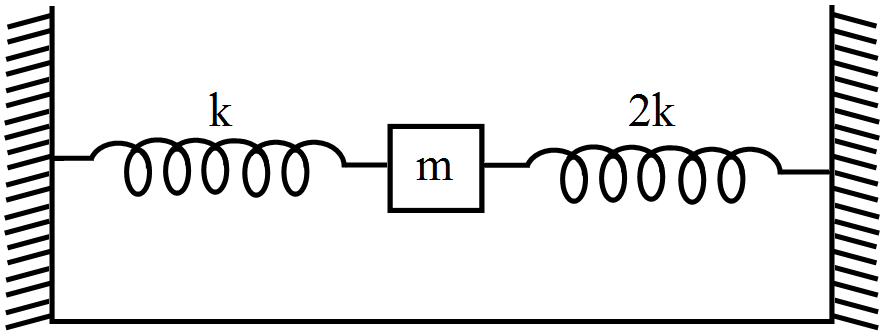
$\text{K}'=\text{K + 2K = 3K}$
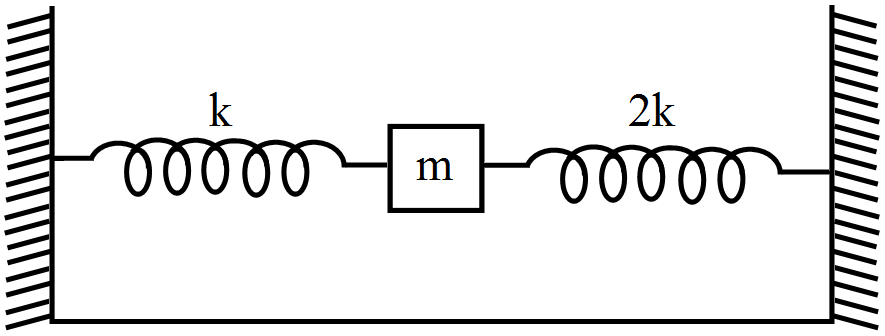
In simple harmonic motion, Frequency $(\text{f})=\frac{1}{2\pi}\sqrt{\frac{\text{K}'}{\text{m}}}=\frac{1}{2\pi}\sqrt{\frac{3\text{K}}{\text{m}}}$ Hence, the frequency of the oscillation ofthe block$=\frac{1}{2\pi}\sqrt{\frac{3\text{K}}{\text{m}}}$
$\text{v}_1=\frac{1}{2\pi}\sqrt{\frac{\text{k}}{\text{m}}}$
If the length is cut into one half, the force constant will becomes 2k for each portion. The frequency with same mass m is,$\text{v}_2=\frac{1}{2\pi}\sqrt{\frac{2\text{k}}{\text{m}}}$ $\because\frac{\text{v}_2}{\text{v}_1}=\frac{\sqrt{2}}{1}$
$\frac{1}{2}\text{m}\omega^2\text{y}^2=\frac{1}{2}\text{m}\omega^2(\text{a}^2-\text{y}^2)$
$\text{y}^2=\text{a}^2-\text{y}^2$
i.e. $\text{y}=\frac{\text{a}}{\sqrt{2}}$ Now $\text{y = a}\sin\omega\text{t}$ or $\text{y = a}\sin\Big(\frac{2\pi}{\text{T}}\Big)\text{t}$$\frac{\text{a}}{\sqrt{2}}\text{a}\sin\Big(\frac{2\pi}{8}\Big)\text{t}\ ....(\text{T = 8 sec}.)$
$\sin\frac{\pi\text{t}}{4}=\frac{1}{\sqrt{2}}=\sin^{-1}\Big(\frac{1}{\sqrt{2}}\Big)$
$\frac{\pi\text{t}}{4}=\frac{\pi}{4}$
$\text{t = 1 sec}.$
Amplitude = r
Displacement from the mean position, where the energy is half kinetic and half potential$\frac{\text{k}}{2}=\frac{\text{U}}{2}$
$\text{K.E. = P.E.}$
$\frac{1}{2}\text{kx}^2=\frac{1}{2}\text{k}(\text{A}^2-\text{x}^2)=\pm\frac{\text{A}}{\sqrt{2}}.$
At the maximum stretched position.
In what way do these functions for SHM differ from each other, in frequency, in amplitude or the initial phase?$\omega=\sqrt{\frac{\text{k}}{\text{m}}}$
$=\sqrt{\frac{1200}{3}}=\sqrt{400}=20\text{ rad s}^{-1}$
At maximum stretched position, the body is at the extreme right position, with an intial phase of
$\frac{\pi}{2}$ rad. Then,$\text{x}=\text{a}\sin\Big(\omega\text{t}+\frac{\pi}{2}\Big)=\text{a}\cos\omega\text{t}=2\cos20\text{t}$
$\omega=\sqrt{\frac{\text{k}}{\text{m}}}$
$=\sqrt{\frac{1200}{3}}=\sqrt{400}=20\text{ rad s}^{-1}$
As time is noted from the mean position, hence using
$\text{x}=\text{a}\sin\omega\text{t},$ we have $\text{x}=2\sin20\text{t}$

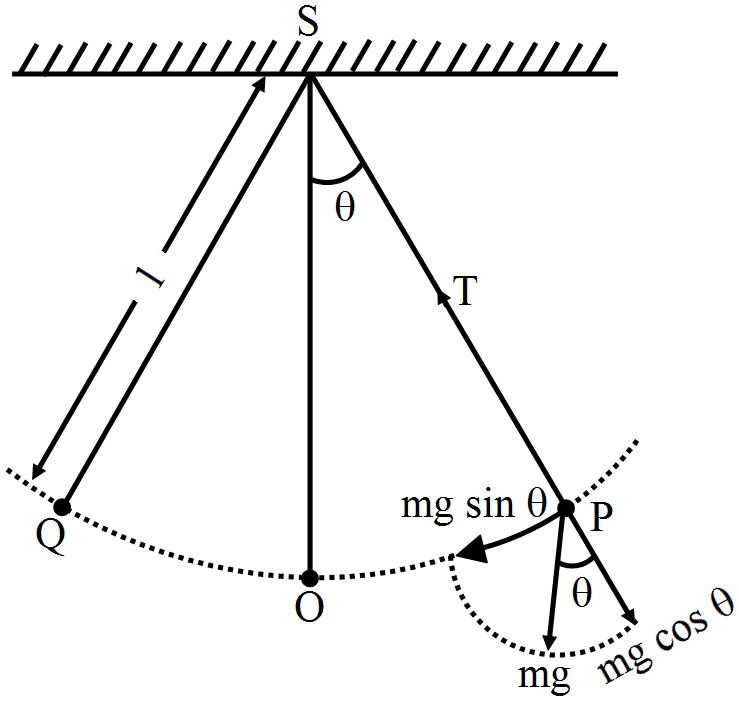
Two forces acting on the bob are:
Tension in the string, T $=\text{mg}\cos\theta$
The force mg sin tends to bring back the bob to its mean position O.$\therefore$ Restoring force acting on bob is $\text{F}=-\text{mg}\sin\theta-\text{ve}$ sign shows force is directed towards mean position: If $\theta$ is small, then
$\sin\theta=\theta\frac{(\text{arc OP})}{\text{l}}=\frac{\text{x}}{\text{l}}$
$\text{F = -mg}\theta=-\text{mg}\frac{\text{x}}{\text{l}}$
$\text{F}\propto$ displacement (x) and F is directed towards mean position O. In S.H.M., Restoring force$\text{F}=-\text{kx} \ ...(\text{ii})$
Comparing (i) and (ii)$\text{k}=\frac{\text{mg}}{\text{l}}$
Inertia factor = Mass of bob = m$\text{T}=2\pi\sqrt{\frac{\text{Inertia factor}}{\text{Spring factor}}}$
$=2\pi\sqrt{\frac{\text{m}}{\frac{\text{mg}}{\text{l}}}}=2\pi\sqrt{\frac{\text{l}}{\text{g}}}$
$\text{T}=2\pi\sqrt{\frac{\text{l}}{\text{g}}}$
No. T does not depend on the mass of the bob.$\sin\omega\text{t}-\cos\omega\text{t}$
$\sin\omega\text{t}-\cos\omega\text{t}$
$=\sqrt{2}\Big[\frac{1}{\sqrt{2}}\sin\omega\text{t}-\frac{1}{\sqrt{2}}\cos\omega\text{t}\Big]$
$=\sqrt{2}\Big[\sin\omega\text{t}\times\cos\frac{\pi}{4}-\cos\omega\text{t}\times\sin\frac{\pi}{4}\Big]$
$=\sqrt{2}\sin\Big(\omega\text{t}-\frac{\pi}{4}\Big)$
This function represents SHM as it can be written in the form:
$\text{a}\sin(\omega\text{t}+\phi)$
Its period is: $\frac{2\pi}{\omega}.$$\therefore\text{T}=2\pi\sqrt{\frac{\text{l}}{\text{a}_{\text{N}}}}=2\pi\sqrt{\frac{\text{l}}{\sqrt{\text{g}^2+\frac{\text{v}^4}{\text{r}^2}}}}$
$\therefore$ Ratio of total energy = 1 : 9
$\text{E}_{\text{Kmax}}=\frac{1}{2}\text{m}\omega^2\text{A}^2$
Given: $\text{E}_{\text{Kmax}}=4\text{J};\text{m}=2\text{kg};\text{A}=1\text{m}$$4\text{J}=\frac{1}{2}\times2\times\omega^2\times\text{l}$
$\omega=2,\text{T}=\frac{2\pi}{\omega}=\pi\text{s}$
At the maximum compressed position.
In what way do these functions for SHM differ from each other, in frequency, in amplitude or the initial phase?$\omega=\sqrt{\frac{\text{k}}{\text{m}}}$
$=\sqrt{\frac{1200}{3}}=\sqrt{400}=20\text{ rad s}^{-1}$
At maximum compressed position, the body is at left position, with an intial phase of $\frac{3\pi}{2}$ rad. Then,
$\text{x}=\text{a}\sin\Big(\omega\text{t}+\frac{3\pi}{2}\Big)=-\text{a}\cos\omega\text{t}=-2\cos20\text{ t}$
The functions neither differ in amplitude nor in frequency. They differ in intial phase.
$\text{T}=2\pi\sqrt{\frac{\text{L}}{2\text{g}}}=2\pi\sqrt{\frac{40}{2\times980}}=\frac{2\pi}{7}$
$=0.9\text{s}$
$\text{v}_0=\omega\text{A}$
On dividing $\frac{\text{v}_0^2}{\text{a}_0}=\frac{\omega^2\text{A}^2}{\omega^2\text{A}}=\text{A}$$\text{A}=\frac{\text{v}_0^2}{\text{a}_0}$