Question
Show that it is not possible for a photon to be completely absorbed by a free electron.

Answer

If the i undergoes an elastic collision with a photon. Then applying energy conservation to this collision.We get, $\frac{\text{hc}}{\lambda}+\text{m}_0\text{c}^2=\text{mc}^2$
and applying conservation of momentum $\frac{\text{h}}{\lambda}=\text{mv}$
Mass of e $=\text{m}=\frac{\text{m}_0}{\sqrt{1-\frac{\text{v}^2}{\text{c}^2}}}$
from above equation it can be easily shown that
V = C
V = 0
both of these results have no physical meaning hence it is not possible for a photon to be completely absorbed by a free electron.

Need a full question paper?

Generate a complete, print-ready paper with questions like this in minutes — across 16+ boards, with answer keys.
Start Generating Free

Similar questions

A constant retarding force of $50N$ is applied to a body of mass $20kg$ moving initially with a speed of $15ms^{-1}$. How long does the body take to stop?
Rain is falling vertically with a speed of $30m s^{-1}$. A woman rides a bicycle with a speed of $10ms^{-1}$ in the north to south direction. What is the direction in which she should hold her umbrella?
A cyclist moving with a velocity of $7.5m s^{-1}$ approaches a U-turn of radius $80m$. He applies brakes to slow down his speed at a rate of $0.5m s^{-2}$. Calculate the acceleration of the cyclist on the turn.
Consider two pairs of neutrons. In each pair, the separation between the neutrons is the same. Can the force between the neutrons have different magnitudes for the two pairs?
Can an electromagnetic wave be polarised?
State and prove the parallel axis theorem.
A liquid is kept in a cylindrical container which is being rotated around its axis. The support of the walls will rise higher. If the radius of the container is 0.05 m and speed of rotation is 2 revolutions per second then find the difference in height of the container between the center and the side of the container.
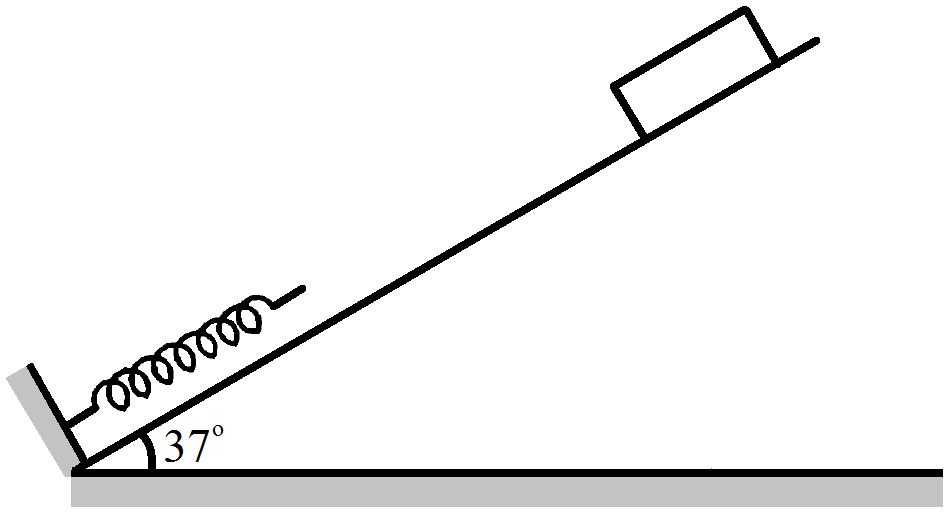
Figure shows a spring fixed at the bottom end of an incline of inclination $37^\circ $. A small block of mass $2\ kg$ starts slipping down the incline from a point $4.8m$ away from the spring. The block compresses the spring by $20\ cm$, stops momentarily and then rebounds through a distance of $1m$ up the incline. Find.
  1. The friction coefficient between the plane and the block.
  2. The spring constant of the spring. Take $g = 10m/s^2$​​​​​​​.
The maximum tension in the string of an oscillating pendulum is double of the minimum tension. Find the angular amplitude.
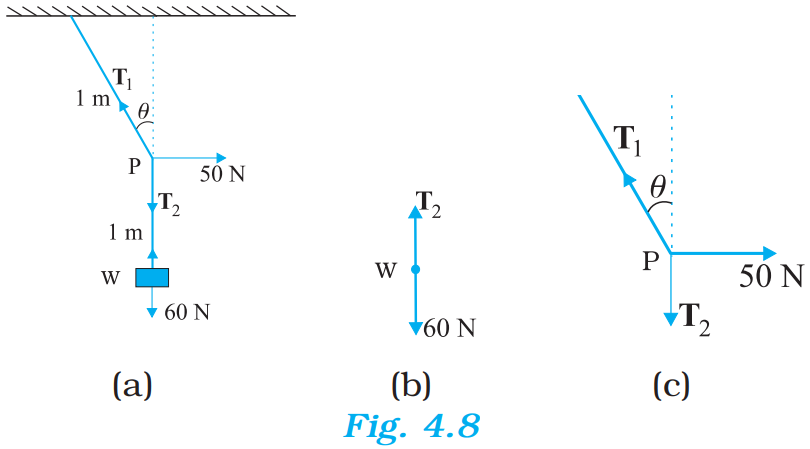
See Fig. $4.8.$ A mass of $6 \ kg$ is suspended by a rope of length $2 m$ from the ceiling. A force of $50 N$ in the horizontal direction is applied at the midpoint $P$ of the rope, as shown. What is the angle the rope makes with the vertical in equilibrium? $($Take $g=10 m s ^{-2} )$. Neglect the mass of the rope.
Image