Question
Show that $|\vec{a}| \vec{b}+|\vec{b}| \vec{a}$ is perpendicular to $|\vec{a}| \vec{b}-|\vec{b}| \vec{a}$ for any two nonzero vectors $\vec a$ and $\vec b$. 

Answer

To show $|\vec{\mathrm{a}}| \vec{\mathrm{b}}+|\vec{\mathrm{b}}| \vec{\mathrm{a}}$ is perpendicular to $|\vec{\mathrm{a}}| \vec{\mathrm{b}}-|\vec{\mathrm{b}}| \vec{\mathrm{a}}$ for  $\vec a \neq0$ and $\vec b \neq 0$,
we need to show Dot product of  $|\vec{\mathrm{a}}| \vec{\mathrm{b}}+|\vec{\mathrm{b}}| \vec{\mathrm{a}}$ and $|\vec{\mathrm{a}}| \vec{\mathrm{b}}-|\vec{\mathrm{b}}| \vec{\mathrm{a}}$  is zero.
$(|\vec{\mathrm{a}}| \vec{\mathrm{b}}+|\vec{\mathrm{b}}| \vec{\mathrm{a}}) \cdot(|\vec{\mathrm{a}}| \vec{\mathrm{b}}-|\vec{\mathrm{b}}| \vec{\mathrm{a}})$ 
= $(|\vec{a}| \vec{b}) \cdot(|\vec{a}| \vec{b})-(|\vec{a}| \vec{b}) \cdot(|\vec{b}| \vec{a})+(|\vec{b}| \vec{a}) \cdot(|\vec{a}| \vec{b})-(|\vec{b}| \vec{a}) \cdot(|\vec{b}| \vec{a})$ 
= $|\vec{\mathrm{a}}|^{2} \vec{\mathrm{b}} \cdot \vec{\mathrm{b}}-|\vec{\mathrm{b}}|^{2} \vec{\mathrm{a}} \cdot \vec{\mathrm{a}}$ 
= $|\vec{\mathrm{a}}|^{2}|\vec{\mathrm{b}}|^{2}-|\vec{\mathrm{b}}|^{2}|\vec{\mathrm{a}}|^{2}$ [Since, $\vec{\mathrm{a}} \cdot \vec{\mathrm{b}}=\vec{\mathrm{b}} \cdot \vec{\mathrm{a}}$]
= 0
$\Rightarrow$ $|\vec{\mathrm{a}}| \vec{\mathrm{b}}+|\vec{\mathrm{b}}| \vec{\mathrm{a}}$ is perpendicular to $|\vec{\mathrm{a}}| \vec{\mathrm{b}}-|\vec{\mathrm{b}}| \vec{\mathrm{a}}$

Need a full question paper?

Generate a complete, print-ready paper with questions like this in minutes — across 16+ boards, with answer keys.
Start Generating Free

Similar questions

For each of the differential equations in find the general solution:
$\text{x}^5\frac{\text{dy}}{\text{dx}}=-\text{y}^5$
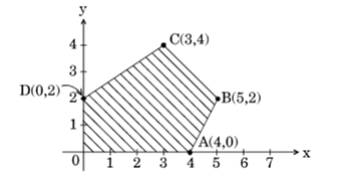
The corner points of the feasible region determined by the system of linear inequations are as shown below :
Image

Answer each of the following:
i. Let $z = 13x - 15y $ be the objective function. Find the maximum and minimum values of $z$ and also the
corresponding points at which the maximum and minimum values occur.
ii. Let $z = kx + y $ be the objective function. Find $k,$ if the value of $z$ at $A$ is same as the value of $z$ at $B$.
Find the points o local maxima or local minima, if any, of the following functions, using the first derivatives test. Also, find the local maximum or local minimum values, as the case may be:
$\text{f}(\text{x})=\frac{1}{\text{x}^{2}+2}$
Solve the following equation:
$2\tan^{-1}\left(\cos x\right)=\tan^{-1}\left(2\ \text{cosec}\ x\right)$
Prove that : $\tan ^{-1} x+\cot ^{-1}(x+1)=\tan ^{-1}\left(x^2+x+1\right)$
Find the value of $\lambda$ so that the following vectors are coplanar:
$\vec{\text{a}}=\hat{\text{i}}-\hat{\text{j}}+\hat{\text{k}},\vec{\text{b}}=2\hat{\text{i}}+\hat{\text{j}}-\hat{\text{k}},\vec{\text{c}}=\lambda\hat{\text{i}}-\hat{\text{j}}+\lambda\hat{\text{k}}$
An ant is moving along the vector $\overrightarrow{l_1}=\hat{\imath}-2 \hat{\jmath}+3 \hat{k}$ Few sugar crystals are kept along the vector $\overrightarrow{l_2}=3 \hat{\imath}-2 \hat{j}+\hat{k}$ which is inclined at an angle $\theta$ with the vector $\overrightarrow{l_1}$. Then find the angle $\theta$. Also find the scalar projection of $\overrightarrow{l_1}$ on $\overrightarrow{l_2}$
Find the mean and standard deviation of the following probability distributions:
$\text{x}_\text{i}$
$0$
$1$
$2$
$3$
$4$
$5$
$\text{p}_\text{i}$
$\frac{1}{6}$
$\frac{5}{18}$
$\frac{2}{9}$
$\frac{1}{6}$
$\frac{1}{9}$
$\frac{1}{18}$
Find $\frac{\text{dy}}{\text{dx}}$ of the functions expressed in parametric:
$\text{x}=\text{t}+\frac{1}{\text{t}},\text{ y}=\text{t}-\frac{1}{\text{t}}$
Prove that $\int_0^{\pi / 2} \frac{\sqrt{\sin x}}{\sqrt{\sin x}+\sqrt{\cos x}} d x=\frac{\pi}{4}$