Question 13 Marks
Find the position vector of a point R which divides the line joining two points P and Q whose position vectors are $\left( {2\vec a + \vec b} \right)$and$\left( {\vec a - 3\vec b} \right)$ externally in the ratio 1 : 2. Also, show that P is the mid point of the line segment RQ.
AnswerLet position vector of point R be $\overrightarrow r $ . As point R divides externally the line segment PQ in the ratio 1:2 .therefore ,
$ \overrightarrow r = \frac{{1\left( {\overrightarrow a - 3\overrightarrow b } \right) - 2\left( {2\overrightarrow a + \overrightarrow b } \right)}}{{1 - 2}} $$ = \frac{{\left( { - 3\overrightarrow a - 5\overrightarrow b } \right)}}{{ - 1}}$ $\overrightarrow r = 3\overrightarrow a + 5\overrightarrow b \\ $
Also , mid point of the line segment RQ is : $= \frac{{3\overrightarrow a + 5\overrightarrow b + \overrightarrow a - 3\overrightarrow b }}{2} = \frac{{4\overrightarrow a + 2\overrightarrow b }}{2} = 2\overrightarrow a + \overrightarrow b$ ,which is the position vector of point P.Therefore , P is the mid point of line segment RQ.
View full question & answer→Question 23 Marks
Find a vector of magnitude 5 units and parallel to the resultant of the vectors $\vec a = 2\hat i + 3\hat j - \hat k$ and $\vec b = \hat i - 2\hat j + \hat k$
AnswerGiven: Vectors $\vec a = 2\hat i + 3\hat j - \hat k$ and $\vec b = \hat i - 2\hat j + \hat k$ Let vector $\vec c$ be the resultant vector of $\vec a$ and $\vec b$
$\therefore \vec c = \vec a + \vec b $ $= 2\hat i + 3\hat j - \hat k + \hat i - 2\hat j + \hat k$
$ = 3\hat i + \hat j + 0\hat k$
$\therefore$ Required vector of magnitude 5 units and parallel (or collinear) to resultant vector $\vec c = \vec a + \vec b$ is
$5\hat c = 5\frac{{\vec c}}{{\left| {\vec c} \right|}} = 5\left( {\frac{{3\hat i + \hat j + 0\hat k}}{{\sqrt {9 + 1 + 0} }}} \right)$
$ = \frac{5}{{\sqrt {10} }}\left( {3\hat i + \hat j} \right)$
$= \frac{5}{{\sqrt {10} }} \times \frac{{\sqrt {10} }}{{\sqrt {10} }}\left( {3\hat i + \hat j} \right)$
$ = \frac{{5\sqrt {10} }}{{10}}\left( {3\hat i + \hat j} \right)$
$ \Rightarrow 5\hat c = \frac{{\sqrt {10} }}{2}\left( {3\vec i + \vec j} \right)$
$= \frac{{3\sqrt {10} }}{2}\hat i + \frac{{\sqrt {10} }}{2}\hat j$
View full question & answer→Question 33 Marks
A girl walks 4 km towards west, then she walks 3 km in a direction 30° east of north and stops. Determine the girl’s displacement from her initial point of departure.
AnswerLet $\overrightarrow r = - x\widehat i + y\widehat j$, $x = \frac{5}{2},y = \frac{{3\sqrt 3 }}{2}$ $\therefore \overrightarrow r = \frac{{ - 5}}{2}\widehat i + \frac{{3\sqrt 3 }}{2}\widehat j$
View full question & answer→Question 43 Marks
Find the area of the triangle with vertices A(1, 1, 2), B(2, 3, 5) and C(1, 5, 5).
AnswerGiven position vector of A ,$\overrightarrow {OA} = \hat i + \hat j + 2\hat k$ position vector of B,$\overrightarrow {OB} = 2\hat i + 3\hat j + 5\hat k$ and that of C,$\overrightarrow {OC} = \hat i + \hat j + 5\hat k$ therefore,$\overrightarrow {AB} = \overrightarrow {OB} - \overrightarrow {OA} = \left( {2\hat i + 3\hat j + 5\hat k} \right) - \left( {\hat i + \hat j + 2\hat k} \right) = \hat i + 2\hat j + 3\hat k$ (by triangle law of vector addition) thus we may write $\vec{AB}=\hat i +2\hat j+3\hat k$, $\vec{AC}=4\hat j+3\hat k,$
$\therefore \overrightarrow{AB}\times \overrightarrow{AC}=\left| {\begin{array}{*{20}{c}} {\hat i}&{\hat j}&{\hat k} \\ 1&2&3 \\ 0&4&3 \end{array}} \right|=-6\hat i-3\hat j+4\hat k$
$\Rightarrow |\overrightarrow{AB}\times\vec{AC}|=\sqrt{61}$
$\Rightarrow\frac{1}{2} |\overrightarrow{AB}\times\vec{AC}|=\frac{1}{2}\sqrt{61}$
Therefore, the area of triangle ABC is =${1 \over 2}\sqrt {61} $
View full question & answer→Question 53 Marks
Find the area of the parallelogram whose adjacent sides are determined by the vectors $\vec{a}=\hat{i}-\hat{j}+3 \hat{k}$ and $\vec{b}=2 \hat{i}-7 \hat{j}+\hat{k}$.
AnswerIt is given that:
$\vec a =\hat i -\hat j+3\hat k$ and $\vec b=2\hat i -7\hat j+\hat k$
$\vec { a } \times \vec { b } = \left| \begin{array} { c c c } { \hat { i } } & { \hat { j } } & { \tilde { k } } \\ { 1 } & { - 1 } & { 3 } \\ { 2 } & { - 7 } & { 1 } \end{array} \right| = 20 \hat { i } + \hat { 5 } \hat { j } - 5 \hat { k }$
$|\vec a \times \vec b| =\sqrt{450}=15\sqrt2$
View full question & answer→Question 63 Marks
Find $\left| {\vec a} \right|$ and $\left| {\vec b} \right|$ if $\left( {\vec a + \vec b} \right).\left( {\vec a - \vec b} \right) = 8$ and $\left| {\vec a} \right| = 8\left| {\vec b} \right|$
AnswerGiven: $\left( {\vec a + \vec b} \right).\left( {\vec a - \vec b} \right) = 8$ and $\left| {\vec a} \right| = 8\left| {\vec b} \right|$ ...(i) $\Rightarrow \vec a.\vec a - \vec a.\vec b + \vec b.\vec a - \vec b.\vec b = 8$
$ \Rightarrow {\left| {\vec a} \right|^2} - \vec a.\vec b + \vec a.\vec b - {\left| {\vec b} \right|^2} = 8$
$ \Rightarrow {\left| {\vec a} \right|^2} - \left| {\vec b} \right|^2 = 8$ ...(ii)
Putting ${\left| {\vec a} \right|^2} = 64\left| {\vec b} \right||^2$ in eq. (ii),
$64{\left| {\vec b} \right|^2} - \left| {\vec b} \right|^2 = 8$
$ \Rightarrow \left( {64 - 1} \right){\left| {\vec b} \right|^2} = 8$
$\Rightarrow \left( {63} \right){\left| {\vec b} \right|^2} = 8$
$ \Rightarrow {\left| {\vec b} \right|^2} = \frac{8}{{63}}$
$ \Rightarrow {\left| {\vec b} \right|^2} = \sqrt {\frac{8}{{63}}} = \frac{{2\sqrt 2 }}{{3\sqrt 7 }}$
Putting ${\left| {\vec b} \right|^2} = \frac{{2\sqrt 2 }}{{3\sqrt 7 }}$ in eq (i),
${\left| {\vec a} \right|^2} = 8\left( {\frac{{2\sqrt 2 }}{{3\sqrt 7 }}} \right) = \frac{{16}}{3}\sqrt {\frac{2}{7}} $
View full question & answer→Question 73 Marks
Find the angle between two vectors $\hat i - 2\hat j + 3\hat k$ and $3\hat i - 2\hat j + \hat k\;$
Answer$\overrightarrow a = \widehat i - 2\widehat j + 3\widehat k,\overrightarrow b = 3\widehat i - 2\widehat j + \widehat k \Rightarrow \left| {\overrightarrow a } \right| = \sqrt {14} ,\left| {\overrightarrow b } \right| = \sqrt {14} ,\overrightarrow a .\overrightarrow b = 10, $ $ \Rightarrow \frac{{\overrightarrow a .\overrightarrow b }}{{\left| {\overrightarrow a } \right|\left| {\overrightarrow b } \right|}} = \cos \theta \Rightarrow \frac{{10}}{{14}} = \cos \theta $
$\Rightarrow \cos \theta = \frac{5}{7} \Rightarrow \theta = {\cos ^{ - 1}}\frac{5}{7} \\\\\\ $
View full question & answer→Question 83 Marks
Show that the points A (1, 2, 7), B (2, 6, 3) and C(3, 10, -1) are collinear.
AnswerThe given points are A (1, 2, 7), B (2, 6, 3) and C(3,10, - 1) respectively.
$\therefore$ Position vector of point $A = \overrightarrow {OA} = \hat i + 2\hat j + 7\hat k$
Position vector of point $B = \overrightarrow {OB} = 2\hat i + 6\hat j + 3\hat k$
Position vector of point $C = \overrightarrow {OC} = 3\hat i + 10\hat j - \hat k$
Now $\overrightarrow {AB} $ = Position vector of point B – Position vector of point A
$= 2\hat i + 6\hat j + 3\hat k - \left( {\hat i + 2\hat j + 7\hat k} \right)$
$= 2\hat i + 6\hat j + 3\hat k - \hat i - 2\hat j - 7\hat k$ $ = \hat i + 4\hat j - 4\hat k$…(i)
And $\overrightarrow {AC} $ = Position vector of point C – Position vector of point A
$= 3\hat i + 10\hat j - \hat k - \left( {\hat i + 2\hat j + 7\hat k} \right)$
$= 3\hat i + 10\hat j - \hat k - \hat i - 2\hat j -7\hat k $ $= 2\hat i + 8\hat j - 8\hat k = 2\left( {\hat i + 4\hat j - 4\hat k} \right)$…(ii)
$ \Rightarrow \overrightarrow {AC} = 2.\overrightarrow {AB} $ [Using eq. (i)]
$\Rightarrow$ Vectors $\overrightarrow {AB} $ and $\overrightarrow {AC} $ are parallel. $\left[ {\because \vec a = mb} \right]$
But $\overrightarrow {AB} $ and $\overrightarrow {AC} $ have a common point A and hence they can’t be parallel. Thus, the points A, B, C are collinear.
View full question & answer→Question 93 Marks
If the vertices A, B, C of a triangle ABC are (1, 2, 3), (–1, 0, 0), (0, 1, 2), respectively, then find $\angle ABC.{\text{ }}[\angle ABC$ is the angle between the vectors $\overrightarrow {BA} \;and\;\overrightarrow {BC} \;$]
AnswerPosition vectors of the points A , B and C are $\widehat{i}+2\widehat{j}+3\widehat{k},-\widehat{i},and \ \widehat{j}+2\widehat{k}$ respectively.
Then;
$cos\theta=\frac{\vec{BA}\vec{BC}}{|\vec {BA}||\vec{BC}|}$ $=\frac{(2\hat i+2\hat j+3\hat k).(\hat i+\hat j+2\hat k)}{\sqrt{17}\sqrt6}$
$\Rightarrow cos\theta=\frac{10}{\sqrt{102}}$
$\Rightarrow \angle ABC=cos^{-1}(\frac{10}{\sqrt{102}})$
View full question & answer→Question 103 Marks
Show that $|\vec{a}| \vec{b}+|\vec{b}| \vec{a}$ is perpendicular to $|\vec{a}| \vec{b}-|\vec{b}| \vec{a}$ for any two nonzero vectors $\vec a$ and $\vec b$.
AnswerTo show $|\vec{\mathrm{a}}| \vec{\mathrm{b}}+|\vec{\mathrm{b}}| \vec{\mathrm{a}}$ is perpendicular to $|\vec{\mathrm{a}}| \vec{\mathrm{b}}-|\vec{\mathrm{b}}| \vec{\mathrm{a}}$ for $\vec a \neq0$ and $\vec b \neq 0$,
we need to show Dot product of $|\vec{\mathrm{a}}| \vec{\mathrm{b}}+|\vec{\mathrm{b}}| \vec{\mathrm{a}}$ and $|\vec{\mathrm{a}}| \vec{\mathrm{b}}-|\vec{\mathrm{b}}| \vec{\mathrm{a}}$ is zero.
$(|\vec{\mathrm{a}}| \vec{\mathrm{b}}+|\vec{\mathrm{b}}| \vec{\mathrm{a}}) \cdot(|\vec{\mathrm{a}}| \vec{\mathrm{b}}-|\vec{\mathrm{b}}| \vec{\mathrm{a}})$
= $(|\vec{a}| \vec{b}) \cdot(|\vec{a}| \vec{b})-(|\vec{a}| \vec{b}) \cdot(|\vec{b}| \vec{a})+(|\vec{b}| \vec{a}) \cdot(|\vec{a}| \vec{b})-(|\vec{b}| \vec{a}) \cdot(|\vec{b}| \vec{a})$
= $|\vec{\mathrm{a}}|^{2} \vec{\mathrm{b}} \cdot \vec{\mathrm{b}}-|\vec{\mathrm{b}}|^{2} \vec{\mathrm{a}} \cdot \vec{\mathrm{a}}$
= $|\vec{\mathrm{a}}|^{2}|\vec{\mathrm{b}}|^{2}-|\vec{\mathrm{b}}|^{2}|\vec{\mathrm{a}}|^{2}$ [Since, $\vec{\mathrm{a}} \cdot \vec{\mathrm{b}}=\vec{\mathrm{b}} \cdot \vec{\mathrm{a}}$]
= 0
$\Rightarrow$ $|\vec{\mathrm{a}}| \vec{\mathrm{b}}+|\vec{\mathrm{b}}| \vec{\mathrm{a}}$ is perpendicular to $|\vec{\mathrm{a}}| \vec{\mathrm{b}}-|\vec{\mathrm{b}}| \vec{\mathrm{a}}$
View full question & answer→Question 113 Marks
If $\vec a = 2\hat i + 2\hat j + 3\hat k,\vec b = - \hat i + 2\hat j + \hat k$ and $\vec c = 3\hat i + \hat j$ are such that $\vec a + \lambda \vec b$ is perpendicular to $\vec c$, then find the value of $\lambda $
AnswerGiven: $\vec a = 2\hat i + 2\hat j + 3\hat k,\vec b = - \hat i + 2\hat j + \hat k$ and $\vec c = 3\hat i + \hat j$ Now $\vec a + \lambda \vec b = 2\hat i + 2\hat j + 3\hat k + \lambda \left( { - \hat i + 2\hat j + \hat k} \right)$=
$ = 2\hat i + 2\hat j + 3\hat k - \lambda \hat i + 2\lambda \hat j + \lambda \hat k$
$\Rightarrow \vec a + \lambda \vec b = \left( {2 - \lambda } \right)\hat i + \left( {2 + 2\lambda } \right)\hat j + \left( {3 + \lambda } \right)\hat k$
Again, $\vec c = 3\hat i + \hat j = 3\hat i + \hat j + 0\hat k$
Since, $\left( {\vec a + \lambda \vec b} \right)$ is perpendicular to $\vec c$ therefore, $\left( {\vec a + \lambda \vec b} \right).\vec c = 0$
$\Rightarrow 6 - 3\lambda + 2 + 2\lambda = 0 \Rightarrow - \lambda + 8 = 0$
$ \Rightarrow - \lambda = - 8 \Rightarrow \lambda = 8$
View full question & answer→Question 123 Marks
Show that the vector $\hat i + \hat j + \hat k$ is equally inclined to the axes OX, OY and OZ.
AnswerLet $\vec a = \hat i + \hat j + \hat k$, then $\left| {\vec a} \right| = \sqrt {{{\left( 1 \right)}^2} + {{\left( 1 \right)}^2} + {{\left( 1 \right)}^2}} = \sqrt 3 $ Let us find angle ${\theta _1}$ (say) between vector $\vec a$ and OX $$
$\Rightarrow \cos {\theta _1} = \frac{{\vec a.\hat i}}{{\left| {\vec a} \right|.\left| {\hat i} \right|}} $ $= \frac{{\left( {i + j + k} \right).\left( {\hat i + 0\hat j + 0\hat k} \right)}}{{\left| {\hat i + \hat j + \hat k} \right|\left| {\hat i + 0\hat j + 0\hat k} \right|}} $ $= \frac{{1\left( 1 \right) + 1\left( 0 \right) + 1\left( 0 \right)}}{{\sqrt {1 + 1 + 1} .\sqrt {1 + 0 + 0} }} = \frac{1}{{\sqrt 3 }}$
$ \Rightarrow {\theta _1} = {\cos ^{ - 1}}\frac{1}{{\sqrt 3 }}$
Similarly angle ${\theta _2}$ (say) between vector $\vec a$ and OY $$ is ${\cos ^{ - 1}}\frac{1}{{\sqrt 3 }}$
And angle ${\theta _3}$ (say) between vector $\vec a$ and OZ $$ is ${\cos ^{ - 1}}\frac{1}{{\sqrt 3 }}$
$\therefore {\theta _1} = {\theta _2} = {\theta _3}$
$\therefore$ Vector $\vec a = \hat i + \hat j + \hat k$ is equally inclined to OX, OY and OZ.
View full question & answer→Question 133 Marks
Find the direction cosines of the vector joining the points A(1, 2, -3) and B(-1, -2, 1) directed from A to B.
AnswerGiven: Points A(1, 2, -3) and B(-1, - 2,1)
$\therefore$ Position vector of point $A = \overrightarrow {OA} = \hat i + 2\hat j - 3\hat k$
And Position vector of point $B = \overrightarrow {OB} = - \hat i - 2\hat j + \hat k$
$\therefore$ Vector $\overrightarrow {AB} = \overrightarrow {OB} - \overrightarrow {OA} $ $= - \hat i - 2\hat j + \hat k - \hat i - 2\hat j + 3\hat k $ $= - 2\hat i - 4\hat j + 4\hat k$
Now $\left| {\overrightarrow {AB} } \right| = \sqrt {{{\left( { - 2} \right)}^2} + {{\left( { - 4} \right)}^2} + {{\left( 4 \right)}^2}} $ $= \sqrt {4 + 16 + 16} = \sqrt {36} = 6$
$\therefore$ A unit vector along $\overrightarrow {AB} = \frac{{\overrightarrow {AB} }}{{\left| {\overrightarrow {AB} } \right|}} = \frac{{ - 2\hat i - 4\hat j + 4\hat k}}{6}$
$ = \frac{{ - 2}}{6}\hat i - \frac{{ 4}}{6}\hat j + \frac{4}{6}\hat k $ $= \frac{{ - 1}}{3}\hat i - \frac{{ 2}}{3}\hat j + \frac{2}{3}\hat k$
Therefore, the direction cosines of vector $\overrightarrow {AB} = \frac{{ - 1}}{3},\frac{{ - 2}}{3},\frac{2}{3}$
View full question & answer→Question 143 Marks
Compute the magnitude of the following vectors: $\vec a = \hat i + \hat j + \hat k,\vec b = 2\hat i - 7\hat j - 3\hat k,$ $\vec c = \frac{1}{{\sqrt 3 }}\hat i + \frac{1}{{\sqrt 3 }}\hat j - \frac{1}{{\sqrt 3 }}\hat k$
AnswerGiven: $\vec a = \hat i + \hat j + \hat k$ $\therefore \left| {\vec a} \right| = \sqrt {{1^2} + {1^2} + {1^2}} = \sqrt {1 + 1 + 1} = \sqrt 3 $
And $\vec b = 2\hat i - 7\hat j - 3\hat k$
$\therefore \left| {\vec b} \right| = \sqrt {{{\left( 2 \right)}^2} + {{\left( { - 7} \right)}^2} + {{\left( { - 3} \right)}^2}} $ $= \sqrt {4 + 49 + 9} = \sqrt {62} $
Also $\vec c = \frac{1}{{\sqrt 3 }}\hat i + \frac{1}{{\sqrt 3 }}\hat j - \frac{1}{{\sqrt 3 }}\hat k$
$\therefore \left| {\vec c} \right| = \sqrt {{{\left( {\frac{1}{{\sqrt 3 }}} \right)}^2} + {{\left( {\frac{1}{{\sqrt 3 }}} \right)}^2} + {{\left( {\frac{{ - 1}}{{\sqrt 3 }}} \right)}^2}} $ $= \sqrt {\frac{1}{3} + \frac{1}{3} + \frac{1}{3}} = 1$
View full question & answer→Question 153 Marks
If with reference to the right handed system of mutually perpendicular unit vectors $\hat i,\hat j$ and $\hat k$, $\vec \alpha = 3\hat i - \hat j$, $\vec \beta = 2\hat i + \hat j - 3\hat k$, then express $\vec \beta $ in the form $\vec \beta = {\vec \beta _1} + {\vec \beta _2}$, where ${\vec \beta _1}$ is || to $\vec \alpha $ and ${\vec \beta _2}$ is perpendicular to $\vec \alpha $.
AnswerLet ${\vec \beta _1} = \lambda \vec \alpha \,\,\left[ {\because \,{{\vec \beta }_1}||to\,\,\vec \alpha } \right]$
${\vec \beta _1} = \lambda \left( {3\hat i - \hat j} \right)$
$ = 3\lambda \hat i - \lambda \hat j$
${\vec \beta _2} = \vec \beta - {\vec \beta _1}$
$= \left( {2\hat i + \hat j - 3\hat k} \right) - \left( {3\lambda \hat i - \lambda \hat j} \right)$
$= \left( {2 - 3\lambda } \right)\hat i + \left( {1 + \lambda } \right)\hat j - 3\hat k$
$\vec \alpha .{\vec \beta _2} = 0\,\,\,\left[ {\because {{\vec \beta }_2} \bot \vec \alpha } \right]$
$3\left( {2 - 3\lambda } \right) - \left( {1 + \lambda } \right) = 0$
$\lambda = \frac{1}{2}$
${\vec \beta _1} = \frac{3}{2}\hat i - \frac{1}{2}\hat j$
${\vec \beta _2} = \frac{1}{2}\hat i + \frac{3}{2}\hat j - 3\hat k$
View full question & answer→Question 163 Marks
Find the area of a parallelogram whose adjacent sides are given by the vectors $\vec{a}=3 \hat{i}+\hat{j}+4 \hat{k}$ and $\vec{b}=\hat{i}-\hat{j}+\hat{k}$
Answer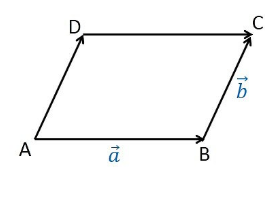
The area of a parallelogram with $\vec a$ and $\vec b$ as its adjacent sides is given by $|\vec{a} \times \vec{b}|$.
Now, $\vec{a} \times \vec{b}=\left|\begin{array}{ccc} {\hat{i}} & {\hat{j}} & {\hat{k}} \\ {3} & {1} & {4} \\ {1} & {-1} & {1} \end{array}\right|=5 \hat{i}+\hat{j}-4 \hat{k}$
Therefore $|\vec{a} \times \vec{b}|=\sqrt{25+1+16}=\sqrt{42}$
Hence, the required area is $\sqrt{42}$.
View full question & answer→Question 173 Marks
Find the area of a triangle having the points A(1, 1, 1), B(1, 2, 3) and C(2, 3, 1) as its vertices.
Answer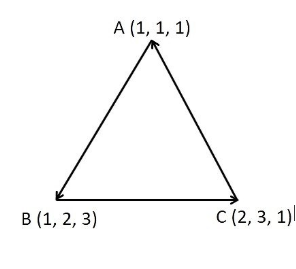
We have $\vec{\mathrm{AB}}=\hat{j}+2 \hat{k}$ and $\vec{\mathrm{AC}}=\hat{i}+2 \hat{j}$.
The area of the given triangle is $\frac{1}{2}|\vec{\mathrm{AB}} \times \vec{\mathrm{AC}}|$
Now, $\vec{\mathrm{AB}} \times \vec{\mathrm{AC}}=\left|\begin{array}{lll} {\hat{i}} & {\hat{j}} & {\hat{k}} \\ {0} & {1} & {2} \\ {1} & {2} & {0} \end{array}\right|=-4 \hat{i}+2 \hat{j}-\hat{k}$
Therefore, $|\vec{\mathrm{AB}} \times \vec{\mathrm{AC}}|=\sqrt{16+4+1}=\sqrt{21}$
Thus, the required area is $\frac{1}{2} \sqrt{21}$
View full question & answer→Question 183 Marks
Find a unit vector perpendicular to each of the vectors $\left( {\vec a + \vec b} \right)$ and $\left( {\vec a - \vec b} \right)$, where $\vec a = \hat i + \hat j + \hat k, \ \vec b = \hat i + 2\hat j + 3\hat k$.
Answer$\vec a+\vec b=(\vec i+\vec j+\vec k)+(\vec i+2\vec j+3\vec k)=2\vec i+3\vec j+4\vec k$
$\vec a-\vec b=(\vec i+\vec j+\vec k)-(\vec i+2\vec j+3 \vec k=-\vec j-2\vec k$
A vector which is perpendicular to both $(\vec a + \vec b)$ are $(\vec a - \vec b)$ is given by
$(\vec a + \vec b) \times (\vec a - \vec b) = \left| {\begin{array}{*{20}{c}} {\hat i}&{\hat j}&{\hat k} \\ 2&3&4 \\ 0&{ - 1}&{ - 2} \end{array}} \right|$
$ = - 2\hat i + 4\hat j - 2\hat k$
Let $\vec c = - 2\hat i + 4\hat j - 2\hat k$
$\left| {\vec c} \right| = \sqrt {4 + 16 + 4} $
$ = \sqrt {24} $
$ = 2\sqrt 6 $
Required unit vector is
$\frac{{\vec c}}{{\left| {\vec c} \right|}} = - \frac{1}{{\sqrt 6 }}\hat i + \frac{2}{{\sqrt 6 }}\hat j - \frac{1}{{\sqrt 6 }}\hat k$
View full question & answer→Question 193 Marks
Show that the points $A ( - 2 \hat { i } + 3 \hat { j} + 5 \hat { k } ) , B ( \hat { i} + 2 \hat { j } + 3 \hat { k } )$ and $C ( 7 \hat { i } - \hat { k } )$ are collinear.
AnswerAccording to the question ,
Given points are $A ( - 2 \hat { i} + 3 \hat { j} + 5 \hat { k } ) , $ $B ( \hat { i } + 2 \hat { j } + 3 \hat { k } ),$ and
$C ( 7 \hat { i} - \hat { k } ).$
Consider, $\vec { A B } = ( \hat {i } + 2 \hat { j } + 3 \hat { k } ) - ( - 2 \hat { i } + 3 \hat {j} + 5 \hat { k } )$$= 3 \hat { i } - \hat { j } - 2 \hat { k }$
Similarly, $\vec { B C } = ( { 7} \hat { i } - \hat { k } ) - ( \hat { i} + 2 \hat { j } + 3 \hat { k } )$$= 6 \hat {i} - 2 \hat {j} - 4 \hat { k }$
Similarly, $\vec { A C } = ( 7 \hat { i } - \hat { k } ) - ( - 2 \hat {i} + 3 \hat { j } + 5 \hat { k } )$$= 9 \hat {i } - 3 \hat { j } - 6 \hat { k }$
Now, consider, $\vec { A B } + \vec { B C } = ( 3 \hat { i } - \hat { j } - 2 \hat { k } )$$+ ( 6 \hat { i } - 2 \hat {j } - 4 \hat { k } ) = 9 \hat { i} - 3 \hat { j } - 6 \hat { k } = \vec { A C }$
$\therefore$ The points A, B and C are collinear.
View full question & answer→Question 203 Marks
Show that the points $A\left( {2\hat i - \hat j + \hat k} \right),B\left( {\hat i - 3\hat j - 5\hat k} \right),C\left( {3\hat i - 4\hat j - 4\hat k} \right)$ are the vertices of a right angled triangle.
Answer$\overrightarrow {AB} = - \hat i - 2\hat j - 6\hat k$
$\vec{BC}=2\vec i-\vec j+\vec k$
$\overrightarrow {CA} = - \hat i + 3\hat j + 5\hat k$
${\left| {\overrightarrow {AB} } \right|^2} ={1^2+2^2+6^2}= 41$
$\left| {\overrightarrow {BC} } \right|^2 = 2^2+1^2+1^2=6$
$\left| {\overrightarrow {CA} } \right|^2 = 1^2+3^2+5^2=35$
${\left| {\overrightarrow {AB} } \right|^2} = {\left| {\overrightarrow {BC} } \right|^2} + {\left| {\overrightarrow {CA} } \right|^2}$
Hence, the $\Delta $ is a right angled triangle.
View full question & answer→