Question
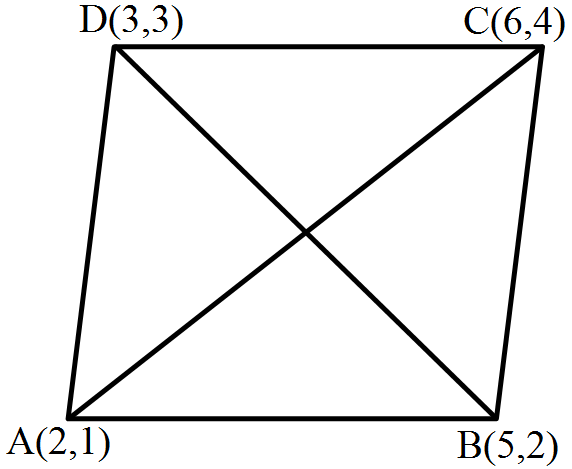
Show that the points A(2, 1), B(5, 2), C(6, 4) and D(3, 3) are the angular points of a parallelogram. Is this figure a rectangle?
Answer

Let A(2, 1), B(5, 2) C(6, 4) and D(3, 3) are the angular points of a Parallogram ABCD. Then
Now, $\text{AB}=\sqrt{(5-2)^2+(2-1)^2}$ $=\sqrt{(3)^2+(1)^2}$ $=\sqrt{10}=\sqrt{10}\text{ units}$ $\text{BC}=\sqrt{(6-5)^2+(4-2)^2}$ $=\sqrt{(1)^2+(2)^2}$ $=\sqrt{1+4}=\sqrt{5}\text{ units}$ $\text{DC}=\sqrt{(6-3)^2+(4-3)^2}$ $=\sqrt{(3)^2+(1)^2}$ $=\sqrt{9+1}=\sqrt{10}\text{ units}$ $\text{AD}=\sqrt{(3-2)^2+(3-1)^2}$ $=\sqrt{(1)^2+(2)^2}$ $=\sqrt{1+4}=\sqrt{5}\text{ units}$ Thus, $\text{AB}=\text{DC}$ and $\text{AD}=\text{BC}$ $\text{Diag}.\text{AC}=\sqrt{(6-2)^2+(4-1)^2}$ $=\sqrt{(4)^2+(3)^2}$ $=\sqrt{16+9}$ $=\sqrt{25}=5\text{ units}$ $\text{Diag}.\text{BD}=\sqrt{(3-5)^2+(3-2)^2}$ $=\sqrt{(2)^2+(1)^2}$ $=\sqrt{4+1}$ $=\sqrt{5}\text{ units}$ $\text{Diag}.\text{AC}\not=\text{Diag}.\text{BD}$ Thus, ABCD is not a rectangle but it is a parallelogram its opposite sides are equal and diagonals are not equal.

Need a full question paper?

Generate a complete, print-ready paper with questions like this in minutes — across 16+ boards, with answer keys.

Start Generating Free