Question
Show that the vector addition is associative.OR
Show that $(\vec{\text{A}}+\vec{\text{B}})+\vec{\text{C}}=\vec{\text{A}}+(\vec{\text{B}}+\vec{\text{C}}).$
Answer


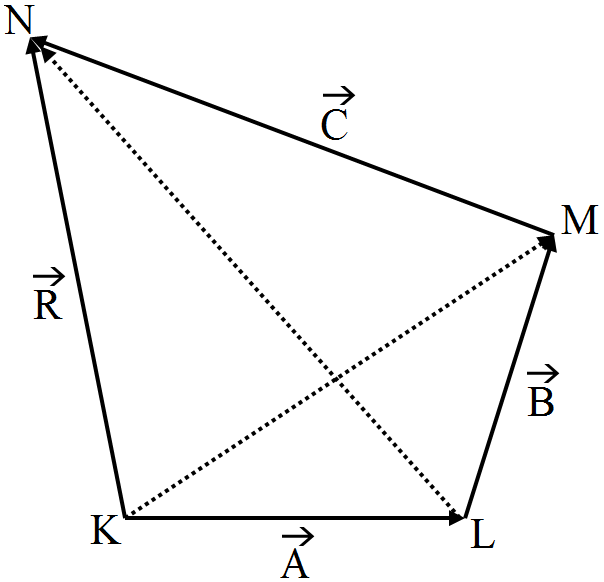
To show that vector addition is associative, we consider addition of three vectors $\vec{\text{A}},\vec{\text{B}}$ and $\vec{\text{C}}$ in two different manners. Let us first add $\vec{\text{A}}$ and $\vec{\text{B}}$ to obtain a vector $\overrightarrow{\text{KM}}$ and then add $\vec{\text{C}}$ to it so as to get the resultant vector $\overrightarrow{\text{KN}}.$ It means that
$(\vec{\text{A}}+\vec{\text{B}})+\vec{\text{C}}=\overrightarrow{\text{KN}}=\vec{\text{R}}\dots(\text{i})$
Again we add $\vec{\text{B}}$ and $\vec{\text{C}}$ to obtain a vector $\overrightarrow{\text{LN}}.$ Now to vector $\vec{\text{A}}$ add $\overrightarrow{\text{LN}}$ so as to get a resultant $\overrightarrow{\text{KN}}=\vec{\text{R}}$ as shown in Fig. It means that,
$(\vec{\text{A}})+(\vec{\text{B}}+\vec{\text{C}})=\overrightarrow{\text{KL}}+\overrightarrow{\text{LN}}=\overrightarrow{\text{KN}}=\vec{\text{R}}\dots(\text{ii})$
From (i) and (ii), it is clear that,
$(\vec{\text{A}}+\vec{\text{B}})+\vec{\text{C}}=\vec{\text{A}}+(\vec{\text{B}}+\vec{\text{C}})$
That is the vector addition is associative.

Need a full question paper?

Generate a complete, print-ready paper with questions like this in minutes — across 16+ boards, with answer keys.

Start Generating Free

Similar questions

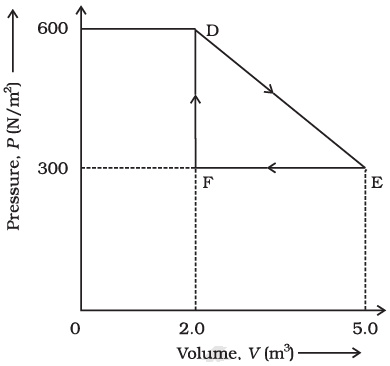
A thermodynamic system is taken from an original state to an intermediate state by the linear process shown in Fig.
Its volume is then reduced to the original value from E to F by an isobaric process. Calculate the total work done by the gas from D to E to F.
Show that terminal velocity V of a spherical object of radius r, density $\rho$ falling vertically through a viscous fluid of density $\sigma$ and coefficient of viscosity n is given by:$\text{V}=\frac29\frac{(\rho-\sigma)\text{r}^2\text{g}}{\eta}$
State three basic laws of motion. Show that the first law of motion gives the definition of force and the second law of motion gives the measure of force.
A $60kg$ man skating with a speed of 10m/s collides with a $40kg$ skater at rest and they cling to each other. Find the loss of kinetic energy during the collision.
At what distance should two charges, each equal to $1C$, be placed so that the force between them equals your weight?
A hydrogen atom emits ultraviolet radiation of wavelength 102.5nm. What are the quantum numbers of the states involved in the transition?
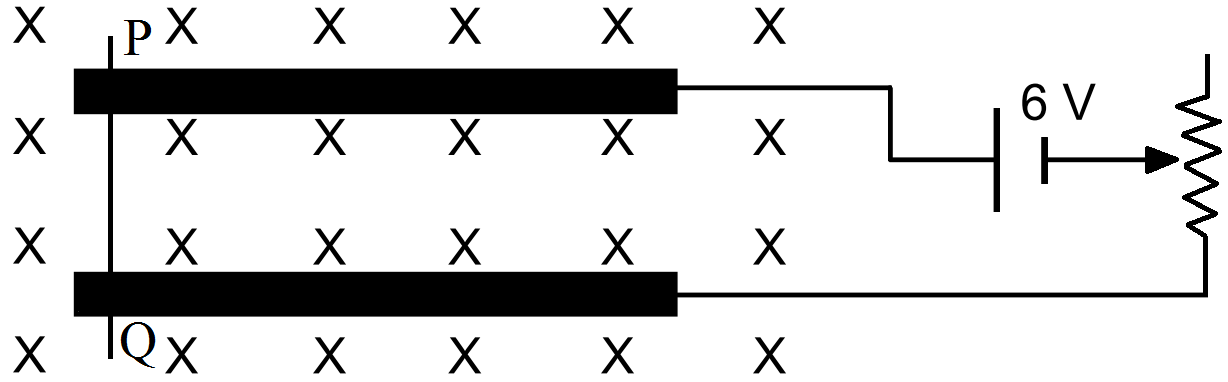
A metal wire PQ of mass 10g lies at rest on two horizontal metal rails separated by 4.90cm A vertically-downward magnetic field of magnitude 0.800T exists in the space. The resistance of the circuit is slowly decreased and it is found that when the resistance goes below 20.0Ω, the wire PQ starts sliding on the rails. Find the coefficient of friction.
If one mole of ideal monoatomic gas $\Big(\gamma=\frac{7}{5}\Big)$ is mixed with one mole of diatomic gas $\Big(\gamma=\frac{7}{5}\Big).$ What is the value of y for the mixtures? (Here, $\gamma$ represents the ratio of specific heat at constant pressure to that at constant volume)
A molecule. of hydrogen contains two protons and two electrons. The nuclear force between these two protons is always neglected while discussing the behaviour of a hydrogen molecule. Why?
Show that Newton's third law of motion is contained in the second law.